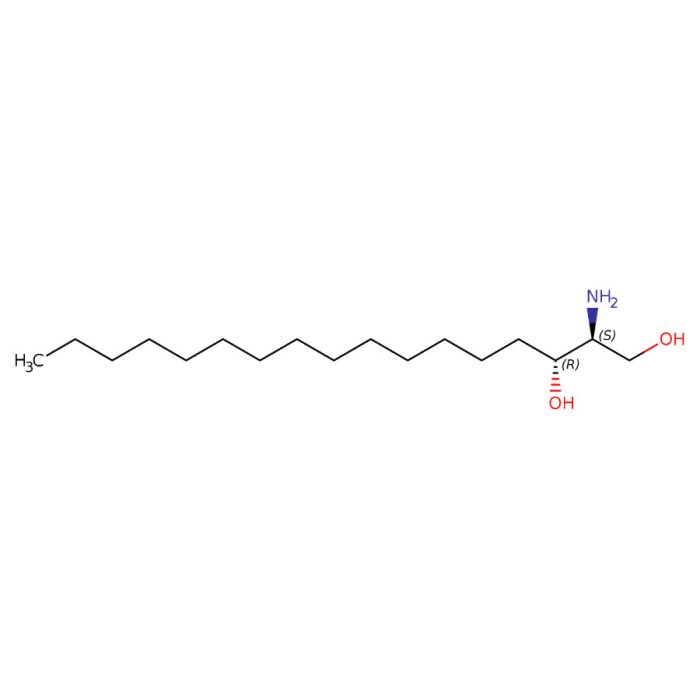
Sphinganine (d17:0), also referred to as dihydrosphingosine, is devoid of double bond. Decarboxylating condensation of serine with palmitoyl-CoA yield keto intermediate(2-oxosphinganine), which is then reduced by NADPH to form Sphinganine. Sphinganine (d17:0) has been used in liquid chromatography-mass spectrometry (LC-MS) for the in-situ estimation of dihydrosphingosine utilization in N-(4-hydroxyphenyl)retinamide (4-HPR) resistant leukemia cells. It is suitable for use as an internal standard in metabolomic study.
Sphinganine (d17:0), also referred to as dihydrosphingosine, is devoid of double bond. Decarboxylating condensation of serine with palmitoyl-CoA yield keto intermediate(2-oxosphinganine), which is then reduced by NADPH to form Sphinganine. Sphinganine (d17:0) has been used in liquid chromatography-mass spectrometry (LC-MS) for the in-situ estimation of dihydrosphingosine utilization in N-(4-hydroxyphenyl)retinamide (4-HPR) resistant leukemia cells. It is suitable for use as an internal standard in metabolomic study.
Sphinganine (SPA) or D-erythro-sphinganine is involved in sphingolipid biosynthesis pathway.It acts as a precursor for ceramide.SPA has an ability to inhibit the activity of protein kinase c. SPA accumulation enables fumonisin B1 to stimulate apoptosis. It also has an ability to block cholesterol transport in Niemann-Pick Type C (NPC) disease.

 K2219525


 危险品化学品经营许可证(带存储)