
 J2619179
计算溶液所需的质量、体积或浓度。
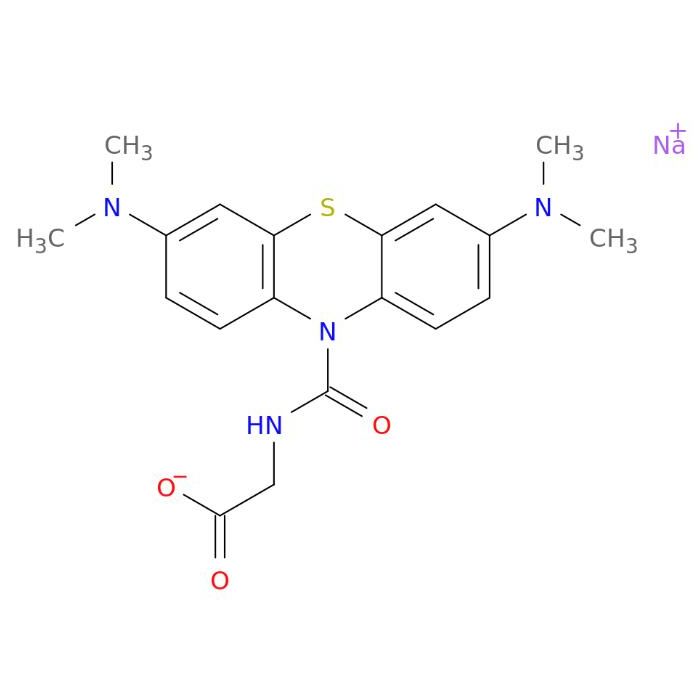
2-(3,7-双(二甲基氨基)-10H-吩噻嗪-10-甲酰胺基)乙酸钠盐 (DA-67)
有货
提供 ≥96% 纯度,适用于对基线干扰要求严格的色谱和分析工作流程。
避光,-20°C储存,充氩。超低温运输 。请查阅批次 COA 获取详细规格。
SDS、COA、产品数据表及规格说明书均可下载。可通过批号查询获取批次 COA。
在色谱分析、有机合成和交叉偶联反应领域已被 0 篇同行评审文献引用。
【检测波长】λ max(显色波长)= 666 nm,ε/H2O2(一个H2O2分子的吸光系数)=9×104
【原理】过氧化氢是生物体中痕量组分分析、食品质量监控、环境物质等检测中的重要中间代谢物。DA-64、DA-67是在有过氧化物酶的存在下高灵敏度地检测出过氧化氢的水溶性氧化显色试剂。传统的水溶性过氧化氢显色试剂由于显色色素的分子吸光系数较低以及虽具有高灵敏度,但是因其微溶性难以处理。DA-64,DA-67兼容了水溶性和高灵敏度。以往,为了追求高灵敏度,不得不使用发光、荧光试剂。现在,检测机检测出的检测对象组也通过采用DA-64,DA-67,用简便的比色计就可以获取结果。本产品的优点难受共存物质的影响,特别适用于生物体成分样本的检测。
【使用示例】
定量H2O2
1.制备显色溶液
把4.08 mg DA67和1 mL100 units/mL的过氧化物酶 (Peroxidase,下文简称POD)放到PIPES缓冲液(0.1mol/L, pH=7, Triton X-100 0.5%)中溶解,定容至100 mL(DA67 100 μmol/L溶液)
2.将上述制备的溶液3 mL与10 μL样本溶液(H2O2:0~5 mmol/L)混合,并在37°C下孵育5分钟。
3.用分光光度计检测666 nm处的吸光度,以空白(用蒸馏水替换样本溶液混合成的溶液)的吸光度差作为检测值,用单独制备的校准曲线确定样本中的含量。
检测POD活性
1.制备显色溶液
把4.08 mg DA67和1 mL H2O2(2%)放到Mcllvaine缓冲液(柠檬酸0.05 mol/L、磷酸二钠0.1 mol/L, pH=5.7)中溶解,调至100 mL(DA67 100 mmol/L溶液)
2.将上述制备的溶液2 mL与2 mL样本溶液(1 fmol~1 pmol/tube POD)在37°C下孵育。
3.用分光光度计检测666 nm处的吸光度,以减去空白(用蒸馏水替换样本溶液混合成的溶液)吸光度差作为检测值,用单独制备的校准曲线确定样本中的含量。
【用途】过氧化氢比色定量
【特点】兼容高灵敏度和水溶性
Detection Wavelength
λmax (chromogenic wavelength) = 666 nm, ε/H₂O₂ (molar absorption coefficient per H₂O₂ molecule) = 9×10⁴
Principle
Hydrogen peroxide is an important intermediate metabolite in the analysis of trace components in organisms, food quality monitoring, environmental substance detection and other applications.DA-64 and DA-67 are water-soluble oxidative chromogenic reagents that enable highly sensitive detection of hydrogen peroxide in the presence of peroxidase.
Traditional water-soluble hydrogen peroxide chromogenic reagents suffer from low molar absorption coefficients of the chromophores. Although some reagents offer high sensitivity, they are difficult to handle due to poor solubility.DA-64 and DA-67 achieve both water solubility and high sensitivity.
In the past, luminescent or fluorescent reagents had to be used to achieve high sensitivity.Now, by using DA-64 and DA-67, the target analytes detected by instruments can be measured with a simple colorimeter.
This product is less affected by coexisting substances and is especially suitable for the detection of biological samples.
Application Examples
Quantitative Determination of H₂O₂
1、Preparation of Chromogenic SolutionDissolve 4.08 mg DA-67 and 1 mL of 100 units/mL peroxidase (POD) in PIPES buffer (0.1 mol/L, pH 7, containing 0.5% Triton X-100), and adjust the volume to 100 mL (100 μmol/L DA-67 solution).
2、Mix 3 mL of the above solution with 10 μL of sample solution (H₂O₂: 0–5 mmol/L), and incubate at 37 °C for 5 minutes.
3、Measure the absorbance at 666 nm using a spectrophotometer.Use the absorbance difference relative to the blank (sample solution replaced with distilled water) as the detection value, and determine the H₂O₂ content in the sample using a separately prepared calibration curve.
Detection of POD Activity
1、Preparation of Chromogenic SolutionDissolve 4.08 mg DA-67 and 1 mL of 2% H₂O₂ in Mcllvaine buffer (0.05 mol/L citric acid, 0.1 mol/L disodium phosphate, pH 5.7), and adjust the volume to 100 mL (100 mmol/L DA-67 solution).
2、Mix 2 mL of the above solution with 2 mL of sample solution (1 fmol–1 pmol POD per tube), and incubate at 37 °C.
3、Measure the absorbance at 666 nm using a spectrophotometer.Use the absorbance difference after subtracting the blank (sample solution replaced with distilled water) as the detection value, and determine the POD content in the sample using a separately prepared calibration curve.
Usage
Colorimetric quantitative determination of hydrogen peroxide
Features
Combines high sensitivity and water solubility


 危险品化学品经营许可证(带存储)