
计算溶液所需的质量、体积或浓度。
概述
Dihydrocapsiate, as a compound of capsinoid family, is an orally active TRPV1 agonist. Dihydrocapsiate can be used for the research of metabolism disease
In Vitro
Dihydrocapsiate (10, 25 and 50 μM; 48 hours; human preadipocytes) does not affect cell viability. Dihydrocapsiate (10 and 20 μM; 8 days; mature adipocytes) markedly decreases the expression levels of other adipogenic markers (such as SREBP1, FABP4, PLIN1, ADIPOQ and LEPTIN) and inflammatory markers (MCP1 and TNFα), whereas it enhances the expression levels of PGC1α (master regulator of mitochondrial biogenesis) and TBX1 (marker of “brite” cell). Dihydrocapsiate (25~200 μM; RAW 264.7 cells) prevents NO release and intracellular ROS generation. MCE has not independently confirmed the accuracy of these methods. They are for reference only. Cell Viability AssayCell Line: Human preadipocytes Concentration: 10, 25 and 50 μM Incubation Time: 48 hours Result: Did not affect cell viability. RT-PCRCell Line: Mature adipocytes Concentration: 10 and 20 μM Incubation Time: 8 days Result: Markedly decreased the expression levels of other adipogenic markers (such as SREBP1, FABP4, PLIN1, ADIPOQ and LEPTIN) and inflammatory markers (MCP1 and TNFα), whereas it enhanced the expression levels of PGC1α (master regulator of mitochondrial biogenesis) and TBX1 (marker of “brite” cell).
In Vivo
Dihydrocapsiate (2 and 10 mg/kg; p.o.) improves morphometric parameters and insulin levels, prevents high fat diet (HFD)-induced adipocyte size and enhances energy expenditure-related genes in WAT, alleviates HFD-induced hepatic steatosis, prevents HFD-induced fat deposition and enhances mitochondrial biogenesis genes in BAT and improves intestinal morphology and modulates SCFA availability. MCE has not independently confirmed the accuracy of these methods. They are for reference only. Animal Model: HFD-fed mice Dosage: 2 and 10 mg/kg Administration: P.o. Result: Improved morphometric parameters and insulin levels, prevented HFD-induced adipocyte size and enhanced energy expenditure-related genes in WAT, alleviated HFD-induced hepatic steatosis, prevented HFD-induced fat deposition and enhanced mitochondrial biogenesis genes in BAT and improved intestinal morphology and modulates SCFA availability.
Form:Oil
IC50& Target:TRPV1
规格
别名
二氢辣椒素
规格或纯度
≥99%
英文名称
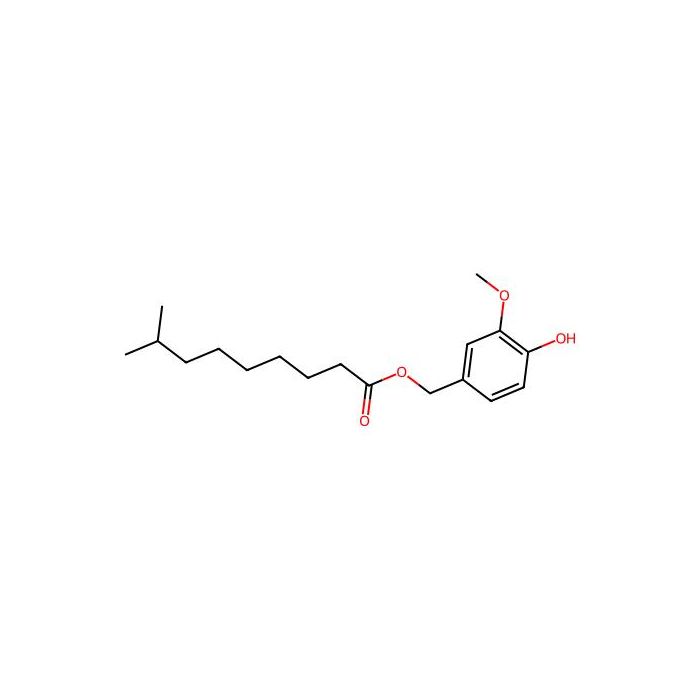
Dihydrocapsiate
生化机理
二氢辣椒素酯是辣椒素家族的一种化合物,是一种口服活性 TRPV1 激动剂。二氢辣椒素酯可用于代谢疾病的研究。
储存条件
避光,-20°C储存
运输条件
超低温运输
作用类型
激动剂
纯度
≥99%
名称和识别符
分子类型
小分子
IUPAC Name
(4-hydroxy-3-methoxyphenyl)methyl 8-methylnonanoate
INCHI
1S/C18H28O4/c1-14(2)8-6-4-5-7-9-18(20)22-13-15-10-11-16(19)17(12-15)21-3/h10-12,14,19H,4-9,13H2,1-3H3
InChi Key
RBCYRZPENADQGZ-UHFFFAOYSA-N
Smiles
CC(C)CCCCCCC(=O)OCC1=CC(=C(C=C1)O)OC
Isomeric SMILES
CC(C)CCCCCCC(=O)OCC1=CC(=C(C=C1)O)OC
PubChem CID
分子量
308.41
高级数据
系统学分类
分类树(Taxonomy Tree)
| 界(kingdom) | 有机化合物 |
|---|---|
| 超类(Superclass) | 苯类化合物 |
| 类(Class) | 酚类 |
| 亚类(Subclass) | 甲氧基苯酚 |
| 中间层级节点(Intermediate Tree Nodes) | 暂无 |
| 直接上位类(Direct Parent) | 甲氧基苯酚 |
| 其他上位类(Alternative Parents) | 苄氧羰基 苯氧基化合物 甲氧基苯 茴香醚 脂肪酸酯 烷基芳基醚 1-羟基-2-未取代苯类化合物 羧酸酯 一元羧酸及其衍生物 有机氧化物 碳氢化合物衍生物 羰基化合物 |
| 分子骨架(Molecular Framework) | 芳香族同单环化合物 |
| 取代基(Substituents) | 1-羟基-2-未取代苯环化合物 - 芳基醚 - 茴香醚 - 芳香族同单环化合物 - 苄氧羰基 - 羰基 - 羧酸衍生物 - 羧酸酰胺 - 乙醚 - 脂肪酸酯 - 脂肪酰基 - 烃衍生物 - 甲氧基苯 - 甲氧基苯酚 - 单羧酸或其衍生物 - 单环苯基基团 - 有机氧化物 - 有机氧化合物 - 有机氧化合物 - 苯酚醚 - 苯氧基化合物 |
| 描述(Description) | 该化合物属于甲氧基酚类有机化合物。这类化合物在酚基团的苯环上连接有甲氧基。 |
| 外部描述符(External Descriptors) | 暂无 |
三维结构
交互式化学结构模型
化学和物理性质
分子量
308.400 g/mol
XLogP3
5.000
氢键供体数Hydrogen Bond Donor Count
1
氢键受体数Hydrogen Bond Acceptor Count
4
可旋转键计数Rotatable Bond Count
11
精确质量Exact Mass
308.199 Da
单同位素质量Monoisotopic Mass
308.199 Da
拓扑极表面积Topological Polar Surface Area
55.800 Ų
重原子数Heavy Atom Count
22
形式电荷Formal Charge
0
复杂度Complexity
303.000
同位素原子数Isotope Atom Count
0
定义的原子立体中心计数Defined Atom Stereocenter Count
0
未定义的原子立体中心计数Undefined Atom Stereocenter Count
0
定义的键立体中心计数Defined Bond Stereocenter Count
0
未定义的键立体中心计数Undefined Bond Stereocenter Count
0
所有立体化学键的总数The total count of all stereochemical bonds
0
共价键合单元计数Covalently-Bonded Unit Count
1
安全和危险性(GHS)
危险声明
H413: 可能对水生生物造成长期持续有害影响
质检证书(CoA,COO,BSE/TSE 和分析图谱)
C of A & Other Certificates(BSE/TSE, COO):
输入批号以搜索分析图谱:
溶液计算器
产品仅提供给经过验证的企业、机构和合格的专业人员用于研发。不适用于人类、动物、诊断或治疗。
Copyright © 2023至今 上海阿拉丁生化科技股份有限公司 SSE:688179 保留所有权利。


 危险品化学品经营许可证(带存储)