是否无菌:是
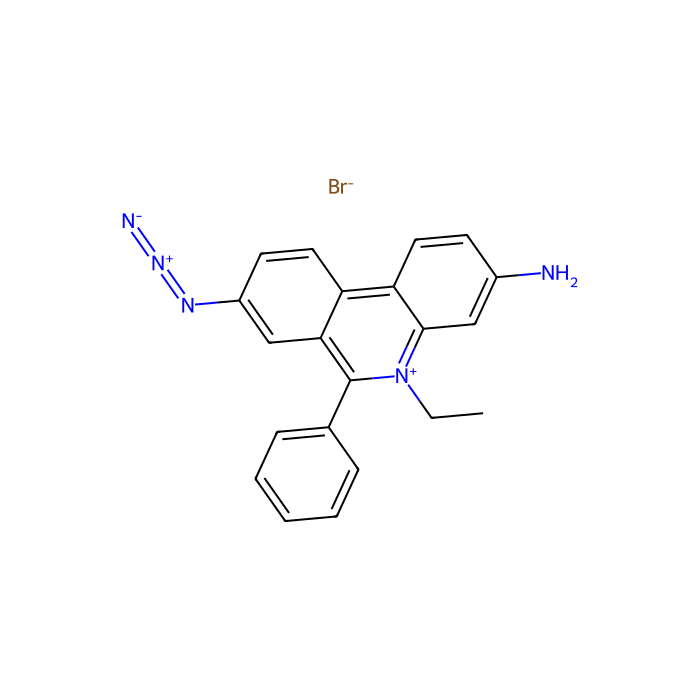
Ethidium Monoazide Bromide (EMA,叠氮溴化乙锭),是一种对DNA具有高亲和性的结合染料。由于EMA对活细胞的通透性相对较低,可特异性标记死细胞内的DNA,染料作用后经光解处理,可使死细胞DNA与染料形成共价结合。EMA的核心优势是对活细胞细胞膜通透性低,经光激活后经10 min孵育即可特异性修饰死菌DNA。能高效区分活死细胞,且不干扰活菌检测,兼容qPCR精准定量,广泛适用于细菌样本检测。
作为早期开发的活死细胞区分关键工具,EMA为微生物学检测与细胞生物学研究提供了突破性技术支撑。传统分子生物学检测技术局限性在于区分死细菌和活细菌周期长,容易高估了样品中存在的细胞数量的背景下,EMA通过标记死细胞DNA的机制,实现了混合体系中活死细胞的高效分离与检测,简化了实验操作流程,降低了生物安全风险,推动了微生物质控、检验临床诊断相关研究的精准化发展。仅限体外科研用途 不得用于临床诊断或治疗。
注:效能等同Biotium Ethidium Monoazide Bromide (EMA)
应用范围:
细菌活死状态鉴定,简单体系中活性微生物的定性分析,DNA足迹分析,修饰质粒DNA等;
产品特点:
1、qPCR 兼容:10 min修饰死菌 DNA,准确区分活死细胞,不干扰活菌检测,避免传统镜检假阴性;
2、特异性高:几乎无法穿透活细胞膜,能特异性结合死细胞或细胞膜受损细胞的核酸;
3、高效的光反应活性:光照下迅速光解生成高活性氮宾中间体,与核酸共价结合,稳定标记目标核酸;
4、强荧光增强:相与核酸结合后荧光强度急剧提升,较于PMA非qPCR荧光观察场景适配性更优;
5、应用场景广泛:涵盖质粒 DNA 修饰、DNA 足迹分析、活死细菌区分等。
产品参数:
1、外观:可溶于乙醇或DMSO的橙色固体
2、Ex (pH3):458 nm
3、Ex/Em:510/600 nm (after photocrosslinking to nucleic acid)
4、CAS号:58880-05-0
5、分子式:C₂₁H₁₈BrN₅
6、分子量:420.31
产品组分:
| 组分 | 1200 T | | A. Ethidium Monoazide Bromide (EMA) | 5 mg |
|
注:1200 T为试剂盒组分A以25 μM进行反应的总数。
注意事项:
1、使用前请将产品瞬时离心至管底,再进行后续实验。
2、本产品推荐浓度为10-200 mg/L,在正式实验前,建议进行预实验,确定最佳的实验参数。
3、EMA对光敏感,应在避光条件下储存和操作。使用过程中,尽量减少光照时间,避免EMA提前激活,影响实验结果。
4、荧光染料均存在淬灭问题,请尽量注意避光,以减缓荧光淬灭。
5、EMA具有一定的毒性,操作时请佩戴手套、护目镜等防护装备,避免皮肤接触和吸入。
6、本产品仅限于科研用途并且不得存放于普通住宅内。
7、为了您的安全和健康,请遵循您所在常规实验室安全规定。
使用说明:
一、实验前准备
1. 试剂准备:
储备液制备:在组分A (Ethidium Monoazide Bromide, EMA)中添加595 μL超纯水,充分涡旋混匀,配制成20 mM的EMA储备液。
注:储备液配置完成后建议分装后,-20 ℃避光保存,避免反复冻融。
2. 仪器准备
RT-PCR仪、蓝光照射灯
3. 菌液准备
菌液制备:将菌液接种至液体LB培养基,放入摇床培养箱培养至OD600≈1.0。
注:培养基种类和培养时长可依据实验情况调整。
4. 对照设置
(1) 活细菌空白对照组:不加EMA;
(2) 活细菌对照组:加入EMA;
(3) 死细菌对照组:加入EMA;
(4) 死细菌空白对照组:不加EMA;
(5) 实验组:加入EMA/不加EMA各做检测。
二、操作步骤
1. 细菌处理:
(1) 取两份400 μL活细菌,分别置于洁净的离心管中。
(2) 若需死细菌作为对照 (可选),可将活细菌放入水浴锅,选择95 ℃加热5 min,或58 ℃加热3 h,具体依样本而定,处理后即得死细菌,后续操作与活细菌一致。
2. 染色
(1) 两份活细菌,一份不做EMA处理,另一份25 μM EMA处理。
注:处理不同类型或来源细菌的最佳EMA浓度,需查阅相关文献并设计预实验。
(2) 将经EMA处理的样本置于室温摇床上,避光孵育10 min,让染料与样本充分混合。
(3) 对样品进行蓝光照射,例可使用60 W蓝光灯照射15 min。若使用卤素灯,建议将EMA处理后的样本管放置在距离光源20 cm处的冰块上,冰块置于透明托盘中,调整光源直射样品,光解5-15 min;若直接使用从环境获取的细菌实验,鉴于环境样本的复杂性和浑浊度,需适当延长光解时间。
注:照射时长仅提供参考。
3. 基因组 DNA 提取
(1) 将处理和未处理的活细菌以5000× g的转速离心10 min,去除上清液。
(2) 根据样本类型选择合适的基因组DNA提取试剂盒,洗脱DNA时,各组样本使用相同的洗脱体积。DNA提取步骤参照所用试剂盒说明书。
注:EMA 的作用机制之一是通过沉淀去除样本中结合的DNA,所以提取基因组DNA时,各组需用相同体积的洗脱液进行体积归一化处理 (由于死菌和活菌提取的基因组DNA量不同,两者浓度差异显著)。
4. 按如下体系制备反应混合液
| 反应组分 | 20 μL反应体积 | 终浓度 | | (自备)qPCR Mix | — | 1× | | F, R引物 | 适量 | 各0.4 μM | | 模板 | 适量 | — | | H₂O | 补足至20 μL | — |
|
5. 测试程序:根据自备qPCR Mix进行程序设定。
注:建议先对引物及qPCR程序的适用性进行验证。
三、 结果判读:
以活细菌和死细菌作为对照,分析计算样本中的活细胞数量。
1. 计算死、活细菌对照dCt
(1) qPCR实验结束后,用仪器自带软件计算每个样本的Ct值。
(2) 通过计算每个对照细菌的dCt来判断EMA是否成功抑制了死细菌DNA的扩增,计算如下:
dCt活=Ct (活, EMA处理)-Ct(活, EMA未处理)
dCt死=Ct (死, EMA处理)-Ct (死, EMA未处理)
(3) 活细菌dCt预期值接近0±1,这意味着EMA不会干扰活细胞DNA的扩增。
(4) 死细菌的dCt预期值大于4 (dCt为4时,代表死细菌DNA减少约16倍,即去除了94%;dCt为8时,减少约250倍,即去除了99.6%)。
注:死细菌的dCt受多种因素影响,包含菌株系/细胞类型、细菌致死方式、EMA使用浓度以及扩增序列长度。
2. 计算活细菌占比
当死、活细菌对照结果无异常,即可开展样本中活细菌占比的计算。
(1) 样本dCt值的计算:
dCt 样本=Ct (样本, EMA处理)-Ct (样本, EMA未处理)
(2) dCt值转换为活细菌比例:
EMA抑制倍数=2(样本dCt)
活细菌%=100/EMA抑制倍数
3. 活细菌绝对数量的计算
若要计算样本中活细菌的绝对数量,需用已知数量的目标菌基因组DNA绘制标准曲线。建议将几组基因组浓度稀释至qPCR分析体系的有效范围内。
(1) 制作标准曲线,细胞数为横坐标,Ct值为纵坐标。
(2) 实验样本拷贝数的计算:
Ct=斜率*细胞数+y轴截距(y=mx+b)
细菌数样本=(Ct-y轴截距)/斜率
注:纯化过程中活细菌DNA未损失。
示例:下图,活/死大肠杆菌用25 μM EMA孵育后光解处理,然后提取gDNA,采用uidA引物进行扩增。

注:因不同仪器不同菌群检测结果会有差异,此结果仅供参考。
常见疑问与解答:
1、问:死菌与活菌dCt小于1,可能是什么情况导致?
答:原因如下,
a.两个样本的Ct值均偏低,暗示所采用的杀菌条件可能未能达到理想效果,导致细菌未能彻底凋亡。而在95 ℃的高温加热处理下,几乎可以确信,细菌的细胞膜将遭受严重破裂,从而达到彻底灭菌的目的。
b.这两个样本的Ct值均偏高 (Ct值超过30),这或许表明您的细菌样本曾经经历过冷冻过程,导致活菌的细胞膜受到损伤,从而影响了检测结果的准确性。
2、问:EMA跑HPLC为什么会出现双峰?
答:由于本产品的特殊合成工艺,往往会导致同分异构体的生成,这些异构体之间在极性上存在微妙差异,从而在液相色谱分析中呈现出独特的双峰现象。尽管如此,经过我司严谨的科学验证,这两种同分异构体的EMA在生物活性上表现出了惊人的一致性—它们均能高效抑制死菌,且在抑制效率上毫无二致,确保了产品的卓越性能与稳定性。
3、问:为什么光照交联最好选择蓝灯?
答:在蓝光的照射下,光解效率显著提升。EMA 分子中的光反应性叠氮基团,在蓝光 (波长约为464 nm)的精准激活下,蜕变为一群高活性的氮烯自由基。这些如同勇士般的自由基,勇猛地搜寻并锁定DNA结合位点周边的烃基部分,与之激烈碰撞,进而铸就出坚固稳定的共价氮碳键。这一过程,无疑是EMA与DNA实现深度交联的核心环节,它不仅揭示了分子间的互动奥秘,也开启了光化学反应的新篇章。
Ethidium Monoazide Bromide (EMA) is a DNA-binding dye with high affinity for deoxyribonucleic acid (DNA). Due to its relatively low permeability to the cell membranes of viable cells, it can specifically label DNA inside dead cells. After the dye acts on the target, photolysis treatment enables the formation of covalent bonds between dead cell DNA and the dye. The core advantage of EMA lies in its low permeability to viable cell membranes; upon photoactivation, it can specifically modify dead bacterial DNA after a 10-minute incubation. It efficiently discriminates between viable and dead cells without interfering with the detection of viable bacteria, is compatible with accurate qPCR quantification, and is widely applicable for bacterial sample detection.
As an early-developed key tool for distinguishing viable and dead cells, EMA provides groundbreaking technical support for microbiological detection and cell biology research. Traditional molecular biology detection techniques have the limitation of a long cycle for distinguishing dead and viable bacteria, which easily leads to overestimation of the number of cells present in samples. Against this backdrop, EMA achieves efficient separation and detection of viable and dead cells in mixed systems through its mechanism of labeling dead cell DNA, simplifying experimental workflows, reducing biosafety risks, and driving the precise development of research related to microbial quality control and clinical diagnostic testing. For in vitro research use only. Not for clinical diagnosis or treatment.
Note: Performance equivalent to Biotium Ethidium Monoazide Bromide (EMA).
Application Scope
Identification of bacterial viability status, qualitative analysis of active microorganisms in simple systems, DNA footprinting, modified plasmid DNA preparation, etc.
Product Features
1. qPCR Compatible: Modifies dead bacterial DNA in 10 minutes, accurately discriminates viable and dead cells without interfering with viable bacteria detection, and avoids false negatives in traditional microscopic examination.
2. High Specificity: Almost impermeable to viable cell membranes, and can specifically bind to nucleic acids in dead cells or cells with damaged cell membranes.
3. High Photoreactivity: Rapidly undergoes photolysis under light irradiation to generate highly reactive nitrene intermediates, which form covalent bonds with nucleic acids and stably label target nucleic acids.
4. Strong Fluorescence Enhancement: Fluorescence intensity increases drastically upon binding to nucleic acids, exhibiting better adaptability than PMA in non-qPCR fluorescence observation scenarios.
5. Wide Application Scenarios: Including plasmid DNA modification, DNA footprinting, discrimination of viable and dead bacteria, etc.
Product Specifications
1. Appearance: Orange solid soluble in ethanol or DMSO
2. Ex (pH3): 458 nm
3. Ex/Em: 510/600 nm (after photocrosslinking to nucleic acid)
4. CAS No.: 58880-05-0
5. Molecular Formula: C₂₁H₁₈BrN₅
6. Molecular Weight: 420.31
Product Components
Component
| 1200 T | | A. Ethidium Monoazide Bromide (EMA) | 5 mg |
|
Note: 1200 T refers to the total number of reactions with Component A of the kit at a concentration of 25 μM.
Precautions
1. Briefly centrifuge the product to the bottom of the tube before use before performing subsequent experiments.
2. The recommended concentration of this product is 10-200 mg/L. It is recommended to conduct a pre-experiment to determine the optimal experimental parameters before the formal experiment.
3. EMA is light-sensitive and should be stored and handled under light-protected conditions. Minimize light exposure time during use to avoid premature activation of EMA and interference with experimental results.
4. Fluorescent dyes are prone to quenching; please pay close attention to light protection to slow down fluorescence quenching.
5. EMA is toxic to a certain extent. Wear protective equipment such as gloves and goggles during operation to avoid skin contact and inhalation.
6. This product is for research use only and must not be stored in ordinary residential premises.
7. For your safety and health, follow the general laboratory safety regulations of your institution.
Instructions for Use
(1) Pre-Experiment Preparation
1. Reagent Preparation
Stock solution preparation: Add 595 μL of ultrapure water to Component A (Ethidium Monoazide Bromide, EMA), vortex thoroughly to mix, and prepare a 20 mM EMA stock solution.
Note: It is recommended to aliquot the stock solution after preparation and store it at -20 ℃ under light-protected conditions to avoid repeated freeze-thaw cycles.
2. Instrument Preparation
RT-qPCR instrument, blue light irradiation lamp
3. Bacterial Suspension Preparation
Bacterial suspension preparation: Inoculate the bacterial suspension into liquid LB medium and culture it in a shaking incubator until the OD₆₀₀ reaches approximately 1.0.
Note: The type of medium and culture duration can be adjusted according to experimental conditions.
4. Control Setting
① Viable bacteria blank control group: No EMA added;
② Viable bacteria control group: EMA added;
③ Dead bacteria control group: EMA added;
④ Dead bacteria blank control group: No EMA added;
⑤ Experimental group: Detection with and without EMA addition respectively.
(2) Operating Procedures
1. Bacterial Treatment
① Take two aliquots of 400 μL viable bacteria and place them in clean centrifuge tubes respectively.
② If dead bacteria are required as a control (optional), place the viable bacteria in a water bath and heat at 95 ℃ for 5 minutes or 58 ℃ for 3 hours (depending on the sample). Dead bacteria are obtained after treatment, and the subsequent operations are the same as those for viable bacteria.
2. Staining
① For the two aliquots of viable bacteria, one is left untreated with EMA, and the other is treated with 25 μM EMA.
Note: The optimal EMA concentration for treating bacteria of different types or sources should be determined by consulting relevant literature and designing pre-experiments.
② Place the EMA-treated samples on a shaker at room temperature and incubate for 10 minutes in the dark to allow sufficient mixing of the dye with the samples.
③ Irradiate the samples with blue light (e.g., 60 W blue light lamp for 15 minutes). If a halogen lamp is used, it is recommended to place the EMA-treated sample tubes on ice at a distance of 20 cm from the light source (the ice is placed in a transparent tray), adjust the light source to irradiate the samples directly, and perform photolysis for 5-15 minutes; if bacteria obtained from the environment are used directly for the experiment, the photolysis time needs to be appropriately extended in view of the complexity and turbidity of environmental samples.
Note: The irradiation duration is for reference only.
3. Genomic DNA Extraction
① Centrifuge the treated and untreated viable bacteria at 5000×g for 10 minutes and discard the supernatant.
② Select a suitable genomic DNA extraction kit according to the sample type, and use the same elution volume for all groups of samples when eluting DNA. Refer to the instruction manual of the used kit for DNA extraction steps.
Note: One of the mechanisms of EMA action is to remove bound DNA from samples through precipitation. Therefore, during genomic DNA extraction, all groups need to perform volume normalization with the same volume of eluent (the concentration of genomic DNA extracted from dead and viable bacteria differs significantly due to different yields).
4. Prepare the Reaction Mixture According to the Following System
Reaction Component
| 20 μL Reaction Volume | Final Concentration
| (Self-prepared) qPCR Mix
| — | 1× | Forward (F) & Reverse (R) Primers
| Appropriate amount
| 0.4 μM each
| Template
| Appropriate amount
| — | | H₂O | Make up to 20 μL
| — |
|
5. Assay Program: Set the program according to the self-prepared qPCR Mix.
Note: It is recommended to verify the applicability of the primers and qPCR program first.
(3) Result Interpretation
Use viable and dead bacteria as controls to analyze and calculate the number of viable cells in the sample.
1. Calculate dCt of Dead and Viable Bacteria Controls
① After the qPCR experiment, calculate the Ct value of each sample using the instrument's built-in software.
② Judge whether EMA has successfully inhibited the amplification of dead bacterial DNA by calculating the dCt of each control bacterium, calculated as follows:
dCt viable =Ct (viable, EMA-treated)-Ct (viable, EMA-untreated)
dCtdead=Ct (dead, EMA-treated)-Ct (dead, EMA-untreated)
③ The expected dCt value of viable bacteria is close to 0±1, which means EMA does not interfere with the amplification of viable cell DNA.
④ The expected dCt value of dead bacteria is greater than 4 (a dCt of 4 represents an approximate 16-fold reduction in dead bacterial DNA, i.e., 94% removal; a dCt of 8 represents an approximate 250-fold reduction, i.e., 99.6% removal).
Note: The dCt of dead bacteria is affected by various factors, including bacterial strain/cell type, bacterial killing method, EMA concentration used, and amplified sequence length.
2. Calculate the Proportion of Viable Bacteria
When the results of the dead and viable bacteria controls are normal, the calculation of the proportion of viable bacteria in the sample can be carried out.
① Calculation of sample dCt value:
dCtsample=Ct (sample, EMA-treated)-Ct (sample, EMA-untreated)
② Convert dCt value to viable bacteria proportion:
EMA inhibition fold = 2sample
Viable bacteria%=100/EMA inhibition fold
3. Calculate the Absolute Number of Viable Bacteria
To calculate the absolute number of viable bacteria in the sample, a standard curve should be plotted using genomic DNA of the target bacteria with a known quantity. It is recommended to dilute several groups of genomic DNA concentrations to the effective range of the qPCR analysis system.
① Generate a standard curve with the number of cells as the abscissa and the Ct value as the ordinate.
② Calculation of the copy number of experimental samples:
Ct=Slope×Cell number+Y-intercept (y=mx+b)
Bacterial countsample=(Ct-Y-intercept)/Slope 朱传侠
Note: No loss of viable bacterial DNA during the purification process.
Example: In the figure below, viable/dead Escherichia coli were incubated with 25 μM EMA followed by photolysis treatment, then gDNA was extracted and amplified with uidA primers.

Note: Detection results may vary with different instruments and bacterial groups; this result is for reference only.
Frequently Asked Questions (FAQs)
1. Q: What may cause the dCt of dead and viable bacteria to be less than 1?
A: The possible reasons are as follows:
a. The Ct values of both samples are low, suggesting that the sterilization conditions adopted may not have achieved the desired effect, resulting in incomplete bacterial inactivation. Under high-temperature heating at 95 ℃, it is almost certain that bacterial cell membranes will be severely disrupted to achieve complete sterilization.
b. The Ct values of both samples are high (Ct value exceeding 30), which may indicate that your bacterial sample has undergone a freezing process, causing damage to the cell membranes of viable bacteria and thus affecting the accuracy of detection results.
2. Q: Why does a double peak appear when EMA is analyzed by HPLC?
A: The special synthetic process of this product often leads to the formation of isomers, which have subtle differences in polarity, thus presenting a unique double peak phenomenon in high-performance liquid chromatography (HPLC) analysis. Nevertheless, through rigorous scientific verification by our company, the two EMA isomers exhibit remarkably consistent biological activity-both can efficiently inhibit dead bacteria with identical inhibition efficiency, ensuring the excellent performance and stability of the product.
3. Q: Why is blue light the best choice for photo-crosslinking?
A: The photolysis efficiency is significantly improved under blue light irradiation. The photoreactive azido group in the EMA molecule is precisely activated by blue light (at a wavelength of approximately 464 nm) and transformed into a group of highly reactive nitrene free radicals. These free radicals, like warriors, actively search for and lock onto the hydrocarbon moieties around DNA binding sites, collide violently with them, and then form strong and stable covalent carbon-nitrogen bonds. This process is undoubtedly the core link for the deep crosslinking of EMA and DNA, which not only reveals the mystery of intermolecular interaction but also opens a new chapter in photoreaction chemistry.

 ZJ26F0737404


 危险品化学品经营许可证(带存储)