
计算溶液所需的质量、体积或浓度。
概述
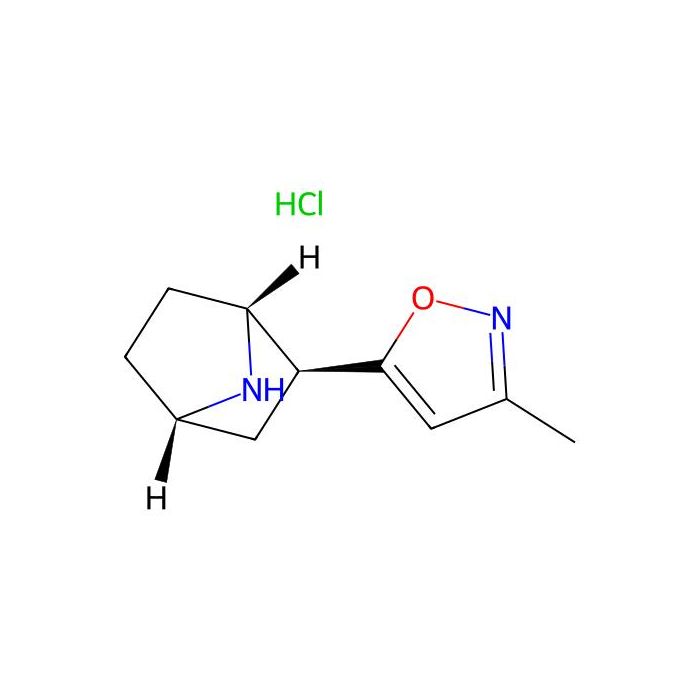
Epiboxidine hydrochloride is a potent and selective neural nAChR agonist with K i s of 0.46 nM and 1.2 nM for rat and human α4β2 nAChRs , respectively. Epiboxidine hydrochloride is a methylisoxazole analog of the alkaloid Epibatidine, and is also an analog of another nAChR agonist, ABT 418.
In Vitro
Epiboxidine hydrochloride has affinity and functional at central neuronal α4β2 receptors, with K i s of 0.46 and 1.2 in rat and humen. Epiboxidine hydrochloride has activity at ganglionic-type α3β4*-nicotinic receptors of PC12 cells, with a K i of 19. Epiboxidine hydrochloride is much less toxic than Epibatidine. Epiboxidine hydrochloride stimulates sodium-22 influx in PC12 and TE671 cells, with EC 50 s of 0.18 and 2.6 μM. MCE has not independently confirmed the accuracy of these methods. They are for reference only.
In Vivo
Epiboxidine hydrochloride (20 μg/kg; ip; once) treatment shows marked analgetic activity in mice . Epiboxidine hydrochloride (50 and 100 mg/kg; intraperitoneal injected; once) causes marked antinociception as measured in the hot-plate assay. Epiboxidine hydrochloride inhibits [ 3 H]nicotine binding in rat cerebral cortical membranes, with a K i of 0.6 nM. MCE has not independently confirmed the accuracy of these methods. They are for reference only.
Form:Solid
规格
别名
盐酸环丙沙星
规格或纯度
≥99%
英文名称
Epiboxidine hydrochloride
生化机理
Epiboxidine hydrochloride 是一种强效的选择性神经 nAChR 激动剂,对大鼠和人类 α4β2 nAChR 的 K i s 分别为 0.46 nM 和 1.2 nM。盐酸依匹哌啶是生物碱依匹哌啶的甲基异噁唑类似物,也是一种类似物。
储存条件
-20°C储存,干燥
运输条件
超低温运输
作用类型
激动剂
纯度
≥99%
名称和识别符
分子类型
小分子
分子量
214.69
高级数据
质检证书(CoA,COO,BSE/TSE 和分析图谱)
C of A & Other Certificates(BSE/TSE, COO):
输入批号以搜索分析图谱:
溶液计算器
产品仅提供给经过验证的企业、机构和合格的专业人员用于研发。不适用于人类、动物、诊断或治疗。
Copyright © 2023至今 上海阿拉丁生化科技股份有限公司 SSE:688179 保留所有权利。


 危险品化学品经营许可证(带存储)