外泌体(Exosome)是由不同细胞分泌的直径30-150nm的胞外膜性囊泡(Extrocellular visicles,EVs)。外泌体普遍存在于多种体液中,其内容物丰富,包括蛋白质、脂质、核酸等,在细胞间信息交流中发挥着重要作用,主要参与免疫抗原呈递,神经递质传递,脂类代谢,及细胞信号转导等过程,并与多种疾病的发生、发展、治疗及预后密切相关。密度超速离心作为传统并有效的外泌体分离方法,但其复杂的操作流程,昂贵的仪器设备,限制了外泌体的常规研究。
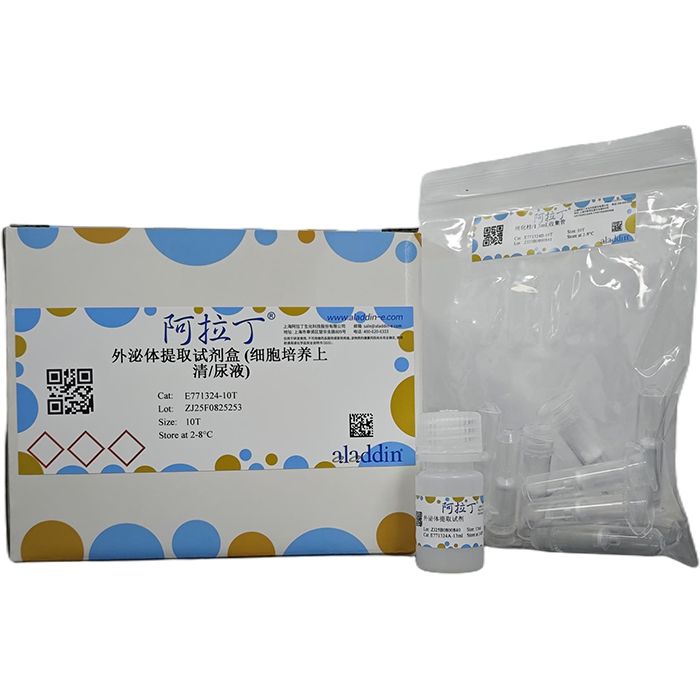
本公司研制一种外泌体提取试剂,通过优化多聚物混合物与样品混合,经离心可将外泌体沉淀富集,其操作简单,用时短,结果稳定,污染蛋白含量较少,只需普通离心机就可以分离得到较纯的完整外泌体。
应用范围:
本产品只用于科学研究,不能用于临床诊断。本试剂盒提取的外泌体可用于NTA粒径分析,WesternBlot,核酸提取及其后续分析(Q-PCR,测序等),不建议用于外泌体标记和蛋白质质谱分析等。
试剂盒组成和说明:
本试剂盒只适用于细胞培养上清或尿液的外泌体提取。
组分表:
E771324
| 组分名称 | 10T | 24T | Storage |
E771324A
| 外泌体提取试剂 | 13mL
| 30mL
| 2-8℃
|
E771324B
| 纯化柱/1.5mL收集管
| 10 套
| 24 套
| 2-8℃ |
本试剂盒每个反应是基于至少5.0ml细胞培养上清或尿液作为外泌体提取样品,如果提取的外泌体用于提取核酸(RNA/DNA)和蛋白质,建议起始样品用量为10.0ml,具体见下表。
样品类型
| 样品体积
| 外泌体提取试剂用量
|
细胞培养上清液
| 5mL/10mL
| 1.25mL/2.5mL
|
尿液
| 5mL/10mL
| 1.25mL/2.5mL |
操作方法:

图1 简单操作流程图
1.样本预处理:对于冻存样品,室温或25℃水浴解冻,将完全融化的样品置于冰上;对于新鲜样品,收集样品后置于冰上,3,000×g,4℃离心15min,去除细胞或细胞碎片,离心后将上清吸入新管中。
2.沉淀外泌体:取至少5.0ml处理后的细胞培养上清或尿液放入15ml离心管中,加入1.25ml外泌体沉淀试剂,颠倒充分混匀后4℃静置至少30min。静置后的样品12,000×g,4℃离心30min,管底可见白色沉淀,吸去上清,注意不要破坏外泌体沉淀。
3.外泌体重悬:加入100ul1×PBS,或下游应用的相应缓冲液,用移液器反复吹打或漩涡混合均匀,彻底溶解沉淀,此重悬液中含有完整的外泌体。
4.外泌体纯化:将重悬的外泌体转移至纯化柱,放入1.5ml收集管中(试剂盒提供),2,000×g,4℃离心5min,弃掉纯化柱,收集管中为提取的外泌体。提取的外泌体可直接应用于下游实验(如,粒径分析、核酸提取等),或者储存在2-8℃保存一周,或者-80℃保存大约三个月。
常见问题:
Q1:细胞培养时,如何去除培养基中牛血清来源的外泌体?
A1:多数情况下,体外细胞培养时培养基中需要添加牛来源血清,但血清中含有大量外泌体,会污染细胞分泌的外泌体,影响外泌体后续实验,可以采取以下两种方法操作:
(1)当细胞长到近乎单层,换成无血清培养基,在24-48小时后收集细胞培养上清。
(2)将血清以100,000g超速离心10h以上去除血清外泌体,或者购买商业化的去除外泌体的血清。
Q2:提取的外泌体如何保存?
A2:短时间内使用,可在2-8℃保存一周,若长时间保存,建议放在-80℃冰箱中,避免反复冻融,另外,最好是使用低吸附蛋白的保存管。
Q4:如何鉴定提取的外泌体?
A4:外泌体是体细胞分泌的细胞外囊泡群体中一种,直径一般为30-150nm,通常确定外泌体一般需要三个条件:电镜形态观察,颗粒粒径测定和蛋白标志物检测(WesternBlot检测CD9,CD81,CD63,Alix,TSG101等)。
Q5:本试剂盒提取外泌体方法与超速离心方法相比有哪些优势?
A5:主要表现在:操作简单,不需要额外仪器设备,节省时间,可小体积样本提取等。
物理外观:Liquid
是否无菌:否
Exosomes are extracellular vesicles (EVs) with a diameter of 30‑150 nm secreted by different cells. Exosomes are widely present in various body fluids and contain abundant contents including proteins, lipids, nucleic acids and so on. They play an important role in intercellular communication, mainly participating in immune antigen presentation, neurotransmitter transmission, lipid metabolism, cell signal transduction and other processes, and are closely related to the occurrence, development, treatment and prognosis of many diseases. Density‑gradient ultracentrifugation serves as a traditional and effective method for exosome isolation. Nevertheless, its complicated operating procedures and expensive instruments restrict routine research on exosomes.
Our company has developed an exosome isolation reagent. By mixing samples with an optimized polymer mixture, exosomes can be precipitated and enriched by centrifugation. It features simple operation, short processing time and stable results with low contaminating protein content. Relatively pure and intact exosomes can be isolated merely with an ordinary centrifuge.
Application Scope:
This product is for research use only and shall not be used for clinical diagnosis. Exosomes isolated with this kit can be applied to NTA particle‑size analysis, Western Blot, nucleic acid extraction and subsequent analysis (Q‑PCR, sequencing, etc.). It is not recommended for experiments such as exosome labeling and protein mass spectrometry analysis.
Kit Components and Description:
This kit is only suitable for exosome extraction from cell culture supernatant or urine samples.
Component
| Component No. | Component Name | 10T | 24T | Storage |
| E771324A | Exosome Extraction Reagent | 13 mL | 30 mL | 2‑8 ℃ |
| E771324B | Filter Spin Columns / 1.5 mL Collection Tubes | 10 sets | 24 sets | 2‑8 ℃ |
Each reaction of this kit requires a minimum of 5.0 mL cell culture supernatant or urine as the starting sample for exosome isolation. If the isolated exosomes are intended for subsequent nucleic acid (RNA/DNA) and protein extraction, a starting sample volume of 10.0 mL is recommended. Refer to the table below for details.
| Sample Type | Sample Volume | Exosome Isolation Reagent Volume |
| Cell culture supernatant | 5 mL / 10 mL | 1.25 mL / 2.5 mL |
| Urine | 5 mL / 10 mL | 1.25 mL / 2.5 mL |
Procedure

Figure 1 Simplified Workflow Diagram
1.Sample pretreatment: For frozen samples, thaw at room temperature or in a 25 °C water bath, and place fully‑thawed samples on ice. For fresh samples, place collected samples on ice. Centrifuge at 3 000 × g for 15 min at 4 °C to remove cells or cell debris. Transfer the supernatant to a new tube after centrifugation.
2.Exosome precipitation: Transfer a minimum of 5.0 mL of pretreated cell culture supernatant or urine into a 15 mL centrifuge tube. Add 1.25 mL exosome precipitation reagent and mix thoroughly by inverting the tube. Incubate at 4 °C for at least 30 min. Centrifuge the incubated sample at 12 000 × g for 30 min at 4 °C. A white pellet will be visible at the bottom of the tube. Aspirate and discard the supernatant; take care not to disturb the exosome pellet.
3.Exosome resuspension: Add 100 μL of 1×PBS or buffer compatible with downstream applications. Resuspend the pellet completely by repeated pipetting or vortexing. The resuspension contains intact exosomes.
4.Exosome purification: Transfer the resuspended exosomes onto the purification column placed in a 1.5 mL collection tube (supplied in the kit). Centrifuge at 2 000 × g for 5 min at 4 °C. Discard the purification column. The collected liquid in the tube is the purified exosome preparation. The isolated exosomes can be directly used for downstream experiments (e.g., particle size analysis, nucleic acid extraction). Store at 2‑8 °C for up to one week, or at −80 °C for approximately three months.
Frequently Asked Questions
Q1: How to remove bovine serum‑derived exosomes from culture medium during cell culture?
A1: Bovine serum is commonly supplemented in cell culture medium, yet it contains abundant exosomes that contaminate cell‑secreted exosomes and interfere with downstream assays. Two approaches are recommended:
(1) When cells reach near‑confluence, replace with serum‑free medium and collect cell culture supernatant after 24‑48 h incubation.
(2) Deplete serum‑derived exosomes by ultracentrifugation at 100 000 × g for ≥10 h, or use commercial exosome‑depleted serum.
Q2: How should isolated exosomes be stored?
A2: For short‑term use, store at 2‑8 °C for up to one week. For long‑term storage, keep samples at −80 °C and avoid repeated freeze‑thaw cycles. Protein low‑binding tubes are recommended for storage.
Q4: How to characterize isolated exosomes?
A4: Exosomes are a subset of cell‑secreted extracellular vesicles with diameters of 30‑150 nm. Valid exosome identification generally requires three lines of evidence: transmission electron microscopy (TEM) morphology observation, particle size measurement, and detection of protein markers (Western Blot for CD9, CD81, CD63, Alix, TSG101, etc.).
Q5: What are the advantages of this kit compared with ultracentrifugation‑based exosome isolation?
A5: Key advantages include simple workflows, no requirement for specialized equipment, shorter experimental time, and compatibility with small‑volume starting samples.

 ZJ26F1039877


 危险品化学品经营许可证(带存储)