产品介绍
甲醛,又称蚁醛,是一种有机化合物,通常为无色气体,有刺激性气味,对人眼、鼻等有刺激作用。甲醛在工业中有多种用途,室内装修常用的板材、油漆、地毯、壁纸等都含有甲醛,烟叶的不完全燃烧也能释放甲醛。医学上,甲醛还常被用作防腐剂和消毒剂。 目前纺织印染助剂中的甲醛超标主要来源于分散剂 MF、含有甲撑磷酸的螯合剂、丙烯酰胺N-羟甲基助剂 、皮革鞣剂 、锦纶助剂等苯酚及其衍生物的甲醛缩合物。随着国内外生态纺织品标准的陆续颁布,国内纺织品的生态安全问题受到广泛关注。在纺织品助剂行业, 甲醛被广泛用作反应剂,以提高助剂在纺织品上的耐久性,如树脂整理剂、固色剂、黏合剂等。
目前检测甲醛常用的方法有分光光度法和色谱法。分光光度计法相对快捷、方便。在日常生活中应用更为广泛,可以有效检测纺织品中甲醛的含量 。
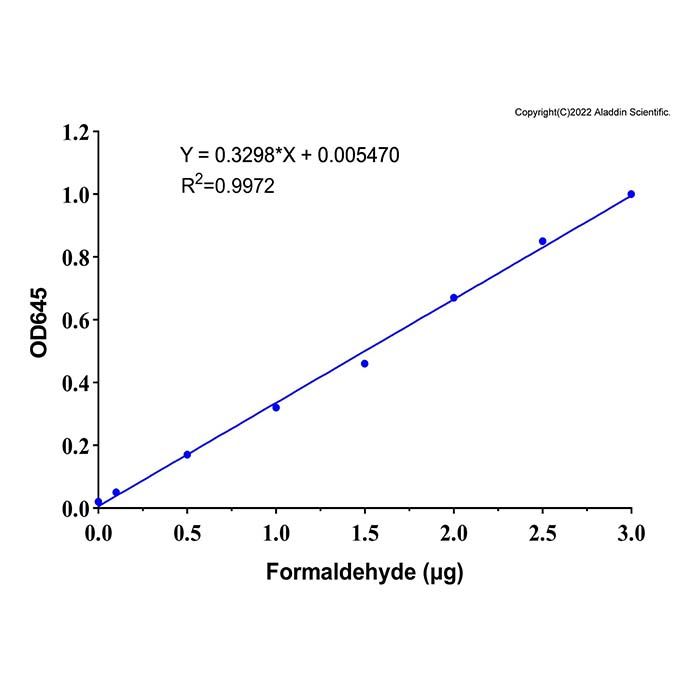
本试剂盒检测原理:甲醛经水吸收后,与酚试剂(MBTH)反应生成吖嗪,在酸性条件下,吖嗪被铁离子氧化生成蓝色化合物,用分光光度计在 630-645 nm 处测定吸光度,在一定浓度范围蓝色化合物的吸光度与甲醛浓度呈线性关系, 进而可计算出样品中甲醛的浓度。主要用于室内空气、纺织品等释放的甲醛含量的检测。该试剂盒仅用于科研领域,不适用于临床诊断或其他用途。
本试剂盒可采用分光光度法进行检测,在样品体积为 5 mL 时,检测在0-3 μg 浓度范围内有良好的线性关系 。
| 组分货号 |
组分名称 |
物理外观 |
50 T |
储存 |
单次测试使用量 |
| F1522033A |
甲醛标准品 (100 mg/L) |
液体 |
2.0 mL |
2-8 ℃. 避光 |
按需 |
| F1522033B |
MBTH 粉剂 |
固体 |
0.1 g |
2-8 ℃. 避光 |
按需 |
| F1522033C |
铁显色液 |
液体 |
20.0 mL |
2-8 ℃. 避光 |
0.4 mL |
使用方法
1. 样品准备:
1) 室内空气采用相关仪器按照相关国家标准方案进行吸收后直接检测;
2) 称取一定质量的剪碎的纺织品或处理后的食品用甲醛吸收液在40℃条件下振荡浸泡 1 小时后用上清液直接检测;如浓度较低,可加大样品的加入量。
2. 试剂准备:
1) 配制酚试剂:将 MBTH 粉剂 0.1 g 充分溶解于 100 mL蒸馏水中,2-8 ℃保存,溶液一般呈无色透明,久置后,逐渐变红色,并加深,一般 3 个月内呈淡红色可正常使用,但吸光度本底值会升高,因此一般建议称取少量粉剂配制液;
2) 配制甲醛吸收液:取 5 mL 酚试剂,加入 95 mL 蒸馏水即成,一般现用现配。
3. 配制系列甲醛标准:
取一定量的甲醛标准品 (100 mg/L),加入甲醛吸收液稀释至 (1 μg/mL) 甲醛标准液 ,再按下表进行操作,依次稀释。
加入物 (mL) | 1 | 2 | 3 | 4 | 5 | 6 | 7 |
甲醛标准液 (1 μg/mL) | 0.1 | 0.5 | 1.0 | 1.5 | 2.0 | 2.5 | 3.0 |
甲醛吸收液 | 4.9 | 4.5 | 4.0 | 3.5 | 3.0 | 2.5 | 2.0 |
相当于甲醛浓度 (μg) | 0.1 | 0.5 | 1.0 | 1.5 | 2.0 | 2.5 | 3.0 |
4. 加样:
按照下表设置空白管、标准管、测定管,溶液应按照顺序依次加入,并注意避免产生气泡。如果样品中的甲醛含量过高,可以减少样品用量或适当稀释后再进行测定, 样品的检测最好能设置 2 平行管,求平均值。
加入物 (mL) | 空白管 | 标准管 | 测定管 |
甲醛吸收液 | 5.0 | - | - |
甲醛标准液 (1-7) | - | 5.0 | - |
待测样品 | - | - | 5.0 |
铁显色液 | 0.4 | 0.4 | 0.4 |
5. 测定:
立即混匀,室温 (20-28 ℃),避光静置 15 min,保证氧化完全;显色结束后静置 10 min,冷却至室温。以空白管调零, 比色杯光径 1 cm,分光光度计测定 645 nm 处系列标准管、测定管的吸光度。
注意事项
1) 显色反应时可室温反应或水浴锅反应,当提高反应温度时,可适当减少反应时间,建议用统一温度条件下测定。
2)试剂如不慎溅入眼、口、皮肤等部位,请立即用清水冲洗。
3)显色后,颜色可稳定 1-2 个小时,一般建议尽快测定。
4)酚、醛等还原性物质会造成假阳性;二氧化硫共存时,使测定结果偏低。
5)为了您的安全和健康,请穿实验服并戴一次性手套操作
Product Introduction
Formaldehyde, also known as methanal, is an organic compound. It is normally a colorless gas with an irritating odor that stimulates human eyes, nose and other mucous membranes. Formaldehyde has a wide range of industrial applications. Boards, paints, carpets, wallpaper and other materials commonly used in interior decoration all contain formaldehyde; incomplete combustion of tobacco also releases formaldehyde. Medically, formaldehyde is widely used as a preservative and disinfectant. Excessive formaldehyde in textile printing and dyeing auxiliaries mainly originates from formaldehyde condensates of phenol and its derivatives, including dispersant MF, chelating agents containing methylenephosphoric acid, N-methylol acrylamide auxiliaries, leather tanning agents and polyamide fiber auxiliaries. With the successive issuance of domestic and international ecological textile standards, the ecological safety of domestic textiles has attracted widespread attention. In the textile auxiliary industry, formaldehyde is extensively adopted as a reactant to improve the durability of auxiliaries on textiles, such as resin finishing agents, color fixing agents and adhesives. At present, spectrophotometry and chromatography are the mainstream methods for formaldehyde detection. Spectrophotometry is relatively rapid, convenient and more widely applied in daily life, which can effectively quantify formaldehyde content in textiles.
After formaldehyde is absorbed by water, it reacts with phenol reagent (MBTH) to generate azine. Under acidic conditions, azine is oxidized by ferric ions to form a blue compound. A spectrophotometer is used to measure the absorbance at a wavelength of 630-645 nm. Within a specific concentration range, the absorbance of the blue compound shows a linear correlation with formaldehyde concentration, based on which the formaldehyde concentration in the sample can be calculated. This kit is mainly applied to detect formaldehyde released by indoor air, textiles and other substances. This kit adopts spectrophotometric detection. When the sample volume is 5 mL, it exhibits favorable linearity within the concentration range of 0-3 μg.
Product Components
Component No. | Component Name | Appearance | 50 T | Storage | Quantity Per Test |
F1522033A | Formaldehyde solution (100 mg/L) | Liquid | 2.0 mL | 2-8 ℃. Store in the dark. | As need |
F1522033B | MBTH powder | Powder | 0.1 g | 2-8 ℃. Store in the dark. | As need |
F1522033C | Iron chromogenic reagent | Liquid | 20.0 mL | 2-8 ℃. Store in the dark. | 0.4 mL |
Operating Procedure
1. Sample Preparation
1) Indoor air samples are directly tested after absorption with corresponding sampling instruments.
2) Weigh a certain mass of shredded textiles or crushed food samples, soak them in formaldehyde absorbing solution with shaking at 40 °C for 1 hour, then take the supernatant for direct detection. If the formaldehyde concentration is low, increase the sample dosage.
2. Reagent Preparation:
1)Preparation of phenol reagent: Dissolve 0.1 g of MBTH powder completely in 100 mL distilled water, and store the prepared solution at 2-8°C. The fresh solution is generally colorless and transparent. After long-term storage, it will gradually turn red with deepening color. Solutions that turn light red within 3 months can still be used normally, yet the blank absorbance will rise accordingly. For this reason, it is recommended to prepare small-volume working solutions by weighing a small amount of powder each time.
2)Preparation of formaldehyde absorbing solution: Mix 5 mL phenol reagent with 95 mL distilled water. Prepare the absorbing solution right before use.
3. Preparation of Serial Formaldehyde Standards
Take an appropriate volume of formaldehyde solution ( 100 mg/L ), dilute it with formaldehyde absorbing solution to prepare formaldehyde standard working solution (1 μg/mL), then perform serial dilution sequentially according to the table below:
Reagent Volume (mL) | 1 | 2 | 3 | 4 | 5 | 6 | 7 |
Formaldehyde Standard working solution (1 μg/mL) | 0.1 | 0.5 | 1.0 | 1.5 | 2.0 | 2.5 | 3.0 |
Formaldehyde Absorbing Solution | 4.9 | 4.5 | 4.0 | 3.5 | 3.0 | 2.5 | 2.0 |
Equivalent Formaldehyde Content (μg) | 0.1 | 0.5 | 1.0 | 1.5 | 2.0 | 2.5 | 3.0 |
4. Sample Loading
Set blank tubes, standard tubes and test tubes as shown below. Add reagents in sequence and avoid bubble formation. If the formaldehyde content in the sample is excessively high, reduce the sample volume or dilute the sample before measurement. It is recommended to prepare 2 parallel tubes for each sample and calculate the average value.
| Reagent Volume (mL) | Blank Tube | Standard Tube | Test Tube |
|---|
Formaldehyde Absorbing Solution
| 5.0 | - | - |
| Formaldehyde Standard working solution (Tube 1-7) | - | 5.0 | - |
| Test Sample | - | - | 5.0 |
Iron chromogenic reagent
| 0.4 | 0.4 | 0.4 |
5. Measurement
Mix thoroughly immediately, incubate at room temperature (20-28 °C) in the dark for 15 min to ensure complete oxidation. After color development, allow to stand for 10 min and cool to room temperature. Zero the spectrophotometer using the blank tube, with a 1 cm path-length cuvette. Measure the absorbance of standard series tubes and sample detection tubes at 645 nm.
Precautions
1) The color development reaction can be carried out at room temperature or in a water bath. If the reaction temperature is increased, the reaction time can be appropriately shortened. It is recommended to perform all measurements under consistent temperature conditions.
2) If reagents accidentally splash into eyes, mouth, skin or other body parts, rinse the affected area thoroughly with clean water immediately.
3) The color developed after reaction remains stable for 1-2 hours; it is generally recommended to complete the absorbance measurement as soon as possible.
4) Reducing substances such as phenols and aldehydes may cause false-positive results; the coexistence of sulfur dioxide leads to lower test values.
5) Wear a lab coat and disposable gloves during operation for your personal safety and health.

 ZJ26F0838797


 危险品化学品经营许可证(带存储)