甲醛,又称蚁醛,是一种有机化合物,通常为无色气体,有刺激性气味,对人眼、鼻等有刺激作用。甲醛在工业中有多种用途,室内装修常用的板材、油漆、地毯、壁纸等都含有甲醛,烟叶的不完全燃烧也能释放甲醛。医学上,甲醛还常被用作防腐剂和消毒剂。
目前纺织印染助剂中的甲醛超标主要来源于分散剂MF、含有甲撑磷酸的螯合剂、丙烯酰胺N -羟甲基助剂 、皮革鞣剂 、锦纶助剂等苯酚及其衍生物的甲醛缩合物。随着国内外生态纺织品标准的陆续颁布,国内纺织品的生态安全问题受到广泛关注。在纺织品助剂行业, 甲醛被广泛用作反应剂,以提高助剂在纺织品上的耐久性,如树脂整理剂、固色剂、黏合剂等。 目前 检测甲醛常用的方法有分光光度法和色谱法。分光光度计法相对快捷、方便。在日常生活中应用更为广泛,可以有效检测纺织品中甲醛的含量 。
阿拉丁甲醛含量检测试剂盒 (AHMT, 比色法) 的检测原理是甲醛经水吸收后,与4-氨基-3-肼基-5-巯基-1,2,4-三氮杂茂 (AHMT) 在碱性条件下缩合,然后再经高碘酸氧化成紫红色化合物,以分光光度计550nm处测定吸光度,在0.1~3.5μg/ml范围内紫红色化合物的吸光度与甲醛浓度呈线性关系,从而可计算出样品中甲醛的浓度,主要用于室内空气、纺织品等释放的甲醛的检测。该试剂盒仅用于科研领域,不适用于临床诊断或其他用途。
组分与储存:
| 项目号 | 物理外观 | 组件 | 50T | 储存 | | F1522034A | 液体 | 甲醛标准 (1mg/ml) | 1 mL | 2-8℃. Store in the dark. | | F1522034B | 液体 | 碱性溶液 | 25 mL | 2-8℃. | | F1522034C | 液体 | AHMT 溶液 | 25 mL | 2-8℃. Store in the dark. | | F1522034D | 液体 | 高碘酸溶液 | 8 mL | 2-8℃. Store in the dark. |
|
自备材料:
1. 蒸馏水、甲醛吸收液
2. 电子天平、剪刀、离心机、离心管、试管、分光光度计、比色皿、恒温箱或水浴锅
操作步骤(仅供参考):
1. 准备样品:
① 室内空气采用相关仪器进行吸收后直接检测;
② 称取一定质量的剪碎的纺织品或粉碎的食品用蒸馏水在40℃条件下振荡浸泡1小时后用上清液直接检测;如浓度较低,可加大样品的加入量。
2. 配制系列甲醛标准:将甲醛标准 (1mg/ml) 用蒸馏水稀释至2μg/ml,再按下表进行操作,依次稀释。
加入物 (ml)
| 1 | 2 | 3 | 4 | 5 | 6 | 7 | 甲醛标准 (2μg/ml)
| 0.05 | 0.1 | 0.2 | 0.4 | 0.6 | 0.8 | 1 | 蒸馏水
| 0.95 | 0.9 | 0.8 | 0.6 | 0.4 | 0.2 | 0 | 相当于甲醛浓度 (μg/ml)
| 0.1 | 0.2 | 0.4 | 0.8 | 1.2 | 1.6 | 2 |
|
3. 加样:按照下表设置空白管、标准管、测定管,溶液应按照顺序依次加入,并注意避免产生气泡。如果样品中的甲醛含量过高,可以减少样品用量或适当稀释后再进行测定,样品的检测最好能设置2平行管,求平均值。
加入物 (ml)
| 空白管
| 标准管
| 测定管
| 蒸馏水
| 1 | / | / | 系列甲醛标准 (1-7号)
| / | 1 | / | 待测样品
| / | / | 1 | 碱性溶液
| 0.5
| 0.5
| 0.5
| AHMT 溶液
| 0.5
| 0.5
| 0.5
| 混匀,室温放置20min
| / | / | / | 高碘酸溶液
| 0.15
| 0.15
| 0.15
|
|
4. 测定:混匀,室温放置5min,以空白管调零,比色杯光径1cm,以分光光度计测定550nm处系列标准管、测定管的吸光度。
计算:
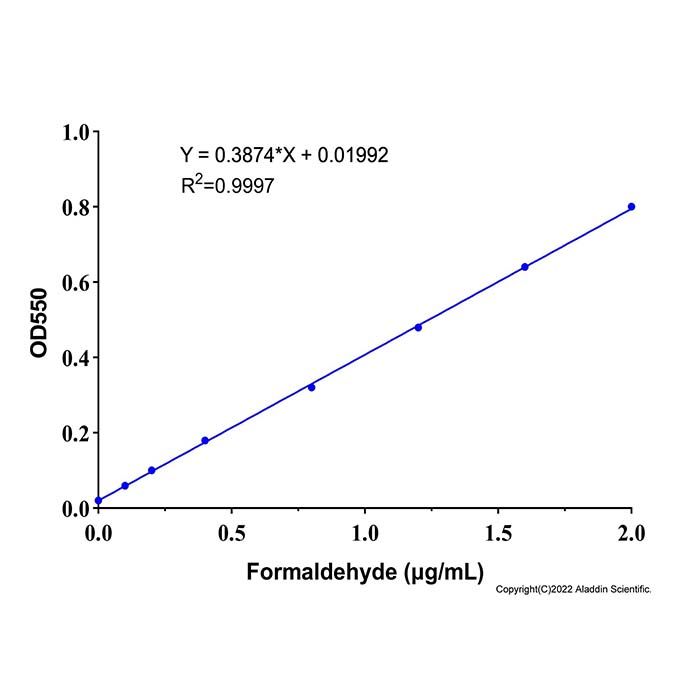
以1-7号管系列甲醛标准浓度 (0.1~2μg/ml) 为横坐标,以对应的吸光度为纵坐标,绘制标准曲线,得出回归方程。测定管吸光度带入回归方程,可求得测定管甲醛浓度c。如果样品被稀释后测定,需乘以稀释倍数。
固体样品甲醛含量 (μg/•g)=c×N×V/W
液体样品甲醛含量 (μg/•ml)=c×N
式中:
c=根据标准曲线求得的测定管甲醛浓度 (μg/ml)
N=稀释倍数
V=样品提取液总体积 (ml)
W=样品质量 (g)
注意事项:
1. 试剂如不慎溅入眼、口、皮肤等部位,请立即用清水冲洗。
2. 为了您的安全和健康,请穿实验服并戴一次性手套操作。
3. 试剂开封后请尽快使用,以防影响后续实验效果。
附:按说明书操作,对系列标准用分光光度计测定550nm时的吸光度,其标准曲线如下 (仅供参考):
甲醛含量检测试剂盒 (AHMT, 比色法)

Formaldehyde, also known as methanal, is an organic compound. It is normally a colourless gas with a pungent odour and irritates the human eyes, nose and other organs. Formaldehyde has a wide range of industrial applications. It can be found in commonly used materials for interior decoration such as boards, paints, carpets and wallpapers. Incomplete combustion of tobacco also releases formaldehyde. Medically, formaldehyde is frequently used as a preservative and disinfectant.
Excessive formaldehyde present in textile printing and dyeing auxiliaries mainly originates from formaldehyde condensates of phenol and its derivatives, including Dispersant MF, chelating agents containing methylenephosphonic acid, N-hydroxymethyl acrylamide auxiliaries, leather tanning agents and polyamide auxiliaries. Following the successive promulgation of eco-textile standards at home and abroad, the ecological safety of domestic textiles has attracted widespread attention. In the textile auxiliary industry, formaldehyde is widely adopted as a reactant to improve the durability of auxiliaries on textiles, such as resin finishing agents, fixing agents and binders. Spectrophotometry and chromatography are the common methods for formaldehyde detection. Spectrophotometry is relatively rapid and convenient, and is more widely used in daily life to effectively determine formaldehyde content in textiles.
The detection principle of Aladdin Formaldehyde Test Kit (AHMT, colorimetric method) is as follows: after being absorbed by water, formaldehyde undergoes a condensation reaction with 4-amino-3-hydrazino-5-mercapto-1,2,4-triazole (AHMT) under alkaline conditions. The condensation product is then oxidised by periodic acid to form a purplish-red compound. The absorbance is measured with a spectrophotometer at 550 nm. Within the range of 0.1–3.5 μg/mL, the absorbance of the purplish-red compound exhibits a linear correlation with formaldehyde concentration, enabling calculation of formaldehyde concentration in samples. This kit is mainly applied to detect formaldehyde released from indoor air, textiles and other matrices. The kit is intended solely for scientific research purposes and is not suitable for clinical diagnosis or other applications.
Contents & Storage:
Item No.
| Appearance
| Components
| 50T | Storage | | F1522034A | Liquid
| Formaldehyde Standard (1 mg/ml)
| 1 mL | 2-8℃. Store in the dark. | | F1522034B | Liquid
| Alkaline Solution
| 25 mL | 2-8℃. | | F1522034C | Liquid
| AHMT Solution
| 25 mL | 2-8℃. Store in the dark. | | F1522034D | Liquid
| Periodic Acid Solution
| 8 mL | 2-8℃. Store in the dark. |
|
Materials to be prepared:
1. Distilled water, formaldehyde absorbing solution
2. Electronic balance, scissors, centrifuge, centrifuge tubes, test tubes, spectrophotometer, cuvettes, incubator or water bath
Operating Procedures (For reference only):
1. Sample Preparation
① Indoor air samples are collected by relevant instruments and tested directly.
② Weigh a certain mass of shredded textiles or crushed food, add distilled water, shake and soak at 40 °C for 1 h; collect the supernatant for direct testing. If the concentration is low, increase the sample dosage.
2. Preparation of serial formaldehyde standards
Dilute formaldehyde standard solution (1 mg/mL) with distilled water to 2 μg/mL, then conduct serial dilution according to the table below.
Additive (ml)
| 1 | 2 | 3 | 4 | 5 | 6 | 7 | Formaldehyde standard (2 μg/ml)
| 0.05 | 0.1 | 0.2 | 0.4 | 0.6 | 0.8 | 1 | Distilled water
| 0.95 | 0.9 | 0.8 | 0.6 | 0.4 | 0.2 | 0 | Corresponding formaldehyde concentration (μg/ml)
| 0.1 | 0.2 | 0.4 | 0.8 | 1.2 | 1.6 | 2 |
|
3. Sample loading
Set blank tube, standard tubes and sample tube according to the table below. Add solutions in sequence and avoid bubble formation. If formaldehyde content in the sample is excessively high, reduce sample volume or dilute appropriately before measurement. It is recommended to prepare 2 parallel tubes for each sample and calculate the average value.
Additive (ml)
| Blank Tube
| Standard Tube
| Sample Tube
| Distilled water
| 1 | / | / | Serial formaldehyde standard (No.1–7)
| / | 1 | / | Test sample solution
| / | / | 1 | Alkaline solution
| 0.5
| 0.5
| 0.5
| AHMT Solution
| 0.5
| 0.5
| 0.5
| Mix thoroughly and stand at room temperature for 20 min
| / | / | / | Periodic acid solution
| 0.15
| 0.15
| 0.15
|
|
4. Measurement
Mix thoroughly and incubate at room temperature for 5 min. Zero the spectrophotometer using the blank tube; use a cuvette with 1 cm optical path. Measure the absorbance of serial standard tubes and sample tube at 550 nm.
Calculation:
Take the formaldehyde concentrations of standard tubes No.1 to No.7 (0.1~2 μg/mL) as the abscissa and the corresponding absorbance as the ordinate to plot the standard curve and obtain the regression equation. Substitute the absorbance of the sample tube into the regression equation to calculate the formaldehyde concentration c in the sample tube. Multiply by the dilution factor if the sample was diluted prior to measurement.
Formaldehyde content of solid sample (μg/g) = c × N × V / W
Formaldehyde content of liquid sample (μg/mL) = c × N
Where:
c = formaldehyde concentration in the sample tube calculated from the standard curve (μg/mL)
N = dilution factor
V = total volume of sample extract (mL)
W = mass of sample (g)
Precautions:
1. In case of accidental splashing of reagents into eyes, mouth, skin or other body parts, rinse immediately with plenty of clean water.
2. Wear a lab coat and disposable gloves during operation for your safety and health.
3. Use reagents promptly after opening to avoid adverse impacts on subsequent experiments.
Appendix:
When operating in accordance with the instructions and measuring the absorbance of serial standards at 550 nm using a spectrophotometer, the standard curve is shown below (for reference only):
Formaldehyde Content Assay Kit (AHMT, Colorimetric Method)

 ZJ26F1039955

 危险品化学品经营许可证(带存储)