
A Cornerstone of Anaerobe Research: A Detailed Guide to the Cultivation and Preservation of Clostridium sporogenes
A Cornerstone of Anaerobe Research: A Detailed Guide to the Cultivation and Preservation of Clostridium sporogenes
Clostridium sporogenes is a representative Clostridium species commonly used in anaerobic bacterial culture, spore formation, strain preservation, food safety testing, and sterility validation research. It is characterized by strict anaerobic growth, Gram-positive rod morphology, spore formation, and a relatively mature culture system. It is often used to establish anaerobic culture workflows, evaluate the stability of anaerobic environments, prepare spore suspensions, and validate strain preservation efficiency.
Keywords: Clostridium sporogenes; anaerobic bacterial culture; Clostridium enrichment medium; spore formation; strain preservation; lyophilized preservation; anaerobic environment control
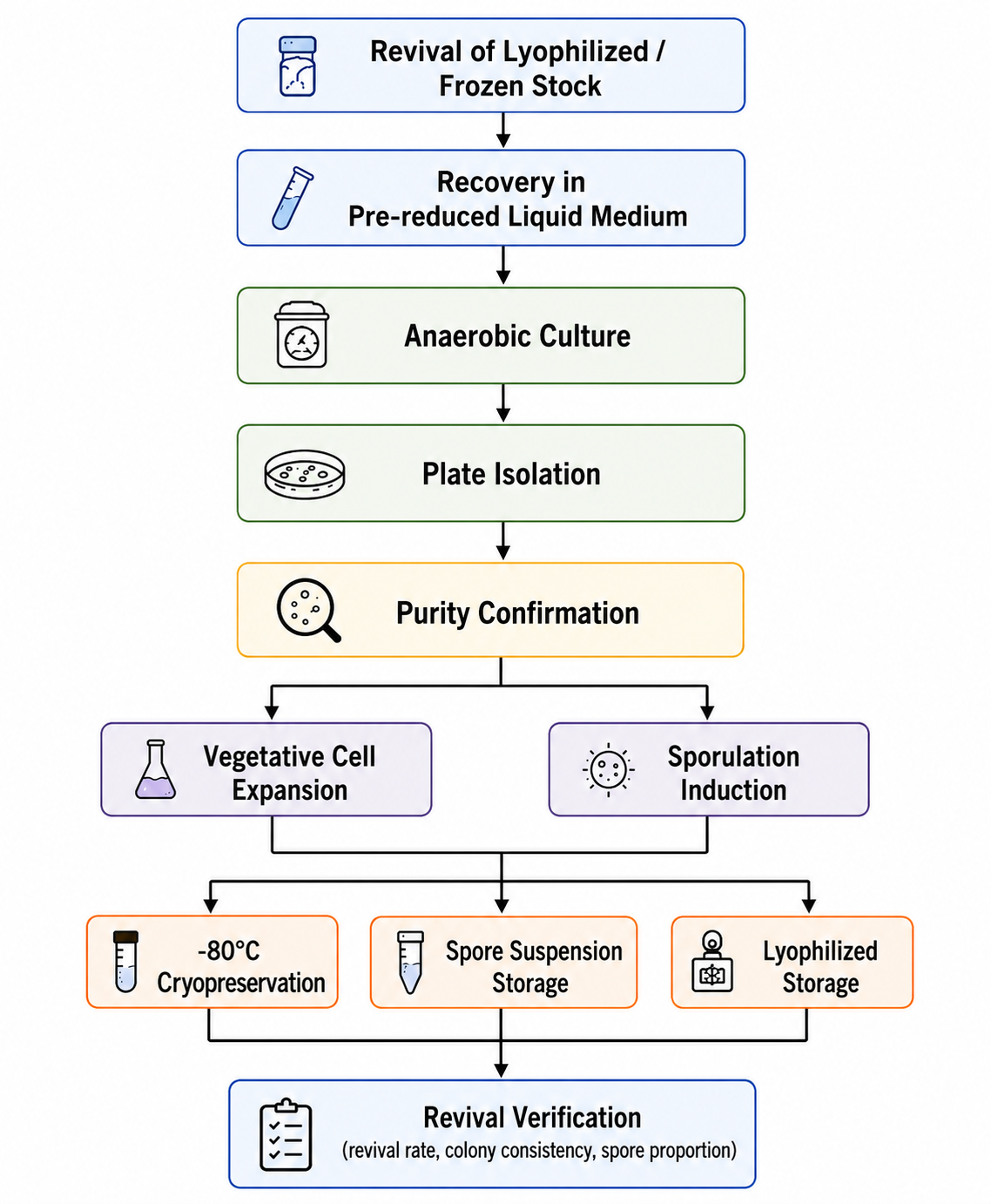
Figure 1. Workflow for Recovery, Anaerobic Culture, Sporulation, Preservation, and Recovery Verification of Clostridium sporogenes
1 Basic Logic of Clostridium sporogenes Research
1.1 Research Positioning of Clostridium sporogenes
Clostridium sporogenes is a representative spore-forming anaerobe within the genus Clostridium. Compared with some high-risk toxigenic Clostridium species, commonly used reference strains of C. sporogenes are generally non-botulinum-toxin-producing. Therefore, it is often used as a model organism in strict anaerobe handling, Clostridium culture systems, spore formation, and preservation stability research.
(1) Anaerobic culture model
C. sporogenes is oxygen-sensitive, and its culture results are highly dependent on the reduction status of the medium, sealing performance of the anaerobic system, inoculation and transfer speed, and oxygen indicator status. It is suitable for verifying whether laboratory anaerobic culture workflows are stable.
(2) Spore research model
C. sporogenes can form spores under unfavorable conditions, and spores are markedly more tolerant than vegetative cells to heat, drying, and preservation environments. Therefore, it is suitable for studies related to spore preparation, spore preservation, recovery efficiency, and sterilization challenge experiments.
(3) Applied tool organism
C. sporogenes can be used in food safety, anaerobic fermentation, sterility validation, and tumor hypoxic microenvironment-related research. In specific applications, however, it should be clearly positioned as a culture and preservation model, and it cannot directly replace studies on virulence, toxin expression, or pathogenic mechanisms of toxigenic Clostridium species.
1.2 Core Challenges in Cultivation and Preservation
The cultivation challenges of C. sporogenes are concentrated in two aspects: strict anaerobiosis and the coexistence of vegetative cells and spores. Successful culture cannot be judged only by liquid turbidity, and successful preservation cannot be judged only by the presence of spores under the microscope.
(1) Oxygen exposure control
During recovery, streaking, single-colony picking, subculture, and aliquoting for frozen preservation, prolonged air exposure can affect recovery efficiency and growth status. Lyophilized cultures, long-term frozen cultures, and low-viability strains are especially dependent on a stable oxygen-free environment.
(2) Culture status interpretation
Turbidity in liquid culture only indicates microbial growth and does not prove that the culture is a pure culture of C. sporogenes. After culture, confirmation should be performed by plate isolation, colony morphology, Gram staining, spore staining, or molecular identification.
(3) Preservation status interpretation
Long-term preservation should focus on recovery rate, colony consistency, spore proportion, passage number, and batch stability. Relying only on short-term slant preservation or continuous passaging can easily lead to reduced viability, accumulated contamination, and phenotypic drift.
2 Biological Characteristics and Preparation Before Culture
2.1 Basic Biological Characteristics
C. sporogenes is a Gram-positive rod with motility and can form oval spores under unfavorable conditions. Under typical culture conditions, its suitable growth temperature is usually 35–37℃, and a neutral to weakly acidic environment is more favorable for growth.
(1) Anaerobic property
C. sporogenes is a strict anaerobe. Before culture, the medium should be fully pre-reduced, and both plate and liquid culture systems should be placed into an anaerobic environment as soon as possible.
(2) Morphological characteristics
Vegetative cells are usually rod-shaped. After spore formation, the cells may appear swollen or spindle-shaped. Morphological observation can only serve as preliminary screening and cannot replace strain identification.
(3) Growth performance
Liquid culture may show turbidity, sedimentation, or gas production. Plate culture may form grayish-white colonies with irregular margins or spreading characteristics. Different media and strain states can affect colony appearance.
2.2 Preparation of the Anaerobic Environment
A stable anaerobic environment should be prepared before cultivating C. sporogenes. Common approaches include anaerobic workstations, anaerobic jars, anaerobic pouches, and anaerobic incubators. If the experiment involves extensive transfers, streaking, and aliquoting for frozen preservation, an anaerobic workstation is more advantageous for reducing oxygen exposure.
(1) Anaerobic workstation
An anaerobic workstation is suitable for recovery, streaking, aliquoting, colony picking, and continuous operations. It allows key steps to be completed within the same oxygen-free environment and is an ideal condition for strict anaerobe handling.
(2) Anaerobic jar or anaerobic pouch
Anaerobic jars or pouches are suitable for static plate culture and routine anaerobic culture. They are relatively low-cost, but each opening causes oxygen exposure and should be used together with an anaerobic gas-generating system and an oxygen indicator.
(3) Verification of anaerobic status
The anaerobic indicator should be observed for every culture. If the indicator color suggests oxygen exposure, the culture results from that batch should not continue to be treated as reliable data, and the anaerobic environment should be re-established.
2.3 Strain and Record Management
C. sporogenes culture should use strains with a clear source, clear identification number, and reliable preservation status. Each recovery, passage, freezing, and use should record the strain number, preservation batch, medium, culture temperature, culture time, anaerobic system, and operator.
(1) Strain source
Reference strains or identified strains are more suitable for method establishment and article-based experimental systems. Unknown Clostridium isolates obtained from environmental or food samples should not be handled directly as C. sporogenes.
(2) Passage control
Continuous passaging increases the risk of phenotypic drift and contamination. It is recommended to establish a master seed batch and a working seed batch. Routine experiments should recover strains from the working seed batch to avoid repeated use of the master seed batch.
(3) Contamination control
Each culture batch should include a negative medium control and necessary purity checks. If multiple colony morphologies appear, obvious growth occurs under aerobic conditions, or staining results are mixed, the batch should be re-purified or discarded.
3 Medium Selection and Application Positioning
3.1 Recovery and Enrichment Media
For C. sporogenes recovery, nutrient-rich media with good reducing status should be prioritized. Clostridium enrichment medium and thioglycolate medium are suitable for recovering frozen cultures, lyophilized cultures, and low-viability strains. Media should be fully pre-reduced before use, and oxygen removal can be performed before use when necessary.
Reinforced Clostridial-type media are suitable for improving recovery opportunity, while thioglycolate medium is suitable for maintaining a low oxidation-reduction potential. For low-viability strains, ordinary nonselective plates should not be used directly to judge strain inactivation. Liquid recovery should be performed first, followed by plate isolation.
3.2 Plate Isolation Media
Plate culture is used for single-colony isolation, colony morphology observation, purity checking, and counting. Columbia agar medium and blood agar base used together with sterile defibrinated sheep blood can be used for anaerobic colony observation and hemolysis assessment. TSA-type media can be used for pure culture recovery and nonselective culture controls, but should not serve as the core enrichment medium for Clostridium from complex samples.
3.3 Preservation and Auxiliary Systems
Short-term preservation can use semisolid medium, slant medium, or oxygen-barrier overlay methods, but these are not recommended as long-term preservation approaches. Long-term preservation should prioritize -80℃ freezing, spore suspension preservation, or lyophilized preservation, and recovery validation should be performed.
Medium bottles, agar powder, skim milk powder, and skim milk-containing buffer systems are not “media” themselves, but they are directly related to medium preparation, lyophilization protection, and preservation system establishment, so they are suitable for inclusion in the product table.
4 Culture Workflow of Clostridium sporogenes
4.1 Recovery of Lyophilized or Frozen Cultures
During recovery, oxygen exposure should be minimized. After rehydration, lyophilized cultures should be inoculated into pre-reduced liquid medium as soon as possible. Frozen cultures should be rapidly thawed and transferred into a pre-reduced culture system to avoid repeated freeze-thaw cycles.
(1) Recovery of lyophilized cultures
Under sterile and preferably low-oxygen conditions, lyophilized bacterial powder should be reconstituted with pre-reduced liquid medium. After gentle pipetting and mixing, it should be inoculated into Clostridium enrichment medium or thioglycolate medium. Frequent opening for observation is not recommended during the early recovery stage.
(2) Recovery of frozen cultures
After the frozen vial is removed, it should be thawed quickly and immediately inoculated into pre-reduced medium. If the recovered bacterial amount is low or the strain state is weak, liquid enrichment can be performed first, followed by plate isolation.
(3) Recovery observation
Within 18–48 hours of culture, changes in liquid medium turbidity, sedimentation, gas production, and odor can be observed. If no growth occurs, the anaerobic system, medium reduction status, and frozen batch should be checked first, rather than directly concluding that the strain is dead.
4.2 Liquid Culture
Liquid culture is suitable for strain recovery, enrichment, pre-preservation expansion, and pre-culture before spore preparation. The medium should be fully pre-reduced before inoculation, and anaerobic culture conditions should be established immediately after inoculation.
(1) Inoculation control
During recovery, the inoculum can be moderately increased. For standardized experiments, the inoculum amount, medium volume, and culture time should be controlled. The initial bacterial amount and medium batch number should be recorded for different experimental batches.
(2) Growth interpretation
Turbidity, sedimentation, or gas production may indicate growth, but cannot prove purity. Before liquid cultures are used for downstream experiments, plate streaking should be performed to confirm colony consistency.
(3) Passage control
C. sporogenes should not be continuously passaged for long periods. Continuous passaging may alter the ratio of vegetative cells to spores and may also affect subsequent preservation and recovery results.
4.3 Solid Culture and Colony Observation
Solid culture should use pre-reduced plates. After streaking, plates should be immediately placed in an anaerobic workstation, anaerobic jar, or anaerobic pouch to avoid prolonged exposure to air.
(1) Streak isolation
Liquid culture should be streaked onto Columbia agar, anaerobic agar, or blood plates. If hemolysis and colony spreading morphology need to be observed, blood agar plates can be selected.
(2) Colony observation
Colony size, color, margin, transparency, surface morphology, spreading characteristics, and hemolysis should be observed. Colony morphology should only be used as preliminary evidence and should not replace staining or identification.
(3) Purification
If colonies with clearly different morphologies appear on the plate, they should be picked separately for purification and subjected to Gram staining or further identification. Mixed colonies should not be used directly for frozen preservation or spore preparation.
5 Spore Formation and Recovery Evaluation
5.1 Differences Between Vegetative Cells and Spores
C. sporogenes cultures may contain both vegetative cells and spores. Vegetative cells are suitable for growth curves, metabolic activity, and short-term expansion. Spores are suitable for long-term preservation, tolerance research, sterilization validation, and recovery stability evaluation.
(1) Vegetative cells
Vegetative cells grow actively, but are more sensitive to oxygen, heat, drying, and preservation environments. If vegetative cells are used for long-term preservation, suitable cryoprotectants and low-temperature conditions should be used.
(2) Spores
Spores are highly tolerant, but the presence of spores does not mean stable recovery capacity. Spore-related experiments should detect spore proportion, viable count, and colony consistency after recovery.
(3) Mixed cultures
Ordinary cultures are often a mixed state of vegetative cells and spores. If the experimental goal is spore suspension preparation, culture conditions and post-processing should be used to increase the spore proportion, and residual vegetative cells should be assessed.
5.2 Spore Induction
Spore formation is affected by medium, culture time, strain status, nutrient limitation, and anaerobic degree. Extending culture time does not necessarily mean better spore quality, and microscopy and recovery experiments are still needed for evaluation.
(1) Induction culture
A culture system suitable for spore formation can be selected for extended culture. If starch-containing or sporulation media are used, culture time, temperature, and strain passage number should be recorded.
(2) Microscopic evaluation
Spore proportion can be evaluated by spore staining or microscopic observation. If the spore proportion is insufficient, the culture conditions are more favorable for vegetative growth, and the medium, culture time, or induction conditions should be adjusted.
(3) Purity confirmation
Strain purity should be confirmed before spore preparation. If contaminating organisms enter the spore suspension, recovery counts, tolerance interpretation, and preservation results will be directly affected.
5.3 Recovery Evaluation of Spore Suspensions
After preservation, spore suspensions should be evaluated for recovery rate rather than only recording storage time. Recovery evaluation includes viable count, recovery time, colony morphology, purity, and batch-to-batch stability.
(1) Recovery rate
A decreased recovery rate may be related to storage temperature fluctuation, unsuitable protection system, insufficient spore proportion, or unstable recovery conditions.
(2) Recovery time
Spore recovery may have a lag phase. If recovery is delayed but colony morphology remains consistent, the issue may be spore germination speed. If no growth occurs for an extended period, anaerobic conditions and preservation inactivation should be investigated.
(3) Batch management
Spore suspensions used for challenge experiments or standardized experiments should be recounted before use, and historical count results should not be used directly.
6 Preservation Methods for Clostridium sporogenes
6.1 Short-Term Preservation
Short-term preservation is suitable for near-term experimental use and can include short-term plate preservation, slant preservation, semisolid stab preservation, or short-term transfer of liquid cultures. Short-term preservation should not exceed the controllable range of strain viability and purity.
(1) Short-term plate preservation
Plates are convenient for observing colony status, but they are prone to drying, oxidation, and contamination. After the short-term use window is exceeded, strains should be recovered again from frozen batches.
(2) Semisolid stab preservation
Semisolid medium can be used for short-term stab preservation or motility observation. If the surface is covered with sterile liquid paraffin, oxygen entry can be reduced, but it is still not recommended as a long-term preservation method.
(3) Slant preservation
Ordinary agar slants can be used for short-term passage preservation, but for strict anaerobes, the risks of oxygen exposure and drying are relatively high, so recovery validation should be performed.
6.2 -80℃ Frozen Preservation
Frozen preservation is suitable for establishing working seed batches. Before preservation, cultures with confirmed purity and stable growth status should be selected, mixed with suitable protectants, aliquoted, and stored.
(1) Protectant
Glycerol is a commonly used cryoprotectant, and other protection systems can also be selected according to the experimental system. The protectant should be sterilized, and exposure of bacterial cells to room temperature should be minimized.
(2) Aliquoting
Frozen suspensions should be aliquoted into small volumes, with one vial used each time to avoid repeated freeze-thaw cycles. Each batch should record freezing date, strain source, culture conditions, and recovery results.
(3) Recovery validation
After freezing is completed, representative frozen vials should be sampled for recovery validation. If recovery is unstable, the batch should not be used as a standard working seed batch.
6.3 Spore Suspension Preservation
Spore suspension preservation is suitable for long-term preservation, tolerance research, and sterilization challenge experiments. When preparing spore suspensions, spore proportion, strain purity, and count stability should be prioritized.
(1) Collection
After spore formation, cultures can be collected and washed to remove residual medium. If the interference from vegetative cells needs to be reduced, appropriate treatment can be used to distinguish spores from vegetative cells.
(2) Preservation
Spore suspensions can be preserved in suitable buffer or protection systems. After preservation, recovery counts should be performed periodically to confirm activity stability.
(3) Use
Before experimental use, spore suspensions should be thoroughly resuspended and recounted. Spores are prone to aggregation, and insufficient pre-count processing can lead to poor reproducibility.
6.4 Lyophilized Preservation
Lyophilized preservation is suitable for long-term storage and transportation. Before lyophilization, strains or spore suspensions with confirmed purity and stable viability should be selected and mixed with skim milk, sugars, or composite protectants.
(1) Protection system
Skim milk powder, skim milk-containing buffer systems, sucrose, trehalose, gelatin, and related materials can be used as references for lyophilization protection systems. The specific formulation should be optimized according to recovery rate and preservation stability.
(2) Lyophilization process
Oxygen exposure should be minimized during lyophilization, and ampoules or containers should be reliably sealed. Recovery validation must be performed after lyophilization.
(3) Long-term management
Lyophilized batches should record preparation date, protection system, lyophilization conditions, recovery rate, and storage location. Long-term preservation does not mean permanent stability, and periodic sampling inspection should be performed.
7 Purity Confirmation and Result Interpretation
7.1 Purity Confirmation
After C. sporogenes culture, purity confirmation should be performed. Purity checks should run through the entire process of recovery, passage, spore preparation, freezing, and recovery validation.
(1) Plate isolation
Single colonies are obtained by streaking, and colony consistency is observed. Mixed colonies indicate contamination or insufficient isolation.
(2) Gram staining
Typical results should mainly show Gram-positive rods. If cocci, Gram-negative rods, or mixed morphologies appear, re-purification should be performed.
(3) Spore staining
Spore staining can confirm spore-forming ability. If spores cannot be observed for a long time, culture conditions, culture time, and strain status should be checked.
7.2 Auxiliary Confirmation by Biochemical Phenotypes
Traditional biochemical identification can serve as an auxiliary tool for confirming strain phenotype. Gelatin liquefaction, litmus milk reaction, nitrate reduction, carbohydrate and alcohol fermentation, and amino acid metabolism tests can help characterize strain metabolic features, but should not be used alone as the final basis for identity confirmation.
7.3 Common Abnormalities and Troubleshooting
Abnormal Situation | Possible Cause | Troubleshooting Approach |
No growth after recovery | Anaerobic failure, medium oxidation, frozen culture inactivation, low inoculum | Check oxygen indicator and medium reduction status; recover again using pre-reduced liquid medium |
Turbid liquid culture but no typical colonies on plates | Contamination, non-pre-reduced plates, oxygen exposure during transfer | Restreak for purification and check the plate and anaerobic system |
Mixed colony morphology | Mixed contamination or insufficient isolation | Pick single colonies again for purification and confirm by staining |
Low spore proportion | Culture conditions favor vegetative growth, induction time is insufficient | Adjust medium, culture time, and induction conditions |
Decreased recovery rate after preservation | Unsuitable protectant, freeze-thaw injury, storage temperature fluctuation | Optimize the freezing protection system, use aliquoted preservation, and perform recovery validation |
Poor counting reproducibility | Spore aggregation, uneven dilution, inconsistent plate status | Mix thoroughly and standardize dilution, plating, and plate culture conditions |
8 Products Related to Clostridium sporogenes Culture, Preservation, and Recovery
Application Module | Cat. No. | Product Name | Grade & Purity | Application Positioning |
Anaerobic recovery and reducing environment | Thioglycollate Medium | BioReagent, suitable for microbiology | Used for anaerobe recovery, post-preservation viability testing, and maintenance of a reducing environment | |
Anaerobic plate culture | Anaerobic Agar |
| Used for anaerobic plate culture and isolation; can be selected for C. sporogenes plate culture | |
Plate isolation and purity checking | Columbia Agar Medium | BioReagent | Used for single-colony isolation, colony morphology observation, and purity checking | |
Nutrient-rich plate culture | Brain Heart Infusion Agar | Suitable for microbiology, CellNourish™ Plus | Can be used for culturing bacteria with higher nutritional requirements and as an auxiliary option for anaerobe recovery and plate culture | |
Nutrient-rich liquid culture | Brain Heart Infusion Broth |
| Can be used for anaerobe liquid expansion, post-recovery culture, and pre-preservation biomass preparation | |
Liquid expansion and pre-preservation culture | Trypticase Soy Broth | BioReagent, suitable for microbiology | Used for pure culture liquid expansion, pre-preservation culture, and culture system controls | |
Basic liquid culture control | General Broth Medium | BioReagent, suitable for microbiology | Can serve as a basic liquid culture or nonselective control, but does not replace Clostridium enrichment medium | |
Short-term stab preservation | Semisolid Nutrient Agar Medium | BioReagent, suitable for microbiology | Used for short-term stab preservation or motility observation; can be placed in the short-term preservation module | |
Medium preparation | Agar | Bacteriological grade | Used for preparing reinforced Clostridial-type agar, semisolid medium, or other microbial solid media | |
Medium preparation | Agar | BioReagent | Can be used as a medium solidifying agent for solid or semisolid medium preparation | |
Lyophilization/preservation protection | Skim Milk Powder | Blotting Grade | Can be used as a reference material for lyophilization protection systems and strain lyophilized preservation formulations | |
Lyophilization/preservation protection | Phosphate Buffered Saline with 3% Non-Fat Milk, pH 7.4 |
| Can serve as a reference option for milk protein-containing protection systems and is suitable for the preservation protection or recovery support module |
The key to cultivating and preserving C. sporogenes lies in controlling oxygen exposure, selecting appropriate media, distinguishing vegetative cells from spores, and establishing a recoverable and traceable strain management system. Only by connecting recovery, enrichment, plate isolation, purity confirmation, spore evaluation, and preservation validation can C. sporogenes serve as a stable and reliable foundational model in anaerobe research.


 危险品化学品经营许可证(带存储)