
Catalytic Mechanisms, Functional Division, and Research Applications of Key Enzymes in Cellulose Degradation
Catalytic Mechanisms, Functional Division, and Research Applications of Key Enzymes in Cellulose Degradation
Cellulose degradation depends on the sequential cooperation of endoglucanases, cellobiohydrolases, and β-glucosidases. These enzymes are responsible for internal cleavage of cellulose chains, degradation from chain ends, and hydrolysis of cellobiose, respectively, and together determine the efficiency of cellulose saccharification.
Keywords: cellulose; cellulase; endoglucanase; cellobiohydrolase; β-glucosidase; cellobiose; enzyme synergy; biomass conversion
1 Structural Characteristics and Enzymatic Degradation of Cellulose
1.1 Molecular Structure of Cellulose
Cellulose is a linear polysaccharide composed of D-glucose units linked through β-1,4-glycosidic bonds. Adjacent glucose residues alternate in orientation, and the repeating structural unit can be represented as cellobiose. Cellulose chains assemble into microfibrils through hydrogen bonding and hydrophobic interactions. Densely packed crystalline regions are structurally stable and have low enzyme accessibility, whereas loosely organized amorphous regions are more readily bound and hydrolyzed by cellulases.
1.2 Accessibility of Cellulose in Lignocellulose
In natural plant cell walls, cellulose generally forms a complex structure together with hemicellulose, lignin, and pectin. Hemicellulose covers the cellulose surface, whereas lignin restricts enzyme diffusion into the cellulose matrix and may reduce the effective enzyme concentration through nonspecific adsorption. Mechanical milling, acid or alkali treatment, steam explosion, and biological pretreatment can disrupt cell-wall structure and increase porosity and cellulose exposure. However, excessively harsh treatment may also generate enzyme inhibitors such as furfural, phenolic compounds, and organic acids.
1.3 Major Stages of Enzymatic Cellulose Degradation
(1) Internal Cleavage of Cellulose Chains
Endoglucanases preferentially act on amorphous regions and cleave β-1,4-glycosidic bonds within cellulose chains. This process rapidly decreases the degree of cellulose polymerization and generates new reducing and nonreducing ends.
(2) Degradation From Cellulose Chain Ends
Cellobiohydrolases continuously remove cellobiose or short-chain oligosaccharides from cellulose chain ends. Their processive hydrolytic activity enables them to move along cellulose chains and continuously release soluble products.
(3) Hydrolysis of Soluble Products
β-Glucosidases hydrolyze cellobiose and short-chain cellooligosaccharides into glucose. This process completes terminal saccharification and reduces product inhibition of other cellulases by cellobiose.
2 Internal Cleavage of Cellulose Chains Mediated by Endoglucanases
2.1 Substrate Recognition Characteristics
Endoglucanases (EGs) mainly recognize accessible β-1,4-glucan segments within cellulose chains. Their active sites generally form open clefts that can accommodate internal regions of cellulose chains without requiring a free chain end. Soluble cellulose derivatives such as carboxymethyl cellulose have high accessibility and are commonly used to measure endoglucanase activity. Microcrystalline cellulose and filter paper contain more crystalline structures, and endoglucanases alone generally cannot achieve extensive degradation of these substrates.
2.2 Catalytic Mechanisms
Endoglucanases catalyze cleavage of β-1,4-glycosidic bonds through acidic amino acid residues in the active site. Depending on whether the configuration at the anomeric carbon is retained, the catalytic mechanism can be classified as retaining or inverting. Retaining enzymes generally complete hydrolysis through a two-step mechanism involving a glycosyl-enzyme intermediate, whereas inverting enzymes perform a single nucleophilic substitution that reverses the anomeric configuration of the product.
2.3 Effects on Cellulose Structure
Internal cleavage can rapidly reduce the average degree of polymerization and solution viscosity of cellulose. As the number of internal cleavage sites increases, more chain ends become available for cellobiohydrolases. Endoglucanases act strongly on amorphous regions but have limited ability to hydrolyze highly crystalline cellulose alone. Their primary role is not to directly generate large amounts of glucose but to open the cellulose structure and increase the number of sites accessible to downstream enzymes.
3 Degradation of Cellulose Chain Ends Mediated by Cellobiohydrolases
3.1 Chain-End Recognition and Processive Hydrolysis
Cellobiohydrolases (CBHs), also known as exocellulases, mainly hydrolyze cellulose from either the reducing or nonreducing end. Different CBHs show different directional preferences for cellulose chain ends. Their catalytic domains commonly contain tunnel-shaped substrate-binding channels that can enclose a single cellulose chain. After the substrate enters the channel, the enzyme can move continuously along the cellulose chain and perform repeated cleavage without fully dissociating after each catalytic cycle.
3.2 Formation of Cellobiose
Each CBH cleavage event generally releases cellobiose, although small amounts of shorter cellooligosaccharides may also be generated. Cellobiose is the principal soluble intermediate of cellulose hydrolysis but cannot directly enter the carbohydrate metabolism of most commonly used fermentation microorganisms. When β-glucosidase activity is insufficient, cellobiose gradually accumulates and inhibits CBHs and some endoglucanases, thereby reducing the overall saccharification rate.
3.3 Cellulose-Binding Domains
Many fungal and bacterial cellulases consist of a catalytic domain, a linker peptide, and a carbohydrate-binding module. The carbohydrate-binding module increases the local enzyme concentration on the surface of insoluble cellulose and prolongs contact between the enzyme and substrate. Stronger binding is not always more favorable. Excessively strong binding may reduce enzyme migration among different reaction sites and may make enzyme desorption from residual solids more difficult.
4 Substrate Recognition and Catalytic Mechanisms of β-Glucosidases
4.1 Substrate Range of β-Glucosidases
β-Glucosidases (BGLs) catalyze the hydrolysis of β-D-glucosidic bonds and can act on cellobiose, short-chain cellooligosaccharides, and certain aryl β-glucosides. Enzymes from different sources vary in their tolerance of substrate chain length, aglycone group, and substituents. Cellobiose is the major natural substrate in cellulose saccharification, whereas artificial substrates such as p-nitrophenyl-β-D-glucopyranoside are commonly used for rapid measurement of β-glucosidase activity.
4.2 Catalytic Reaction
When β-glucosidase hydrolyzes cellobiose, two glucose molecules are generated:
Cellobiose + H₂O → 2 D-Glucose
Most β-glucosidases use glutamate or aspartate residues in the active site for acid-base catalysis. Different glycoside hydrolase families may employ retaining or inverting mechanisms.
4.3 Retaining Catalysis
Retaining β-glucosidases generally complete the reaction through a double-displacement mechanism. In the first step, a nucleophilic residue attacks the anomeric carbon and forms a covalent glycosyl-enzyme intermediate. In the second step, a water molecule hydrolyzes the intermediate and releases glucose. This mechanism also allows some β-glucosidases to exhibit transglycosylation activity at high substrate concentrations or in the presence of suitable acceptors. Under these conditions, the glycosyl group may be transferred to another sugar molecule rather than being directly hydrolyzed.
4.4 Inverting Catalysis
Inverting β-glucosidases cleave the glycosidic bond through a single-step reaction. One acidic residue donates a proton to the leaving group, whereas another residue activates a water molecule, allowing it to attack the anomeric carbon. The anomeric configuration of the product is opposite to that of the original substrate. Inverting enzymes generally do not form a stable covalent glycosyl-enzyme intermediate.
5 Synergistic Interactions Among Cellulase Components
5.1 Synergy Between Endo- and Exo-Acting Enzymes
Endoglucanases generate new cellulose chain ends through internal cleavage, after which cellobiohydrolases perform processive degradation from these newly formed ends. When the two enzymes act together, cellobiose release is generally greater than the simple sum of the products generated by each enzyme alone. The degree of synergy is affected by substrate crystallinity, the number of internal cleavage sites, and enzyme ratios. An insufficient proportion of endoglucanase limits chain-end formation, whereas an excessively high proportion may generate large amounts of short-chain substrates without proportionally increasing processive degradation efficiency.
5.2 Relief of Product Inhibition by β-Glucosidases
β-Glucosidases convert cellobiose into glucose and thereby reduce feedback inhibition of CBHs and EGs by cellobiose. When β-glucosidase activity is insufficient, the final conversion of cellulose into glucose may remain limited even when upstream cellulases exhibit high activity. β-Glucosidases may also be inhibited by glucose. In high-solids saccharification systems, increasing the amount of BGL alone may be insufficient, and glucose-tolerant enzymes or timely removal of saccharification products may be required.
5.3 Functions of Auxiliary Enzymes in Improving Cellulose Accessibility
Lytic polysaccharide monooxygenases can oxidatively cleave cellulose chains, disrupt highly ordered cellulose surfaces, generate new chain ends, and improve the accessibility of crystalline cellulose to conventional hydrolases. Hemicellulases, pectinases, and lignin-degrading enzymes can also improve cellulose exposure by removing surrounding components. Practical biomass saccharification systems generally require the combined action of multiple hydrolases and auxiliary enzymes.
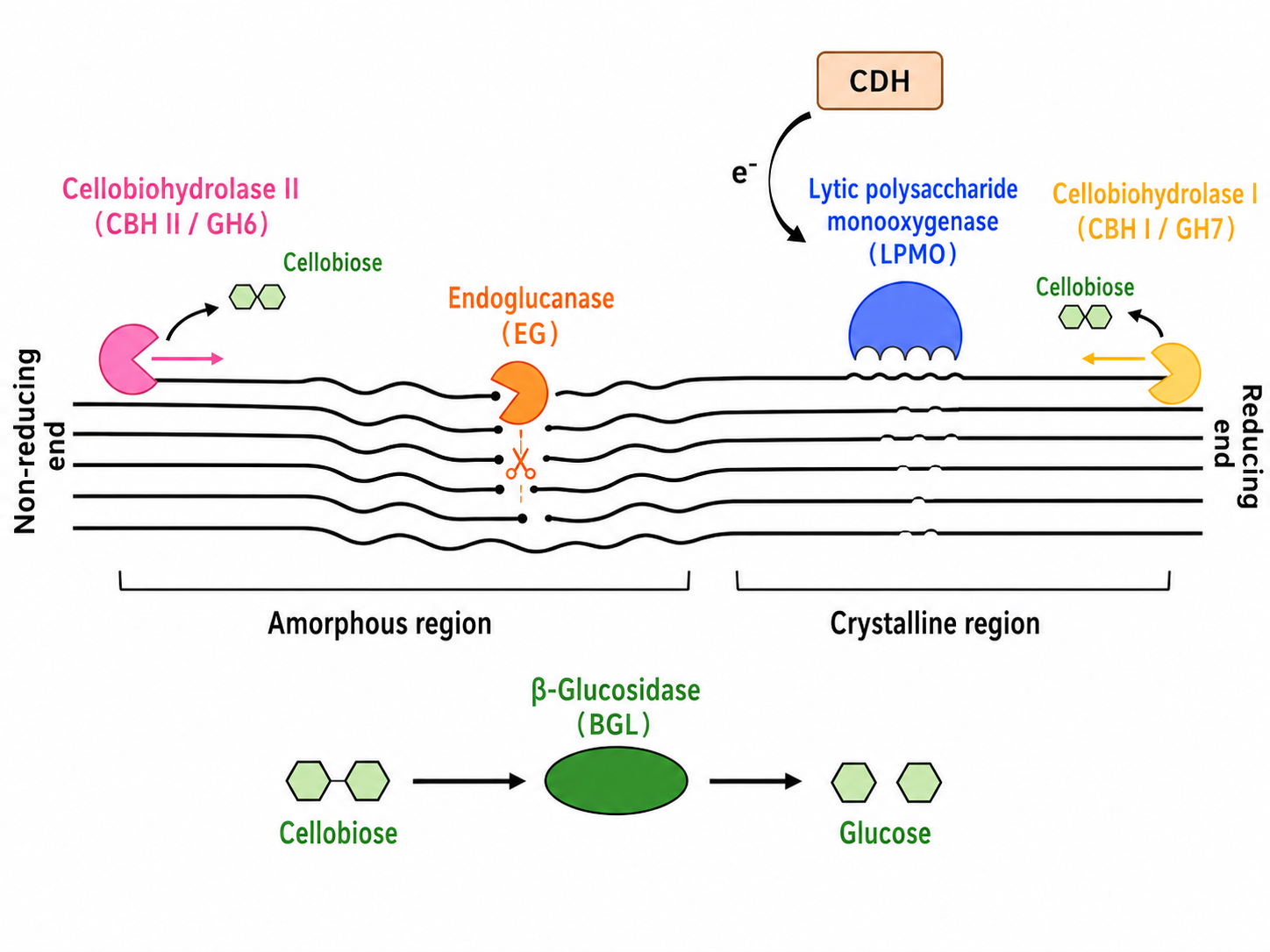
Figure 1. Cooperative action of core cellulolytic enzymes and LPMO in cellulose degradation
5.4 Functional Comparison of the Three Core Enzyme Types
Table 1 Functional Differences Among the Core Enzymes Involved in Cellulose Degradation
Comparison Item | Endoglucanase | Cellobiohydrolase | β-Glucosidase |
Main site of action | Internal regions of cellulose chains | Reducing or nonreducing ends of cellulose chains | Cellobiose and termini of soluble oligosaccharides |
Main substrates | Amorphous cellulose and soluble cellulose derivatives | Insoluble cellulose and microcrystalline cellulose | Cellobiose and short-chain cellooligosaccharides |
Main products | Oligosaccharides of different lengths and new chain ends | Cellobiose | Glucose |
Core function | Opens cellulose chains and increases the number of chain ends | Performs processive degradation from chain ends | Completes terminal saccharification and relieves cellobiose inhibition |
Common assay substrates | Carboxymethyl cellulose | Filter paper and microcrystalline cellulose | Cellobiose and pNPG |
Major limiting factors | Low accessibility of crystalline regions | Number of chain ends and cellobiose inhibition | Glucose inhibition and thermal stability |
6 Enzymatic Properties and Activity Regulation of β-Glucosidases
6.1 Optimal pH and Temperature
The optimal pH and temperature of β-glucosidases vary according to microbial source and protein structure. Many fungal enzymes exhibit high activity under mildly acidic conditions, whereas some bacterial and thermophilic microbial enzymes remain stable at neutral pH or elevated temperatures. Optimal reaction conditions are not equivalent to long-term stability conditions. The temperature that produces the highest short-term activity may exceed the temperature that the enzyme can tolerate during prolonged saccharification.
6.2 Substrate Affinity and Catalytic Efficiency
Enzyme kinetic studies commonly use parameters such as Km, Vmax, and kcat to evaluate substrate binding and catalytic performance of β-glucosidases. Under Michaelis–Menten conditions, Km is the substrate concentration at which the reaction rate reaches one-half of Vmax. A lower Km generally indicates that a lower substrate concentration is required to reach the half-maximal rate, but Km alone cannot determine catalytic efficiency without considering Vmax, kcat, and the assay conditions. Kinetic parameters obtained using artificial substrates do not directly represent catalytic performance toward cellobiose. When comparing enzymes, the substrate, pH, temperature, and reaction time should be standardized.
6.3 Glucose and Cellobiose Inhibition
Glucose may compete with the substrate for the active site or alter enzyme conformation through other binding regions. β-Glucosidases differ markedly in glucose tolerance, which is an important screening criterion for high-substrate-concentration saccharification systems. Excessively high cellobiose concentrations may also cause substrate inhibition. Some enzymes undergo transglycosylation at high sugar concentrations, resulting in a measured glucose amount lower than the actual extent of glycosidic-bond conversion.
6.4 Metal Ions and Chemical Environment
Ca²⁺, Mg²⁺, Mn²⁺, and other ions may improve the structural stability or activity of certain β-glucosidases, whereas Cu²⁺, Hg²⁺, and other ions may inhibit activity by binding to critical residues. The specific effects depend on the enzyme source and ion concentration. Organic solvents, surfactants, salt concentration, and fermentation metabolites can also affect enzyme activity. β-Glucosidases intended for industrial applications should therefore be evaluated under conditions resembling the actual substrate and product environment.
6.5 Enzyme Activity Regulation and Protein Engineering
Directed evolution, rational design, and domain engineering can be used to improve the thermal stability, glucose tolerance, or catalytic efficiency of β-glucosidases. Engineering sites commonly involve the substrate-binding pocket, flexible regions surrounding the active site, and subunit interfaces. Both initial activity and long-term stability should be evaluated. Simply increasing the hydrolysis rate of an artificial substrate does not necessarily improve glucose yield in actual lignocellulosic systems.
7 Applications of Cellulose-Degrading Enzymes in Biomass Conversion, Food Processing, and Fermentation Research
7.1 Lignocellulose Saccharification and Biofuels
After pretreatment, agricultural straw, forestry residues, and energy crops can be converted into fermentable sugars using complex cellulase preparations. The released glucose can subsequently be used for the production of ethanol, organic acids, bio-based chemicals, and microbial oils. Saccharification efficiency depends on pretreatment severity, substrate solids content, enzyme ratio, and product inhibition. Increasing the activity of a single cellulase cannot fully resolve the challenges of biomass conversion; both substrate structure and the multienzyme system must be optimized.
7.2 Food Processing
Cellulases can be used for plant tissue softening, fruit and vegetable juice extraction, coffee and tea processing, and dietary-fiber modification. Partial degradation of the cell wall can increase juice release and improve the extraction efficiency of soluble components. The extent of enzymatic hydrolysis must be carefully controlled in food systems because excessive degradation may damage tissue structure, cause abnormal viscosity, or reduce sensory quality.
7.3 Feed and Nutrition Research
Cellulases can reduce the degree of polymerization of certain structural polysaccharides in plant-based feeds and improve the release of intracellular nutrients. Their effects commonly depend on synergy with xylanases, pectinases, and other enzymes. Conditions in the animal gastrointestinal tract differ from standard in vitro enzyme assay conditions. Evaluation of feed enzymes should therefore consider gastrointestinal pH, protease tolerance, and the actual feed matrix.
7.4 Fermentation and Microbial Research
Cellulose can serve as the main carbon source for screening cellulase-producing microorganisms. Clear zones, reducing-sugar release, and enzyme activity can be measured to compare the cellulose-degrading capacity of different strains. The size of a clear zone reflects only local substrate degradation around a colony. Strain evaluation should also include enzyme activity in culture supernatants, protein secretion, glucose yield, and culture stability.
7.5 Soil Carbon Cycling and Organic Matter Decomposition
Plant residues, root tissues, and organic fertilizers in soil contain large amounts of cellulose. Bacteria, fungi, and other soil microorganisms can secrete endo-β-1,4-glucanases, exo-β-1,4-glucanases, and β-glucosidases to gradually convert cellulose into cellooligosaccharides, cellobiose, and glucose. These three enzyme types reflect the potential for internal cellulose-chain cleavage, chain-end degradation, and terminal hydrolysis of soluble products, respectively. They can be used to evaluate plant-residue decomposition, microbial carbon acquisition, and the effects of fertilization, tillage, and environmental treatments on soil carbon transformation.
7.6 Textiles, Papermaking, and Biorefining
Cellulases can be used for textile biopolishing, denim finishing, pulp modification, and wastepaper deinking. Controlled hydrolysis can remove microfibrils from fiber surfaces or improve interactions among fibers. These applications generally require careful control of fiber-strength loss. Enzyme type, reaction time, and mechanical shear should be jointly optimized to avoid excessive hydrolysis and deterioration of material properties.
8 Products Related to Cellulose-Degrading Enzymes, Activity Assays, and Substrates
Table 2 Core Cellulose-Degrading Enzymes and Auxiliary Enzymes for Complex Saccharification
Catalog # | Product Name | Grade & Purity | Research Stage | Main Application |
Cellobiohydrolase I (CBH I) | Bioactive, ActiBioPure™, native, high-performance, EnzymoPure™, from Trichoderma longibrachiatum; ≥3 U/mL; approximately 0.1 U/mg protein | Degradation from cellulose chain ends | Used to study processive hydrolysis by CBH I and cellobiose release | |
Cellulase | Native, EnzymoPure™, ≥4,500 CNU-R/g | Overall cellulose saccharification | Used for cellulose degradation, biomass saccharification, and complex-enzyme activity studies | |
Cellulase from Aspergillus sp. | Bioactive, ActiBioPure™, high-performance, EnzymoPure™, ≥1,000 U/g liquid | Fungal cellulase research | Used for saccharification with liquid enzyme preparations, cellulose degradation, and fermentation research | |
Cellulase from Trichoderma sp. | Powder, ≥5,000 units/g solid | Trichoderma cellulase research | Used for biomass degradation, cellulase-ratio optimization, and product-release studies | |
Cellulase from Trichoderma reesei | EnzymoPure™, ≥100,000 U/g powder | High-activity cellulose saccharification | Used for high-activity cellulose degradation, biomass saccharification, and optimization of enzyme dosage | |
Cellulase from Trichoderma reesei | Aqueous solution, ≥700 units/g | Liquid saccharification systems | Used for hydrolysis of cellulose substrates and studies of liquid complex-enzyme systems | |
Cellulase from Trichoderma reesei | Bioactive, ActiBioPure™, high-performance, EnzymoPure™, ≥700 EGU/g | Endoglucanase-related research | Used to evaluate internal cellulose-chain cleavage, reducing-sugar release, and lignocellulose saccharification | |
Cellulase from Trichoderma reesei ATCC 26921 | Lyophilized powder, ≥1 unit/mg solid | Research on enzymes from a standard strain | Used to compare enzyme sources, substrate types, and saccharification conditions | |
Cellulase from Aspergillus niger(Carrier for starch) | Bioactive, ActiBioPure™, high-performance, EnzymoPure™, ≥10,000 U/g enzyme powder | Food and fermentation research | Used for processing plant-derived materials, food applications, and fermentation saccharification | |
Cellulase, enzyme blend | Bioactive, ActiBioPure™, high-performance, EnzymoPure™, >1,000 BHU/g | Complex cellulase research | Used to evaluate the synergistic saccharification capacity of multicomponent cellulase preparations | |
Cellulase(Carrier for starch) | EnzymoPure™, from Trichoderma viride, ≥20,000 U/g, powder | Process-oriented cellulose degradation | Used for biomass processing, food applications, and saccharification of fermentation materials | |
β-Glucosidase | Bioactive, ActiBioPure™, native, high-performance, EnzymoPure™, ≥10 U/mg powder; 10-60 U/mg protein | Terminal hydrolysis of cellobiose | Used for conversion of cellobiose into glucose and studies of product inhibition and enzyme synergy | |
β-Glucosidase | Bioactive, ActiBioPure™, native, high-performance, EnzymoPure™, ≥4 U/mg powder | Hydrolysis of β-glucosidic bonds | Used for cellobiose hydrolysis and evaluation of substrate specificity and enzymatic properties | |
β-Glucosidase | Bioactive, recombinant, ActiBioPure™, high-performance, EnzymoPure™, ≥90% (SDS-PAGE), ≥5 U/mg enzyme powder; ≥25 U/mg protein | Recombinant-enzyme mechanism studies | Used for β-glucosidase kinetics, substrate-recognition studies, and glucose-generation assays | |
Hemicellulase | Bioactive, ActiBioPure™, high-performance, EnzymoPure™, from Aspergillus niger; ≥400 HCU/mg enzyme powder | Hemicellulose removal | Used to increase cellulose exposure and enzyme accessibility in lignocellulose | |
Hemicellulase from yeast | EnzymoPure™, ≥200 units/mg solid | Complex biomass saccharification | Used for hemicellulose degradation and studies of synergy with cellulases | |
Hemicellulase from Aspergillus niger | Bioactive, ActiBioPure™, high-performance, EnzymoPure™, ≥50 U/mg enzyme powder | Auxiliary lignocellulose degradation | Used to improve saccharification efficiency of plant-derived materials and biomass substrates |
Table 3 Cellulose-Degrading Enzyme Activity Assay Kits
Catalog # | Product Name | Grade & Purity | Research Stage | Main Application |
Endo-β-1,4-Glucanase Activity Assay Kit (Micro Method) | BioReagent | Endoglucanase activity assay | Used to evaluate internal cellulose-chain cleavage capacity in microscale samples | |
Endo-β-1,4-Glucanase Activity Assay Kit (Colorimetric Method) | BioReagent | Endoglucanase activity assay | Used for colorimetric measurement of endoglucanase activity in plant, microbial, or enzyme preparations | |
Exo-β-1,4-Glucanase Activity Assay Kit (Micro Method) | BioReagent | Exoglucanase activity assay | Used to evaluate degradation from cellulose chain ends in microscale samples | |
Exo-β-1,4-Glucanase Activity Assay Kit (Colorimetric Method) | BioReagent | Exoglucanase activity assay | Used to analyze exoglucanase activity, treatment conditions, and enzyme synergy | |
Cellulase (CL) Activity Assay Kit (DNS, Micro Method) | BioReagent | Complex cellulase activity assay | Used to measure reducing sugars generated by cellulose degradation in microscale samples using the DNS method | |
Cellulase (CL) Activity Assay Kit (DNS, Colorimetric Method) | BioReagent | Complex cellulase activity assay | Used to evaluate overall cellulase activity in enzyme solutions, fermentation broths, or biological samples | |
β-Glucosidase (β-GC) Activity Assay Kit (Micro Method) | BioReagent | β-Glucosidase activity assay | Used to measure β-glucosidase activity in microscale samples | |
β-Glucosidase (β-GC) Activity Assay Kit (Colorimetric Method) | BioReagent | β-Glucosidase activity assay | Used for colorimetric analysis of β-glucosidase activity in enzyme preparations, plant samples, or microbial samples | |
Soil Endo-β-1,4-Glucanase Activity Assay Kit (Micro Method) | BioReagent | Soil cellulose internal-cleavage research | Used to measure endoglucanase activity in microscale soil samples | |
Soil Endo-β-1,4-Glucanase Activity Assay Kit (Colorimetric Method) | BioReagent | Soil cellulose internal-cleavage research | Used to evaluate soil microbial endoglucanase activity and carbon-cycling status | |
Soil Exo-β-1,4-Glucanase Activity Assay Kit (Micro Method) | BioReagent | Degradation from cellulose chain ends in soil | Used to detect soil exoglucanase activity | |
Soil Exo-β-1,4-Glucanase Activity Assay Kit (Colorimetric Method) | BioReagent | Degradation from cellulose chain ends in soil | Used to evaluate the capacity of soil microorganisms to degrade cellulose chain ends | |
Soil β-Glucosidase (S-β-GC) Activity Assay Kit (Micro Method) | BioReagent | Terminal saccharification research in soil | Used to detect β-glucosidase activity in microscale soil samples | |
Soil β-Glucosidase (S-β-GC) Activity Assay Kit (Colorimetric Method) | BioReagent | Terminal saccharification research in soil | Used to evaluate soil cellobiose hydrolysis and enzyme activity associated with carbon cycling |
Table 4 Products Related to Cellobiose Substrates and Detection of Saccharification Products
Catalog # | Product Name | Grade & Purity | Research Stage | Main Application |
D-(+)-Cellobiose | ≥98% | Natural substrate for β-glucosidase | Used for β-glucosidase hydrolysis, enzyme kinetic studies, and product-inhibition research | |
D-(+)-Cellobiose | 10 mM in Water | Ready-to-use substrate system | Used for β-glucosidase reactions and enzyme activity assays | |
D-(+)-Cellobiose | Analytical standard | Cellobiose quantification | Used for chromatographic analysis, product quantification, and preparation of standard curves | |
Cellobiose Disks | Suitable for microbiology, sterile filter paper discs impregnated with cellobiose | Microbial fermentation identification | Used to evaluate microbial utilization and fermentation of cellobiose | |
Glucose Oxidase from Aspergillus niger | Bioactive, ActiBioPure™, high-performance, EnzymoPure™, lyophilized powder, ≥180 U/mg enzyme powder | Glucose-coupled detection | Used to establish glucose oxidase-coupled detection systems | |
Recombinant Glucose Oxidase (GOD) | Bioactive, recombinant, ActiBioPure™, high-performance, EnzymoPure™, ≥90% (SDS-PAGE), ≥150 U/mg enzyme powder; ≥300 U/mg protein | Recombinant coupled-detection systems | Used to establish glucose quantification methods and analyze enzymatic hydrolysis products | |
Glucose (Glu) Content Assay Kit (GOD-POD, Colorimetric Method) | BioReagent | Detection of the glucose end product | Used to quantify glucose generated by hydrolysis of cellulose or cellobiose | |
Glucose Colorimetric Detection Kit (GOD-POD Microplate Method) | BioReagent | High-throughput glucose detection | Used for batch measurement of glucose in saccharification solutions using microplate systems | |
Glucose Assay Kit (GOD-POD Microplate Method) | BioReagent, suitable for analysis, colorimetric method | High-throughput glucose detection | Used for glucose quantification during cellulase screening and optimization of saccharification conditions | |
Glucose Content Assay Kit (Folin-Wu, Micro Method) | BioReagent | Microscale glucose detection | Used to estimate glucose in compositionally simple microscale samples | |
Glucose Content Assay Kit (Folin-Wu, Colorimetric Method) | BioReagent | Colorimetric glucose detection | Used to estimate glucose in compositionally simple samples | |
Reducing Sugar Content Assay Kit (DNS, Micro Method) | BioReagent | Total reducing-sugar detection | Used to detect glucose, cellobiose, and other reducing oligosaccharides generated during cellulose degradation | |
Reducing Sugar Content Assay Kit (Fehling, Micro Method) | BioReagent | Microscale reducing-sugar detection | Used to measure reducing-sugar content in microscale saccharification samples | |
Reducing Sugar Content Assay Kit (Fehling, Colorimetric Method) | BioReagent | Colorimetric reducing-sugar detection | Used to evaluate total reducing sugars in enzymatic hydrolysates and fermentation broths | |
Reducing sugar content detection kit (Fehling titration method) | BioReagent | Titrimetric reducing-sugar detection | Used to quantify reducing sugars in relatively large sample batches or process-scale systems |


 危险品化学品经营许可证(带存储)