
Electron Transfer and Nucleophilic Reactions of Benzoquinones: Effects of the Conjugated Dicarbonyl Structure, Substituents, and Medium
Electron Transfer and Nucleophilic Reactions of Benzoquinones: Effects of the Conjugated Dicarbonyl Structure, Substituents, and Medium
1 The Quinoid Conjugated Dicarbonyl Structure Is the Structural Basis of Reactivity
1.1 From a Benzenoid Aromatic Structure to a Quinoid Conjugated Structure
The International Union of Pure and Applied Chemistry (IUPAC) defines quinones as compounds having a fully conjugated cyclic dione structure. Formally, they may be regarded as being derived from aromatic compounds by conversion of an even number of —CH= units into —C(=O)— units, accompanied by rearrangement of the double bonds.[1]
The two basic isomers of benzoquinone differ in the relative positions of their carbonyl groups:
Compound | Carbonyl positions | Product after two-electron, two-proton reduction |
1,2-Benzoquinone | Adjacent at the 1- and 2-positions | Catechol |
1,4-Benzoquinone | Opposite at the 1- and 4-positions | Hydroquinone |
Taking 1,4-benzoquinone as an example, the two C=O bonds and two C=C bonds in the six-membered ring are mutually conjugated. Unlike benzene, the carbon–carbon bonds within the ring no longer constitute a benzenoid aromatic six-π-electron system, but instead exhibit pronounced quinoid bond-order differentiation. Upon reduction to hydroquinone, the two carbonyl groups are converted into phenolic hydroxyl groups, and the π bonds within the ring reorganize to form a benzenoid aromatic structure.

1.2 Why Carbonyl Conjugation Enhances Electron-Accepting Ability
The C=O bond of a carbonyl group is strongly polarized and also possesses a π* antibonding orbital. When the carbonyl groups are conjugated with the C=C bonds in the ring, low-energy acceptor orbitals are distributed over the carbonyl groups and the adjacent carbon framework. Upon electron addition, the newly introduced electron density can be redistributed throughout the quinoid system rather than being localized on a single carbonyl group.
Gas-phase photoelectron spectroscopy directly measured the electron affinities of 1,2-benzoquinone and 1,4-benzoquinone to be approximately 1.90 and 1.85 electron volts (eV), respectively, demonstrating that both neutral benzoquinones can form energetically stable radical anions.[2]
Quantum-chemical studies of 1,2-benzoquinone, 1,4-benzoquinone, as well as naphthoquinones, phenanthrenequinones, and anthraquinones have further shown that the thermodynamics of quinone reduction are influenced by the relative positions of the carbonyl groups and by the structure of the overall conjugated framework.[3]
2 Stepwise Reduction States Form as Electrons Enter Benzoquinone
2.1 The First Electron Forms a Semiquinone Radical Anion
Let 1,4-benzoquinone be denoted as Q. In an aprotic medium lacking an effective proton donor, its reduction can be divided into two consecutive one-electron steps:[4]
First step:
Q + e⁻ ⇌ Q•⁻
Here, Q•⁻ is the semiquinone radical anion.
Second step:
Q•⁻ + e⁻ ⇌ Q²⁻
Q²⁻ is the dianionic state formed after acceptance of a second electron.
IUPAC defines a semiquinone as a radical anion that may formally be formed by the one-electron reduction of a quinone.[1] A semiquinone contains both a negative charge and an unpaired electron and represents an intermediate state with a distinct electronic structure during the one-electron reduction of benzoquinone.
After electron addition, the changes are not limited to “one oxygen atom gaining an electron.” The radical spin density, charge, and the bond orders of the C=O and C—C bonds are all redistributed. Continued addition of a second electron into the same conjugated system produces Q²⁻.
This gives rise to the following sequence of electronic states:
Q ⇌ Q•⁻ ⇌ Q²⁻
This stepwise relationship explains why benzoquinones can participate both in two-electron redox chemistry and in one-electron processes involving semiquinone intermediates.
2.2 Conversion of Benzoquinone to Hydroquinone Is the Overall Result of Electron and Proton Transfer
In systems capable of supplying protons, the overall reaction for complete reduction of 1,4-benzoquinone is:
Q + 2 e⁻ + 2 H⁺ ⇌ H₂Q
Here, H₂Q represents hydroquinone.
This equation expresses the net stoichiometric relationship and does not imply that the two electrons and two protons are transferred simultaneously through the same elementary reaction step.
In nominally aprotic nonaqueous solvents, 1,4-benzoquinone can exhibit two separate, approximately electrochemically reversible one-electron reduction processes, corresponding to the Q/Q•⁻ and Q•⁻/Q²⁻ redox couples, respectively.[4]
Redox state | Main electronic characteristics |
Q | Neutral quinoid conjugated dicarbonyl system |
Q•⁻ | Contains one additional electron and one unpaired electron |
Q²⁻ | Dianionic state after acceptance of two electrons |
H₂Q | Protonated two-electron reduction product, forming the aromatic hydroquinone structure |
Whether semiquinone can accumulate on an experimental timescale depends on the relative free energies and reaction rates of the first and second electron-transfer steps and the associated protonation processes.
The different reduction states formed as benzoquinone accepts electrons stepwise are also affected by charge-compensating ions. Wang et al. combined electrochemical experiments with density functional theory (DFT) calculations to compare the stabilization modes and charge distributions of different reduction states of 1,4-benzoquinone in the presence of tetrabutylammonium ions (TBA⁺), Li⁺, and H⁺.[6]
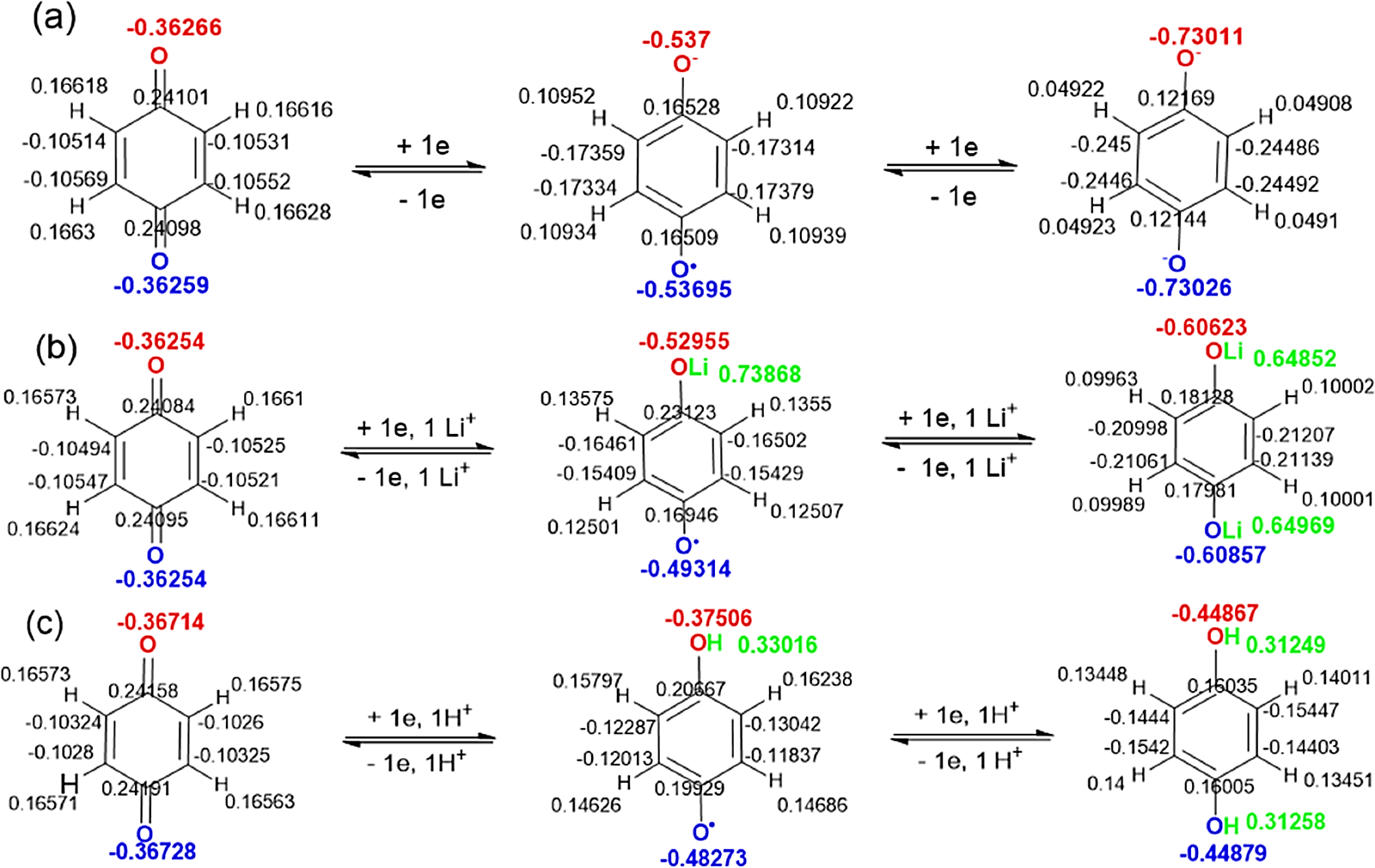
Figure 1. Redox states and calculated charge distributions of 1,4-benzoquinone under different charge-compensating ion conditions.
(a) TBAPF₆/acetonitrile; (b) LiClO₄/acetonitrile; (c) acetonitrile or aqueous systems involving H⁺. The calculations employed a polarizable continuum model corresponding to the respective solvent environment. The values shown in the figure are Mulliken atomic charges obtained from density functional theory calculations; red and blue denote the two oxygen atoms, respectively, while green denotes the ions involved in charge compensation. Adapted from Wang et al.[6]
In the TBAPF₆/acetonitrile system, 1,4-benzoquinone exhibits two distinct one-electron reduction processes, Q → Q•⁻ and Q•⁻ → Q²⁻. Li⁺ stabilizes the reduced states and markedly decreases the potential separation between the two reduction steps. When H⁺ is involved, the fully protonated two-electron reduction state, H₂Q, is more strongly stabilized, making stable accumulation of the semiquinone intermediate less favorable; experimentally, the process appears as an overall two-electron, two-proton redox process.[6]
3 Protons, Hydrogen Bonding, and Solvents Alter the Reduction Pathways of Benzoquinone
3.1 Proton Donors Preferentially Stabilize Reduced States
After benzoquinone accepts an electron, the negative charge of the oxygen-containing conjugated system increases. Compared with neutral Q, Q•⁻ and more deeply reduced species can generally interact more strongly with hydrogen-bond donors and may subsequently undergo proton transfer.
In their study of 1,4-benzoquinone in acetonitrile, Hooe et al. found that addition of the weak proton donor 2,2,2-trifluoroethanol led to the formation of hydrogen-bonded complexes between reduced benzoquinone species and the proton donor. Hydrogen bonding preferentially stabilizes the reduced species, thereby altering the potential of the second electron-transfer step.[4]
At an appropriate proton-donor concentration, the potential of the second reduction can shift positively to a value higher than that of the first reduction. This phenomenon is known as potential inversion. When addition of the second electron becomes more favorable after the first electron has entered, stable accumulation of the semiquinone radical anion decreases, and cyclic voltammetry may show an overall two-electron reduction process.[4]
Therefore, the role of protons is not limited to protonating Q²⁻ after reduction is complete. Hydrogen bonding and subsequent proton transfer can alter the relative free energies of the different reduction states, thereby changing the sequence by which electrons enter benzoquinone and the intermediates that can be experimentally observed.
3.2 Proton-Coupled Electron Transfer Is Not Equivalent to a Single Concerted Transfer Step
When electron transfer and proton transfer are thermodynamically or kinetically coupled, the process is generally referred to as proton-coupled electron transfer (PCET).
PCET can proceed through several possible pathways, including:
· electron transfer followed by proton transfer;
· proton transfer followed by electron transfer;
· concerted transfer of an electron and a proton within the same elementary step.
The third case is referred to as concerted proton–electron transfer. The overall reaction equation, “Q + 2 e⁻ + 2 H⁺ → H₂Q,” alone cannot determine which microscopic mechanism is involved.
When Evans and René reinvestigated the reduction of the radical anion of 3,5-di-tert-butyl-1,2-benzoquinone, they found that changing experimental conditions, including the cation in the supporting electrolyte, could shift the observed behavior from what had previously been interpreted as concerted proton–electron transfer to a process showing clear stepwise characteristics.[5] This demonstrates that PCET mechanisms in quinone systems must be evaluated in the context of the specific solvent, electrolyte, proton donor, and kinetic data.
3.3 Counterions and Solvents Directly Affect Reduction Potentials
Reduced benzoquinone species carry relatively high negative charge, and stabilization by the solvent and charge-compensating ions therefore directly affects the free energy of reduction.
Wang et al. compared the electrochemical behavior of a series of substituted quinones in water and acetonitrile and separately examined differences arising when H⁺, Li⁺, or tetrabutylammonium ions participated in charge compensation. In the systems studied, the formal reduction potentials were generally higher when H⁺ participated in the redox cycle and lower in the tetrabutylammonium-ion system, with the Li⁺ system lying between the two. The authors related this trend to the different abilities of these cations to stabilize the fully reduced Q²⁻ state.[6]
The same study also found that the relationship between the electron-withdrawing ability of substituents and the reduction potential showed pronounced solvent dependence:
Condition | Observed structure–potential relationship |
Acetonitrile system | A relatively clear correlation exists between the electron-withdrawing ability of substituents and the reduction potential |
Aqueous system | The above correlation is markedly weakened and essentially disappears within the series investigated |
Density functional theory calculations explicitly incorporating water molecules indicated that interactions between surrounding water molecules and the quinones and their reduced states can compensate for part of the electronic effects introduced by substituents.[6]
The reduction potentials of the same benzoquinone derivative cannot be compared independently of the solvent, electrolyte, pH, and reference-electrode conditions. Substituents determine the intrinsic electronic structure of the molecule, while the solvent and ionic environment further alter the relative stabilities of the different redox states.
4 The Conjugated Dicarbonyl Structure Also Generates Electrophilic Reactivity
4.1 Acceptance of a Single Electron and Acceptance of an Electron Pair from a Nucleophile Are Distinct Processes
When benzoquinone accepts one electron, the electron enters an acceptor orbital of the molecule to form Q•⁻:
Q + e⁻ → Q•⁻
Nucleophilic addition involves a different electronic process. The nucleophile donates an electron pair to form a new σ bond at a carbon atom of the quinone ring.
In 1,4-benzoquinone, the C=O bonds are conjugated with the C=C bonds. The electron-withdrawing effect of the carbonyl groups lowers the electron density at the carbon atoms of the conjugated alkene moieties, rendering these positions electrophilic. Nucleophiles such as thiolates can attack the quinone ring, accompanied by redistribution of the π bonds.
The two types of reaction share a common structural origin but lead to different outcomes:
Reaction type | Electronic change | Direct outcome |
Single-electron transfer | One electron enters an acceptor orbital of the quinone | Formation of a semiquinone radical anion |
Nucleophilic addition | The nucleophile donates an electron pair to form a σ bond | Formation of a new C—Nu covalent bond on the quinone ring |
“Strong electron-accepting ability” and “rapid nucleophilic addition” cannot be regarded as identical properties. The former involves redox thermodynamics and electron-transfer kinetics, whereas the latter is additionally influenced by the nature of the nucleophile, reaction site, steric effects, leaving groups, and solvent conditions.
4.2 Thiols Undergo Reductive Conjugate Addition to 1,4-Benzoquinone
The reaction of glutathione (GSH) with 1,4-benzoquinone provides a clear experimental example. Using absorption spectroscopy and subsequent oxidation experiments, Brunmark and Cadenas showed that GSH undergoes nucleophilic addition to 1,4-benzoquinone, producing a glutathione-substituted hydroquinone product.[7]
The overall reaction can be represented as:
1,4-Benzoquinone + RSH → SR-substituted hydroquinone
Here, RSH represents a thiol.
This process is generally classified as a Michael-type conjugate addition. The sulfur nucleophilic center attacks an electrophilic carbon of the quinone ring to form a new C—S bond, while the quinoid π system undergoes rearrangement and proton transfer, ultimately producing a hydroquinone-type product.
This reaction demonstrates that the electrophilicity of benzoquinone arises from the influence of the conjugated carbonyl groups on the electron distribution within the quinone ring.
4.3 Halogen Substitution Can Alter Nucleophilic Reaction Pathways
In addition to changing the electron density of the quinone ring, substituents can introduce new leaving groups and thereby alter the mechanism of nucleophilic reactions.
Mbiya et al. systematically compared the reactions of 1,4-benzoquinone and its methyl-, tert-butyl-, and chloro-substituted derivatives with sulfur-containing nucleophiles. Kinetic experiments showed that the chloro-substituted derivatives generally exhibited higher reactivity, whereas methyl- and tert-butyl-substituted derivatives showed lower reactivity. Mass spectrometric and nuclear magnetic resonance results supported Michael-type addition as the principal bond-forming pathway in the nonhalogenated systems. For chloro-substituted benzoquinones, in addition to addition reactions, nucleophilic vinylic substitution accompanied by chloride departure was also observed.[8]
The effects of substituents on the nucleophilic reactions of benzoquinones involve two distinct factors:
1. Electronic effect: changes the electrophilicity of the quinone ring and the energetics of nucleophilic attack;
2. Leaving-group effect: substituents capable of leaving can provide product-forming pathways different from ordinary conjugate addition.
This is also why halogenated and alkyl-substituted benzoquinones cannot be ranked simply according to their “relative electrophilicity.”
5 Substituents and the Surrounding Medium Jointly Determine the Observable Reduction States
In 2026, Somani and Sander used low-temperature matrix-isolation experiments to compare the one-electron and two-electron reduction of 1,4-benzoquinone and tetrafluoro-1,4-benzoquinone. The experiments were performed in argon matrices and amorphous water ice at 3–9 K, using sodium atoms as the electron source, and different reduction states were identified by matrix-isolation infrared spectroscopy and UV–visible absorption spectroscopy.[9]
The major species observed differed under different conditions:
Molecule and matrix | Experimental observation |
1,4-Benzoquinone/argon matrix | Formation of the 1,4-benzoquinone radical anion |
Tetrafluoro-1,4-benzoquinone/argon matrix | Formation of the corresponding radical anion |
1,4-Benzoquinone/amorphous water ice | Both the radical anion and dianion were detected |
Tetrafluoro-1,4-benzoquinone/amorphous water ice | Preferential formation of the two-electron-reduced dianion |
Upon irradiation at 430 nm, the 1,4-benzoquinone radical anion undergoes photoionization and regenerates neutral benzoquinone, whereas the tetrafluoro-1,4-benzoquinone radical anion exhibits different photostability under the same conditions. In amorphous water ice, reversible photochemical interconversion was also observed among the neutral, radical-anion, and dianionic states of 1,4-benzoquinone.[9]
Replacement of the four hydrogen atoms by fluorine leaves the basic quinoid framework unchanged, but the electron-withdrawing substituents alter the relative stabilities of the different reduction states. Changing the matrix from inert argon to strongly polar, hydrogen-bonding amorphous water ice further alters the distribution of the reduction products.
These data are specific to matrix-isolation conditions at 3–9 K and cannot be directly used to infer equilibrium compositions or reaction rates in aqueous solution at ambient temperature.
These results share the same physical basis as the solvent, proton-donor, and counterion effects observed in solution electrochemistry: different environments stabilize the neutral, semiquinone, and more deeply reduced states to different extents, thereby altering the free-energy differences among these states.[4,6,9]
6 Relationship Between Benzoquinone Structure and Reactivity
The conjugated dicarbonyl structure of benzoquinone gives rise to two related but mechanistically distinct modes of electronic reactivity.
Electron-transfer pathway:
Conjugated dicarbonyl structure
→ formation of low-energy electron-accepting states
→ Q accepts one electron to form Q•⁻
→ in an aprotic medium, it can continue to accept another electron to form Q²⁻
→ in the presence of proton donors, electron transfer can be coupled with proton transfer, ultimately forming hydroquinone-type reduction products.
Nucleophilic reaction pathway:
Conjugation of the carbonyl groups with C=C bonds
→ the alkene carbon atoms of the quinone ring become electrophilic
→ nucleophiles such as thiols form new C—Nu bonds
→ π-bond rearrangement and proton transfer
→ formation of addition products; substituted benzoquinones containing suitable leaving groups can also undergo nucleophilic substitution.
The structural and environmental factors affecting the two pathways are not completely identical:
Factor | Effect on electron transfer | Effect on nucleophilic reactions |
Relative positions of the carbonyl groups | Alter the mode of conjugation and the thermodynamics of reduction | Alter the electron distribution at electrophilic sites |
Electron-withdrawing/electron-donating substituents | Alter the relative stabilities of the different reduction states | Alter the electrophilicity of the quinone ring |
H⁺ and hydrogen-bond donors | Stabilize reduced states and alter electron-transfer steps | Can participate in proton transfer following addition |
Solvents and counterions | Alter solvation and charge stabilization | Alter nucleophile speciation and reaction kinetics |
Leaving groups such as halogens | Alter the electronic structure | Can introduce nucleophilic vinylic substitution pathways |
The quinoid framework provides electron-accepting orbitals and electrophilic sites; substituents alter the intrinsic electronic structure of the quinone ring; and protons, hydrogen bonding, solvents, and counterions alter the stability of different electronic states and reaction intermediates.
Electron transfer and nucleophilic addition therefore constitute two clearly distinguishable reaction pathways. The former changes the redox state of the molecule, whereas the latter directly changes its covalent connectivity.
7 Representative Chemicals for Studies of Electron Transfer, Substituent Effects, and Nucleophilic Reactions in Benzoquinone Conjugated Dicarbonyl Systems
Table 1. Structure–Reactivity Models of the Benzoquinone Parent Compound and Substituted Quinones
Category | CAS No. | Aladdin Cat. No. | Name | Specification or Purity | Product Features and Applications |
1,4-Benzoquinone parent compound | 106-51-4 | p-Benzoquinone | Moligand™, ≥99% | Benchmark conjugated 1,4-dicarbonyl model; used to study sequential electron transfer from quinone → semiquinone radical anion → dianion, reduction potentials, and sulfur-nucleophile conjugate addition | |
Sterically hindered 1,2-benzoquinone | 3383-21-9 | 3,5-Di-tert-butyl-1,2-benzoquinone | ≥98% (HPLC) | tert-Butyl-stabilized o-quinone model; used to study the electronic structure of vicinal dicarbonyl systems, semiquinone radicals, electrochemical reduction, hydrogen bonding, and proton-coupled electron transfer | |
2,5-Dichloro-substituted 1,4-benzoquinone | 615-93-0 | 2,5-Dichloro-1,4-benzoquinone | ≥98% (HPLC) | Electron-deficient quinone bearing chlorine substituents at the 2- and 5-positions; used to study the inductive effects of chlorine substitution and the influence of substitution position on reduction behavior and sulfur-nucleophile reaction sites | |
2,6-Dichloro-substituted 1,4-benzoquinone | 697-91-6 | 2,6-Dichloro-1,4-benzoquinone | ≥98% | Electron-deficient quinone bearing chlorine substituents at the 2- and 6-positions; can be compared with the 2,5-dichloro isomer to investigate the effects of chlorine substitution position on electron-accepting ability, reduction potential, and nucleophilic reaction selectivity | |
Perchlorinated 1,4-benzoquinone | 118-75-2 | Tetrachloro-1,4-benzoquinone | Suitable for synthesis | Strongly electron-deficient quinone in which all four ring hydrogens are replaced by chlorine; used to study electron acceptance, redox behavior, and nucleophilic vinylic substitution reactions of halogenated quinones | |
Perfluorinated 1,4-benzoquinone | 527-21-9 | Tetrafluoro-1,4-benzoquinone | ≥98% (HPLC) | Perfluorinated electron acceptor with relatively high electron affinity; used to study halogen electronic effects, electron-accepting ability, and reduction thermodynamics | |
Strong electron-accepting dichloro-dicyano quinone | 84-58-2 | 2,3-Dichloro-5,6-dicyano-p-benzoquinone (DDQ) | ≥98% | Chlorine and cyano substituents jointly lower the electronic energy levels of the quinone ring; used to study strong electron acceptors, electron transfer, redox reactions, and oxidative dehydrogenation | |
Monomethyl 1,4-benzoquinone | 553-97-9 | Methylbenzoquinone (MBQ) | ≥98% | Monomethyl electron-donating substitution model; used to compare the effects of methyl substitution on quinone-ring electrophilicity, reduction potential, thiol addition rate, and addition position | |
2,6-Dimethyl-1,4-benzoquinone | 527-61-7 | 2,6-Dimethyl-p-benzoquinone | ≥98% | Contains two methyl groups at the 2- and 6-positions; used to compare the effects of substitution number and position on electron-accepting ability, steric environment, and nucleophilic reaction sites | |
Permethylated 1,4-benzoquinone | 527-17-3 | Tetramethyl-1,4-benzoquinone | ≥98% (GC) | Methyl groups occupy the 2-, 3-, 5-, and 6-positions; used to study quinone/hydroquinone redox chemistry, reduction potentials, and accessibility to nucleophilic reactions under highly alkyl-substituted conditions | |
Sterically hindered mono-tert-butyl 1,4-benzoquinone | 3602-55-9 | tert-Butyl-p-benzoquinone | ≥98% (GC) | A single tert-butyl group introduces both an alkyl electronic effect and local steric hindrance; used to study thiol reaction kinetics, substituent effects, and nucleophilic addition sites | |
Sterically hindered 2,6-di-tert-butyl-1,4-benzoquinone | 719-22-2 | 2,6-Di-tert-butyl-1,4-benzoquinone | ≥98% | Two tert-butyl groups at the 2- and 6-positions create pronounced steric shielding and an electron-donating substitution effect; used to study the effects of substituents on reduction potentials, semiquinone stability, and the approach of nucleophiles to the quinone ring |
Table 2. Reference Compounds for Quinone Reduction States and Models for Sulfur-Nucleophile Reactions
Category | CAS No. | Aladdin Cat. No. | Name | Specification or Purity | Product Features and Applications |
Reduced counterpart of 1,4-benzoquinone | 123-31-9 | Hydroquinone | Suitable for synthesis | Two-electron, two-proton reduction counterpart of p-benzoquinone; used to study quinone/hydroquinone redox couples, electron–proton coupling, and redox cycling | |
Reduced counterpart of 1,2-benzoquinone | 120-80-9 | Catechol | Suitable for synthesis | Reduced structural counterpart of 1,2-benzoquinone; used to study o-quinone/catechol redox systems and differences between 1,2- and 1,4-carbonyl arrangements | |
Reduced counterpart of methylbenzoquinone | 95-71-6 | Methylhydroquinone | ≥99% | Reduced-state model of methyl-substituted 1,4-benzoquinone; can be paired with methylbenzoquinone to study quinone/hydroquinone redox relationships under methyl-substituted conditions | |
Reduced counterpart of tetramethylbenzoquinone | 527-18-4 | Tetramethylhydroquinone | ≥95% (GC) | Reduced counterpart of tetramethyl-1,4-benzoquinone; used to study highly alkyl-substituted quinone/hydroquinone redox couples and proton and electron transfer | |
Reduced counterpart of tetrachlorobenzoquinone | 87-87-6 | Tetrachlorohydroquinone | Moligand™, 10 mM in DMSO | Reduced counterpart of tetrachloro-1,4-benzoquinone; used to study perchlorinated quinone/hydroquinone redox cycling, reduced-state stability, and halogen substitution effects | |
Aromatic thiol kinetic probe | 1849-36-1 | 4-Nitrobenzenethiol | ≥95% | Aromatic thiol with a well-defined thiol reaction site; used to study the kinetics of nucleophilic reactions, adduct formation, and substituent effects of benzoquinone and its methyl-, tert-butyl-, and chloro-substituted derivatives | |
Thiol-containing amino acid nucleophile | 52-90-4 | L-Cysteine | Animal origin-free, Moligand™, for cell culture, ≥98% | Biologically relevant sulfur nucleophile; used to study initial quinone–cysteine addition, covalent modification, and subsequent transformations of the resulting adducts | |
Tripeptide biological thiol | 70-18-8 | Glutathione (reduced) | PharmPure™, European Pharmacopoeia (Ph. Eur.) | One of the major intracellular low-molecular-weight thiols; used to study sulfur-nucleophile addition to 1,4-benzoquinone, successive glutathione substitution, and quinone redox cycling | |
Acetylated cysteine nucleophile | 616-91-1 | N-Acetyl-L-cysteine (NAC) | PharmPure™, USP, Moligand™, European Pharmacopoeia (Ph. Eur.), ≥98.5% | Thiol-containing nucleophilic reaction model; used to study quinone electrophilicity, covalent addition by sulfur nucleophiles, and subsequent redox behavior of quinone–thiol adducts |
Table 3. Reagents for Studies of Electrochemistry, Charge Compensation, and Hydrogen-Bonding Environments
Category | CAS No. | Aladdin Cat. No. | Name | Specification or Purity | Product Features and Applications |
Supporting electrolyte with a weakly coordinating cation | 3109-63-5 | Tetrabutylammonium hexafluorophosphate (TBAHFP) | Electrochemical grade, ≥99% | Benchmark supporting electrolyte for nonaqueous quinone electrochemistry; used to observe the two-step one-electron reductions of quinone/semiquinone and semiquinone/dianion and as a control for systems involving lithium ions and protons | |
Lithium-ion-coordinating supporting electrolyte | 7791-03-9 | L110164 | Lithium perchlorate (explosive precursor) | Anhydrous grade, PrimorTrace™, ≥99.99% metals basis | Provides a lithium-ion charge-compensation environment; used to study stabilization of semiquinone and dianionic reduction states by lithium ions, ion coordination, and changes in reduction potential |
Hydrogen-bonding and proton-donor modulator | 75-89-8 | 2,2,2-Trifluoroethanol (TFEA) | Molecular biology grade, ≥99.8% | Alcohol-based hydrogen-bond and proton donor; used to study hydrogen-bond stabilization of quinone radical anions, shifts in reduction potential, and changes in electron–proton transfer pathways caused by concentration variation |
Note: The products listed above are representative Aladdin products relevant to scientific research. Specific applications should be determined according to the product specifications, lot-specific COA, and the intended reaction or evaluation system. Additional information on product specifications, grades, and COAs can be retrieved from the Aladdin website using the “product name/CAS/Cat. No.”
References
[1] International Union of Pure and Applied Chemistry. Quinones; Semiquinones. IUPAC Compendium of Chemical Terminology (the Gold Book), 5th ed. International Union of Pure and Applied Chemistry, 2025. Online version 5.0.0, 2025. DOI: 10.1351/goldbook.Q05015; 10.1351/goldbook.S05600.
[2] Fu Q, Yang J, Wang X B. On the electronic structures and electron affinities of the m-benzoquinone (BQ) diradical and the o-, p-BQ molecules: A synergetic photoelectron spectroscopic and theoretical study. The Journal of Physical Chemistry A, 2011, 115(15): 3201–3207. DOI: 10.1021/jp1120542.
[3] Johnsson Wass J R T, Ahlberg E, Panas I, Schiffrin D J. Quantum chemical modeling of the reduction of quinones. The Journal of Physical Chemistry A, 2006, 110(5): 2005–2020. DOI: 10.1021/jp055414z.
[4] Hooe S L, Cook E N, Reid A G, Machan C W. Non-covalent assembly of proton donors and p-benzoquinone anions for co-electrocatalytic reduction of dioxygen. Chemical Science, 2021, 12(28): 9733–9741. DOI: 10.1039/D1SC01271A.
[5] Evans D H, René A. Reinvestigation of a former concerted proton-electron transfer (CPET), the reduction of a hydrogen-bonded complex between a proton donor and the anion radical of 3,5-di-tert-butyl-1,2-benzoquinone. Physical Chemistry Chemical Physics, 2012, 14(14): 4844–4848. DOI: 10.1039/C2CP00021K.
[6] Wang H, Emanuelsson R, Banerjee A, Ahuja R, Strømme M, Sjödin M. Effect of cycling ion and solvent on the redox chemistry of substituted quinones and solvent-induced breakdown of the correlation between redox potential and electron-withdrawing power of substituents. The Journal of Physical Chemistry C, 2020, 124(25): 13609–13617. DOI: 10.1021/acs.jpcc.0c03632.
[7] Brunmark A, Cadenas E. Reductive addition of glutathione to p-benzoquinone, 2-hydroxy-p-benzoquinone, and p-benzoquinone epoxides. Effect of the hydroxy- and glutathionyl substituents on p-benzohydroquinone autoxidation. Chemico-Biological Interactions, 1988, 68(3–4): 273–298. DOI: 10.1016/0009-2797(88)90021-X.
[8] Mbiya W, Chipinda I, Siegel P D, Mhike M, Simoyi R H. Substituent effects on the reactivity of benzoquinone derivatives with thiols. Chemical Research in Toxicology, 2013, 26(1): 112–123. DOI: 10.1021/tx300417z.
[9] Somani A, Sander W. Substituent and matrix effects in electron-induced one- and two-electron reduction of quinones. The Journal of Physical Chemistry A, 2026, 130(23): 4342–4348. DOI: 10.1021/acs.jpca.6c01210.
For more related articles, see below:
Extraction, isolation and characterization of anthraquinones in Rheum palmatum (Rheum palmatum)
Tetramethyl-1,4-benzoquinone(DQ)
Extraction and isolation of free hydroxyanthraquinone components from Cynodon dactyliflorus
Chloranil, Tetrachloro-1,4-benzoquinone
Tetramethyl-1,4-benzoquinone(DQ)


 危险品化学品经营许可证(带存储)