
Fundamentals of the Reactivity of 9,10-Phenanthrenequinone and Its Derivatives: Vicinal Dicarbonyl Electronic Structure, Electron Transfer, and Photochemical Reactions
Fundamentals of the Reactivity of 9,10-Phenanthrenequinone and Its Derivatives: Vicinal Dicarbonyl Electronic Structure, Electron Transfer, and Photochemical Reactions
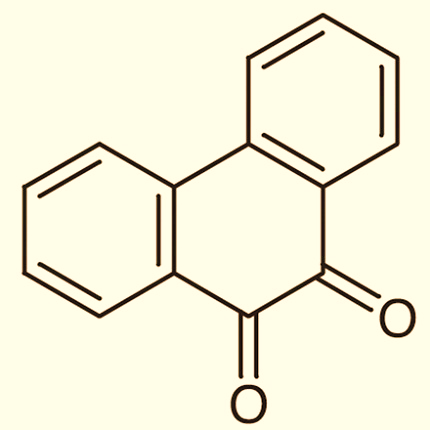
9,10-Phenanthrenequinone (PQ) is formed by converting the 9- and 10-positions of phenanthrene into two adjacent carbonyl groups and is a typical fused-ring dicarbonyl system of the ortho-quinone type. The two C=O groups are directly adjacent and connected to the peripheral aromatic π system, giving PQ both ground-state electron-accepting ability and pronounced excited-state photochemical reactivity. Ground-state reduction can generate a semiquinone radical anion and further reduced states, whereas photoexcitation can populate singlet and triplet states and enable efficient photoinduced cycloaddition with electron-rich alkenes.[1–3]
Both types of reactions are associated with the 9,10-vicinal dicarbonyl unit, but they are governed by different factors. Ground-state electron transfer depends primarily on electron-accepting ability and the stability of different oxidation states, whereas photochemical reactions are additionally controlled by the ordering of excited-state energy levels, intersystem crossing efficiency, triplet-state character, and triplet-state lifetime. Recent studies have further demonstrated that substituents, solvents, and even steric effects can alter these excited-state parameters, thereby markedly modulating the rate and pathway of phenanthrenequinone photoreactions.[3–6]
1 The 9,10-Vicinal Dicarbonyl Unit Establishes the Electron-Accepting Framework of Phenanthrenequinone
1.1 Two adjacent carbonyl groups jointly participate in electron acceptance
The central region of 9,10-phenanthrenequinone consists of two adjacent carbonyl carbons, and the two C=O groups form a continuous π-electron system with the peripheral fused aromatic framework. The carbonyl groups provide low-energy acceptor orbitals. Electron uptake alters the bond orders of both C—O bonds and the C—C bond between positions 9 and 10; thus, the reduction process involves electronic redistribution throughout the vicinal dicarbonyl region.
In dichloromethane containing 0.1 mol·L⁻¹ tetrabutylammonium hexafluorophosphate, Tao et al. measured the first and second reduction potentials of uncomplexed 9,10-phenanthrenequinone to be approximately −1.13 V and −1.80 V, respectively, versus ferrocene/ferrocenium (Fc/Fc⁺). Under the same experimental conditions, the corresponding potentials of 9,10-anthraquinone were approximately −1.49 V and −2.0 V.[1] These data show that even though both compounds are tricyclic fused-ring quinones, changes in carbonyl arrangement and fused-ring connectivity can lead to pronounced differences in reduction thermodynamics.
The first one-electron reduction of 9,10-phenanthrenequinone can be represented as:
PQ + e⁻ ⇌ PQ•⁻
Here, PQ•⁻ is the 9,10-phenanthrenequinone semiquinone radical anion. Further electron uptake produces the dianionic state:
PQ•⁻ + e⁻ ⇌ PQ²⁻
The semiquinone lies between the neutral quinone and the fully reduced state and possesses both a negative charge and an unpaired electron, making it a distinct electronic state in phenanthrenequinone electron-transfer processes.[1]
1.2 One- and two-electron reduction alter the bond orders of C—O and C9—C10
Tao et al. used the strong Lewis acid tris(pentafluorophenyl)borane to stabilize the phenanthrenequinone semiquinone and obtained the structures of the 9,10-phenanthrenequinone semiquinone radical anion and its further-reduced dianion by single-crystal X-ray diffraction.[1]
In this Lewis-acid-stabilized system:
Structural parameter | Semiquinone radical anion | Dianion |
C—O bond 1 | 1.308 Å | 1.366 Å |
C—O bond 2 | 1.295 Å | 1.357 Å |
C9—C10 bond | 1.458 Å | 1.370 Å |
After uptake of the second electron, the C—O bonds are further elongated, whereas the C9—C10 bond between the two original carbonyl carbons becomes markedly shorter. This change reflects bond-order redistribution following electron population of the carbonyl π* acceptor system during reduction: the C=O double-bond character decreases, whereas the π-bonding character between C9 and C10 increases.[1]
The above data were obtained from a semiquinone/dianion system stabilized by tris(pentafluorophenyl)borane, and the specific bond lengths are influenced by the Lewis-acid coordination environment. The study also indicated that borane coordination perturbs the semiquinone core structure only to a relatively limited extent; its principal roles are to facilitate electron transfer and stabilize the resulting semiquinone radical anion.[1]
2 Photoexcitation Opens Reaction Pathways Distinct from Ground-State Reduction
2.1 Carbonyl n orbitals and the π system generate multiple low-energy excited states
The carbonyl oxygens of 9,10-phenanthrenequinone possess nonbonding n orbitals, while the molecule also contains conjugated π and π* orbitals. Accordingly, two important types of electronic excitation can occur upon light absorption:
① nπ*: an electron is promoted from a nonbonding n orbital on a carbonyl oxygen to a π* orbital;
② ππ*: an electron is promoted from a π-bonding orbital to a π* orbital.
In the commonly used excited-state model for unsubstituted PQ, excitation with ultraviolet to blue light first generates a higher-energy singlet ¹ππ* state, followed by internal conversion to a lower-energy singlet ¹nπ* state. Intersystem crossing (ISC) then occurs, producing energetically close triplet ³ππ* and ³nπ* states, of which the ³ππ* state is closely associated with the reactivity of PQ in photocycloaddition with electron-rich alkenes.[3]
Transient absorption experiments showed that triplet-state absorption signals from unsubstituted PQ appear within approximately 9 ps after excitation at 400 nm, with two triplet-state absorption features exhibiting ³nπ* and ³ππ* character, respectively.[3,4]
Thus, after photoexcitation, PQ no longer has the same electronic occupancy as ground-state PQ. The rate of a photochemical reaction depends not only on the ground-state structure, but also on how much of the excited population enters a reactive triplet state and how long that triplet state persists.
9,10-Phenanthrenequinone can form a reactive triplet state through intersystem crossing following direct photoexcitation. Alternatively, a triplet photosensitizer can populate the reactive triplet state of phenanthrenequinone through triplet–triplet energy transfer. Both pathways can subsequently drive the photocycloaddition of PQ with electron-rich alkenes.[5]
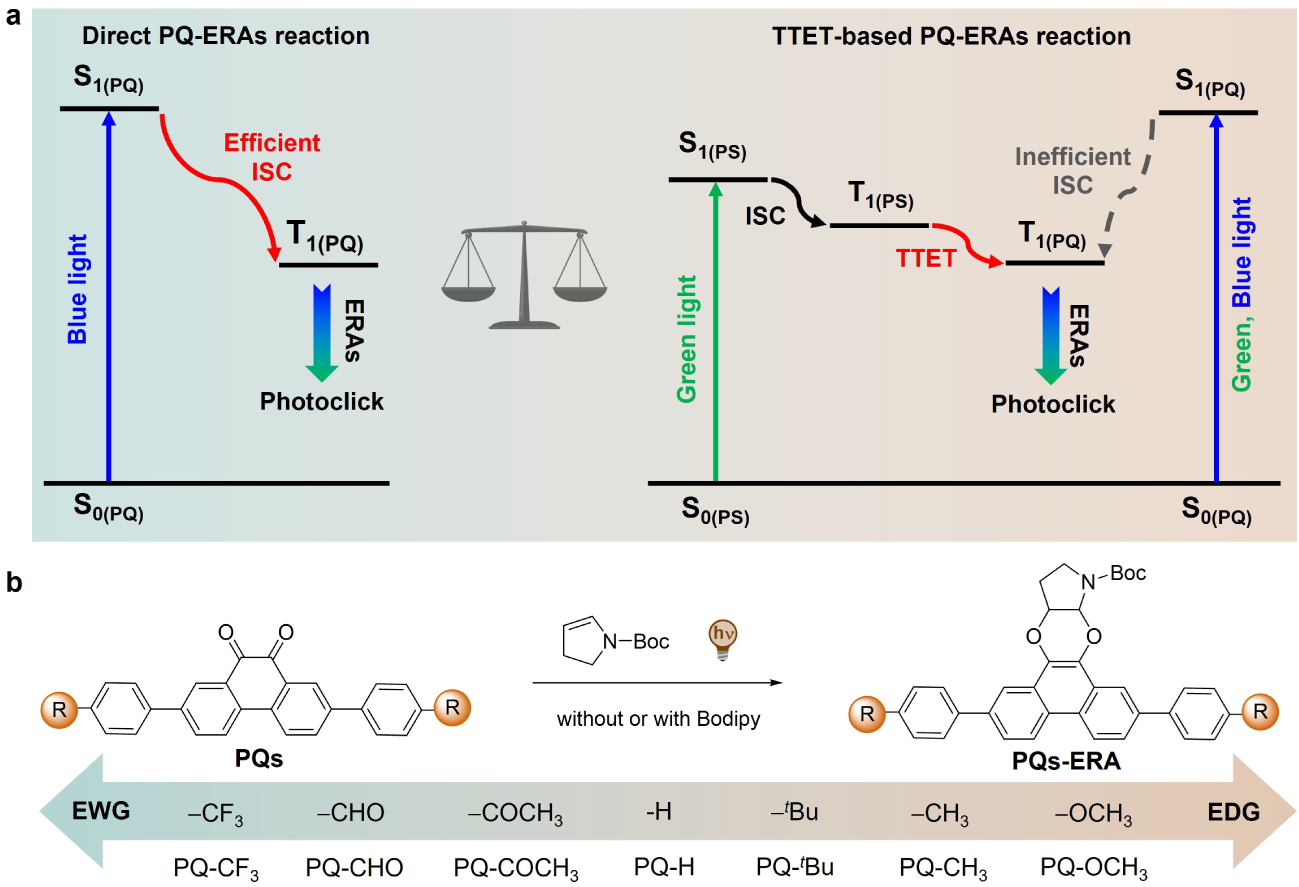
Direct excitation and triplet–triplet energy-transfer pathways in the 9,10-phenanthrenequinone–electron-rich alkene photoclick reaction. (a) Formation of the reactive triplet state of phenanthrenequinone through intersystem crossing (ISC) after direct photoexcitation, and the triplet–triplet energy-transfer (TTET) pathway mediated by a photosensitizer (PS); (b) phenanthrenequinone derivatives ranging from electron-withdrawing groups (EWGs) to electron-donating groups (EDGs), together with their photocycloaddition products formed with electron-rich alkenes. Adapted from Fu et al.[5], Scheme 1.
2.2 Triplet-state PQ undergoes photoinduced bond formation with electron-rich alkenes
In 2018, Li et al. reported that 9,10-phenanthrenequinone undergoes a photoinduced reaction with electron-rich alkenes (ERAs) under visible-light irradiation without an added catalyst, producing fluorescent [4+2] cycloaddition products. The reaction can be performed under biocompatible conditions.[2]
Subsequent mechanistic studies of the PQ–ERA system further resolved the key steps as follows:
PQ absorbs light
→ Formation of a singlet excited state
→ ISC forms reactive triplet-state PQ
→ Photoinduced electron transfer (PeT) with ERA
→ Formation of a 1,6-biradical intermediate
→ Intramolecular radical recombination
→ Formation of the [4+2] cycloaddition product.[3]
Here, “[4+2]” denotes the final bond connectivity. The original mechanistic studies support the involvement of photoinduced electron transfer and a 1,6-biradical intermediate; therefore, the process cannot be fully represented by a single concerted ground-state cycloaddition step.[3]
The vicinal dicarbonyl unit performs two sequential functions in this process. First, it establishes the electronic structure that enables light absorption and formation of nπ* and ππ* excited states. It then acts in the excited state as an electron-accepting and radical reaction center, undergoing electron transfer and bond formation with the electron-rich alkene.
3 Triplet-State Lifetime Is an Important Kinetic Parameter Affecting Phenanthrenequinone Photocycloaddition Efficiency
Formation of a triplet state does not necessarily mean that a reaction will occur. Triplet-state PQ must undergo an effective encounter and electron transfer with ERA before deactivation; therefore, the triplet-state lifetime is an important kinetic parameter affecting the efficiency of the PQ–ERA photoreaction.
3.1 DMSO markedly shortens the lifetime of the reactive triplet state
In 2024, Doze et al. used femtosecond-to-microsecond transient absorption spectroscopy to investigate the effects of different cosolvents on the excited states of PQ. Dimethyl sulfoxide (DMSO) had little effect on the rate of triplet-state formation through intersystem crossing: at different DMSO concentrations, the triplet state formed in approximately 9 ps. However, the lifetime of the triplet state changed dramatically after its formation.[4]
Volume fraction of DMSO in acetonitrile | PQ triplet-state lifetime |
0 | 3.8 μs |
0.05% | 126 ns |
0.10% | 79.5 ns |
0.50% | 20.9 ns |
1% | 10.9 ns |
2% | 5.9 ns |
5% | 2.2 ns |
Upon addition of 0.05% DMSO, the triplet-state lifetime decreased from 3.8 μs to 126 ns; at 5% DMSO, it was only approximately 2.2 ns. In the PQ–PY model system, 0.5% (v/v) DMSO reduced the reaction rate by approximately fivefold. As the DMSO concentration was increased further, the inhibitory effect became stronger, with 5% DMSO reducing the reaction rate by approximately 50-fold.[4]
These results connect the “solvent effect” to a specific excited-state process: DMSO primarily affects not whether the triplet state can form, but how long the triplet state survives after formation.
3.2 Extending the effective triplet-state lifetime increases the photoreaction quantum yield
In the absence of DMSO, the researchers reacted an optimized phenanthrenequinone derivative with 1 equivalent of ERA, achieving a photoreaction quantum yield of up to approximately 93% and complete conversion within seconds.[4]
The relationship between triplet-state lifetime and reaction efficiency can be represented as a set of competing processes:
³PQ* + ERA → photocycloaddition pathway
At the same time:
³PQ* → nonradiative deactivation / quenching by solvent, oxygen, etc.
As the proportion of ³PQ* entering the first pathway increases, the efficiency of photochemical conversion increases accordingly. In 2023, experiments using the PQ-3TP/PY model system also showed that molecular oxygen, acting as a triplet-state quencher, reduces the reaction rate, consistent with a mechanism involving the triplet state.[3]
4 Substituents Regulate Reaction Pathways by Altering Excited-State Energy Levels
The influence of substituents on the photoreactivity of phenanthrenequinone is not limited to their ground-state electron-withdrawing or electron-donating effects. Substituents can also reorder the relative energies of the ¹nπ*, ¹ππ*, and triplet states, thereby altering intersystem crossing efficiency and the actual photochemical reaction pathway.
4.1 Substituents can alter the relative efficiencies of direct excitation and energy-transfer pathways
In 2025, Fu et al. systematically investigated 2,2′-substituted phenanthrenequinone derivatives spanning electron-withdrawing to electron-donating substituents and compared two modes of photoreaction:
1. PQ directly absorbs light and enters a reactive triplet state;
2. A photosensitizer first absorbs light and then transfers energy to PQ through triplet–triplet energy transfer (TTET).[5]
Experiments showed that as the substituents changed from electron-withdrawing to electron-donating character, the reaction rate of the direct-excitation pathway gradually decreased, whereas the reaction rate of the TTET-mediated pathway gradually increased. Transient absorption spectroscopy and theoretical calculations linked this trend to changes in the energetic ordering of the ¹nπ* and ¹ππ* singlet excited states. Changes in solvent polarity can also modulate the direct photoreactivity of some phenanthrenequinone derivatives.[5]
This phenomenon indicates that substituent effects need to be analyzed along the complete excited-state pathway:
Electronic properties of the substituent
→ Changes in the relative energies of ¹nπ* and ¹ππ*
→ Changes in ISC efficiency
→ Changes in the population of reactive triplet states
→ Changes in the relative contributions of the direct photoreaction and TTET pathways.
Therefore, two phenanthrenequinone derivatives with similar absorption wavelengths can nevertheless exhibit markedly different photoreaction kinetics because of differences in excited-state energy-level ordering.
Both substituent electronic effects and solvent polarity can modulate the electronic character of the lowest singlet excited state of phenanthrenequinone. In the overall mechanism summarized in this study, electron-withdrawing substitution or a low-polarity environment favors ¹nπ* character in the lowest singlet excited state and promotes intersystem crossing and the direct photoreaction pathway. In contrast, electron-donating substitution or a high-polarity environment favors ¹ππ* character, reducing the efficiency of direct intersystem crossing and giving the photosensitizer-mediated triplet–triplet energy-transfer pathway a relative advantage.[5]
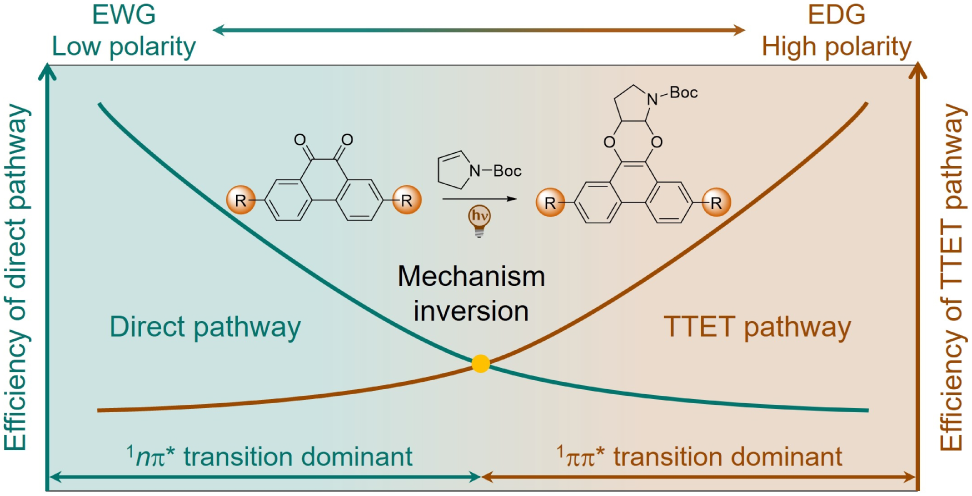
Electronic effects and solvent polarity regulate pathway switching in the PQ–ERA photoclick reaction. Electron-withdrawing groups and low-polarity environments favor the direct pathway dominated by ¹nπ* excitation; as the electron-donating ability of the substituent increases or the polarity of the medium rises, direct intersystem crossing becomes less efficient and the photosensitizer-mediated triplet–triplet energy-transfer pathway becomes relatively more favorable. Adapted from Fu et al.[5], Figure 7.
5 Steric Effects Can Alter Excited-State Properties Through Conformational Changes
A 2026 study further demonstrated that excited-state regulation does not necessarily depend on stronger electron-withdrawing or electron-donating groups. Conformational changes caused by steric effects of substituents can themselves alter the photoreactivity of phenanthrenequinone.
Fu et al. introduced ortho steric groups into aryl-substituted phenanthrenequinones. For example, in PQ-o2CH₃, 2,6-dimethyl substitution caused the attached aryl group to adopt a dihedral angle of approximately 69.5°. Computational and spectroscopic results showed that this conformational change made ¹nπ* the lowest singlet excited state, S₁, while the lowest triplet state, T₁, retained ³ππ* character; at the same time, the effective triplet-state lifetime was extended.[6]
This excited-state reorganization was directly reflected in the reaction kinetics. The steric-engineering strategy increased the rate of the direct PQ–ERA photoclick reaction by more than 21-fold, with the highest second-order reaction rate constant reaching:
k₂ = 11 300 M⁻¹·s⁻¹
Across the entire series of derivatives, the reaction rates spanned approximately two orders of magnitude.[6]
These results establish a more specific structure–reactivity relationship:
Steric bulk of the substituent
→ Aryl dihedral angle
→ Ordering of singlet excited-state energy levels
→ Triplet-state formation and lifetime
→ Rates of photoinduced electron transfer and cycloaddition.
Traditional substituent analysis focuses mainly on inductive and resonance effects. In phenanthrenequinone photochemistry, molecular conformation has emerged as an important variable alongside electronic effects.
6 Ground- and Excited-State Reactions of the 9,10-Vicinal Dicarbonyl Unit Are Controlled by Different Factors
Electron-transfer and photochemical reactions of 9,10-phenanthrenequinone are both founded on the electronic structure of the vicinal dicarbonyl unit, but the two classes of processes require consideration of different parameters.
Reaction level | Key process | Main controlling factors |
Ground-state single-electron reduction | PQ → PQ•⁻ | Reduction potential, substituent electronic effects, solvent, and Lewis-acid stabilization |
Further reduction | PQ•⁻ → PQ²⁻ | Second-electron affinity process, stabilization of ionic and oxygen-containing centers |
Light absorption | PQ → ¹PQ* | Absorption energy, nπ* and ππ* transitions |
Intersystem crossing | ¹PQ* → ³PQ* | Singlet/triplet energy levels and orbital character |
Triplet-state survival | ³PQ* | Solvent, DMSO, O₂, and other quenching factors |
PQ–ERA bond formation | ³PQ* + ERA | Triplet-state character and lifetime, electronic properties and concentration of ERA |
Derivative-level regulation | Substituted PQ | Electronic effects, substitution position, spatial conformation, and medium polarity |
After 9,10-phenanthrenequinone accepts electrons, the bond orders of C—O and C9—C10 within the vicinal dicarbonyl region are redistributed as the oxidation state changes. After photoexcitation, the same carbonyl region gives rise to nπ* and ππ* electronic states and forms triplet states of differing reactivity through intersystem crossing.[1,3]
Recent studies have further expanded the understanding of phenanthrenequinone reactivity from the ground-state relationship of “substituent-controlled electron density” to excited-state regulation. Transient spectroscopic studies in 2024 established the strong quenching effect of DMSO on triplet-state lifetime; a 2025 study demonstrated that substituents and solvent polarity can alter excited-state energy-level ordering and reaction pathways; and steric engineering reported in 2026 further used conformational changes to achieve a second-order rate constant of up to 11 300 M⁻¹·s⁻¹ for direct PQ–ERA photocycloaddition.[4–6]
For a new 9,10-phenanthrenequinone derivative, evaluation of ground-state reactivity requires consideration of electronic effects around the vicinal dicarbonyl unit and the stability of reduced states. For photochemical reactions, it is also necessary to examine the energy-level ordering of ¹nπ* and ¹ππ*, the efficiency of formation of the reactive ³ππ* state, the triplet-state lifetime, and the effects of solvents and quenchers. The characteristic reactivity of phenanthrenequinone is established by the vicinal dicarbonyl unit, whereas the actual reaction rate and pathway are jointly determined by the ground- and excited-state electronic structures.
7 Representative Chemicals Relevant to Studies of Vicinal Dicarbonyl Electron Transfer, Substituent Effects, and Photochemical Reactions of Phenanthrenequinones
Table 1. Phenanthrenequinone Core Scaffolds, Structural Controls, and Halogenated Functionalization Precursors
Category | CAS No. | Aladdin Cat. No. | Name | Specification or Purity | Product Features and Applications |
Carbonyl-free fused aromatic hydrocarbon control | 85-01-8 | Phenanthrene | Sublimation grade, ≥99.5% | Tricyclic fused aromatic hydrocarbon scaffold control; used to compare changes in electron-accepting ability, electronic structure, and photochemical reactivity before and after introduction of a vicinal dicarbonyl unit at the 9,10-positions. | |
Parent 9,10-vicinal dicarbonyl phenanthrenequinone | 84-11-7 | Phenanthrenequinone | ≥99% | Benchmark model of a conjugated 9,10-vicinal dicarbonyl acceptor; used in studies of single-electron reduction, semiquinone radical anions, excited-state energy levels, intersystem crossing, triplet-state reactivity, and photocycloaddition with electron-rich alkenes. | |
Non-vicinal fused quinone structural control | 84-65-1 | Anthraquinone | ≥98% | Fused aromatic quinone structural control; used to compare the effects of carbonyl arrangement and aromatic framework on single-electron reduction, semiquinone stability, and Lewis-acid-assisted electron transfer. | |
Monobrominated phenanthrenequinone functionalization precursor | 13292-05-2 | 3-Bromo-9,10-phenanthrenequinone | ≥97% | 3-Position monohalogenated phenanthrenequinone coupling precursor; used for site-specific introduction of aryl or heteroaryl groups to construct substituted phenanthrenequinones and investigate the effects of substitution position on conjugated structure, triplet-state population, and photocycloaddition reactivity. | |
2,7-Dibromophenanthrenequinone dual-site precursor | 84405-44-7 | 2,7-Dibromophenanthrene-9,10-dione | ≥97% | 2,7-Dihalogenated phenanthrenequinone functionalization precursor; used for dual-site coupling to construct symmetric substituted phenanthrenequinone series and investigate the regulation of excited-state energy levels and reaction pathways by substituent electronic effects. | |
3,6-Dibromophenanthrenequinone dual-site precursor | 53348-05-3 | 3,6-Dibromophenanthrene-9,10-dione | ≥97% (HPLC) | 3,6-Dihalogenated phenanthrenequinone functionalization precursor; used to construct 3,6-substituted derivatives and investigate the effects of substitution position and conjugation extension on triplet-state formation and photocycloaddition kinetics. | |
2,7-Diiodophenanthrenequinone dual-site precursor | 16218-32-9 | 2,7-Diiodophenanthrenequinone | ≥98% | Highly reactive dual-site coupling precursor; used to introduce aryl substituent units with different electronic properties, construct phenanthrenequinone electronic-effect series, and investigate singlet- and triplet-state energy levels as well as direct-excitation and triplet-energy-transfer pathways. |
Table 2. Reagents for Constructing Substituted Phenanthrenequinones and Modulating Electronic and Steric Effects
Category | CAS No. | Aladdin Cat. No. | Name | Specification or Purity | Product Features and Applications |
Aryl coupling catalyst | 14221-01-3 | Tetrakis(triphenylphosphine)palladium(0) | Pd ≥8.9% | Zero-valent palladium coupling catalyst; used for coupling halogenated phenanthrenequinones with arylboronic acids to construct substituted phenanthrenequinone series with different electronic, conjugative, and steric effects. | |
Strongly electron-withdrawing aryl building block | 128796-39-4 | 4-(Trifluoromethyl)phenylboronic acid (contains varying amounts of anhydride) | ≥98% | Trifluoromethyl-substituted aryl coupling building block; used to construct electron-deficient aryl-substituted phenanthrenequinones and investigate the effects of electron-withdrawing substitution on excited-state energy-level ordering, intersystem crossing, and photoreaction pathways. | |
Acetyl-substituted aryl building block | 149104-90-5 | 4-Acetylphenylboronic acid (contains varying amounts of anhydride) | ≥98% | Carbonyl-containing electron-withdrawing aryl coupling building block; used to construct acetylaryl-substituted phenanthrenequinones and compare the effects of substituent electronic properties on triplet-state formation and phenanthrenequinone photocycloaddition reactivity. | |
Formyl-substituted aryl building block | 87199-17-5 | 4-Formylphenylboronic acid (contains varying amounts of anhydride) | ≥97% | Formyl-substituted aryl coupling building block; used to construct phenanthrenequinone derivatives containing electron-withdrawing aryl groups and investigate the regulation of singlet excited-state properties, intersystem crossing, and triplet-energy-transfer pathways by electronic effects. | |
Electron-donating aryl building block | 5720-07-0 | 4-Methoxyphenylboronic acid (contains varying amounts of anhydride) | ≥95% | Methoxy-substituted electron-donating aryl coupling building block; used to construct electron-donating substituted phenanthrenequinones and investigate changes in excited-state energy levels and switching between the direct and triplet-energy-transfer pathways as electron-donating ability increases. | |
Thiophene heteroaryl building block | 6165-68-0 | 2-Thiopheneboronic acid (contains varying amounts of anhydride) | ≥98% | Thiophene heteroaryl coupling building block; used to construct thiophene-substituted phenanthrenequinones and investigate the effects of conjugation extension on reactive triplet-state population, photoreaction quantum efficiency, and photocycloaddition kinetics with electron-rich alkenes. | |
Ortho-dimethyl steric-effect building block | 100379-00-8 | 2,6-Dimethylphenylboronic acid (contains varying amounts of anhydride) | ≥98% | Ortho-dimethyl-substituted aryl coupling building block; used to construct aryl-substituted phenanthrenequinones with pronounced ortho steric effects and investigate relationships among aryl torsion angle, excited-state energy-level ordering, triplet-state lifetime, and photocycloaddition kinetics. |
Table 3. Photochemical, Electron-Transfer, and Electrochemical Research Systems
Category | CAS No. | Aladdin Cat. No. | Name | Specification or Purity | Product Features and Applications |
Polar aprotic reaction solvent | 75-05-8 | Acetonitrile (ACN) | ACS, ≥99.5% | Common reaction medium for phenanthrenequinone photochemical and electrochemical studies; used in investigations of photocycloaddition kinetics, transient absorption, excited-state lifetimes, and the effects of solvent polarity on direct-excitation and triplet-energy-transfer pathways. | |
Triplet-quenching polar cosolvent | 67-68-5 | Dimethyl sulfoxide (DMSO) | Anhydrous grade, ≥99.9% | Sulfur-containing polar cosolvent; used to investigate quenching of phenanthrenequinone triplet excited states, decreases in photocycloaddition rates, and back electron transfer in Lewis-acid-stabilized quinone semiquinone systems. | |
Supporting electrolyte for nonaqueous electrochemistry | 3109-63-5 | Tetrabutylammonium hexafluorophosphate (TBAHFP) | Electrochemical grade, ≥99% | Supporting electrolyte for nonaqueous systems; used in phenanthrenequinone cyclic voltammetry, stepwise single-electron reduction, formation of semiquinone radical anions, and studies of substituent effects on reduction potentials. | |
Redox-potential reference compound | 102-54-5 | Ferrocene | ≥99% | Stable reversible redox couple; used for potential calibration in nonaqueous electrochemistry, comparison of phenanthrenequinone reduction potentials, and studies of the driving force for acceptor–donor electron transfer. | |
Strong Lewis-acid carbonyl activator | 1109-15-5 | Tris(pentafluorophenyl)borane | ≥97% | Strong Lewis acid; can coordinate to quinone carbonyl oxygens and stabilize semiquinone radical anions, and is used in studies of phenanthrenequinone single-electron reduction, semiquinone stabilization, and electron-transfer equilibria. | |
Strong organometallic electron donor | 12126-50-0 | Bis(pentamethylcyclopentadienyl)iron(II) | ≥97% | Low-potential electron-donor model; used in studies of quinone single-electron transfer, Lewis-acid-assisted semiquinone formation, and relationships between electron-donor strength and reduction driving force. | |
Cyclic vinyl ether-type electron-rich alkene | 110-87-2 | 3,4-Dihydro-2H-pyran | ≥98% | Cyclic electron-rich alkene reaction model; used in studies of phenanthrenequinone photoinduced cycloaddition, substituted phenanthrenequinone reaction rates, triplet-state reactivity, and structure–kinetics relationships. | |
Acyclic vinyl ether-type electron-rich alkene | 764-48-7 | Ethylene glycol vinyl ether | ≥95% (GC) | Vinyl ether-type electron-rich alkene; used in studies of phenanthrenequinone–electron-rich alkene photocycloaddition, relationships between alkene electron richness and photoreaction efficiency, and triplet-state trapping processes. | |
Nitrogen-containing cyclic electron-rich alkene | 73286-71-2 | N-Boc-2,3-dihydro-1H-pyrrole | ≥95% | Cyclic enamine-type electron-rich reaction partner; used in studies of phenanthrenequinone photocycloaddition kinetics, reaction quantum efficiency, triplet-state lifetime, and comparisons of the photoreactivity of substituted phenanthrenequinones. | |
Heavy-atom triplet photosensitizer | 1031443-55-6 | 2,6-Diiodo-BODIPY 493/503 | —— | Diiodo-substituted boron-dipyrromethene photosensitizer; used to generate long-lived triplet states under visible-light excitation and transfer triplet-state energy to phenanthrenequinone, enabling studies of sensitized photocycloaddition pathways under conditions where direct intersystem crossing is inefficient. |
Note: The products listed above are representative Aladdin products relevant to scientific research. Their specific uses should be determined according to product specifications, batch COAs, and the intended reaction or evaluation system. Additional information on product specifications, grades, and COAs can be searched on the Aladdin website using the product name, CAS number, or catalog number.
References
[1] Tao X, Daniliuc C G, Knitsch R, Hansen M R, Eckert H, Lübbesmeyer M, Studer A, Kehr G, Erker G. The special role of B(C₆F₅)₃ in the single electron reduction of quinones by radicals. Chemical Science, 2018, 9(41): 8011–8018. DOI: 10.1039/C8SC03005G.
[2] Li J, Kong H, Huang L, Cheng B, Qin K, Zheng M, Yan Z, Zhang Y. Visible Light-Initiated Bioorthogonal Photoclick Cycloaddition. Journal of the American Chemical Society, 2018, 140(44): 14542–14546. DOI: 10.1021/jacs.8b08175.
[3] Fu Y, Alachouzos G, Simeth N A, Di Donato M, Hilbers M F, Buma W J, Szymanski W, Feringa B L. Establishing PQ-ERA photoclick reactions with unprecedented efficiency by engineering of the nature of the phenanthraquinone triplet state. Chemical Science, 2023, 14(27): 7465–7474. DOI: 10.1039/D3SC01760E.
[4] Doze A M, Fu Y, Di Donato M, Hilbers M F, Luurtsema G, Elsinga P H, Buma W J, Szymanski W, Feringa B L. With or without a co-solvent? highly efficient ultrafast phenanthrenequinone-electron rich alkene (PQ-ERA) photoclick reactions. Chemical Science, 2024, 15(29): 11557–11563. DOI: 10.1039/D4SC01810A.
[5] Fu Y, Zhou J, Zou X, Shi L, Zhang X, Doze A M, Hilbers M F, Buma W J, Zhang J, Feringa B L. Mechanism Inversion in Visible Light-Induced Photoclick Reactions. Journal of the American Chemical Society, 2025, 147(39): 35903–35912. DOI: 10.1021/jacs.5c12759.
[6] Fu Y, Zhou J, Doze A M, Zhang X, Xu Q, Hilbers M F, Buma W J, Shi Y, Zhang J, Feringa B L. Steric Engineering of Phenanthrenequinone for Ultrafast and Tunable Visible Light-Induced Photoclick Reaction. Journal of the American Chemical Society, 2026, 148(9): 9793–9802. DOI: 10.1021/jacs.5c21739.
For more related articles, see below:
Extraction, isolation and characterization of anthraquinones in Rheum palmatum (Rheum palmatum)
Tetramethyl-1,4-benzoquinone(DQ)
Extraction and isolation of free hydroxyanthraquinone components from Cynodon dactyliflorus
Chloranil, Tetrachloro-1,4-benzoquinone
Tetramethyl-1,4-benzoquinone(DQ)


 危险品化学品经营许可证(带存储)