
How to Evaluate Reaction Generality through Substrate Scope: From the Number of Examples to Standardized Substrate Selection
How to Evaluate Reaction Generality through Substrate Scope: From the Number of Examples to Standardized Substrate Selection
Introduction
Substrate scope is one of the primary forms of evidence used to evaluate reaction applicability in synthetic methodology research. Researchers typically select substrates with different electronic properties, steric environments, substitution patterns, and functional groups and test their transformations under a defined set of reaction conditions, thereby determining which molecular structures a method can accommodate.
The number of substrates can reflect the scale of experimental testing, but it cannot by itself characterize reaction generality. The amount of information about generality provided by a set of substrates also depends on their source, structural distribution, selection criteria, and whether low-yielding and failed reactions are recorded.
In 2024, Rana et al. proposed a standardized substrate-selection strategy in ACS Central Science. Using molecular structure representations, unsupervised learning, and clustering, they selected structurally diverse experimental substrates from a larger pool of candidate compounds. This study transformed the question of “which molecules should be selected for experiments” in substrate-scope evaluation into an explicitly defined and reproducible selection process and used the same substrate set to compare the applicability profiles of different reactions.[1]
1. Why the Number of Substrates Alone Cannot Evaluate Reaction Generality
1.1 Substrate scope is the result of finite sampling
The number of substrates that a reaction could potentially encounter is far greater than the number that can realistically be tested experimentally. Any substrate-scope table can therefore be abstracted into the following process:
Candidate substrate set → Selection of a subset of substrates → Experimental testing → Recording of results → Inference of reaction applicability
Accordingly, whether 20, 50, or 100 substrates are tested, they still constitute only a finite sample from a much larger candidate set. Increasing the sample size increases the amount of data, but the additional information gained also depends on the structural differences between the newly added substrates and those already tested.[1]
For example, systematically testing a series of styrene derivatives can provide direct insight into the effects of aryl-ring electronics, substitution position, and steric variation and is therefore highly useful for establishing local structure–reactivity relationships. However, if many additional examples continue to revolve around closely related scaffolds, they mainly increase the amount of information within the same structural class while providing relatively limited information about applicability to heterocycles, multifunctional molecules, or highly complex structures.
Evaluation of substrate scope therefore involves at least three dimensions:
Evaluation Dimension | Information Reflected |
Number of substrates | How many experimental examples were completed |
Structural diversity | How many types of scaffolds, substitution patterns, and functional-group combinations were covered |
Completeness of results | Whether successful, low-yielding, and failed reactions are all included in the evaluation |
Rana et al.’s analysis of existing methodology studies showed that the number of substrate examples reported in publications has increased substantially in recent years, but expanded substrate scopes may contain considerable structural redundancy. Adding similar successful examples can further validate an already observed reaction trend, but it does not automatically increase knowledge of other structural classes.[1]
1.2 Substrate selection and result reporting affect judgments of generality
Traditional substrate scopes are generally designed based on researchers’ chemical expertise. Experimentalists may preferentially select compounds that are expected to give higher yields, are readily available, or are structurally similar to the model substrate, thereby introducing selection bias. After the experiments have been completed, successful and higher-yielding results are also more likely to appear in the formal substrate scope than low-yielding or failed experiments, resulting in reporting bias.[1]
These types of data provide different information. Successful results confirm that a particular class of structures can undergo the desired transformation; low-yielding results indicate that the structure is poorly matched to the existing reaction conditions; and failed results obtained through properly controlled experiments directly document structural classes to which the method is not applicable. When the latter two types of data are absent, the substrate scope tends to emphasize transformations that the reaction can accomplish while providing an incomplete description of its applicability limitations. The authors therefore emphasized that low-yielding and failed results have independent value for defining the applicability range of a new reaction and for guiding subsequent method improvement.[1]
2. Basic Requirements for Evaluating Reaction Generality
The first question in standardized substrate selection is not “how many molecules should be tested,” but rather what molecular population is being evaluated and what rules are used to select experimental substrates. Rana et al. divided this process into several consecutive steps involving a reference molecular set, a candidate substrate set, structural selection rules, and experimental outcome criteria.[1]
2.1 Defining the reference molecular set
A statement that “a reaction has broad generality” must refer to a specific set of molecules. For drug-related synthesis, the authors used drug molecules in DrugBank to establish a reference structural space, with the aim of ensuring that the final experimental substrates represented a variety of structural features found in drug molecules.[1]
The choice of reference set determines the target of the evaluation. When DrugBank is used as the reference, the resulting evaluation mainly reflects coverage of drug-relevant structures. Agrochemicals, materials monomers, or other molecular classes would require datasets corresponding to the objectives of the particular study. The authors also explicitly discussed the dataset bias introduced by the choice of DrugBank.[1]
2.2 Establishing an experimentally accessible candidate substrate set
The molecules that can actually be used for reaction testing are also constrained by compound class, commercial availability, price, and previously established reaction limitations.
The authors proposed first defining filtering criteria on the basis of conventional substrate-scope studies and existing knowledge of the reaction, and then performing structural-diversity selection among the candidate molecules that meet these criteria. In this way, known functional-group incompatibilities or steric limitations can be explicitly incorporated into the filtering process rather than remaining implicit in manual substrate selection.[1]
2.3 Fixing the substrate-selection rules and evaluation criteria
Once the candidate set has been defined, experimental substrates are selected according to a consistent set of rules for molecular structure representation, dimensionality reduction, and clustering. Here, standardized selection refers to selecting experimental substrates from the candidate set according to predefined structural rules. It is not probability sampling conducted in proportion to the composition of the overall population and therefore is not intended to calculate an overall reaction success rate for the entire candidate set.[1]
Experimental evaluation likewise requires clearly defined criteria. Selected substrates for the same reaction are tested under the corresponding reaction conditions. When different reactions are compared, each reaction retains its own reaction system, but the same substrate set and the same criteria for determining experimental outcomes are used. Only under these conditions do the resulting data provide a direct basis for comparison.[1]
3. Standardized Substrate Selection Based on Structural Diversity
3.1 ECFP provides a unified molecular structure representation
Rana et al. first converted molecules in DrugBank into extended-connectivity fingerprints (ECFPs).
ECFPs are circular topological molecular fingerprints that encode the local structural environment around each atom in successive layers, allowing molecular substructures to be converted into computable structural representations. Different molecules can therefore be compared for structural similarity in a consistent manner.[3]
ECFPs provide information about molecular structure. In this study, their role was to distinguish different structural features; they do not directly describe reaction yields or reaction rates.
3.2 UMAP and hierarchical clustering organize the molecular structural distribution
The high-dimensional molecular fingerprints were subsequently subjected to nonlinear dimensionality reduction using Uniform Manifold Approximation and Projection (UMAP). UMAP is a manifold-learning dimensionality-reduction algorithm that can map structural relationships in high-dimensional data into a lower-dimensional representation.[4]
The authors further compared different clustering approaches and ultimately used agglomerative hierarchical clustering to divide the dimensionally reduced distribution of drug structures. Silhouette scores were examined for cluster numbers ranging from 10 to 25, but no clear trend was observed. Fifteen clusters were ultimately selected on the basis of experimental practicality. The paper also noted that a larger number of clusters could likewise be used; thus, 15 was an experimental design parameter in this study rather than a fixed sample size for evaluating reaction generality.[1]
The authors integrated molecular structure mapping with existing reaction knowledge to establish a complete substrate-selection workflow (Figure 2 of the paper). The workflow comprises two interconnected information streams. On the one hand, molecules in DrugBank are encoded using extended-connectivity fingerprints (ECFPs), subjected to dimensionality reduction by UMAP, and organized by hierarchical clustering to establish a drug-relevant structural space (Figure 2B). On the other hand, the reaction site and known incompatible structural features are identified on the basis of the classical substrate scope and existing reaction knowledge, and these limitations are translated into structural filtering rules for prescreening candidate substrates (Figure 2A). The filtered candidate substrates are then projected onto the DrugBank-derived structural space, and commercially accessible compounds located preferentially near the centers of the individual clusters are selected as standardized test substrates.[1]
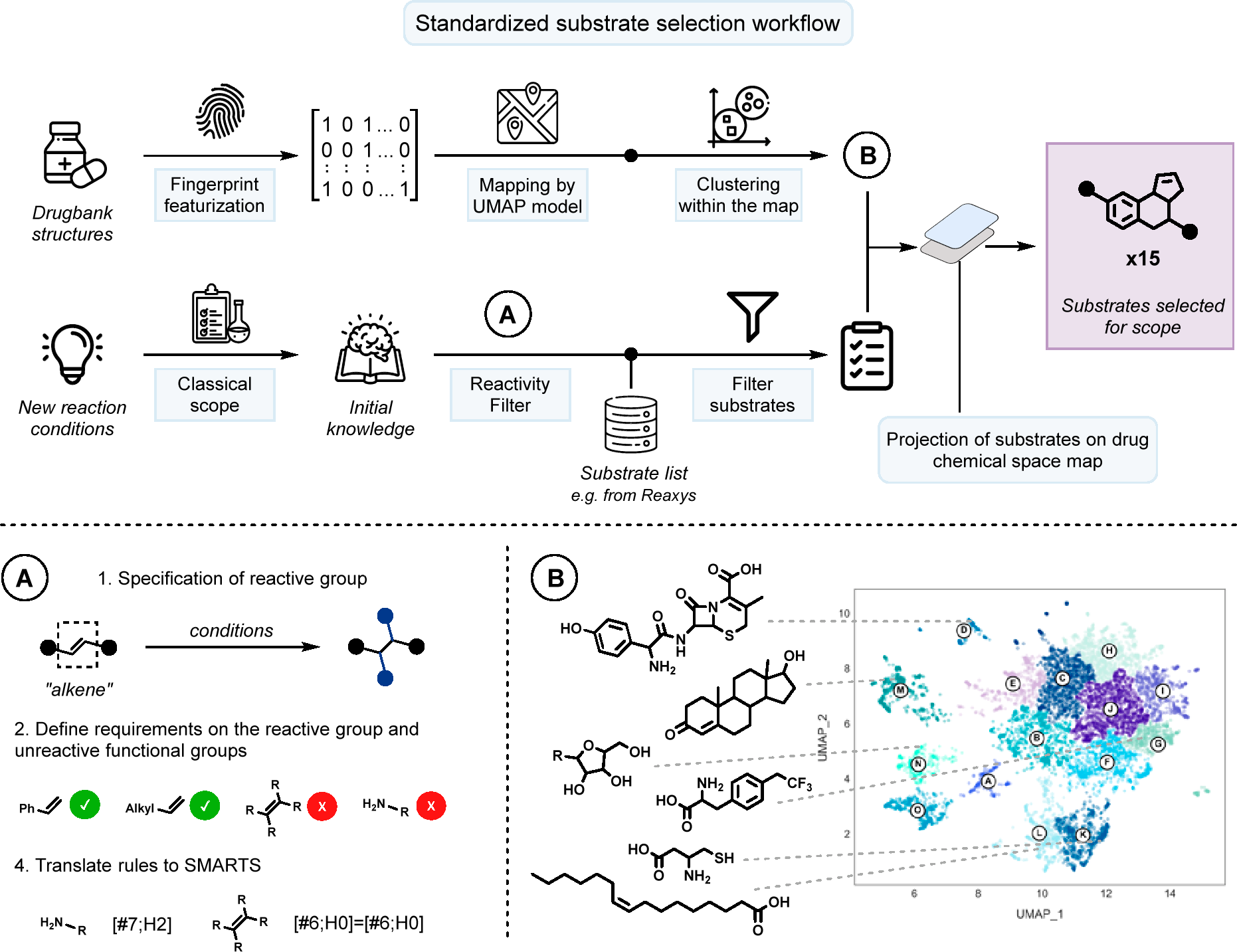
Standardized substrate-selection workflow. Panel A illustrates the definition of reaction compatibility and structural filtering criteria based on the classical substrate scope and existing reaction knowledge; Panel B shows the DrugBank-derived chemical space established through UMAP dimensionality reduction and hierarchical clustering. The filtered candidate substrates are projected onto this structural space, and representative experimental substrates are selected from the vicinity of each cluster center. Reproduced from Ref. [1] under CC BY 4.0.
3.3 Selecting 15 test substrates from 3,811 alkenes
In the alkene case study, the authors first retrieved commercially available alkenes from Reaxys and then applied filtering criteria including a price below €100/g and a molecular weight below 700 Da. Tetrasubstituted alkenes and compounds containing free amines were also excluded because previous studies had established that these two structural classes were incompatible with the photochemical iminocarboxylation conditions. After filtering, 3,811 candidate alkenes remained.[1]
These candidate alkenes were projected onto the previously established DrugBank structural distribution, and available candidate compounds were then identified near the center of each cluster. When the compound closest to a cluster center was difficult to obtain, other candidate structures located near the cluster center could be considered.[1]
The final set of 15 alkenes covered terminal alkenes, 1,1-disubstituted alkenes, 1,2-disubstituted alkenes, and trisubstituted alkenes. It also included electron-deficient, unactivated, and electron-rich alkenes, together with functional groups such as alcohols, esters, amides, ethers, silyl ethers, halides, thiols, and tertiary amines. A substantial proportion of the selected structures were multifunctional.[1]
The standardized substrate-selection workflow can be summarized as follows:
Reference molecular set → ECFP structural representation → UMAP dimensionality reduction → Hierarchical clustering → Establishment and filtering of the candidate substrate set → Projection of candidate substrates → Selection of representative substrates near different clusters → Experimental evaluation
The computational methods in this workflow determine which molecules are selected for experimentation, whereas whether an individual substrate actually undergoes the reaction is determined by the experimental result.[1]
4. Evaluation of Two Alkene Reactions Using the Standardized Substrate Set
4.1 The same substrate set used for two different reactions
The authors selected two alkene transformations to test this substrate-selection method.
The first was the photochemical alkene iminocarboxylation reaction reported by the Glorius group in Nature Chemistry in 2022. The original study used an energy-transfer photochemical process to achieve the difunctionalization of alkenes or (hetero)arenes, enabling the one-step construction of β-amino acid derivatives, with up to approximately 140 examples reported. The 2024 study noted that these already included 100 different alkenes.[1,2]
The second was osmium-catalyzed alkene dihydroxylation. The same 15 standardized alkenes were subjected separately to the respective experimental conditions of the two reactions. All experiments were performed on a 0.2 mmol scale, and the paper defined success as the formation of an isolable expected product in a yield greater than 10%.[1]
The experimental results were as follows:[1]
Reaction | Substrates Meeting the Success Criterion | Proportion of the 15 Test Substrates | Average Isolated Yield of Successful Reactions |
Osmium-catalyzed dihydroxylation | 8/15 | 53% | 47% |
Photochemical iminocarboxylation | 7/15 | 47% | 30% |
The values of 53% and 47% describe only the experimental outcomes obtained for these 15 standardized test substrates. Because these substrates were selected on the basis of structural diversity rather than randomly sampled in proportion to the actual composition of the 3,811 candidate alkenes, these percentages do not represent the overall reaction success rates for all alkenes.[1]
After the same 15 alkenes were subjected to the two respective reaction conditions, the numbers of substrates meeting the success criterion were similar for the two methods, but the specific structures that succeeded or failed were different (Figure 4 of the paper). This difference shifts the comparison of reaction applicability from the number of successful examples to the specific molecular structures involved.[1]
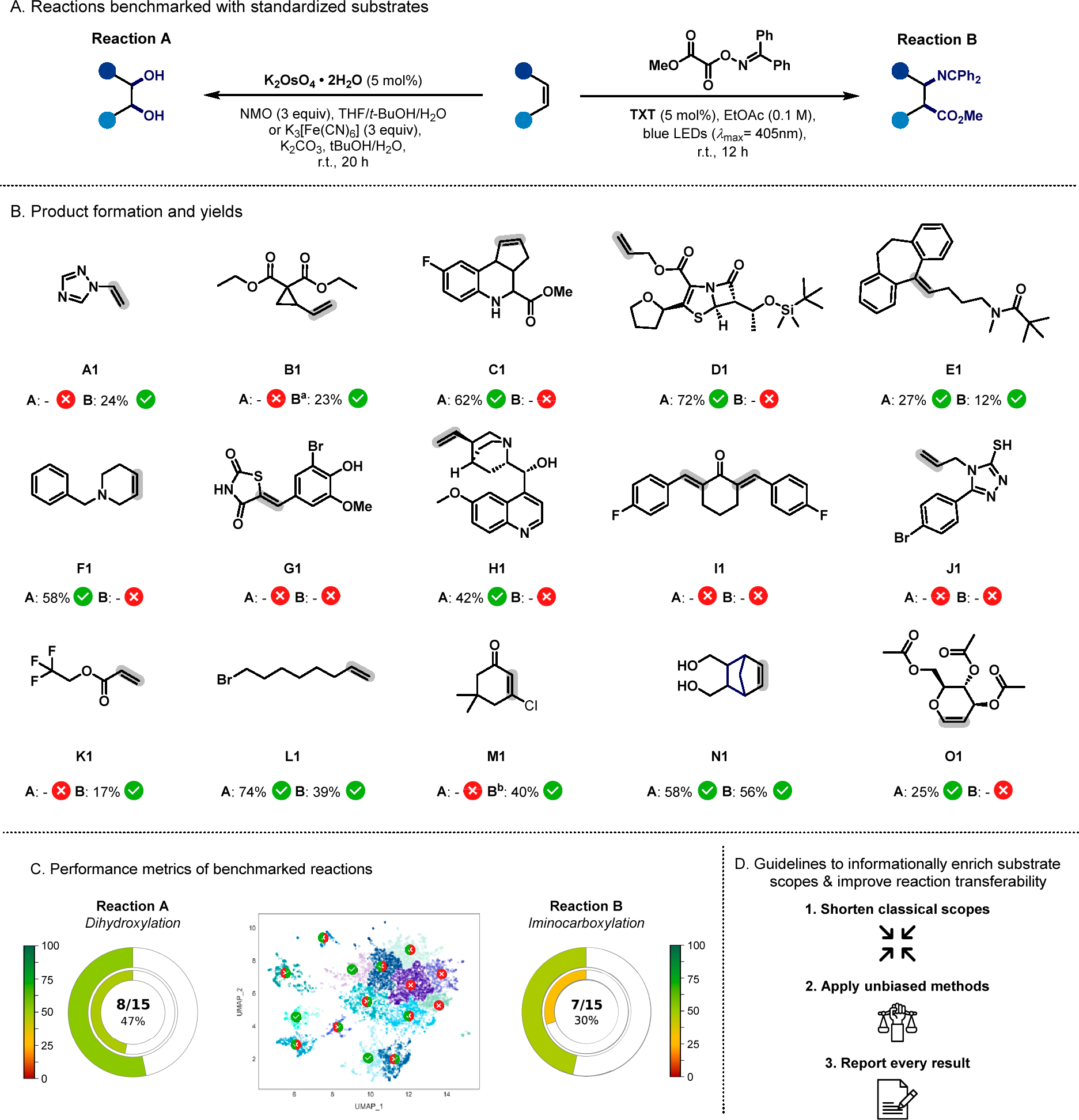
Experimental evaluation of two reactions using the standardized alkene substrate set. The same set of 15 alkenes was used separately for osmium-catalyzed dihydroxylation and photochemical iminocarboxylation. The figure presents the experimental outcome and isolated yield for each substrate as well as the overall performance of the two reactions. Experiments were performed on a 0.2 mmol scale, and formation of the expected product in an isolated yield greater than 10% was defined as a successful result. Reproduced from Ref. [1], CC BY 4.0.
Image source: Rana D, Pflüger P M, Hölter N P, et al. ACS Central Science, 2024, 10, 899–906, Figures 2 & 4. DOI: 10.1021/acscentsci.3c01638. © 2024 The Authors, CC BY 4.0.
4.2 Similar numbers of successful reactions correspond to different applicable structures
Eight and seven substrates, respectively, met the success criterion in the two reactions, giving similar overall numbers. However, comparison of the results for the same individual substrates revealed clearly different structural applicability profiles for the two methods.[1]
The unactivated alkenes L1 and N1 underwent the target transformation under both reaction conditions. The nortriptyline derivative E1 also participated in both reactions, although at relatively low yields.[1]
1-Vinyltriazole A1, vinylcyclopropane derivative B1, electron-deficient alkene M1, and trifluoroethyl acrylate K1 did not undergo the expected transformation under the dihydroxylation conditions but did participate in the photochemical iminocarboxylation reaction. B1 underwent cyclopropane ring opening, whereas M1 underwent dechlorination followed by β-hydrogen elimination, demonstrating that, in addition to whether the target type of transformation occurs, side reactions and product changes also constitute important experimental information when evaluating reaction applicability.[1]
Another group of substrates showed the opposite reaction preference. The tetrahydropyridine derivative F1, β-lactam-containing D1, H1, tri-O-acetyl-D-glucal O1, and other complex alkenes such as C1 formed the corresponding diols, whereas no expected products were detected under the photochemical iminocarboxylation conditions. G1, I1, and J1 failed to meet the success criterion in either reaction.[1]
These results can be divided into three categories according to reaction performance:
Test Result | Information Provided |
Both reactions successful | The structure is compatible with two different types of reaction conditions |
Only one reaction meets the criterion | The two methods have different applicability to this structural class |
Neither reaction meets the criterion | The structure shows clear limitations under both sets of current reaction conditions |
The same substrate set therefore provides more detailed information than the “total number of successful examples.” Although eight and seven successful examples are numerically similar, the successful substrates do not completely overlap. Comparing only the number of successful reactions would conceal differences in how the two reactions accommodate specific structural classes.[1]
4.3 Multifunctional complex structures reveal different limitations of the two reactions
In standardized testing, the reactivity trends observed for styrenes, unactivated alkenes, and some electron-deficient alkenes in the photochemical iminocarboxylation reaction were consistent with those reported in the original study. At the same time, more cases in which the expected product was not obtained were observed among complex substrates containing multiple potentially reactive functional groups.[1]
The authors further noted that the original 2022 substrate scope also included complex molecules, but in some examples the alkene reaction site was spatially distant from other reactive functional groups. Structural-diversity-guided selection increased the testing of additional multifunctional combinations and thereby provided further evidence of the applicability limitations of the photochemical reaction in complex substrates.[1,2]
Osmium-catalyzed dihydroxylation was able to accommodate a variety of complex alkenes in this test set, while displaying known limitations for structures such as electron-deficient alkenes and heteroatom-linked alkenes. The two reaction classes therefore exhibited different distributions of structurally applicable substrates.[1]
This comparison shows that useful information about reaction generality includes not only “how many substrates were successful,” but also “which structures succeeded, which failed, and whether the successful and failed structures are the same across different methods.”
5. Substantive Information Provided by Standardized Selection
5.1 Reducing information redundancy caused by repeated testing of similar structures
Conventional substrate scopes often vary substituents progressively around a model substrate. This design is highly suitable for investigating electronic effects, steric effects, and substitution patterns, but when closely related structures continue to be added, the amount of new information about broader structural classes gradually decreases.
Structural-diversity-guided selection distributes a limited number of experiments across different structural regions, allowing the test set to include substrates that differ substantially in electronic properties, functional-group combinations, and molecular complexity. When the number of experiments is limited, this design can increase the range of structural classes examined.[1]
5.2 Using the same substrate set improves comparability between different reactions
Different publications generally use independently designed substrate scopes. One reaction may extensively test aryl-substituted alkenes, whereas another may emphasize derivatives of complex natural products. Even if both papers report 50 substrates, the resulting data are difficult to compare directly.
In the experiments of Rana et al., the same set of 15 alkenes was used for both reactions, and the outcomes were compared using identical substrate identities and the same success criterion. The resulting data therefore provide not only two success proportions but also the response of each individual structure to the different reaction systems.[1]
5.3 Low-yielding and failed results are incorporated into the evaluation of reaction applicability
Substrates selected according to predefined rules may produce low yields, unexpected products, or complete failure. When these outcomes are retained, the reaction scope records both viable and non-applicable structures.
Rana et al. proposed that standardized testing will include a substantial proportion of low-yielding or failed examples. These negative results help define the applicability limitations of a new reaction and can also identify structural problems that need to be addressed in subsequent method development.[1]
5.4 Conventional substrate scopes and standardized testing serve different purposes
The authors ultimately proposed a two-stage evaluation strategy: first, a relatively concise conventional substrate scope is used to identify electronic effects, steric effects, and basic reaction trends; standardized substrates are then added to test a broader range of structural classes.[1]
Evaluation Approach | Substrate Design | Main Information Obtained |
Conventional substrate scope | Deliberate variation of substituents, electronic properties, and steric effects | Local structure–reactivity relationships and functional-group compatibility |
Structural-diversity-guided standardized testing | Selection of substrates from a predefined structural set according to consistent rules | Actual performance across diverse structures, direct comparison between different reactions, and failed examples |
Combination of the two stages | First analyze reaction trends, then broaden structural coverage | Simultaneous description of reaction trends and applicability across a broader range of structural classes |
Standardized substrate selection therefore does not diminish the role of conventional substrate-scope studies. Instead, it adds a different type of experimental information: conventional scopes focus on explaining how structural changes affect a reaction, whereas standardized sets focus on testing how far these reaction trends extend across molecules with substantially different structures.[1]
6. Scope of Applicability of the Method and Conclusions
6.1 Structural representativeness cannot be directly converted into reactivity representativeness
ECFP, UMAP, and clustering organize compounds according to molecular structural features, whereas the outcomes of organic reactions are also influenced by the electronic properties, steric environment, conformation, coordination ability, and competing reactions around the reaction center.
Accordingly, the fact that a substrate lies near the center of a cluster indicates only that it has relatively high structural representativeness under the structural representation being used. The authors explicitly noted that a single molecule near a cluster center cannot fully represent the reactivity of all molecules within that cluster. Changes in UMAP parameters and clustering parameters may also produce a similar, but not identical, set of 15 substrates.[1]
This limitation means that standardized substrate selection is an experimental-design method. It cannot replace actual reaction experiments, nor can the yields of untested substrates be predicted directly from structural mapping.
6.2 A small number of standardized substrates cannot estimate the overall success rate of the complete substrate set
Fifteen substrates remain a very small sample relative to the entire set of candidate alkenes. The authors also noted that small structural changes may significantly affect reaction outcomes, meaning that a limited number of molecules cannot fully capture all reaction trends within a substrate class.[1]
At the same time, standardized substrates are actively selected from different structural regions and therefore do not satisfy the conditions of random sampling in proportion to the composition of the overall population. Values of 8/15 or 7/15 are appropriate for describing performance within this particular test set, but they cannot be interpreted as indicating overall reaction success probabilities of 53% or 47%, respectively, for the entire alkene class.[1]
6.3 Evidence for reaction generality consists jointly of quantity, structural coverage, and completeness of results
The number of substrate examples remains important information in reaction evaluation. It indicates how many experiments have been completed, but it cannot by itself show which structural classes were covered or whether unsuccessful structures were recorded.
Rana et al. further standardized the substrate-selection process as follows:
Define the reference molecular set → Establish the candidate substrate set → Specify known reaction limitations → Select experimental substrates according to consistent structural rules → Test using predefined criteria → Record both successful and failed results.[1]
In the experimental validation, eight and seven standardized substrates met the success criterion for the two alkene reactions, respectively. Although the numbers of successful examples appeared very similar, comparison of the same 15 individual structures revealed clearly different applicable structures and failure modes for the two reactions.[1]
This is the key information that standardized selection adds to the evaluation of reaction generality: the number of examples describes the scale of experimentation, structural distribution describes what was actually examined, and successful and failed outcomes together describe how the reaction performs across those structures.
When all three types of information are clearly defined, a substrate scope can progress beyond the accumulation of successful examples to become evidence of reaction applicability with a clearly defined evaluation target, reproducible selection rules, and comparable experimental results.
7. Representative Chemicals Related to Standardized Substrate-Scope Evaluation
Table 1. Reaction-Evaluation Reagents and Representative Test Substrates
Category | CAS No. | Aladdin Cat. No. | Name | Specification or Purity | Product Features and Applications |
Photochemical iminocarboxylation reaction system | 141-78-6 | Ethyl acetate | Anhydrous, ≥99.8% | Reaction solvent for the photochemical iminocarboxylation system; suitable for experimental evaluation of standardized alkene substrates under photochemical difunctionalization conditions. | |
Photochemical iminocarboxylation reaction system | 492-22-8 | Thioxanthone | ≥98% | Photosensitizer for photochemical iminocarboxylation, used in the energy-transfer process and to promote the generation of reactive intermediates from the key oxime oxalate reagent; suitable for studies of photochemical alkene difunctionalization. | |
Osmium-catalyzed dihydroxylation reaction system | 7529-22-8 | N-Methylmorpholine N-oxide (NMO) | 50% aqueous solution | Co-oxidant for osmium-catalyzed alkene dihydroxylation; participates in reoxidation of the osmium species and helps maintain the catalytic cycle, and can be used to evaluate the applicability of dihydroxylation to standardized alkene substrates. | |
Osmium-catalyzed dihydroxylation reaction system | 70187-32-5 | 4-Methylmorpholine N-oxide monohydrate | ≥98% | A commonly used form of the co-oxidant for osmium-catalyzed alkene dihydroxylation; applicable to the conversion of alkenes to vicinal diols and to comparisons of reaction applicability across structurally different substrates. | |
Representative alkene substrate | 100-42-5 | Styrene | ≥99%, stabilized with 10–15 ppm 4-tert-butylcatechol | A typical aryl-substituted alkene that can serve as a model substrate in alkene reaction studies for examining the reaction behavior and substrate applicability of aryl-substituted alkenes under different reaction conditions. | |
Standardized test substrate | 2873-29-2 | Tri-O-acetyl-D-glucal | ≥98% | A representative multifunctional oxygen-containing alkene structure that can be used to examine differences in the behavior of complex molecular scaffolds in alkene dihydroxylation and photochemical iminocarboxylation, as well as functional-group compatibility. | |
Standardized test substrate | 407-47-6 | 2,2,2-Trifluoroethyl acrylate (stabilized with MEHQ) (TFEA) | ≥98% | A representative electron-deficient fluorinated alkene substrate that can be used to compare the applicability of different reaction systems to electron-deficient alkenes and to examine reaction behavior in the presence of fluorinated functional groups. |
Table 2. Raw Materials and Reagents Related to the Preparation of the Key Photochemical Oxime Oxalate Reagent
Category | CAS No. | Aladdin Cat. No. | Name | Specification or Purity | Product Features and Applications |
Raw material for oxime precursor preparation | 119-61-9 | Benzophenone | Suitable for synthesis | Starting material for benzophenone oxime; can undergo oxime formation to construct the oxime functionality required for the subsequent oxime oxalate reagent and is suitable for precursor synthesis of key reagents used in photochemical difunctionalization. | |
Raw material for oxime precursor preparation | 5470-11-1 | Hydroxylamine hydrochloride | PrimorTrace™, ≥99.99% metals basis | Serves as a source of hydroxylamine and can react with benzophenone to prepare benzophenone oxime, providing a precursor for subsequent synthesis of the key oxime oxalate reagent. | |
Auxiliary reagent for oxime precursor preparation | 127-09-3 | Sodium acetate | Anhydrous, reagent grade, high purity, ≥99% | Can be used for acid–base adjustment during the preparation of oxime compounds from benzophenone and hydroxylamine hydrochloride and is suitable for the synthesis of precursors such as benzophenone oxime for key photochemical reagents. | |
Direct starting material for oxime oxalate synthesis | 574-66-3 | Benzophenone oxime | ≥97% | Direct oxime precursor to the key oxime oxalate reagent; can undergo acylation with methyl oxalyl chloride to construct the bifunctional radical precursor required for photochemical iminocarboxylation. | |
Direct starting material for oxime oxalate synthesis | 5781-53-3 | Methyl oxalyl chloride | ≥97% | Used for oxalylation of benzophenone oxime to construct the key photochemical reagent containing both oxime and oxalate structural elements; suitable for the synthesis of reagents related to alkene iminocarboxylation. | |
Auxiliary reagent for oxime oxalate preparation | 110-86-1 | Pyridine | Anhydrous, ≥99.8% | Can serve as a basic reagent during oxime oxalate preparation and is used to regulate the acylation reaction between methyl oxalyl chloride and benzophenone oxime. | |
Auxiliary reagent for oxime oxalate preparation | 75-09-2 | D116144 | Dichloromethane | AR ≥99.5% | Can serve as an organic solvent for the acylation reaction between benzophenone oxime and methyl oxalyl chloride and is suitable for the preparation of oxime oxalate photochemical reagents and related organic synthesis operations. |
Note: The products listed above are representative Aladdin products related to scientific research. Their specific uses should be determined according to the product specifications, batch-specific COA, and the target reaction or evaluation system. Additional information on product specifications, grades, and COAs can be retrieved from the Aladdin website using the product name, CAS number, or catalog number.
References
[1] Rana, D.; Pflüger, P. M.; Hölter, N. P.; Tan, G.; Glorius, F. Standardizing Substrate Selection: A Strategy toward Unbiased Evaluation of Reaction Generality. ACS Central Science 2024, 10(4), 899–906. DOI: 10.1021/acscentsci.3c01638.
[2] Tan, G.; Das, M.; Keum, H.; Bellotti, P.; Daniliuc, C.; Glorius, F. Photochemical Single-Step Synthesis of β-Amino Acid Derivatives from Alkenes and (Hetero)arenes. Nature Chemistry 2022, 14(10), 1174–1184. DOI: 10.1038/s41557-022-01008-w.
[3] Rogers, D.; Hahn, M. Extended-Connectivity Fingerprints. Journal of Chemical Information and Modeling 2010, 50(5), 742–754. DOI: 10.1021/ci100050t.
[4] McInnes, L.; Healy, J.; Melville, J. UMAP: Uniform Manifold Approximation and Projection for Dimension Reduction. arXiv 2018, arXiv:1802.03426; v3 revised September 18, 2020. DOI: 10.48550/arXiv.1802.03426.
For more related articles, see below:
Peroxidase Substrate Detection System
Principles for Selecting Firefly Luciferin Substrates and Experimental Optimization Strategies
Coelenterazine 400a: A High-Resolution Substrate for Advanced Bioluminescent Assays


 危险品化学品经营许可证(带存储)