
2-Oxabicyclo[2.1.1]hexane as a Replacement for ortho- and meta-Disubstituted Benzenes: From Geometric Matching to Functional Validation
2-Oxabicyclo[2.1.1]hexane as a Replacement for ortho- and meta-Disubstituted Benzenes: From Geometric Matching to Functional Validation
Introduction
2-Oxabicyclo[2.1.1]hexane (2-oxa-BCH) is a rigid, sp³-rich, oxygen-containing bicyclic scaffold. Based on crystallographic structures, a 2020 study proposed that 1,4-disubstituted 2-oxa-BCH could mimic meta-disubstituted benzene, although the corresponding biological activity had not yet been validated [2]. A 2023 study further showed that 1,5-disubstituted 2-oxa-BCH and ortho-disubstituted benzene have relatively similar exit-vector relationships and compared the physicochemical properties of the corresponding bioactive molecules; the 1,5-disubstituted analogs of Fluxapyroxad and Boscalid were also evaluated for antifungal activity [3]. A subsequent study published in 2024 expanded the scalable synthesis and functionalization scope of this scaffold. The meta-disubstituted benzene in Sonidegib and the ortho-disubstituted benzenes in seven other bioactive molecules were replaced to investigate the geometric parameters, physicochemical properties, and biological activities of 1,4- and 3,4-disubstituted 2-oxa-BCH scaffolds, respectively [1].
These studies show that geometric similarity alone is insufficient to establish a bioisosteric relationship. A saturated scaffold that is geometrically similar to benzene must also satisfy the relevant molecular-recognition requirements within a specific bioactive molecule and undergo biological activity validation before it can be regarded as a bioisostere of practical significance.
1. Functional Differences of the Saturated Sonidegib Analog
The 2024 study first replaced the meta-disubstituted benzene in Sonidegib with 1,4-disubstituted 2-oxa-BCH to obtain saturated analog 78. Sonidegib is a Smoothened (Smo) receptor antagonist that acts by inhibiting the Hedgehog signaling pathway. The researchers compared the pathway-inhibitory activities of the two compounds in a Gli-Luc reporter NIH3T3 cell system and simultaneously measured their bidirectional permeability across Caco-2 cell monolayers [1].
Sonidegib and analog 78 showed similar permeability in the Caco-2 assay, but their inhibitory potencies against Hedgehog signaling differed markedly. The half-maximal inhibitory concentration (IC₅₀) was 1.462 nM for Sonidegib and 179 nM for analog 78. Although analog 78 retained nanomolar activity, its potency decreased by approximately two orders of magnitude [1].

Figure 1. Structures and experimental results of Sonidegib and its saturated 2-oxa-BCH analog 78. The meta-disubstituted benzene replaced in Sonidegib is shown in blue, and the 1,4-disubstituted 2-oxa-BCH in analog 78 is shown in red. The two compounds exhibited similar bidirectional Caco-2 permeability, whereas the IC₅₀ for Hedgehog pathway inhibition increased from 1.462 nM to 179 nM. Caco-2 data reflect properties related to transport across cell monolayers and cannot, by themselves, exclude other factors affecting cellular activity. Reproduced from Figure 2 of Ref. [1] under CC BY 4.0.
These results distinguish three levels of assessment: whether the chemical replacement can be achieved, whether the two scaffolds possess a certain degree of geometric similarity, and whether the original biological function is retained at a comparable level. These are not equivalent conclusions.
The residual activity of analog 78 indicates that 1,4-disubstituted 2-oxa-BCH can connect the two flanking structural fragments in this molecule. However, the marked loss of potency suggests that the effective molecular-recognition or intracellular activity requirements of the complete molecule were not maintained to the same extent after replacement. Because the Gli-Luc IC₅₀ reflects cellular inhibition of the Hedgehog pathway rather than direct binding affinity for Smo, the observed potency difference cannot be attributed solely to the exit-vector angle.
2. Spatial Constraints of Benzene Substituents and Exit Vectors
A disubstituted benzene ring not only provides an aromatic π-electron system but also serves as a rigid spatial-positioning unit. Ortho, meta, and para substitution patterns define both the distance between the two attachment sites and the directions in which the substituent bonds extend from the aromatic ring. When an aromatic ring is replaced with another rigid scaffold, the positions of the terminal functional groups in three-dimensional space may change even if the overall connectivity of the molecule remains unchanged.
These spatial relationships are commonly described using exit-vector analysis. The bonds connecting the core scaffold to its external substituents are treated as directional vectors. Parameters such as the distance between attachment sites, the distance between substituents, the angle between the vectors, and the dihedral angle can be used to determine whether two different cores project their external functional groups into similar spatial positions [1,3]. This method has been used to compare 2-oxa-BCH scaffolds with different connectivity patterns. The 2023 study quantitatively compared the spatial relationship between 1,5-disubstituted structures and ortho-disubstituted benzenes [3], whereas the 2024 study compared the geometric parameters of 3,4-disubstituted structures and ortho-disubstituted benzenes [1].
For drug molecules, both distance and direction must remain within reasonable ranges. Even when two cores have similar distances between their substituents, markedly different exit directions can project pharmacophores extending along the substituent bonds into different spatial regions. The longer the substituents, the more likely an angular difference at the core is to produce a pronounced positional displacement of the terminal functional groups.
Crystallographic comparisons show that 2-oxa-BCH scaffolds with different substitution patterns exhibit distinctly different degrees of geometric matching with benzene.
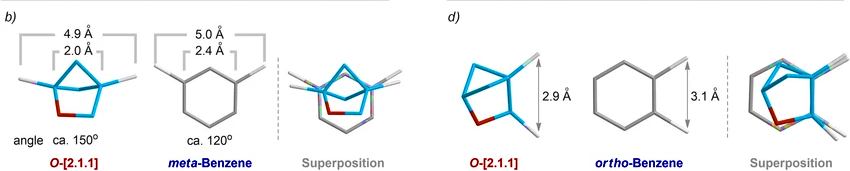
Figure 2. Geometric comparison of 2-oxa-BCH with meta- and ortho-disubstituted benzenes. Left: the two exit directions of 1,4-disubstituted 2-oxa-BCH form an angle of approximately 150°, compared with approximately 120° for meta-disubstituted benzene; superimposition reveals a clear angular difference. Right: 3,4-disubstituted 2-oxa-BCH and ortho-disubstituted benzene have relatively similar principal attachment positions and overall spatial profiles, although 2-oxa-BCH retains a distinctly nonplanar three-dimensional structure. Source: Figures 1b and 1d of Ref. [1], CC BY 4.0.
3. The Intermediate meta–para Geometry of 1,4-Disubstituted 2-oxa-BCH
The left panel of Figure 2 explains why 1,4-disubstituted 2-oxa-BCH cannot simply be regarded as an exact spatial replica of meta-disubstituted benzene.
X-ray crystallographic data show that some distance parameters of the two types of cores are indeed similar. The substituent distance, d, is 4.92–4.95 Å for 2-oxa-BCH and 4.93–5.05 Å for the meta-disubstituted benzenes examined. Based on this distance alone, the two scaffolds show a high degree of similarity [1].
A more pronounced difference lies in the angle γ between the two exit vectors:
Scaffold | γ |
meta-Disubstituted benzene | 116–122° |
1,4-Disubstituted 2-oxa-BCH | 153° |
para-Disubstituted benzene | Approximately 180° |
The 153° angle of 1,4-disubstituted 2-oxa-BCH is not a minor deviation from the approximately 120° angle of meta-disubstituted benzene; instead, it is substantially closer to that of para-disubstituted benzene. Accordingly, the original study described this structure as occupying chemical space between meta- and para-disubstituted benzenes and proposed that it could serve as an alternative scaffold between these two structural classes [1].
This finding demonstrates that the spatial mimicry of disubstituted benzenes by 2-oxa-BCH strongly depends on the substitution pattern. The corresponding aromatic substitution pattern cannot be assigned solely from the type of scaffold.
The activity results for Sonidegib and analog 78 are consistent with this structural difference. The original study proposed that their potency difference might be related to the different angular characteristics of meta-disubstituted benzene and 1,4-disubstituted 2-oxa-BCH [1].
Replacing the aromatic ring also removes the aromatic π-electron surface and changes the local electronic distribution, hydrophobic surface, solvation, and three-dimensional shape. The bridging oxygen in 2-oxa-BCH additionally introduces a new polar feature. If the original benzene ring directly participates in π–π interactions, π–amide stacking, or other aromatic interactions, molecular recognition may still be affected even when the external pharmacophores occupy similar positions [3].
4. Ortho Geometry and Functional Validation of 3,4-Disubstituted 2-oxa-BCH
The overall geometric match between 3,4-disubstituted 2-oxa-BCH and ortho-disubstituted benzene is clearly better than that observed in the meta system described above.
In the crystal structures, the substituent distance, d, is 3.11–3.17 Å for 3,4-disubstituted 2-oxa-BCH and 2.87–2.95 Å for ortho-disubstituted benzene. The corresponding attachment-site distances, r, are 1.55–1.56 Å and 1.40–1.41 Å, respectively. The in-plane angles φ₁ and φ₂ of the exit vectors are 61–65° and 57–59°, respectively, indicating relatively similar principal exit directions [1].
The two structures are not completely identical. Ortho-disubstituted benzene remains essentially planar, with a dihedral angle |θ| of only 0–6°, whereas |θ| reaches 54–56° for 3,4-disubstituted 2-oxa-BCH. Thus, this replacement introduces pronounced three-dimensionality while largely preserving the principal exit directions [1].
This structural relationship is more meaningful in medicinal chemistry than simply increasing the proportion of sp³ carbon. Three-dimensionality is not an independent objective. Introducing a new nonplanar core may alter molecular shape and physicochemical properties while preserving the original recognition mode only when the spatial relationship between key pharmacophores remains within an acceptable range.
Geometric matching still does not directly demonstrate retention of biological function. The researchers incorporated 3,4-disubstituted 2-oxa-BCH into structures corresponding to Fluxapyroxad, Bixafen, and Boscalid to obtain saturated analogs 83–85 and tested their antifungal activities against Fusarium culmorum and F. oxysporum. Analogs 83 and 85 showed no activity under the assay conditions, whereas Bixafen analog 84 retained high antifungal activity, although the parent Bixafen remained slightly more potent [1].
The 1,5-disubstituted analogs 29 and 31 reported in Ref. [3] corresponded to Fluxapyroxad and Boscalid, respectively, and retained activity in the corresponding antifungal assays. By contrast, compounds 83–85 in Ref. [1] employed a 3,4-disubstituted connectivity pattern. Because the two sets of compounds differ in their attachment positions and spatial orientations of the substituents, and because the fungal strains and specific experimental conditions were not identical, the results of the two studies cannot be compared directly on a one-to-one basis. Together, they demonstrate that the effectiveness of 2-oxa-BCH replacement depends on the specific connectivity pattern and complete molecular structure.
A good exit-vector match increases the likelihood that key pharmacophores will remain in reasonable spatial positions after aromatic-ring replacement, but it cannot guarantee that every complete molecule will retain its original function. Proteins recognize the overall three-dimensional, electrostatic, and solvation surfaces formed by a ligand rather than the exit vectors alone. Functional outcomes are also influenced by aromatic interactions, local polarity, conformation, cellular exposure, and the fit of the complete molecule within the binding site.
5. Changes in Physicochemical Properties and Their Relationship to Bioisosterism
Replacing benzene with 2-oxa-BCH also changes the physicochemical properties of a molecule. The 2024 study compared five drugs and three agrochemicals with their corresponding saturated analogs. The reported solubility was experimental kinetic solubility in phosphate-buffered saline at pH 7.4 rather than equilibrium aqueous solubility in the general sense. Kinetic solubility increased in six of the eight matched pairs, and the calculated octanol/water partition coefficient (cLogP) decreased in all eight pairs. Among the five pairs that could be measured reliably using the experimental method, the octanol/buffer distribution coefficient, logD, at pH 7.4 decreased by approximately 0.5 units [1].
These changes are consistent with removal of the hydrophobic aromatic surface and introduction of the bridging oxygen. However, solubility is not determined by polarity alone. Solid-state lattice energy, molecular conformation, and other functional groups also affect dissolution, and individual compounds may therefore deviate from the overall trend.
In human liver microsome assays, changes in metabolic stability showed clear compound dependence. The analogs corresponding to Sonidegib, Lomitapide, and Bixafen showed lower metabolic stability, whereas those corresponding to Conivaptan, Fluxapyroxad, and Boscalid showed higher metabolic stability. No clear change was observed for the remaining two pairs because both the parent compounds and their analogs were intrinsically stable [1]. The researchers therefore limited their overall conclusion to the following: 2-oxa-BCH replacement tends to increase water solubility and reduce lipophilicity, whereas its effect on metabolic stability has no uniform direction.
Optimization of physicochemical properties and validation of bioisosterism are distinct dimensions of assessment. Reducing lipophilicity or increasing water solubility may enhance the development value of a structural replacement, but it does not demonstrate that the original molecular-recognition properties have been retained. Conversely, a replacement that retains good biological activity may not improve every physicochemical property simultaneously.
6. Geometric Isosterism, Bioisosterism, and Practical Utility
A systematic review of replacements for ortho- and meta-substituted benzenes distinguished between geometric isosteres and bioisosteres. The former are defined by geometric properties similar to those of the parent structure, whereas the latter additionally require experimental evidence of corresponding biological activity [4].
The series of studies on 2-oxa-BCH further shows that aromatic-ring replacement can be divided into three successive but noninterchangeable levels:
Level of Assessment | Core Question | Results or Conclusions Provided by the Relevant Studies |
Geometric matching | Are the positions and directions of the two key substituents reasonably preserved? | The exit-vector angle of 1,4-disubstituted 2-oxa-BCH lies between those of meta- and para-disubstituted benzenes. The overall geometry of the 3,4-disubstituted scaffold is relatively similar to that of ortho-disubstituted benzene, but it is markedly more nonplanar. |
Molecular recognition | Can the spatial arrangement, electronic properties, and noncovalent interactions created after replacement continue to satisfy the requirements for target binding? | The relevant studies did not directly measure target binding. Removal of the aromatic π surface and changes in local polarity and three-dimensional shape suggest that the original noncovalent interactions may be altered. |
Functional validation | Is activity retained to an acceptable extent in a specific biological system? | Sonidegib analog 78 retained nanomolar activity in the Gli-Luc cellular pathway assay, but its IC₅₀ increased from 1.462 nM to 179 nM. Bixafen analog 84 retained high antifungal activity in the agar well diffusion assay, whereas analogs 83 and 85 showed no activity under the assay conditions. |
Practical medicinal chemistry is also constrained by synthetic accessibility. In the 2024 study, the key 2-oxa-BCH intermediate 2 was prepared on a 377 g scale in a single batch, and subsequent transformations afforded more than 100 functionalized 2-oxa-BCH derivatives in gram quantities [1]. These results show that the scaffold has an experimental foundation for use in structure–activity relationship studies and medicinal chemistry design–synthesis–testing cycles. However, scalable preparation demonstrates synthetic practicality and does not, by itself, establish a bioisosteric relationship.
Geometric analysis of 2-oxa-BCH is first used to determine whether a particular substitution pattern provides a spatial basis for replacing the corresponding disubstituted benzene, but such geometric similarity is only the starting point for structural design. After incorporation into a specific bioactive molecule, it remains necessary to determine whether aromatic-ring replacement alters key molecular-recognition properties and to establish through actual biological activity whether the replacement is successful. Changes in physicochemical properties are used to evaluate the development benefits of the replacement, whereas synthetic accessibility determines whether the design can proceed into subsequent structure–activity relationship studies. Neither can substitute for biological functional validation.
7. Bioactive Compounds, Analytical Standards, and Functionalized Building Blocks Relevant to 2-Oxabicyclo[2.1.1]hexane Bioisostere Research
Table 1. Bioactive Compounds and Analytical Standards
Classification | CAS Number | Aladdin Cat. No. | Name | Specification or Purity | Product Features and Applications |
Smoothened receptor antagonist | 956697-53-3 | LDE225 (NVP-LDE225, Erismodegib), Smoothened (Smo) antagonist | Moligand™, ≥99% | A Smoothened receptor antagonist and Hedgehog signaling pathway inhibitor. In the original study, its meta-disubstituted benzene was replaced with 1,4-disubstituted 2-oxabicyclo[2.1.1]hexane to construct the corresponding analog. It can serve as the parent reference in studies of receptor inhibition, Hedgehog pathway activity, and permeability across cell monolayers. | |
Microsomal triglyceride transfer protein inhibitor | 182431-12-5 | Lomitapide | Moligand™, ≥98% (HPLC) | A microsomal triglyceride transfer protein inhibitor. The original study used it in a matched molecular-pair comparison between ortho-disubstituted benzene and 3,4-disubstituted 2-oxabicyclo[2.1.1]hexane to investigate the effects of saturated aromatic-ring replacement on water solubility, lipophilicity, and metabolic stability. | |
Arginine vasopressin V1A/V2 receptor antagonist | 168626-94-6 | Conivaptan Hydrochloride | ≥99% | An arginine vasopressin V1A/V2 receptor antagonist. In Ref. [1], its ortho-disubstituted benzene was replaced with 3,4-disubstituted 2-oxa-BCH to obtain analog 81, which was used to compare solubility, lipophilicity, and metabolic stability before and after replacement. | |
Angiotensin II receptor antagonist | 137862-53-4 | Valsartan | Moligand™, ≥98% (HPLC) | An angiotensin II receptor antagonist containing a biphenyl tetrazole structure. It was used in the original study as one of the parent drugs for ortho-aromatic-ring replacement and can be used to compare the water solubility, lipophilicity, and metabolic stability of a 2-oxabicyclo[2.1.1]hexane analog with those of its aromatic parent compound. | |
Sulfonamide antibacterial compound | 85-73-4 | Phthalylsulfathiazole | ≥95% (T) | A sulfonamide antibacterial compound containing aromatic, sulfonamide, and thiazole units. It was used in the original study as one of the parent drugs for ortho-disubstituted benzene replacement and can be used for structural and physicochemical comparisons between the saturated analog and its aromatic parent. | |
Succinate dehydrogenase inhibitor fungicide | 907204-31-3 | Fluxapyroxad | Moligand™, 10 mM in DMSO | A succinate dehydrogenase inhibitor fungicide containing an ortho-substituted biphenyl structure. The original study constructed its 3,4-disubstituted 2-oxabicyclo[2.1.1]hexane analog to compare antifungal activity, water solubility, lipophilicity, and metabolic stability after aromatic-ring replacement. | |
Succinate dehydrogenase inhibitor fungicide | 581809-46-3 | Bixafen | Moligand™, ≥95% | A succinate dehydrogenase inhibitor fungicide. Its 3,4-disubstituted 2-oxabicyclo[2.1.1]hexane analog retained high antifungal activity in the original study, making Bixafen a representative reference compound for evaluating the relationship between the geometric matching of ortho-disubstituted benzene and the retention of biological function. | |
Succinate dehydrogenase inhibitor fungicide standard solution | 188425-85-6 | Boscalid Solution in Methanol | 1,000 μg/mL in methanol, uncertainty 2% | A Boscalid quantitative standard solution that can be used for chromatographic analysis, instrument calibration, and analytical method validation. Boscalid was also one of the parent agrochemicals subjected to ortho-disubstituted benzene replacement in the original study and can serve as a reference for quantitative analysis of the corresponding parent compound. |
Table 2. Monofunctionalized 2-Oxabicyclo[2.1.1]hexane Building Blocks
Classification | CAS Number | Aladdin Cat. No. | Name | Specification or Purity | Product Features and Applications |
C1 carboxylic acid building block | 2228699-81-6 | 2-oxabicyclo[2.1.1]hexane-1-carboxylic acid | ≥97% | The carboxylic acid is directly attached at C1 of the scaffold and can undergo amidation, esterification, and other carboxylic acid derivatizations. It can be used to attach side chains at C1 and construct 2-oxabicyclo[2.1.1]hexane libraries for investigating how attachment sites and side-chain directions affect molecular properties. | |
C4 carboxylic acid building block | 1784145-36-3 | 2-oxabicyclo[2.1.1]hexane-4-carboxylic acid | ≥97% | The carboxylic acid is located at C4 of the scaffold and can be used to introduce different side chains through amidation and esterification. It is a basic building block for constructing C4-substituted 2-oxabicyclo[2.1.1]hexane derivatives and conducting structure–property relationship studies. | |
C4 methyl carboxylate building block | 2113569-16-5 | methyl 2-oxabicyclo[2.1.1]hexane-4-carboxylate | ≥97% | The methyl ester form of the C4 carboxylic acid can serve as a relatively stable protected form of the acid and can be hydrolyzed to regenerate the reactive carboxylic acid site. It is useful for controlling the reaction sequence of the C4 functional group in multistep synthesis. | |
C4 nitrile building block | 2113569-19-8 | 2-oxabicyclo[2.1.1]hexane-4-carbonitrile | ≥97% | The C4 nitrile combines relatively small steric demand with polarity. It can be used directly as a terminal functional group in structure–property studies or as a functional-group conversion site for preparing nitrogen-containing or carboxylic acid derivatives. | |
C4 hydroxymethyl building block | 1782594-07-3 | 2-oxabicyclo[2.1.1]hexan-4-ylmethanol | ≥97% | The hydroxymethyl group is connected to C4 through a methylene group and can undergo esterification, etherification, oxidation, and other transformations. It can be used to construct oxygen-containing side chains and investigate the effects of side-chain length and attachment direction on the properties of 2-oxabicyclo[2.1.1]hexane derivatives. | |
C4 amino hydrochloride building block | 2260936-52-3 | 2-oxabicyclo[2.1.1]hexan-4-amine;hydrochloride | ≥97% | The amino group is directly attached at C4 of the scaffold and, after liberation of the free amine, can participate in amidation, sulfonamidation, urea formation, and reductive amination. It can be used to construct nitrogen-containing 2-oxabicyclo[2.1.1]hexane derivatives with a short attachment distance. | |
C4 aminomethyl hydrochloride building block | 2287280-60-6 | 2-oxabicyclo[2.1.1]hexan-4-ylmethanamine;hydrochloride | ≥97% | A methylene spacer separates the primary amine from C4. The compound can be used to prepare amide, sulfonamide, and urea derivatives and in reductive amination. In combination with the directly attached C4 amino building block, it enables comparison of how attachment length affects the spatial position of a side chain. | |
C1 iodomethyl electrophilic building block | 1935986-52-9 | 1-(iodomethyl)-2-oxabicyclo[2.1.1]hexane | ≥97% | The C1 iodomethyl group provides an activated alkyl halide reaction site for introducing nitrogen-, oxygen-, or sulfur-containing side chains through nucleophilic substitution. It is suitable for expanding diverse substituents from a single electrophilic site to construct libraries of 2-oxabicyclo[2.1.1]hexane side-chain derivatives. |
Table 3. Bifunctionalized 2-Oxabicyclo[2.1.1]hexane Building Blocks
Classification | CAS Number | Aladdin Cat. No. | Name | Specification or Purity | Product Features and Applications |
C1 hydroxymethyl/C4 carboxylic acid bifunctional building block | 2416234-08-5 | 1-(hydroxymethyl)-2-oxabicyclo[2.1.1]hexane-4-carboxylic acid | ≥97% | The C1 hydroxymethyl and C4 carboxylic acid groups provide two chemically distinct reaction sites that can undergo hydroxyl derivatization and carboxylic acid coupling, respectively. The compound is suitable for the stepwise installation of two side chains and for investigating the exit directions and spatial relationships of disubstituted 2-oxabicyclo[2.1.1]hexanes. | |
C1 Boc-protected aminomethyl/C4 carboxylic acid bifunctional building block | 2168970-99-6 | 1-[(tert-butoxycarbonylamino)methyl]-2-oxabicyclo[2.1.1]hexane-4-carboxylic acid | ≥97% | C1 bears a protected aminomethyl group, while C4 retains a free carboxylic acid. Carboxylic acid coupling can be performed first, followed by deprotection to release the primary amine for a second side-chain extension. The two attachment sites have a defined spatial relationship imposed by the scaffold, making the compound suitable for constructing structures with two exit vectors. | |
C4 Boc-protected amino/C1 carboxylic acid bifunctional building block | 2287287-55-0 | 4-(tert-butoxycarbonylamino)-2-oxabicyclo[2.1.1]hexane-1-carboxylic acid | ≥97% | The C4 amino group is directly attached to the bicyclic core and protected with a tert-butoxycarbonyl group, while C1 contains a free carboxylic acid. Stepwise functionalization can be achieved through carboxylic acid coupling followed by amino-group deprotection. The compound is suitable for constructing 1,4-disubstituted scaffolds with relatively short attachment distances. | |
C1 carboxylic acid/C4 methoxycarbonyl dicarboxyl building block | 2377030-85-6 | 4-methoxycarbonyl-2-oxabicyclo[2.1.1]hexane-1-carboxylic acid | ≥97% | The compound contains a free carboxylic acid at C1 and a methyl ester-protected carboxyl group at C4, enabling sequential functionalization based on their different states. The free carboxylic acid can be coupled first, followed by hydrolysis of the methyl ester to expose the second carboxylic acid site for constructing 1,4-disubstituted derivatives. | |
C4 amino/C1 methyl carboxylate bifunctional building block | 2306264-27-5 | methyl 4-amino-2-oxabicyclo[2.1.1]hexane-1-carboxylate | ≥97% | The free C4 amino group and C1 methyl carboxylate provide differentiated reaction sites. The amino group can first undergo acylation, sulfonylation, or urea formation, followed by ester hydrolysis to expose the C1 carboxylic acid. The compound is suitable for the stepwise construction of 1,4-disubstituted 2-oxabicyclo[2.1.1]hexane structures. |
Note: The products listed above are representative Aladdin products relevant to scientific research. Their specific uses should be determined according to the product specification, batch-specific certificate of analysis (COA), and the intended reaction or evaluation system. Additional information on product specifications, grades, and COAs can be found on the Aladdin website by searching the product name, CAS number, or catalog number.
References
[1] Levterov V. V., Panasiuk Y., Shablykin O., et al. 2-Oxabicyclo[2.1.1]hexanes: Synthesis, Properties, and Validation as Bioisosteres of ortho- and meta-Benzenes. Angewandte Chemie International Edition, 2024, 63: e202319831. DOI: 10.1002/anie.202319831.
[2] Levterov V. V., Panasyuk Y., Pivnytska V. O., Mykhailiuk P. K. Water-Soluble Non-Classical Benzene Mimetics. Angewandte Chemie International Edition, 2020, 59: 7161–7167. DOI: 10.1002/anie.202000548.
[3] Denisenko A., Garbuz P., Voloshchuk N. M., et al. 2-Oxabicyclo[2.1.1]hexanes as saturated bioisosteres of the ortho-substituted phenyl ring. Nature Chemistry, 2023, 15: 1155–1163. DOI: 10.1038/s41557-023-01222-0.
[4] Diepers H. E., Walker J. C. L. (Bio)isosteres of ortho- and meta-substituted benzenes. Beilstein Journal of Organic Chemistry, 2024, 20: 859–890. DOI: 10.3762/bjoc.20.78.
For more related articles, see below:


 危险品化学品经营许可证(带存储)