
Scientific Rationale and Application Assessment of Olive Leaf Extract in Skin Redness Care
Scientific Rationale and Application Assessment of Olive Leaf Extract in Skin Redness Care
1 How Does Skin Redness Develop?
1.1 Increased Superficial Blood Flow Is the Direct Cause of Visible Skin Redness
Skin color is influenced by the number of superficial blood vessels, vessel diameter, local blood flow, and hemoglobin content. When the skin is exposed to heat, physical exercise, emotional changes, or external stimuli, superficial blood vessels dilate and cutaneous blood flow increases, causing temporary redness.
Flushing that resolves spontaneously within a short period is generally considered a normal physiological response. Recurrent or persistent redness, particularly when accompanied by burning, stinging, tightness, scaling, or papules, often involves abnormalities in neurovascular regulation, inflammatory responses, and skin barrier function.
1.2 Skin Redness Is Driven by Interacting Responses
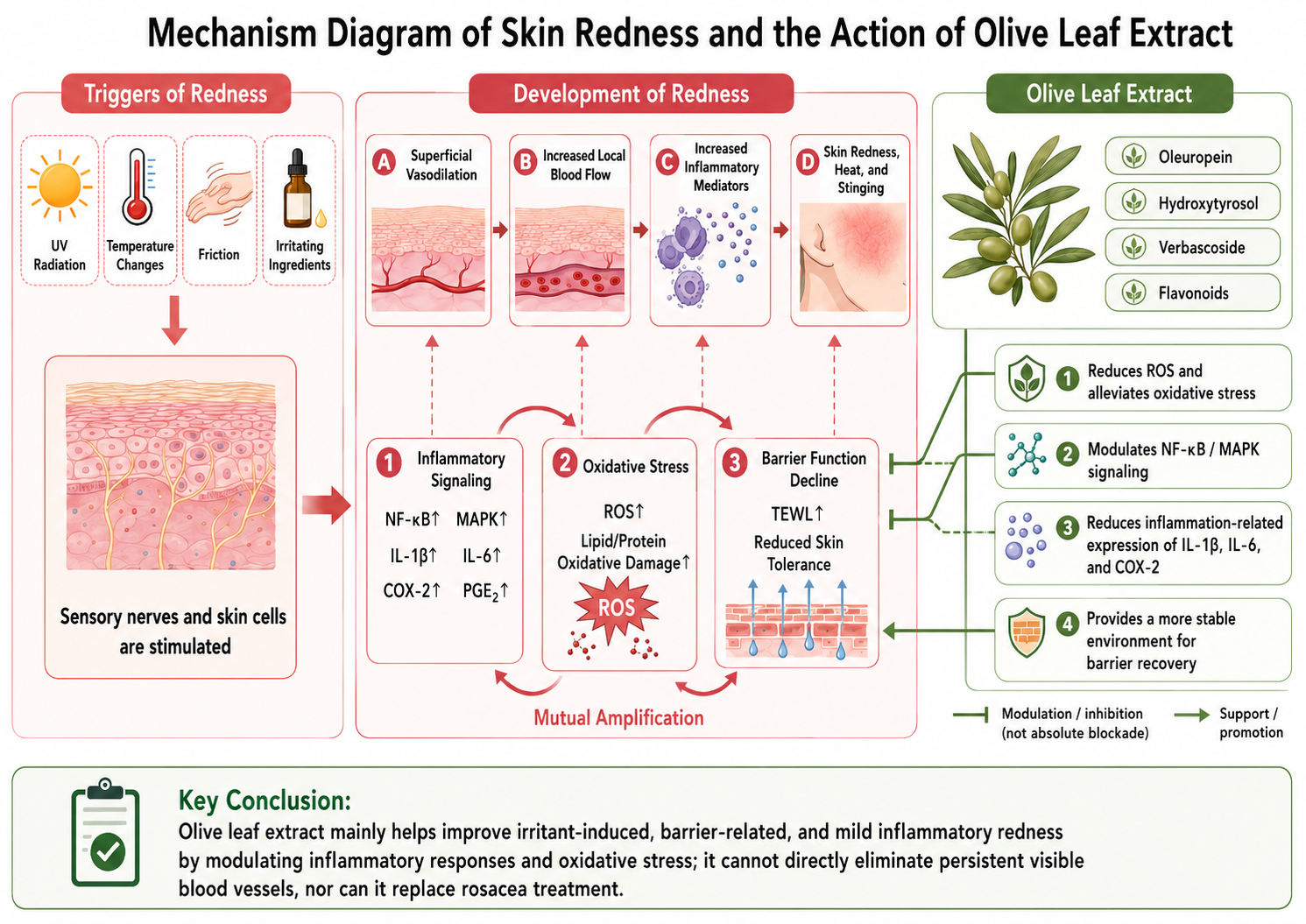
When the skin is exposed to ultraviolet radiation, temperature changes, friction, or irritating ingredients, sensory nerves, keratinocytes, and immune cells may all become activated.
Ultraviolet radiation, temperature changes, friction, or irritating ingredients → Stimulation of sensory nerves and skin cells → Dilation of superficial blood vessels and increased inflammatory mediators → Increased reactive oxygen species and impaired barrier function → Reduced skin tolerance → Persistent or recurrent redness
More specifically:
① Vasodilation increases blood flow in the superficial layers of the skin, making redness more visible.
② Sensory nerve activation contributes to burning, stinging, and flushing and may trigger the release of neuropeptides that affect blood vessels and immune cells.
③ Increased inflammatory mediators prolong vascular responses and intensify redness, warmth, swelling, and discomfort.
④ Oxidative stress and barrier impairment reduce the skin’s tolerance to temperature changes, friction, and skincare ingredients.
Skin affected by rosacea may exhibit increased transepidermal water loss (TEWL), reduced skin hydration, elevated surface pH, and abnormalities in the stratum corneum and intercellular junction structures. Once barrier function is compromised, external stimuli can affect the skin more readily, while inflammatory and vascular responses are more likely to recur, creating a mutually reinforcing feedback cycle.
1.3 Different Types of Redness Require Different Assessments
Presentation of redness | Main associated factors | Key skincare considerations |
Temporary redness after sun exposure, friction, or the use of irritating products | Acute irritation and increased inflammatory mediators and reactive oxygen species | Minimize irritation and combine moisturization with antioxidant and soothing care |
Dryness and tightness accompanied by stinging | Impaired barrier function and increased transepidermal water loss | Replenish water and barrier lipids and reduce cleansing and friction |
Recurrent flushing or burning, with or without papules | Abnormal neurovascular and inflammatory responses | Use gentle skincare and seek dermatological assessment |
Persistent visible capillaries or fixed erythema | Sustained vasodilation or changes in vascular density or tissue structure | Skincare products can only help control irritation and inflammation and are unlikely to eliminate established blood vessels |
2 What Is Olive Leaf Extract?
2.1 A Botanical Extract Whose Composition Varies with the Raw Material and Manufacturing Process
Olive leaf extract is derived from the leaves of the olive tree, Olea europaea L. Its International Nomenclature of Cosmetic Ingredients (INCI) name is generally Olea Europaea (Olive) Leaf Extract. It is not a single compound, but a mixture of secoiridoids, phenolic alcohols, phenylethanoid glycosides, flavonoids, and other plant-derived constituents.
The composition of the raw material is primarily influenced by the following factors:
① Olive cultivar, geographical origin, climate, and harvest season;
② Leaf maturity, storage conditions, and drying method;
③ Water, ethanol, or hydroethanolic extraction processes;
④ Extraction temperature, duration, and solid-to-liquid ratio;
⑤ Purification, concentration, spray-drying, or freeze-drying methods;
⑥ The proportions of carriers such as water, glycerin, propylene glycol, or maltodextrin.
The concentrations of oleuropein, hydroxytyrosol, verbascoside, and flavonoids may vary considerably among olive cultivars and extraction methods. Therefore, identical INCI names do not necessarily indicate identical active-compound concentrations or biological activities.
2.2 Major Active Constituents
Active constituent | Chemical class | Relevance to skin redness care |
Oleuropein | Phenolic secoiridoid glycoside | Reduces reactive oxygen species in certain cellular models and modulates inflammatory factors, inflammasome-related responses, NF-κB, and other signaling pathways |
Hydroxytyrosol | Phenolic alcohol | Scavenges peroxyl radicals and helps reduce oxidative damage to lipids, proteins, and cellular structures |
Verbascoside | Phenylethanoid glycoside | Contributes to antioxidant activity and the modulation of inflammatory signaling and may act together with other olive-derived polyphenols |
Luteolin, apigenin, their glycosides, and rutin | Flavonoids | Modulate oxidative stress and certain inflammatory responses; actual concentrations depend on the cultivar and extraction process |
Oleanolic acid, ursolic acid, and related compounds | Pentacyclic triterpenoids | May contribute to inflammatory modulation and cellular protection but are not generally used as the principal standardization markers for olive leaf extract |
Oleuropein is generally the most commonly used quantitative marker for olive leaf extract. Hydroxytyrosol, verbascoside, and flavonoids collectively influence the extract’s antioxidant capacity, stability, and overall biological activity. Oleocanthal has primarily been studied as a phenolic constituent of extra virgin olive oil.
3 How May Olive Leaf Extract Affect Redness-Related Responses?
3.1 Reducing Cellular Stress Caused by Excessive Reactive Oxygen Species
Reactive oxygen species (ROS) are normal products of cellular metabolism and immune responses. At appropriate levels, ROS participate in signal transduction and defense mechanisms. When ROS production becomes excessive or antioxidant clearance is insufficient, lipid peroxidation, protein oxidation, and damage to cellular structures may occur.
Oleuropein, hydroxytyrosol, and certain flavonoids contain phenolic hydroxyl groups that can donate hydrogen atoms to peroxyl radicals. A simplified reaction is shown below:
ROO• + ArOH → ROOH + ArO•
Here, ROO• represents a peroxyl radical, while ArOH represents a phenolic antioxidant molecule. By donating a hydrogen atom, the phenolic compound can terminate certain free-radical chain reactions and reduce continued radical attack on cell-membrane lipids and proteins.
Some studies have also found that combinations of oleuropein, hydroxytyrosol, and verbascoside can affect nuclear factor erythroid 2-related factor 2 (Nrf2) signaling. Nrf2 helps regulate endogenous antioxidant enzymes and cellular stress-defense systems. This activity may reduce the oxidative burden caused by excessive ROS, but it neither eliminates nor needs to eliminate all ROS in the skin.
3.2 Modulation of NF-κB- and MAPK-Related Inflammatory Signaling
Nuclear factor kappa B (NF-κB) and mitogen-activated protein kinase (MAPK) pathways are important signaling systems through which cells respond to ultraviolet radiation, oxidative stimuli, and inflammatory factors. When these pathways remain persistently activated, cells may increase the expression of inflammatory molecules such as interleukin-1 beta (IL-1β), interleukin-6 (IL-6), and cyclooxygenase-2 (COX-2).
Cyclooxygenase-2 participates in the upstream reactions involved in the synthesis of prostaglandin E₂ (PGE₂). The process can be divided into three consecutive steps:
Arachidonic acid
↓ COX-2 cyclooxygenase activity: oxygen incorporation and cyclization
Prostaglandin G₂ (PGG₂)
↓ COX-2 peroxidase activity: reduction of the hydroperoxide group
Prostaglandin H₂ (PGH₂)
↓ Catalysis by prostaglandin E synthase
Prostaglandin E₂ (PGE₂)
COX-2 does not directly complete the entire synthesis of PGE₂. Instead, it generates PGH₂, a common precursor of multiple prostaglandins. PGH₂ may subsequently be converted by different terminal synthases into lipid mediators such as PGE₂, PGD₂, PGF₂α, prostacyclin, or thromboxanes. During inflammatory responses, increased COX-2 expression, together with enhanced prostaglandin E synthase activity, often promotes PGE₂ production. PGE₂ can participate in pain, inflammation, and vascular responses, depending on the tissue environment and the prostaglandin receptors involved.
In a HaCaT keratinocyte model, purified oleuropein reduced hydrogen peroxide-induced ROS accumulation, IL-1β levels, and certain caspase-1 activities. In UVB-treated human fibroblast models, an experimental combination of purified oleuropein, hydroxytyrosol, and verbascoside reduced the phosphorylation of p38, ERK2, and NF-κB p65 while also decreasing the expression of COX-2 and certain inflammation-related molecules.
These experiments reflect changes in intracellular signaling and protein expression. Current research has not demonstrated that topically applied olive leaf extract can completely block NF-κB in the human face, directly inhibit cutaneous COX-2 enzymatic activity, or definitively reduce PGE₂ levels in human skin.
3.3 Its Role in Skin Barrier Support Is Primarily Adjunctive
Olive leaf extract may support barrier recovery by reducing inflammation and oxidative stress, but it cannot directly replace the structural lipids required by the stratum corneum.
Restoration of the skin barrier primarily depends on:
① Intercellular lipids such as ceramides, cholesterol, and free fatty acids;
② Humectants such as glycerin that help maintain water content in the stratum corneum;
③ Normal keratinocyte differentiation and restoration of cellular junctions;
④ Reducing excessive cleansing, frequent exfoliation, friction, and exposure to irritating ingredients.
Using olive leaf extract together with humectants and barrier lipids is more consistent with the practical needs of redness-prone skin than relying on a single antioxidant extract alone.
4 Can Olive Leaf Extract Improve Skin Redness?
Based on existing mechanistic studies, olive leaf extract may influence inflammatory and oxidative-stress processes associated with redness. However, these findings are insufficient to confirm that it produces a redness-reducing effect in humans, and it cannot alter established vascular structures.
4.1 Types of Redness That May Potentially Benefit Based on Mechanism
① Temporary redness caused by sun exposure, friction, or irritating skincare products;
② Redness associated with dryness, impaired barrier function, and mild stinging;
③ Mild redness and warmth involving both inflammation and oxidative stress;
④ Sensitivity-prone skin requiring combined moisturization, barrier repair, and soothing care.
4.2 Types of Redness That Cannot Be Resolved by Olive Leaf Extract Alone
① Clearly visible and persistent dilated capillaries;
② Persistent central facial erythema;
③ Rosacea involving recurrent papules, pustules, or pronounced burning;
④ Ocular symptoms such as dryness, redness, itching, or a foreign-body sensation.
Evidence directly related to skin redness currently comes mainly from chemical antioxidant assays and skin-cell models. A controlled split-face study involving 16 healthy women reported improvements in the skin-lightness L* value and transepidermal water loss at certain time points after one year of using an emulsion containing 2% olive leaf extract. However, the study did not evaluate erythema, visible redness, or rosacea, and statistically significant differences were observed mainly in a subgroup analysis of 11 participants younger than 50 years. The study therefore cannot be used to confirm a redness-reducing effect in humans. Effective concentrations and signaling changes observed in cellular studies also cannot be directly equated with reductions in facial redness in humans.
Once incorporated into a finished product, performance is further influenced by solubility, formulation stability, skin-contact time, penetration, and the actual use concentration. Olive leaf extract may be used as an antioxidant and inflammation-modulating ingredient in products for redness-prone skin, but it cannot replace medical diagnosis and treatment for persistent erythema or rosacea.
5 How Can the Quality of Olive Leaf Extract Be Assessed?
5.1 Raw-Material Identity Forms the Basis of Evaluation
The following information should be available for the raw material:
① The botanical name is identified as Olea europaea L.;
② The plant part is clearly identified as the leaf;
③ The extraction solvent, extraction ratio, and manufacturing process are specified;
④ The raw-material form is identified as a liquid extract, concentrate, or dried powder;
⑤ The carriers and their proportions, including water, glycerin, propylene glycol, or maltodextrin, are specified;
⑥ It is clearly stated whether active-compound concentrations are calculated on an as-is basis or a dry-matter basis.
An INCI name identifies only the source of the ingredient. It does not disclose the extraction process, carrier proportion, or active-compound concentration.
5.2 Oleuropein Content Must Be Interpreted Together with the Analytical Method
“Oleuropein ≥20%” may be used as an example of a standardized raw-material specification. However, it is not a universal quality standard for all olive leaf extracts and cannot independently predict soothing effects in humans.
For an oleuropein test result to be meaningfully comparable, it should also specify:
① Whether quantification was performed by high-performance liquid chromatography (HPLC);
② The reference standard, chromatographic conditions, and calculation method;
③ Whether the content was calculated on an as-is or dry-matter basis;
④ Whether the raw material contains diluting carriers;
⑤ Whether oleuropein content and chromatographic fingerprints are consistent across production batches.
Total polyphenols are generally measured using colorimetric methods, which may respond to multiple reducing substances. Such measurements cannot replace chromatographic quantification of oleuropein, hydroxytyrosol, and verbascoside.
5.3 Four Aspects Must Be Controlled to Ensure a High-Quality Raw Material
Quality dimension | Key testing requirements |
Identity and origin | Botanical species, plant part, geographical origin, extraction process, and carrier composition |
Active constituents | HPLC quantification of oleuropein, chromatographic fingerprinting of major constituents, and batch-to-batch consistency |
Purity and safety | Heavy metals, pesticide residues, residual solvents, microorganisms, and extraneous plant matter |
Stability and compatibility | Moisture, solubility, color, odor, storage stability, and compatibility with the finished formulation |
The Cosmetic Ingredient Review Expert Panel concluded that olive leaf extract is safe for use in cosmetics under the conditions and concentrations described in its safety assessment. The Panel also recommends that the industry minimize heavy metals, pesticide residues, and extraneous plant matter in botanical raw materials in accordance with relevant limits. Individual raw materials and finished products should still undergo appropriate safety assessments and necessary product verification based on their composition, use concentration, site of contact, and intended user population.
6 Formulation pH, Use Level, and Stability
6.1 pH 4.5–5.5 May Be Used as a Candidate Initial Development Range
The stability of oleuropein is affected by pH, temperature, light, oxygen, moisture, and storage duration. In studies of specific olive leaf extracts, conditions close to pH 5 favored oleuropein retention, whereas high temperatures and prolonged storage at room temperature accelerated oleuropein loss. Mildly acidic formulations are also closer to the normal surface environment of the skin. For barrier-impaired and redness-prone skin, long-term use of distinctly alkaline products may increase the effects of surfactants and other irritants on the skin barrier.
Considering both skin compatibility and stability studies conducted on specific olive leaf extracts, a finished-product pH of 4.5–5.5 may be used as a candidate initial screening range during formulation development. However, it is not the universally optimal pH range for all raw materials or formulation systems. The final pH should be determined according to the specific extract, emulsification system, preservative system, other active ingredients, and finished-product stability results.
6.2 A Use Level of 0.5%–3% Is Not Universally Applicable to All Raw Materials
The percentage of olive leaf extract added to a formulation is not equivalent to the actual oleuropein concentration.
Actual oleuropein concentration = raw-material use level × oleuropein content in the raw material
If the oleuropein content is reported on a dry-matter basis, while the material being added is a liquid containing water, glycerin, propylene glycol, or other carriers, the value should first be converted to an as-is concentration based on the solids content and carrier proportions. The following example assumes that the stated 20% oleuropein content is calculated on an as-is basis:
Raw-material use level | Theoretical oleuropein concentration |
0.5% | 0.10% |
1.0% | 0.20% |
2.0% | 0.40% |
3.0% | 0.60% |
If a liquid raw material contains only 2% oleuropein, adding 1% of that raw material would produce a theoretical oleuropein concentration of only 0.02%. Raw materials with different degrees of standardization cannot be compared solely on the basis of their formulation use levels. The final use level should be determined according to the degree of raw-material standardization, formulation stability, skin tolerability, and human efficacy data for the finished product.
6.3 Active-Compound Stability Must Be Verified by Quantitative Analysis
Oleuropein may undergo hydrolysis and degradation under the influence of moisture, temperature, light, acidic or alkaline conditions, or enzymatic activity. Hydroxytyrosol may be generated through the transformation of oleuropein and related secoiridoid derivatives.
The changes may be summarized as follows:
Oleuropein and related derivatives → aglycones and intermediate products → hydroxytyrosol and other degradation products
This process may involve multiple reaction pathways. The specific products and reaction rates depend on pH, temperature, moisture, enzymatic activity, and oxidative conditions.
Finished-product stability testing should include:
① Appearance, color, odor, pH, and viscosity;
② Centrifugation, freeze–thaw cycling, high-temperature, low-temperature, and long-term storage stability;
③ Microbial limits and preservative efficacy;
④ Changes in oleuropein content over time;
⑤ Hydroxytyrosol and major degradation products, where necessary;
⑥ The effects of light, air exposure, and packaging materials on the active constituents.
An unchanged total-polyphenol value does not necessarily mean that oleuropein has not undergone transformation. Products containing oleuropein should therefore be quantitatively tested in the final formulation and in samples collected throughout the intended shelf life.
7 Chemicals Related to the Mechanisms of Action of Olive Leaf Extract in Skin Redness, Constituent Analysis, and Antioxidant Evaluation
Table 1. Chemicals Related to the Characteristic Constituents and Analytical Study of Olive Leaf Extract
Category | CAS No. | Aladdin Cat. No. | Name | Specification or Purity | Product Features and Applications |
Characteristic phenylethanoid glycoside | 61276-17-3 | Verbascoside | Analytical standard, Moligand™, ≥99% | A representative phenylethanoid glycoside in olive leaves; used for raw-material constituent identification, quantitative analysis, chromatographic fingerprinting, batch comparison, and studies of antioxidant activity and inflammatory responses. | |
Characteristic phenolic alcohol | 501-94-0 | 2-(4-Hydroxyphenyl)ethanol | Moligand™, ≥98% | An olive-derived phenolic alcohol; used for tyrosol identification, quantitative analysis, phenolic-composition studies, and comparisons of antioxidant activity. | |
Major secoiridoid glycoside | 32619-42-4 | Oleuropein | Moligand™, ≥98% | A principal marker constituent of olive leaves; used for raw-material quantification, chromatographic fingerprinting, batch-consistency assessment, storage-stability studies, and research on inflammation and oxidative stress. | |
Characteristic phenolic alcohol | 10597-60-1 | Hydroxytyrosol (DOPET) | Moligand™, ≥98% | An important phenolic alcohol in olive leaves and a product associated with oleuropein degradation; used for constituent quantification, degradation monitoring, free-radical-scavenging studies, and cellular-protection research. | |
Related secoiridoid glycoside | 35897-92-8 | Ligustroside | ≥98% | An olive-derived secoiridoid glycoside; used for chromatographic fingerprinting, cultivar-comparison studies, extraction-process comparisons, and phenolic-composition research. | |
Secoiridoid aglycone | 31773-95-2 | Oleuropein aglycone | — | An aglycone associated with oleuropein hydrolysis; used in studies of degradation pathways, metabolic transformation, storage stability, and aglycone activity. |
Table 2. Chemicals for the Study of Olive Leaf-Related Phenolic Acids, Flavonoids, and Triterpenoids
Category | CAS No. | Aladdin Cat. No. | Name | Specification or Purity | Product Features and Applications |
Phenolic acid | 331-39-5 | Caffeic acid | Analytical standard, Moligand™ | Used for the identification and quantitative determination of phenolic acids in olive leaves, chromatographic-method development, and comparisons of antioxidant activity. | |
Flavonoid-related constituent | 491-70-3 | Luteolin | Moligand™, ≥98% (HPLC) | The aglycone of luteolin glycosides; used in studies of flavonoid composition, glycoside hydrolysis, inflammatory signaling, and oxidative stress. | |
Flavonoid-related constituent | 520-36-5 | Apigenin | Moligand™, ≥98% (HPLC) | The aglycone of apigenin glycosides; used in studies of flavonoid composition, glycoside transformation, inflammatory mediators, and cellular stress. | |
Phenolic acid | 327-97-9 | Chlorogenic acid | Moligand™, ≥98% | Used for the identification of phenolic-acid composition in olive leaves, quantitative analysis, chromatographic separation, and antioxidant-activity evaluation. | |
Flavonoid research compound | 117-39-5 | Quercetin | Moligand™, ≥95% | Used for comparisons of flavonoid antioxidant activity, studies of inflammatory signaling, and validation of analytical methods. | |
Characteristic flavonoid glycoside | 5373-11-5 | Luteolin-7-O-glucoside | ≥98% (HPLC) | A representative flavonoid glycoside in olive leaves; used for constituent identification, quantitative determination, chromatographic fingerprinting, and batch-consistency evaluation. | |
Pentacyclic triterpenoid | 77-52-1 | Ursolic acid | ≥98% | A pentacyclic triterpenoid associated with olive leaves; used in studies of triterpenoid composition, inflammatory responses, cellular protection, and skin-related effects. | |
Characteristic flavonoid glycoside | 578-74-5 | Apigenin-7-O-glucoside | ≥98% | A representative flavonoid glycoside in olive leaves; used for constituent identification, quantitative determination, chromatographic fingerprinting, and extraction-process comparisons. | |
Flavonoid glycoside | 153-18-4 | Rutin | ≥95% | Used for analysis of the flavonoid composition of olive leaves, chromatographic-method validation, free-radical-scavenging studies, and comparisons of flavonoid activity. |
Table 3. Chemicals for Research on Inflammation and the Arachidonic Acid–Prostaglandin Pathway
Category | CAS No. | Aladdin Cat. No. | Name | Specification or Purity | Product Features and Applications |
Substrate of the arachidonic acid pathway | 506-32-1 | Arachidonic acid (AA) | Moligand™, ≥99% (GC) | A biosynthetic substrate for prostaglandins and other eicosanoid mediators; used in studies of arachidonic acid metabolism, inflammatory-mediator production, and pathway intervention. | |
Cyclooxygenase inhibitor | 53-86-1 | Indomethacin (NSC-77541) | Moligand™, ≥99% | Used as an inhibitory control for the cyclooxygenase pathway and in studies of prostaglandin production, inflammatory-mediator release, and mechanisms of action. | |
Cyclooxygenase-2 inhibitor | 169590-42-5 | Celecoxib | Moligand™, ≥99% | Used as a selective COX-2 inhibition control and in studies of prostaglandin production and inflammatory signaling pathways. | |
Prostaglandin E₂ research compound | 363-24-6 | Dinoprostone | Moligand™, ≥98% | Prostaglandin E₂; used in studies of prostaglandin-receptor signaling, inflammatory-mediator stimulation, vascular responses, and cellular responses. |
Table 4. Chemicals for Oxidative-Stress Models, Cellular Oxidative-State Detection, and Antioxidant Evaluation
Category | CAS No. | Aladdin Cat. No. | Name | Specification or Purity | Product Features and Applications |
Oxidative-stress-inducing reagent | 7722-84-1 | Hydrogen peroxide solution | Suitable for microbiology, 3% | Used to establish oxidative-stress conditions and cellular-injury models and to evaluate antioxidant interventions involving olive leaf extract and its active constituents. | |
Reference antioxidant intervention compound | 616-91-1 | N-Acetyl-L-cysteine (NAC) | PharmPure™, USP, Moligand™, European Pharmacopoeia (Ph. Eur.), ≥98.5% | Used as an antioxidant intervention control and in studies of glutathione-related defense, reactive-oxygen-species regulation, and oxidative-stress mechanisms. | |
Calibration standard for total phenolic determination | 149-91-7 | Gallic acid | Moligand™, ≥99% | Used to establish standard curves for total phenolic-content assays and to express the total phenolic level of olive leaf extract as gallic acid equivalents. | |
Reference compound for antioxidant capacity | 53188-07-1 | Trolox | ≥98%, white | Used to calculate Trolox-equivalent antioxidant capacity and to compare antioxidant results obtained from different samples or analytical methods. | |
Reagent for free-radical-scavenging evaluation | 30931-67-0 | 2,2′-Azino-bis(3-ethylbenzothiazoline-6-sulfonic acid) diammonium salt [ABTS diammonium salt; AzBTS-(NH₄)₂] | ≥98% | Used to generate the ABTS radical cation (ABTS•+) for free-radical-scavenging assays and to evaluate the in vitro antioxidant capacity of olive leaf extract and individual constituents. | |
Reagent for free-radical-scavenging evaluation | 1898-66-4 | 2,2-Diphenyl-1-picrylhydrazyl radical (DPPH, containing 10%–20% benzene) | ≥97% (HPLC) | Used in stable free-radical-scavenging assays to evaluate the in vitro antioxidant capacity of botanical extracts, polyphenols, and flavonoids. | |
Fluorescent probe for cellular oxidative status | 4091-99-0 | 2′,7′-Dichlorodihydrofluorescein diacetate (DCFH-DA) | ≥97% | Used to monitor changes in the intracellular oxidative state and to evaluate oxidative stress and intervention effects following hydrogen peroxide, ultraviolet, or inflammatory stimulation. |
Note: The products listed above are primarily intended for characteristic-constituent analysis, in vitro antioxidant evaluation, and cellular-signaling-mechanism research. They are for research or analytical use only and are not necessarily suitable for direct use as cosmetic formulation ingredients or for human use. Specific catalog numbers, specifications, purities, and product names should be verified against the current information on the Aladdin website and the latest Certificate of Analysis (COA). Additional product information is available through the Aladdin website.
References
[1] Fisher GW, Travers JB, Rohan CA. Rosacea pathogenesis and therapeutics: current treatments and a look at future targets. Frontiers in Medicine. 2023;10:1292722. doi:10.3389/fmed.2023.1292722.
[2] Medgyesi B, Dajnoki Z, Béke G, et al. Rosacea is characterized by a profoundly diminished skin barrier. Journal of Investigative Dermatology. 2020;140(10):1938–1950.e5. doi:10.1016/j.jid.2020.02.025.
[3] Khelouf I, Jabri Karoui I, Lakoud A, Hammami M, Abderrabba M. Comparative chemical composition and antioxidant activity of olive leaves Olea europaea L. of Tunisian and Algerian varieties. Heliyon. 2023;9(12):e22217. doi:10.1016/j.heliyon.2023.e22217.
[4] Li H, Deng N, Yang J, et al. Anti-inflammatory and antioxidant properties of oleuropein in human keratinocytes characterized by bottom-up proteomics. Frontiers in Pharmacology. 2025;15:1496078. doi:10.3389/fphar.2024.1496078.
[5] Wang J, Yuan M, Li Q, et al. Combined protection against UVB-induced photoaging by oleuropein, hydroxytyrosol, and verbascoside through modulation of inflammation, oxidative stress, and collagen homeostasis. Scientific Reports. 2025;15:41008. doi:10.1038/s41598-025-24845-4.
[6] Ogata M, Yashiki K, Kiso A, Hashii Y, Kawashima Y. One-Year Clinical Trial of Olive Leaf Extract. Journal of Society of Cosmetic Chemists of Japan. 2021;55(4):379–384. doi:10.5107/sccj.55.379.
[7] Expert Panel for Cosmetic Ingredient Safety. Safety Assessment of Olea europaea (Olive)-Derived Ingredients as Used in Cosmetics. Cosmetic Ingredient Review. Final Report. 2023.
[8] Safarzadeh Markhali F, Teixeira JA. Effect of storage, temperature, and pH on the preservation of the oleuropein content of olive leaf extracts. Sustainable Food Technology. 2024;2:750–759. doi:10.1039/D4FB00044G.
More Related Articles
See below for additional related articles:
Ferulic Acid: Structural Features, Preparation Routes, and Key Points for Research Applications
Role of Sphingolipid Metabolic Remodeling in Apoptotic and Inflammatory Signaling
How to decipher the whitening code?
Niacin (Vitamin B3): Structural Features, Metabolic Roles, and Application Landscape
The "Six Key Checkpoints" of Skin Lightening
Tyrosinase: a key regulatory enzyme in melanin synthesis and its biological and applied significance
Enzymatic Hydroxylation Mechanism of Salicylate Conversion to Catechol


 危险品化学品经营许可证(带存储)