Structure–Property Relationships and Identification of Phenylpropanoid Alcohols and Aldehydes: C9 Oxidation State, Conjugation Effects, and Aromatic-Ring Substitution
Structure–Property Relationships and Identification of Phenylpropanoid Alcohols and Aldehydes: C9 Oxidation State, Conjugation Effects, and Aromatic-Ring Substitution
1 Basic Structures of Phenylpropanoid Alcohols and Aldehydes
1.1 The C6–C3 skeleton and terminal side-chain functional groups
The three-carbon side chain of a phenylpropanoid is generally numbered with the carbon directly attached to the aromatic ring as C7, followed by C8 and C9 [1–2]. In a representative cinnamyl structure, a double bond is present between C7 and C8:
Ar–C7H=C8H–C9H₂OH
Ar–C7H=C8H–C9(=O)H
The phenylpropanoid alcohols and aldehydes discussed in this article mainly refer to cinnamyl alcohol, cinnamaldehyde, and their oxygenated aromatic-ring derivatives, which contain Ar–CH=CH–CH₂OH and Ar–CH=CH–CHO side chains, respectively. These two classes of compounds share the same aromatic ring–C7=C8 skeleton, and the principal distinction between them is determined by the C9 functional group.
The C7=C8 double bond also permits E/Z geometric isomerism. The classic natural monolignols and their corresponding aldehydes covered in this article are discussed mainly with reference to their E forms; when comparing reference standards or performing chromatographic analysis and spectroscopic confirmation, the geometric configuration of the specific product should also be verified.
1.2 Principal representative structural series
The structural diversity of natural phenylpropanoid alcohols and aldehydes also arises from hydroxylation and methoxylation of the aromatic ring. Common representatives can be arranged into the following corresponding series:
Aromatic-ring substitution | Phenylpropanoid alcohol | Molecular formula | Phenylpropanoid aldehyde | Molecular formula |
No additional oxygen-containing substituents | Cinnamyl alcohol | C₉H₁₀O | Cinnamaldehyde | C₉H₈O |
4-OH | p-Coumaryl alcohol | C₉H₁₀O₂ | p-Coumaraldehyde | C₉H₈O₂ |
3-OCH₃, 4-OH | Coniferyl alcohol | C₁₀H₁₂O₃ | Coniferaldehyde | C₁₀H₁₀O₃ |
3,5-di-OCH₃, 4-OH | Sinapyl alcohol | C₁₁H₁₄O₄ | Sinapaldehyde | C₁₁H₁₂O₄ |
Among these compounds, p-coumaryl alcohol, coniferyl alcohol, and sinapyl alcohol are the three classic monolignols involved in plant lignin biosynthesis and are associated with p-hydroxyphenyl (H), guaiacyl (G), and syringyl (S) lignin units, respectively.[3–4]
2 Relationship Between Side-Chain Oxidation State and Plant Biosynthesis
2.1 —CH₂OH and —CHO represent different C9 oxidation states
In terms of formal oxidation state, the C9 carbon of a phenylpropanoid alcohol has two C—H bonds, one C—O bond, and one C—C bond, giving it a formal oxidation number of −1. The aldehydic C9 carbon has one C=O double bond, one C—H bond, and one C—C bond, giving it a formal oxidation number of +1.
Ar–CH=CH–CH₂OH → Ar–CH=CH–CHO
This transformation corresponds to an increase in the C9 oxidation number from −1 to +1, namely an oxidation process involving the loss of two hydrogen atoms.
A phenylpropanoid alcohol and aldehyde with the same aromatic-ring substitution pattern differ in molecular composition by H₂. For example:
Coniferyl alcohol C₁₀H₁₂O₃ and coniferaldehyde C₁₀H₁₀O₃
Their nominal molecular masses differ by approximately 2 Da. This relationship has structural discriminatory value in mass-spectrometric analysis.
2.2 Hydroxycinnamoyl coenzyme A forms phenylpropanoid alcohols through aldehyde intermediates
In plant monolignol biosynthesis, phenylpropanoic acid derivatives are activated with coenzyme A and then undergo sequential reduction steps:
Hydroxycinnamoyl-CoA
↓ Cinnamoyl-CoA reductase
Hydroxycinnamaldehyde
↓ Cinnamyl alcohol dehydrogenase
Hydroxycinnamyl alcohol
Cinnamoyl-CoA reductase (CCR) uses reduced nicotinamide adenine dinucleotide phosphate (NADPH) as the source of reducing equivalents to reduce hydroxycinnamoyl-CoA to the corresponding hydroxycinnamaldehyde. Cinnamyl alcohol dehydrogenase (CAD) then reduces p-coumaraldehyde, coniferaldehyde, and sinapaldehyde to the corresponding p-coumaryl alcohol, coniferyl alcohol, and sinapyl alcohol.[4–6]
Representative reactions include:
p-Coumaraldehyde → p-Coumaryl alcohol
Coniferaldehyde → Coniferyl alcohol
Sinapaldehyde → Sinapyl alcohol
CCR and CAD constitute two important terminal reduction steps in the monolignol pathway. In actual plant phenylpropanoid metabolism, aromatic-ring hydroxylation and methylation can occur at different intermediate stages, and complete monolignol biosynthesis forms an interconnected metabolic network rather than a single linear reaction sequence.[3–5]
Figure 1 uses the p-coumaryl, caffeyl, and coniferyl structural series to illustrate the common side-chain conversion sequence of “hydroxycinnamoyl-CoA–hydroxycinnamaldehyde–hydroxycinnamyl alcohol.” Hydroxycinnamaldehydes are generally important intermediates in the formation of the corresponding hydroxycinnamyl alcohols; some hydroxycinnamaldehydes can also enter lignin as aldehydic residues, and their accumulation and incorporation may increase when CAD activity is reduced [7,9].
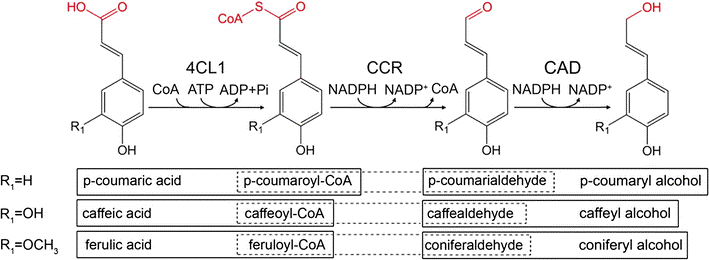
Figure 1. Biosynthetic relationship between hydroxycinnamaldehydes and hydroxycinnamyl alcohols
The figure shows the activation of 4-hydroxycinnamic acids by 4CL1 to form the corresponding acyl-CoA derivatives, followed by reduction by CCR to form hydroxycinnamaldehydes and subsequent reduction by CAD, using NADPH as the source of reducing equivalents, to form the corresponding hydroxycinnamyl alcohols. The p-coumaryl, caffeyl, and coniferyl series exhibit the same “acyl-CoA–aldehyde–alcohol” pattern of functional-group transformation. Source: Liu S, Liu J, Hou J, et al. Microbial Cell Factories, 2017, Figure 1, CC BY 4.0.[7]
3 Effects of Side-Chain Oxidation State on Physicochemical Properties
3.1 Conjugated systems and electronic structure
The representative structure of a phenylpropanoid alcohol is:
Ar–CH=CH–CH₂OH
The aromatic ring can conjugate with the C7=C8 double bond, but the C9 hydroxymethyl carbon is sp³-hybridized, so continuous π conjugation terminates beyond C8.
The structure of a phenylpropanoid aldehyde is:
Ar–CH=CH–CHO
C9 changes from an sp³-hybridized hydroxymethyl carbon to an sp²-hybridized carbonyl carbon, forming an extended, continuous Ar–C=C–C=O conjugated system.
A phenylpropanoid aldehyde not only contains an additional carbonyl group but also forms a representative α,β-unsaturated carbonyl structure. Electron delocalization between C=C and C=O gives the aldehyde an electronic structure, ultraviolet absorption profile, and chemical reactivity that differ significantly from those of the corresponding alcohol.
3.2 Ultraviolet absorption
Both the aromatic ring and C=C can produce ultraviolet absorption. When the terminal —CH₂OH group is oxidized to —CHO, C=O becomes incorporated into the existing conjugated system, generally giving hydroxycinnamaldehydes more pronounced absorption at longer wavelengths.
In a practical high-performance liquid chromatography study, p-coumaraldehyde, caffealdehyde, coniferaldehyde, and sinapaldehyde were detected at approximately 340 nm, whereas p-coumaryl alcohol, caffeyl alcohol, and coniferyl alcohol were detected at approximately 280 nm.[7] This difference has been used to distinguish the corresponding aldehydes and alcohols simultaneously.
These wavelengths are detection conditions from a specific analytical method and are not fixed absorption maxima for all phenylpropanoid alcohols and aldehydes. The number and positions of —OH and —OCH₃ groups on the aromatic ring, as well as the solvent and pH, can alter the actual ultraviolet spectrum.
3.3 Hydrogen bonding, polarity, and solubility behavior
The terminal hydroxy group of a phenylpropanoid alcohol, —CH₂OH, can act as both a hydrogen-bond donor and a hydrogen-bond acceptor.
In the —CHO group of a phenylpropanoid aldehyde, the carbonyl oxygen acts mainly as a hydrogen-bond acceptor and cannot provide the same hydrogen-bond donor function as an alcoholic hydroxy group. At the same time, C=O has a substantial bond dipole.
Conversion of —CH₂OH to —CHO changes the molecule’s hydrogen-bonding pattern and dipole distribution.
However, this alone does not establish that all phenylpropanoid alcohols are more polar than their corresponding aldehydes, or vice versa.
The solubility behavior of the complete molecule is controlled by the following structural factors:
① The aromatic ring and unsaturated side chain provide a relatively large hydrophobic region;
② The alcoholic hydroxy or aldehyde carbonyl group provides polar interactions;
③ Phenolic hydroxy groups increase hydrogen-bonding capacity and exhibit weak acidity;
④ Methoxy groups alter the electronic properties of the aromatic ring and intermolecular interactions.
Less highly substituted members, such as cinnamyl alcohol and cinnamaldehyde, are sufficiently volatile for direct gas-chromatographic analysis; coniferyl alcohol, sinapyl alcohol, and the corresponding aldehydes, which contain more hydroxy and methoxy substituents, are often analyzed by liquid chromatography.
3.4 Acid–base properties
Terminal primary alcoholic hydroxy and aldehyde groups remain neutral under ordinary aqueous conditions and are not functional groups that readily undergo acid–base ionization.
p-Coumaryl alcohol, coniferyl alcohol, sinapyl alcohol, and their corresponding aldehydes contain phenolic hydroxy groups and exhibit the weak acidity characteristic of phenols. Under sufficiently alkaline conditions, the phenolic hydroxy group can be deprotonated to form a phenolate.
3.5 Chemical reactivity and stability
The principal reactive sites in a phenylpropanoid alcohol include:
① The terminal primary alcoholic hydroxy group;
② The C7=C8 double bond;
③ The phenolic hydroxy group on the aromatic ring.
The —CH₂OH group can undergo reactions such as oxidation, esterification, and etherification; oxidation can form the corresponding phenylpropanoid aldehyde.
The —CHO group in a phenylpropanoid aldehyde exhibits more pronounced carbonyl reactivity and can undergo:
① Reduction to the corresponding phenylpropanoid alcohol;
② Oxidation to the corresponding phenylpropanoic acid;
③ Nucleophilic addition at the carbonyl carbon;
④ Conjugate addition to the α,β-unsaturated carbonyl system.
Ar–CH=CH–CHO: the carbonyl carbon is electrophilic, and C=C is influenced by the electron-withdrawing effect of the carbonyl group; the entire C=C–CHO fragment therefore functions as a continuous reactive unit.
Air, light, and temperature can all affect the stability of phenylpropanoids with unsaturated side chains; compounds containing phenolic hydroxy groups may additionally undergo phenolic oxidation. Further oxidation of a phenylpropanoid aldehyde to the corresponding acid is one of the changes that must be controlled during sample storage and quantitative analysis.
4 Further Modulation of Alcohol and Aldehyde Properties by Aromatic-Ring Substitution
The side-chain groups —CH₂OH and —CHO determine the fundamental distinction between phenylpropanoid alcohols and aldehydes, while differences within each class are further controlled by aromatic-ring substitution.
4.1 The p-coumaryl series: 4-hydroxy substitution
p-Coumaryl alcohol and p-coumaraldehyde contain one para-phenolic hydroxy group: 4-OH.
The phenolic hydroxy group increases hydrogen-bonding capacity, exhibits weak acidity, and can participate in phenolic redox reactions.
4.2 The coniferyl series: 3-methoxy-4-hydroxy substitution
Coniferyl alcohol and coniferaldehyde have the following substitution pattern: 3-OCH₃, 4-OH.
This is a representative guaiacyl substitution pattern. The methoxy group can influence the electron distribution of the aromatic ring through resonance effects and provides an additional hydrogen-bond acceptor, but it lacks the hydrogen-bond donor function and ionizable hydrogen of a phenolic hydroxy group.
Coniferyl alcohol is an important monomeric precursor of G-type lignin, and coniferaldehyde is its direct biosynthetic precursor.[3–5]
4.3 The sinapyl series: 3,5-dimethoxy-4-hydroxy substitution
Sinapyl alcohol and sinapaldehyde have the following substitution pattern: 3,5-di-OCH₃, 4-OH.
This series contains one more methoxy group than the coniferyl series, a representative feature of the syringyl substitution pattern. Sinapyl alcohol is closely associated with the formation of S-type lignin units.[3–4]
The variations among the three structural series can be summarized as follows:
Series | Principal aromatic-ring substitution | Phenylpropanoid alcohol | Phenylpropanoid aldehyde |
p-Coumaryl series | 4-OH | p-Coumaryl alcohol | p-Coumaraldehyde |
Coniferyl series | 3-OCH₃, 4-OH | Coniferyl alcohol | Coniferaldehyde |
Sinapyl series | 3,5-di-OCH₃, 4-OH | Sinapyl alcohol | Sinapaldehyde |
The properties of phenylpropanoid alcohols and aldehydes are jointly determined at two structural levels: the C9 functional group determines the fundamental distinction between an alcohol and an aldehyde, while hydroxylation and methoxylation of the aromatic ring determine further differences within each class.
5 Common Methods for the Detection, Identification, and Structural Confirmation of Phenylpropanoid Alcohols and Aldehydes
5.1 Functional-group reactions and thin-layer chromatography
Phenylpropanoid aldehydes contain a carbonyl group and can be examined using carbonyl reagents as an aid to identification. For example, 2,4-dinitrophenylhydrazine can react with aldehyde and ketone carbonyl groups to form hydrazone derivatives, whereas the corresponding phenylpropanoid alcohol does not undergo this carbonyl reaction.
Chemical visualization is suitable for preliminary functional-group screening but cannot independently identify a specific structure.
Thin-layer chromatography (TLC) can be used to compare the Rf values and visualization characteristics of a sample and reference standard and is suitable for rapidly screening constituents such as cinnamyl alcohol and cinnamaldehyde. Reliable confirmation of structurally similar phenylpropanoid alcohols and aldehydes also requires reference standards and results from other instrumental analyses.
5.2 The phloroglucinol–hydrochloric acid reaction and hydroxycinnamaldehydes
The phloroglucinol–hydrochloric acid reaction, also known as the Wiesner reaction, has long been used for the histochemical examination of lignified plant tissues.
Studies of its chemical basis have shown that hydroxycinnamaldehyde structures are closely associated with the characteristic color produced by this reaction. Modern quantitative studies have further demonstrated that Wiesner staining can be used to observe the accumulation of coniferaldehyde residues in lignin systems.[9]
This method is used mainly to study hydroxycinnamaldehyde structures in lignified tissues and lignin and is not a general-purpose confirmatory method for all samples of free phenylpropanoid aldehydes.
5.3 HPLC–DAD/PDA
High-performance liquid chromatography (HPLC) is suitable for analyzing p-coumaryl alcohol, coniferyl alcohol, sinapyl alcohol, and the corresponding hydroxycinnamaldehydes.
When coupled with a diode array detector (DAD; also called a photodiode array detector, PDA), it can simultaneously provide:
① Chromatographic retention time;
② Ultraviolet absorption spectra;
③ Responses at different detection wavelengths.
Hydroxycinnamaldehydes have a longer Ar–C=C–C=O conjugated system, allowing their longer-wavelength absorption to be used to distinguish them from the corresponding phenylpropanoid alcohols.
For example, in the method reported in reference [7]:
Type | Representative compounds | Example detection wavelength |
Hydroxycinnamaldehydes | p-Coumaraldehyde, caffealdehyde, coniferaldehyde, and sinapaldehyde | 340 nm |
Hydroxycinnamyl alcohols | p-Coumaryl alcohol, caffeyl alcohol, and coniferyl alcohol | 280 nm |
5.4 LC–MS and the mass difference between alcohols and aldehydes
Liquid chromatography–mass spectrometry (LC–MS) is suitable for the simultaneous analysis of multiple hydroxycinnamyl alcohols and hydroxycinnamaldehydes.
For a pair of compounds with the same aromatic-ring substitution pattern, conversion of the alcohol to the aldehyde corresponds to the loss of H₂; their neutral molecular masses therefore differ by approximately 2 Da.
LC–MS can combine pseudomolecular-ion mass, chromatographic retention, and tandem mass-spectrometric (MS/MS) fragmentation for determination. The mass difference alone indicates only a change in molecular composition; positional isomers and other isomers still require retention time, reference standards, and fragmentation information for confirmation.
5.5 GC–MS
Gas chromatography–mass spectrometry (GC–MS) is suitable for phenylpropanoid alcohols and aldehydes with sufficient volatility and thermal stability.
Cinnamaldehyde has a low molecular weight and contains no free phenolic hydroxy group, allowing it to be separated, qualitatively identified, and quantitatively analyzed by GC–MS.[10] Cinnamyl alcohol can likewise be analyzed by GC or GC–MS under appropriate chromatographic conditions.
p-Coumaryl alcohol, coniferyl alcohol, sinapyl alcohol, and their corresponding aldehydes contain free phenolic hydroxy groups, which increase polarity and intermolecular hydrogen bonding. Without derivatization, their volatility and peak shape may affect GC analysis. These compounds are frequently analyzed by HPLC or LC–MS; when GC–MS is used, appropriate derivatization can be performed according to the structure of the target analyte.
5.6 IR: hydroxy and carbonyl groups provide functional-group information
Infrared (IR) spectroscopy can directly reveal the distinction between —CH₂OH and —CHO.
Phenylpropanoid alcohols principally exhibit O—H stretching, C—O stretching, and C=C and aromatic-ring vibrations.
Phenylpropanoid aldehydes exhibit pronounced conjugated C=O absorption, aldehydic C—H-related absorption, and C=C and aromatic-ring vibrations.
Infrared and Raman spectroscopic studies of coniferyl alcohol and coniferaldehyde have confirmed that their hydroxymethyl and conjugated aldehyde groups produce different vibrational spectral characteristics; the C=C–C=O system in coniferaldehyde also produces characteristic vibrations of substantial diagnostic value.[8]
5.7 NMR: the signal difference between CH₂OH and CHO is the most direct
Nuclear magnetic resonance (NMR) spectroscopy can directly determine whether the terminal side-chain carbon is present as an alcohol or aldehyde.
For the trans-p-coumaryl series, the literature reports:
p-Coumaryl alcohol
The ¹H NMR signal of —CH₂OH is located at approximately δH 4.20.
The ¹³C NMR signal of the corresponding C9 carbon is approximately δC 63.5.
p-Coumaraldehyde
The aldehydic proton can be located at δH 9.64.
The signal of the aldehydic C9 carbonyl carbon is approximately δC 193.8.[6]
This difference can be used for structural confirmation.
6 Correspondence Between Side-Chain Oxidation State, Properties, and Identification Methods
Structural feature | Phenylpropanoid alcohol | Phenylpropanoid aldehyde | Resulting analytical difference |
C9 functional group | —CH₂OH | —CHO | Alcoholic hydroxy and aldehyde carbonyl groups react differently |
C9 hybridization | sp³ | sp² | The aldehyde group becomes incorporated into the π-conjugated system |
Extent of conjugation | Ar–C=C | Ar–C=C–C=O | Aldehydes generally exhibit more pronounced long-wavelength UV absorption |
Hydrogen bonding | OH can donate and accept hydrogen bonds | C=O primarily accepts hydrogen bonds | Affects solvent interactions and chromatographic behavior |
Oxidation state | Lower at C9 | Higher at C9 | The corresponding aldehyde contains two fewer hydrogen atoms than the alcohol |
Molecular mass | Approximately 2 Da higher than the corresponding aldehyde | Approximately 2 Da lower than the corresponding alcohol | LC–MS can assist in differentiation |
Principal chemical reactions | Oxidation, esterification, and etherification | Oxidation, reduction, carbonyl addition, and conjugate addition | Functional-group reactions can assist in screening |
UV detection | Generally at shorter wavelengths | Shifted to longer wavelengths as a result of extended conjugation | HPLC–DAD/PDA can utilize spectral differences |
IR | OH, C—O | Conjugated C=O, aldehydic C—H | Functional-group identification |
¹H NMR | CH₂OH generally in the approximately 4 ppm region | CHO generally in the 9–10 ppm region | Clear differentiation between alcohols and aldehydes |
¹³C NMR | C9 generally in the approximately 60 ppm region | C9 generally in the approximately 190 ppm region | Direct confirmation of oxidation state |
7 Structural Classification and Research Applications of Representative Phenylpropanoid Alcohol and Aldehyde Products
Table 1. Phenylpropanoid Alcohol Products
Classification | CAS No. | Aladdin Cat. No. | Name | Specification or purity | Product features and applications |
Dihydroxy phenylpropanoid alcohol—catechol type | 3598-26-3 | Caffeyl alcohol | ≥95% | Catechol-type phenylpropanoid alcohol; used in studies of monolignol biosynthesis, aromatic-ring hydroxylation, redox behavior, and lignin structure. | |
Monohydroxy phenylpropanoid alcohol—para-hydroxy monolignol | 3690-05-9 | p-Hydroxycinnamyl alcohol | ≥98% | Representative H-type monolignol; used in studies of monolignol biosynthesis and cinnamyl alcohol dehydrogenase substrates, and in lignin monomer analysis. | |
Hydroxy-methoxy phenylpropanoid alcohol—guaiacyl monolignol | 458-35-5 | Coniferyl alcohol | ≥98% | Representative G-type monolignol; used for coniferaldehyde/coniferyl alcohol redox comparisons and in studies of lignin biosynthesis and enzymology. | |
Hydroxy-dimethoxy phenylpropanoid alcohol—syringyl monolignol | 537-33-7 | Sinapyl alcohol | Moligand™, ≥95% | Representative S-type monolignol; used in studies of the sinapaldehyde/sinapyl alcohol redox relationship, lignin monomer composition, and metabolism. | |
Basic cinnamyl alcohol type—E form | 4407-36-7 | (E)-Cinnamyl alcohol | ≥97% | Basic phenylpropanoid alcohol with a defined E configuration; used in alcohol/aldehyde oxidation-state comparisons and studies of double-bond configuration and spectroscopic analysis. | |
Basic cinnamyl alcohol type | 104-54-1 | Cinnamyl alcohol | ≥98% | Representative basic cinnamyl alcohol structure; used in studies of cinnamyl alcohol/cinnamaldehyde functional-group transformations, redox behavior, and chromatographic methods. | |
Monomethoxy phenylpropanoid alcohol—para-methoxy type | 53484-50-7 | 4-Methoxycinnamyl alcohol | —— | Para-methoxy-substituted phenylpropanoid alcohol; used to investigate the effects of aromatic-ring methoxylation on polarity, electronic properties, and chromatographic behavior. | |
Dimethoxy phenylpropanoid alcohol | 40918-90-9 | (E)-3,4-Dimethoxycinnamyl alcohol | Moligand™, ≥97% | Dimethoxy-substituted phenylpropanoid alcohol; used to investigate the effects of methoxy-group number and position on molecular polarity, spectroscopic properties, and oxidative behavior. | |
Trimethoxy phenylpropanoid alcohol | 30273-62-2 | 3,4,5-Trimethoxycinnamyl alcohol | ≥95% | Trimethoxy-substituted phenylpropanoid alcohol; used in studies of the electronic effects and lipophilicity of polymethoxylated aromatic rings and structure–chromatography relationships. |
Table 2. Phenylpropanoid Aldehyde Products
Classification | CAS No. | Aladdin Cat. No. | Name | Specification or purity | Product features and applications |
Dihydroxy phenylpropanoid aldehyde—catechol type | 141632-15-7 | (2E)-3-(3,4-Dihydroxyphenyl)prop-2-enal | —— | Caffealdehyde-type conjugated aldehyde; used in studies of catechol structures, carbonyl reactivity, phenylpropanoid alcohol/aldehyde redox processes, and metabolic intermediates. | |
Monohydroxy phenylpropanoid aldehyde—ortho-hydroxy type | 60125-23-7 | o-Hydroxycinnamaldehyde | ≥95% | Ortho-hydroxy-substituted conjugated phenylpropanoid aldehyde; used to investigate the effects of hydroxy-group position on conjugation, intramolecular hydrogen bonding, and chromatographic behavior. | |
Monohydroxy phenylpropanoid aldehyde—para-hydroxy type | 2538-87-6 | 3-(4-Hydroxyphenyl)acrylaldehyde | ≥95% | p-Coumaraldehyde-type structure; used in p-coumaryl alcohol/aldehyde redox comparisons and studies of cinnamyl alcohol dehydrogenase and lignin precursors. | |
Hydroxy-methoxy phenylpropanoid aldehyde—guaiacyl type | 458-36-6 | 4-Hydroxy-3-methoxycinnamaldehyde | ≥98% | Coniferaldehyde-type structure; used in studies of coniferaldehyde/coniferyl alcohol oxidation-state interconversion, G-type lignin precursors, and enzymology. | |
Hydroxy-dimethoxy phenylpropanoid aldehyde—syringyl type | 4206-58-0 | trans-3,5-Dimethoxy-4-hydroxycinnamaldehyde | ≥98% | Sinapaldehyde-type conjugated aldehyde; used in studies of sinapaldehyde/sinapyl alcohol conversion, S-type lignin biosynthesis, and structural analysis. | |
Hydroxy-dimethoxy phenylpropanoid aldehyde—syringyl type | 4206-58-0 | Sinapaldehyde | Moligand™, 10 mM in DMSO | Sinapaldehyde solution product; used in enzyme-activity screening, cellular experiments, metabolic-pathway studies, and quantitative analysis. | |
Basic cinnamaldehyde type—E form | 14371-10-9 | Cinnamaldehyde | ≥98% | Representative E-form conjugated phenylpropanoid aldehyde; used in studies of α,β-unsaturated aldehydes, carbonyl reactivity, cinnamyl alcohol/aldehyde structural comparisons, and spectroscopic analysis. | |
Basic cinnamaldehyde type | 104-55-2 | Cinnamaldehyde | Moligand™, ≥95% (GC) | Representative basic phenylpropanoid aldehyde structure; used in studies of conjugated-aldehyde reactions, redox behavior, and gas- and liquid-chromatographic methods. | |
Monomethoxy phenylpropanoid aldehyde—ortho-methoxy type | 1504-74-1 | 2-Methoxycinnamaldehyde | ≥98% | Ortho-methoxy-substituted phenylpropanoid aldehyde; used to investigate the effects of substituent position on conjugated electronic structure, polarity, and chromatographic retention. | |
Monomethoxy phenylpropanoid aldehyde—para-methoxy type | 1963-36-6 | 4-Methoxycinnamaldehyde | Moligand™, 10 mM in DMSO | Para-methoxy-substituted conjugated aldehyde; used in studies of aromatic-ring methoxy electronic effects, carbonyl reactions, cellular experiments, and structure–activity relationships. |
Note: The products listed above are representative Aladdin products related to scientific research. Their specific uses should be determined in conjunction with the product specifications, batch COA, and the intended reaction or evaluation system. Further information on product specifications, grades, and COAs can be retrieved from the Aladdin website using the product name, CAS number, or catalog number.
References
[1] Zhu Z, Chen R, Zhang L. Simple phenylpropanoids: recent advances in biological activities, biosynthetic pathways, and microbial production. Natural Product Reports, 2024, 41(1): 6–24. doi:10.1039/D3NP00012E.
[2] Vogt T. Phenylpropanoid biosynthesis. Molecular Plant, 2010, 3(1): 2–20. doi:10.1093/mp/ssp106.
[3] Boerjan W, Ralph J, Baucher M. Lignin biosynthesis. Annual Review of Plant Biology, 2003, 54: 519–546. doi:10.1146/annurev.arplant.54.031902.134938.
[4] Vanholme R, Demedts B, Morreel K, Ralph J, Boerjan W. Lignin biosynthesis and structure. Plant Physiology, 2010, 153(3): 895–905. doi:10.1104/pp.110.155119.
[5] Pan H, Zhou R, Louie GV, et al. Structural studies of cinnamoyl-CoA reductase and cinnamyl-alcohol dehydrogenase, key enzymes of monolignol biosynthesis. The Plant Cell, 2014, 26(9): 3709–3727. doi:10.1105/tpc.114.127399.
[6] Jun SY, Walker AM, Kim H, et al. The enzyme activity and substrate specificity of two major cinnamyl alcohol dehydrogenases in sorghum (Sorghum bicolor), SbCAD2 and SbCAD4. Plant Physiology, 2017, 174(4): 2128–2145. doi:10.1104/pp.17.00576.
[7] Liu S, Liu J, Hou J, et al. Three steps in one pot: biosynthesis of 4-hydroxycinnamyl alcohols using immobilized whole cells of two genetically engineered Escherichia coli strains. Microbial Cell Factories, 2017, 16: 104. doi:10.1186/s12934-017-0722-9.
[8] Bock P, Gierlinger N. Infrared and Raman spectra of lignin substructures: coniferyl alcohol, abietin, and coniferyl aldehyde. Journal of Raman Spectroscopy, 2019, 50(6): 778–792. doi:10.1002/jrs.5588.
[9] Blaschek L, Champagne A, Dimotakis C, et al. Cellular and genetic regulation of coniferaldehyde incorporation in lignin of herbaceous and woody plants by quantitative Wiesner staining. Frontiers in Plant Science, 2020, 11: 109. doi:10.3389/fpls.2020.00109.
[10] Zhao H, Xie Y, Yang Q, et al. Pharmacokinetic study of cinnamaldehyde in rats by GC-MS after oral and intravenous administration. Journal of Pharmaceutical and Biomedical Analysis, 2014, 89: 150–157. doi:10.1016/j.jpba.2013.10.044.
For more related articles, see below:
Ferulic Acid: Structural Features, Preparation Routes, and Key Points for Research Applications


 危险品化学品经营许可证(带存储)