
Structure–Reactivity Relationships of Naphthoquinone Compounds: Structural Control of Electron Transfer and Nucleophilic Addition
Structure–Reactivity Relationships of Naphthoquinone Compounds: Structural Control of Electron Transfer and Nucleophilic Addition
Naphthoquinones are formed by fusion of a quinonoid six-membered ring containing two carbonyl groups with a benzene ring. This fused structure gives the molecule both a quinonoid reactive region and a benzenoid ring region, which influence each other through a continuous π system. The quinonoid region is primarily responsible for electron acceptance and electrophilic reactivity, whereas the fused benzene ring extends the molecular orbitals and allows substituents at different positions to modulate the electronic properties of the quinone ring.
Naphthoquinones therefore exhibit two important reaction pathways: acceptance of electrons to form semiquinones and further reduced states, and acceptance of electron pairs from nucleophiles to form new covalent bonds such as C—S and C—N bonds. Carbonyl arrangement, substitution position, intramolecular hydrogen bonding, and the reaction medium collectively influence these two types of reactions.
1 Fused Aromatic Rings Establish the Electronic-Structure Basis of Naphthoquinones
1.1 1,2- and 1,4-Carbonyl Arrangements Generate Distinct Quinonoid Electronic Structures
Naphthoquinones mainly comprise two basic structural frameworks: 1,2-naphthoquinone and 1,4-naphthoquinone. In 1,2-naphthoquinone, the two carbonyl groups are adjacent, whereas in 1,4-naphthoquinone, the two carbonyl groups occupy the 1- and 4-positions of the quinonoid six-membered ring. The relative positions of the carbonyl groups alter the connectivity of the quinonoid π system and also change the spatial relationship between the two oxygen-containing centers after one-electron reduction.[2]
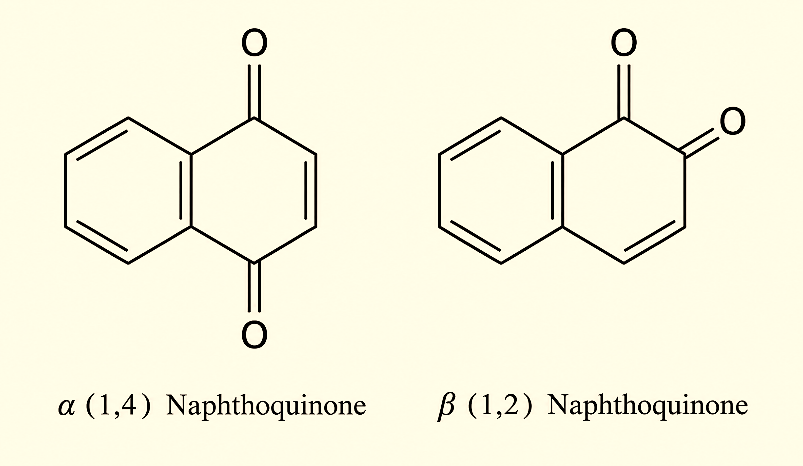
Taking 1,4-naphthoquinone as an example, C1 and C4 are the carbonyl carbons, while C2=C3 forms an alkene bond conjugated with both carbonyl groups; on the other side is the benzenoid ring fused to the quinone ring. The entire molecule contains a continuous π-electron system, but the electronic properties of the individual positions are not equivalent. The quinonoid region encompassing C1–C4 directly participates in electron acceptance and nucleophilic addition, whereas the benzenoid ring alters the electron-accepting orbitals and substituent electronic effects through conjugation.
The same substituent can therefore exert markedly different electronic effects on the quinone center depending on whether it is located on the quinone ring or the benzenoid ring.
1.2 One-Electron Reduction Is Accompanied by π-Electron and Molecular Geometric Rearrangement
After accepting one electron, 1,4-naphthoquinone forms a semiquinone radical anion:
NQ + e⁻ ⇌ NQ•⁻
Here, NQ represents 1,4-naphthoquinone, and NQ•⁻ represents its semiquinone radical anion.
After an electron enters an acceptor orbital of the naphthoquinone, the added electron density is distributed over the carbonyl-containing conjugated system, resulting in adjustments to the bond orders of C=O, C—C, and C=C bonds. One-electron reduction therefore involves changes in both electronic occupancy and molecular geometry.
In 2025, White et al. investigated 1,4-naphthoquinone and its radical anion using cyclic voltammetry, quantum-chemical calculations, and negative-ion photoelectron spectroscopy. The calculated gas-phase adiabatic electron affinity of the neutral singlet ground state of 1,4-naphthoquinone was 2.035 eV; vibrational analysis showed that structural changes between the radical anion and the neutral molecule involved ring-framework deformation, C—C stretching, and symmetric C=O stretching.[1]
These results indicate that electron acceptance by naphthoquinone involves redistribution of charge and bond order throughout the entire fused π system. The carbonyl groups are important components of the electron-accepting process, while the fused carbon framework also participates in structural relaxation of the reduced state.
1.3 Adjacent Carbonyl Groups Give 1,2-Semiquinone a Distinct Proton-Stabilizing Structure
Another difference between 1,2-naphthoquinone and 1,4-naphthoquinone arises from the spatial arrangement of their two carbonyl groups.
Gopinath et al. compared a series of ortho-quinone-type and para-quinone-type naphthoquinone derivatives having similar quinone/semiquinone reduction potentials. In their electrocatalytic oxygen-reduction experiments, the 1,2-naphthoquinone-type compounds exhibited markedly higher catalytic activity than the corresponding 1,4-naphthoquinone-type compounds.[2]
The authors proposed that, following one-electron reduction of 1,2-naphthoquinone, the two adjacent oxygen-containing centers in the semiquinone can interact with a proton to form a five-membered-ring hydrogen-bonded structure. This local structure can stabilize the proton-associated semiquinone state and provide favorable conditions for proton transfer during subsequent oxygen reduction. In 1,4-semiquinone, the two oxygen-containing centers are farther apart and cannot form the same local five-membered-ring hydrogen-bonded structure.[2]
Thus, the relative positions of the carbonyl groups affect not only the static reduction potential but also the spatial manner in which a proton can interact with the reduced center after semiquinone formation.
2 Substitution Position Determines the Extent to Which Electronic Effects Are Transmitted to the Quinone Center
2.1 Quinone-Ring Substitution Can Affect the Reduction Potential Much More Strongly Than Benzenoid-Ring Substitution
Naphthoquinone molecules contain two nonequivalent substitution regions: the carbonyl-containing quinone ring and the fused benzenoid ring. Because substituents at these positions lie at different distances from the quinonoid electron-accepting center, their inductive and resonance effects are transmitted to the reduction center to different extents.
In a study of a series of substituted 1,2-naphthoquinones, Gopinath et al. compared the positional effects of methoxy groups. In acetonitrile, relative to unsubstituted 1,2-naphthoquinone, a methoxy group at the C4 position of the quinone ring shifted the reduction potential negatively by approximately 160 mV, whereas a methoxy group at the C6 position of the benzenoid ring produced a negative shift of only approximately 50 mV.[2]
Although the methoxy substituent has the same chemical composition in both cases, the two substitution positions produce different changes in reduction potential. This result demonstrates that the effect of a substituent on naphthoquinone reduction behavior is jointly determined by the electronic nature of the substituent and its position.
Structural Factor | Effect on Electronic Structure |
Substituent located on the quinone ring | Directly conjugated with the quinonoid electron-accepting system, resulting in a relatively pronounced effect on local electron density and reduction potential |
Substituent located on the benzenoid ring | Electronic effects are transmitted through the fused π system, and their influence on the quinone center may be attenuated |
Multiple substituents present simultaneously | Inductive, resonance, and local structural effects act together |
Substituent adjacent to a carbonyl group | May additionally form an intramolecular hydrogen bond or participate in proton transfer |
3 Intramolecular Hydrogen Bonding Directly Alters the Reduction Free Energy of Naphthoquinones
Guerra et al. designed three substituted naphthoquinone models and used 1,4-naphthoquinone as a reference. By comparing carboxylic acid model 4 with model 2, which lacks a carboxylic acid group, and methyl ester model 3, they evaluated the effect of intramolecular hydrogen bonding on the reduction process.[3]

Molecular structures of 1,4-naphthoquinone and the three substituted naphthoquinone models investigated in the study.
1 is 1,4-naphthoquinone; 2 is a 2,3-disubstituted naphthoquinone model; 3 is the corresponding methyl ester derivative; and 4 is a carboxylic acid naphthoquinone model capable of forming an intramolecular carboxylic acid—carbonyl hydrogen bond. Adapted from Guerra et al.[3], Chart 1.
3.1 Stabilization of the Reduced State by Hydrogen Bonding Positively Shifts the Reduction Potential
After naphthoquinone accepts an electron, the negative charge in the oxygen-containing region increases. If a proton donor adjacent to a carbonyl group can form an intramolecular hydrogen bond, its stabilizing effect on the reduced state becomes stronger upon electron addition.
In 2024, Guerra et al. synthesized a 1,4-naphthoquinone model bearing a carboxylic acid group, allowing the carboxylic acid proton to form an intramolecular hydrogen bond with a neighboring naphthoquinone carbonyl group. Calculations gave a distance of 1.58 Å between the carboxylic acid hydrogen and carbonyl oxygen in the neutral molecule; the hydrogen-bonded conformation was 5.5 kcal·mol⁻¹ more stable than the conformation without this hydrogen bond.[3]
In degassed tetrahydrofuran, the first-reduction half-wave potential of this carboxylic acid naphthoquinone model was −0.86 V relative to the ferrocenium/ferrocene (Fc⁺/Fc) reference couple. The first-reduction potentials of the bridged control lacking the carboxylic acid hydrogen bond and the corresponding methyl ester control were both approximately −1.23 V. Thus, the intramolecular carboxylic acid hydrogen bond positively shifted the first reduction by approximately 370 mV.[3]
This control experiment distinguishes the effect of intramolecular hydrogen bonding from general substituent electronic effects. The methyl ester retains a similar carbon skeleton and carbonyl substitution pattern but cannot provide a carboxylic acid proton capable of forming the same hydrogen bond and therefore does not exhibit a potential shift of comparable magnitude.[3]
One-electron reduction not only changes the electronic state of the naphthoquinone but also strengthens the intramolecular hydrogen bond between the carboxylic acid and quinone carbonyl and makes proton transfer energetically accessible. Calculations identified two one-electron-reduced structures of similar energy, 4A•⁻ and 4B•⁻, corresponding respectively to states before and after intramolecular proton transfer.[3]
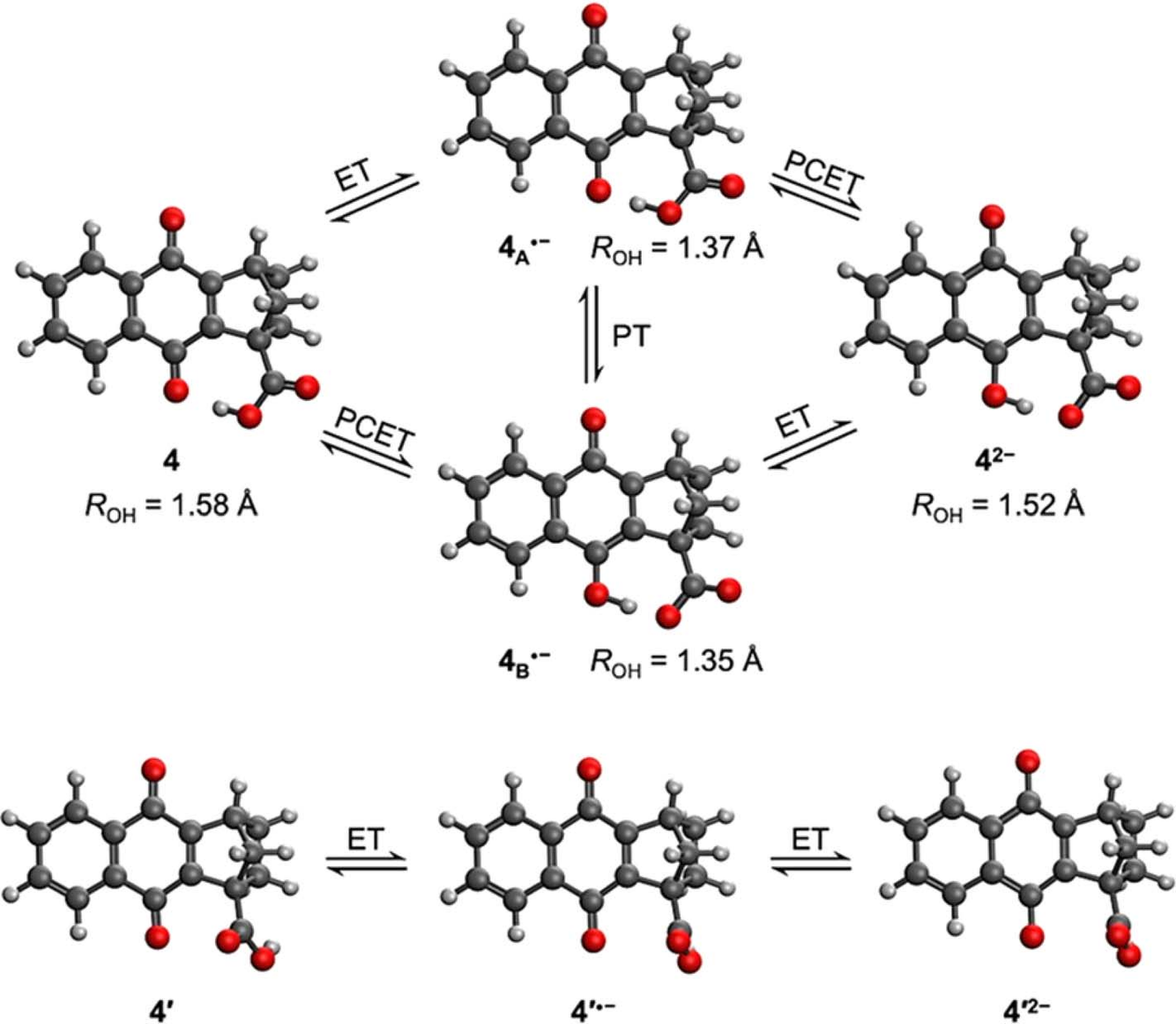
Calculated structures involved in the electrochemical reduction of the intramolecularly hydrogen-bonded naphthoquinone model.
ET denotes electron transfer, PT denotes proton transfer, and PCET denotes proton-coupled electron transfer; Rₒₕ denotes the distance between the hydrogen atom and the acceptor atom in the hydrogen bond. Structure 4′ shown below is a conformation that does not form an intramolecular hydrogen bond. Adapted from Guerra et al.[3], Figure 1.
3.2 One-Electron Reduction Strengthens Hydrogen Bonding and Introduces Proton Transfer
After an electron enters the carboxylic acid naphthoquinone described above, calculations show that the distance between the carboxylic acid hydrogen and the naphthoquinone carbonyl oxygen decreases from 1.58 Å to 1.37 Å, indicating strengthening of the intramolecular hydrogen bond in the reduced state.[3]
Two thermodynamically similar structures exist in the one-electron-reduced state:
One-Electron-Reduced State | Structural Characteristics | Corresponding Process |
4A•⁻ | An electron enters the naphthoquinone, while the carboxylic acid proton remains on the carboxylic acid side and forms a strengthened hydrogen bond with the naphthoquinone carbonyl | Electron transfer (ET) |
4B•⁻ | Electron addition is accompanied by proton transfer to an oxygen-containing center of the naphthoquinone, forming a hydrogen-bonded structure between the protonated semiquinone and the carboxylate | Proton-coupled electron transfer (PCET) |
Calculations show that 4A•⁻ is only approximately 0.29 kcal·mol⁻¹ more stable than 4B•⁻, indicating that both structures are thermally accessible under the experimental conditions. After electron transfer, 4A•⁻ can also undergo proton transfer (PT) to form 4B•⁻.[3]
Infrared spectroelectrochemical experiments and computational results together support reversible redistribution of electrons and protons during reduction of this system.[3]
This study demonstrates that the effects of naphthoquinone substituents on reduction reactions operate at multiple levels: substituents alter the electron density of the quinone ring; spatial position determines whether an intramolecular hydrogen bond can form; and hydrogen bonding strengthened after reduction can further couple electron transfer with proton transfer.
4 The Quinonoid Conjugated Alkene Forms the Nucleophilic Reaction Sites of Naphthoquinones
4.1 C2 and C3 Are Important Electrophilic Positions in 1,4-Naphthoquinone
The C2=C3 double bond of 1,4-naphthoquinone is conjugated with both carbonyl groups. The carbonyl groups lower the electron density in the conjugated alkene region, enabling C2 and C3 to accept electron pairs from nucleophiles such as thiolates and amines.
Nucleophilic reactions and one-electron reduction involve different electronic changes:
Reaction | Principal Electronic Change | Product Characteristics |
NQ + e⁻ → NQ•⁻ | A single electron enters an acceptor orbital of the naphthoquinone | Formation of a semiquinone radical anion |
NQ + RS⁻ → C—S adduct | The sulfur nucleophilic center donates an electron pair and forms a σ bond | Formation of a new C—S covalent bond on the quinone ring |
Olson et al. noted that when an unsubstituted reactive site remains at C2 or C3 of 1,4-naphthoquinone, the compound can undergo reductive 1,4-Michael addition with thiol or amine nucleophiles.[5]
The reduction potential primarily reflects the thermodynamic properties of electron transfer, whereas nucleophilic addition is also influenced by nucleophile strength, the substitution status of C2/C3, steric hindrance, and solvent conditions.
4.2 Thia-Michael Addition Is Accompanied by Rearrangement of Quinonoid Bond Orders
Micheletti et al. used N-acetyl-L-cysteine (NAC) as a sulfur-containing nucleophile to investigate the reactions of 1,4-naphthoquinone and several substituted derivatives. The corresponding sulfur-containing adducts were obtained from 1,4-naphthoquinone, menadione, plumbagin, juglone, and naphthazarin.[4]
The reaction initially proceeds through a thia-Michael-type 1,4-addition. The sulfur atom forms a C—S bond with an electrophilic carbon of the quinonoid conjugated alkene while the π electrons rearrange, generating a reduced naphthohydroquinone-type adduct. This reduced product can subsequently be oxidized in the reaction system, restoring the quinonoid structure and forming a stable sulfur-substituted naphthoquinone.[4]
The overall process can be represented as:
Nucleophilic attack → C—S bond formation → naphthohydroquinone-type adduct state → oxidation restoring the quinonoid structure
Nucleophilic bond formation and redox processes can therefore occur sequentially within the same naphthoquinone reaction process.
5 C2/C3 Substitution Controls Michael-Type Sulfur Nucleophilic Addition
Whether a naphthoquinone retains a reactive site at C2 or C3 directly affects the conditions under which a nucleophile can form a C—S bond.
Within the same research framework, Micheletti et al. compared the reactions of several substituted 1,4-naphthoquinones with NAC:[4]
Naphthoquinone | Major Substitution Features | Result of Reaction with NAC |
1,4-Naphthoquinone | Both C2 and C3 unsubstituted | Sulfur-containing adduct obtained |
Menadione | C2 methyl | Sulfur-containing adduct obtained |
Juglone | Hydroxyl group at C5 of the benzenoid ring | Sulfur-containing adduct obtained |
Plumbagin | C2 methyl and C5 hydroxyl | Sulfur-containing adduct obtained |
Naphthazarin | Hydroxyl groups at C5 and C8 | Adduct obtained, but the reaction was slower |
Lawsone | C2 hydroxyl | No corresponding adduct obtained under the experimental conditions |
Lawsone was noted in Olson et al.’s 2023 study of small-molecule thiols, whereas the hydroxyl groups of juglone and plumbagin are located at the C5 position of the benzenoid ring. The experimental results show that a hydroxyl group located at C2 of the quinone ring and one located at C5 of the benzenoid ring produce different reaction outcomes.[4]
A C2 hydroxyl group simultaneously alters the electronic structure of the quinonoid conjugated system, the acid–base equilibrium, and the reaction conditions in the C2/C3 region. Micheletti et al. established experimentally that lawsone did not form an NAC adduct under their reaction conditions, but this observation alone is insufficient to attribute the absence of reaction to a single electronic factor. When predicting nucleophilic reactions of specific hydroxynaphthoquinones, substitution position, ionization state, tautomerism, and the reaction medium must all be considered.[4]
6 Thiol Adducts Can Continue to Participate in Naphthoquinone Redox Processes
After formation of a C—S bond, if oxidation restores the quinonoid dicarbonyl structure, the resulting sulfur-substituted naphthoquinone can retain redox activity.
Olson et al. investigated the reactions of 1,4-naphthoquinone with small-molecule thiols such as glutathione and cysteine using mass spectrometry, electron paramagnetic resonance, ultraviolet–visible absorption spectroscopy, and oxygen-consumption measurements. Naphthoquinones are reduced during thiol addition, after which the reduced naphthoquinone–thiol adducts can undergo reoxidation with concomitant oxygen consumption. Different naphthoquinone–thiol adducts showed enhanced, reduced, or retained activity in subsequent H₂S oxidation reactions, depending on the naphthoquinone structure and the type of thiol.[5]
These experiments connect the two major types of naphthoquinone reactions:
Electron transfer changes the oxidation state of the naphthoquinone;
Nucleophilic addition changes the covalent structure of the naphthoquinone;
After the adduct restores a quinonoid structure, it can enter additional redox cycles.
Thus, formation of an adduct between a naphthoquinone and a nucleophile does not necessarily terminate redox reactions. Whether the product retains electron-transfer capability depends on whether the quinonoid conjugated dicarbonyl structure is restored after addition and on how the newly introduced substituent alters its electronic properties.
7 Relationships Between Naphthoquinone Structure and Reactivity
Electron transfer and nucleophilic reactions of naphthoquinones arise from the same quinonoid electronic structure but are regulated by different structural factors.
Structural Factor | Effect on Electron Transfer | Effect on Nucleophilic Reactions |
1,2- or 1,4-carbonyl arrangement | Alters the spatial relationship between the oxygen-containing centers of the semiquinone and the mode of proton stabilization | Alters the geometry and electron distribution of the quinonoid reactive region |
Fused benzene ring | Extends the π system and participates in structural reorganization after reduction | Allows substituents on the benzenoid ring to indirectly modulate the quinone ring |
Quinone-ring substituents | Directly alter the electron density of the quinonoid electron-accepting center | Alter the electrophilicity and steric accessibility of C2/C3 |
Benzenoid-ring substituents | Affect the reduction potential through the fused π system | Indirectly alter the electrophilicity of the quinone ring |
Intramolecular hydrogen bonding | Selectively stabilizes the reduced state and alters the reduction potential | Can alter local electron density and protonation state |
Transferable protons | Couple electron transfer with PT and PCET | Participate in proton redistribution after addition |
C2/C3 substitution status | Alters the quinonoid electronic structure | Directly influences the accessible sites and reactivity for Michael-type nucleophilic addition |
Nucleophiles such as thiols | May be accompanied by reduction of the naphthoquinone | Form C—S covalent bonds |
The fused structure of naphthoquinones creates two substitution regions with different electronic effects: the quinone ring and the benzenoid ring. After an electron enters the naphthoquinone, formation of the semiquinone is accompanied by electronic and geometric reorganization throughout the fused framework; the position of a substituent determines the extent of its influence on the reduction center; and proton donors adjacent to carbonyl groups can substantially stabilize the reduced state through intramolecular hydrogen bonding, thereby further coupling electron transfer with proton transfer.
The electron-deficient nature of the quinone ring also makes C2/C3 nucleophilic reaction sites. When a sulfur nucleophile forms a C—S bond, the quinonoid π system undergoes rearrangement; after oxidation restores the quinone structure, the resulting sulfur-substituted naphthoquinone can continue to participate in electron-transfer processes.
When assessing the fundamental reactivity of a naphthoquinone derivative, four structural features can be considered first: whether the carbonyl groups adopt a 1,2- or 1,4-arrangement; whether the substituents are located on the quinone ring or the benzenoid ring; whether groups capable of forming intramolecular hydrogen bonds or undergoing proton transfer are present near the carbonyl groups; and whether C2/C3 retain nucleophilic reaction sites. These structural factors collectively influence the reduction potential of the naphthoquinone, the mode of semiquinone stabilization, and its tendencies toward electron transfer and covalent addition; the actual reaction pathway is also affected by conditions such as the reaction medium, nucleophile, and proton donor.
8 Representative Chemicals Relevant to Studies of Electron Transfer, Substituent Effects, and Nucleophilic Reactions of Naphthoquinones
Table 1. Parent Naphthoquinones, Substituted Naphthoquinones, and Reduced-State Reference Compounds
Category | CAS No. | Aladdin Product No. | Name | Specification or Purity | Product Features and Applications |
Parent 1,4-naphthoquinone | 130-15-4 | 1,4-Naphthoquinone | ≥97% | Benchmark model of a conjugated 1,4-dicarbonyl system; used to study stepwise electron reduction, semiquinone radical anion formation, reduction potentials, and sulfur-nucleophile conjugate addition. | |
Parent 1,2-naphthoquinone | 524-42-5 | 1,2-Naphthoquinone | ≥95% | Benchmark model of an ortho-dicarbonyl naphthoquinone; used in comparison with 1,4-naphthoquinone to investigate the effects of carbonyl arrangement on semiquinone formation, reduction behavior, and nucleophilic-addition reactivity. | |
Monomethyl-substituted 1,4-naphthoquinone | 58-27-5 | Menadione | Crystalline | C2-methyl-substituted naphthoquinone model; used to investigate the effects of methyl substitution on redox cycling, semiquinone formation, and adduct formation with glutathione and N-acetyl-L-cysteine. | |
2,3-Dimethyl-1,4-naphthoquinone | 2197-57-1 | 2,3-Dimethyl-1,4-naphthoquinone | — | Model bearing two adjacent methyl substituents; used to investigate the effects of methyl electron donation and steric occupancy on electrochemical reduction, semiquinone formation, and electron-accepting ability. | |
Methoxy-substituted 1,4-naphthoquinone | 2348-82-5 | 2-Methoxy-1,4-naphthoquinone | Moligand™, ≥97% | C2-methoxy-substituted model; used to investigate the effects of methoxy electronic properties on redox cycling and quinone-ring electrophilicity, as well as nucleophilic substitution and derivatization with amines. | |
Dichloro-substituted 1,4-naphthoquinone | 117-80-6 | 2,3-Dichloro-1,4-naphthoquinone | ≥98% | Electrophilic naphthoquinone bearing chlorine substituents at C2 and C3; used to study halogen electron-withdrawing effects, redox behavior, and substitution reactions with nitrogen- and sulfur-containing nucleophiles. | |
2-Hydroxy-1,4-naphthoquinone | 83-72-7 | 2-Hydroxy-1,4-naphthoquinone | ≥98% | Naphthoquinone model with a hydroxyl group directly attached to the quinone ring; can be used to investigate the effects of 2-hydroxy substitution on electrochemical reduction, acid–base/protonation behavior, and nucleophilic reactivity. | |
Hydroxy-methyl-substituted 1,4-naphthoquinone | 483-55-6 | 2-Hydroxy-3-methyl-1,4-dihydronaphthalene-1,4-dione | ≥98% | Vitamin K-type structural model bearing adjacent hydroxyl and methyl substituents; used to investigate substituent effects on electrochemical reduction, semiquinone stabilization, and coordination behavior of reduced states. | |
5-Hydroxy-1,4-naphthoquinone | 481-39-0 | 5-Hydroxy-1,4-naphthoquinone | ≥97% (GC) | Model bearing a hydroxyl substituent on the benzenoid ring; used to investigate the effects of hydroxyl position on one-electron reduction potentials, semiquinone radical anion stability, and the reactivity of substituted naphthoquinones. | |
5,8-Dihydroxy-1,4-naphthoquinone | 475-38-7 | 5,8-Dihydroxy-1,4-naphthoquinone | ≥97% | Dihydroxynaphthoquinone model; used to investigate the effects of intramolecular hydrogen bonding on reduction potentials, semiquinone stability, oxygen reduction, and redox cycling. | |
Sulfonated 1,2-naphthoquinone electrophilic reagent | 521-24-4 | Sodium 1,2-naphthoquinone-4-sulfonate | ≥98% | Water-soluble sulfonated ortho-naphthoquinone electrophile; used to study nucleophilic substitution by amines and amino acids, quinone-ring electrophilic reactivity, and colorimetric derivatization. | |
Reduced-state reference compound for 1,4-naphthoquinone | 571-60-8 | 1,4-Dihydroxynaphthalene | Industrial grade, ≥90% (HPLC) | Two-electron, two-proton reduced counterpart of 1,4-naphthoquinone; used to study the naphthoquinone/naphthohydroquinone redox couple, reversible electron–proton transfer, and reoxidation processes. | |
Reduced-state reference compound for methyl-1,4-naphthoquinone | 481-85-6 | 1,4-Dihydroxy-2-methylnaphthalene | ≥97% | Reduced counterpart of menadione; used to investigate the menadione/methyl-naphthohydroquinone redox couple, reoxidation of the reduced state, and methyl-substitution effects. | |
Reduced-state reference compound for 1,2-naphthoquinone | 574-00-5 | 1,2-Dihydroxynaphthalene | ≥95% | Catechol-type reduced counterpart of 1,2-naphthoquinone; used to study ortho-naphthoquinone/catechol redox interconversion and differences in electron transfer between 1,2- and 1,4-quinone systems. |
Table 2. Natural, Vitamin K-Type, and Functionalized Naphthoquinones
Category | CAS No. | Aladdin Product No. | Name | Specification or Purity | Product Features and Applications |
Phytyl-side-chain vitamin K-type 1,4-naphthoquinone | 84-80-0 | Vitamin K1 | Viscous liquid | Natural naphthoquinone electron carrier with a long hydrophobic side chain; used to investigate electron transfer involving quinone acceptors in photosystem I, semiquinone intermediates, and the influence of membrane-phase environments on redox processes. | |
Tetraisoprenyl-side-chain vitamin K-type 1,4-naphthoquinone | 863-61-6 | Menatetrenone | ≥98%, Mixture of cis-trans isomers | Long-side-chain vitamin K-type naphthoquinone; used to investigate membrane-phase quinone electron carriers, quinone/hydroquinone cycling, and the effects of hydrophobic side chains on electron and proton transfer. | |
Polyhydroxy alkenyl natural 1,4-naphthoquinone | 517-89-5 | Shikonin | Analytical standard, ≥98% | Polyhydroxylated natural naphthoquinone; used to study direct reactions of naphthoquinones with glutathione and protein thiols, as well as thiol depletion and redox reactions. | |
Hydroxy-methyl natural 1,4-naphthoquinone | 481-42-5 | Plumbagin | Moligand™, ≥98% | Natural naphthoquinone bearing both hydroxyl and methyl substituents; used to investigate semiquinone radical anion reactivity, glutathione binding, and substituent effects on redox behavior. | |
Hydroxy-isoprenyl natural 1,4-naphthoquinone | 84-79-7 | Lapachol | ≥98% | Natural naphthoquinone bearing a hydroxyl group and an isoprenyl side chain; used to investigate the effects of side-chain substitution on redox cycling, reactive oxygen species formation, and cellular thiol oxidation. | |
Fused pyran-type 1,4-naphthoquinone | 4707-33-9 | α-Lapachone | Moligand™, ≥98% | 1,4-Naphthoquinone fused with a pyran ring; used to investigate the effects of fused-ring structure and 1,4-quinone carbonyl arrangement on electron transfer, redox properties, and structure-dependent reactivity. | |
Fused pyran-type 1,2-naphthoquinone | 4707-32-8 | β-Lapachone | Moligand™, ≥99% | Ortho-naphthoquinone fused with a pyran ring; used to investigate 1,2-quinone carbonyl arrangement, enzymatic two-electron reduction, quinone/hydroquinone cycling, and reactive oxygen species formation. | |
Arylcyclohexyl-substituted hydroxynaphthoquinone | 95233-18-4 | Atovaquone | Moligand™, ≥98% | Hydroxynaphthoquinone bearing a bulky hydrophobic side chain; used to investigate competition of naphthoquinone structures at ubiquinone-binding sites, inhibition of electron transfer in mitochondrial complex III, and side-chain structural effects. | |
tert-Butylcyclohexylmethyl-substituted hydroxynaphthoquinone | 88426-33-9 | Buparvaquone | ≥95% | Hydroxynaphthoquinone bearing a hydrophobic side chain; used to investigate hydroxynaphthoquinone side-chain structure, disruption of protozoan mitochondrial function, and relationships between substitution patterns and biological reactivity. |
Table 3. Sulfur Nucleophilic Addition and Biological Thiol Models
Category | CAS No. | Aladdin Product No. | Name | Specification or Purity | Product Features and Applications |
Thiol-containing amino acid nucleophile | 52-90-4 | L-Cysteine | Animal-origin free, Moligand™, for cell culture, ≥98% | Biological nucleophile containing both thiol and amino reactive sites; used to study sulfur nucleophilic addition to 1,2- and 1,4-naphthoquinones, nitrogen-centered nucleophilic reactions, and covalent adduct formation. | |
Tripeptide biological thiol | 70-18-8 | Glutathione (Reduced) | PharmPure™, European Pharmacopoeia (Ph.Eur.) | Typical intracellular low-molecular-weight thiol; used to study sulfur nucleophilic addition to naphthoquinones, glutathione adducts, thiol depletion, and subsequent redox cycling of the resulting adducts. | |
Acetylated cysteine nucleophile | 616-91-1 | N-Acetyl-L-cysteine (NAC) | PharmPure™, USP, Moligand™, European Pharmacopoeia (Ph.Eur.), ≥98.5% | Stable small-molecule sulfur nucleophile model; used to study thia-conjugate addition and adduct formation involving 1,4-naphthoquinone, menadione, plumbagin, 5-hydroxynaphthoquinone, and dihydroxynaphthoquinones. |
Note: The products listed above are representative Aladdin products relevant to scientific research. Specific applications should be determined according to product specifications, batch-specific Certificates of Analysis (COAs), and the intended reaction or evaluation system. Additional information on product specifications, grades, and COAs can be retrieved from the Aladdin website using the “product name/CAS/product number.”
References
[1] White N J, Tunstall W W, Vargas L A, Workman K T, Moldenhauer J, Gichuhi W K. Benzoquinone, 1,4-naphthoquinone radical anions, and their didehydro derivatives: electroanalytical and predicted negative ion photoelectron spectroscopic studies. Physical Chemistry Chemical Physics, 2025, 27(17): 8976–8993. DOI: 10.1039/D5CP00392J.
[2] Gopinath P, Mahammed A, Ohayon S, Gross Z, Brik A. Understanding and predicting the potency of ROS-based enzyme inhibitors, exemplified by naphthoquinones and ubiquitin specific protease-2. Chemical Science, 2016, 7(12): 7079–7086. DOI: 10.1039/C6SC02758J.
[3] Guerra W D, Odella E, Cui K, Secor M, Dominguez R E, Gonzalez E J, Moore T A, Hammes-Schiffer S, Moore A L. The role of an intramolecular hydrogen bond in the redox properties of carboxylic acid naphthoquinones. Chemical Science, 2024, 15(42): 17425–17434. DOI: 10.1039/D4SC05277C.
[4] Micheletti G, Boga C, Zalambani C, Farruggia G, Esposito E, Fiori J, Rizzardi N, Taddei P, Di Foggia M, Calonghi N. Synthesis of thia-Michael-Type Adducts between Naphthoquinones and N-Acetyl-L-Cysteine and Their Biological Activity. Molecules, 2022, 27(17): 5645. DOI: 10.3390/molecules27175645.
[5] Olson K R, Clear K J, Gao Y, Ma Z, Cieplik N M, Fiume A R, Gaziano D J, Kasko S M, Luu J, et al. Redox and Nucleophilic Reactions of Naphthoquinones with Small Thiols and Their Effects on Oxidization of H₂S to Inorganic and Organic Hydropolysulfides and Thiosulfate. International Journal of Molecular Sciences, 2023, 24(8): 7516. DOI: 10.3390/ijms24087516.
For more related articles, see below:
Extraction, isolation and characterization of anthraquinones in Rheum palmatum (Rheum palmatum)
Tetramethyl-1,4-benzoquinone(DQ)
Extraction and isolation of free hydroxyanthraquinone components from Cynodon dactyliflorus
Chloranil, Tetrachloro-1,4-benzoquinone
Tetramethyl-1,4-benzoquinone(DQ)


 危险品化学品经营许可证(带存储)