
Why Do Skincare Oligopeptides Have Different Effects? — Molecular Structure, Skin Delivery, and Mechanisms of Action
Why Do Skincare Oligopeptides Have Different Effects? — Molecular Structure, Skin Delivery, and Mechanisms of Action
Introduction
Oligopeptides are short-chain peptides formed by a small number of amino acid residues linked through peptide bonds. According to biochemical nomenclature materials from the International Union of Pure and Applied Chemistry (IUPAC), peptides containing fewer than approximately 10–20 amino acid residues may be termed oligopeptides. This range is a conventional nomenclature rather than a strict molecular-weight boundary.[1]
Oligopeptides used as skincare ingredients do not constitute a single class of active ingredients with uniform effects. The amino acid sequence determines the basic chemical characteristics of a molecule and its potential for biological recognition; lipidation, acetylation, amidation, and metal coordination can further alter charge, hydrophilicity/hydrophobicity, stability, and skin partitioning. After topical application, actual effects are also influenced by release from the formulation, the stratum corneum barrier, degradation within the skin, and the location of the relevant target.
Although they are all classified as oligopeptides, differences in amino acid sequence and chemical modification can result in distinct physicochemical properties and potential biological activities. Even for the same oligopeptide, formulation differences may affect its stability, skin distribution, and exposure at the target site. The resulting biological effects also depend on the molecular or cellular target and its location. Therefore, molecular structure, skin delivery, and target-site matching collectively influence the actual effects of oligopeptides. The figure below summarizes the relationships among these factors and illustrates the differences in the actions of representative oligopeptides.
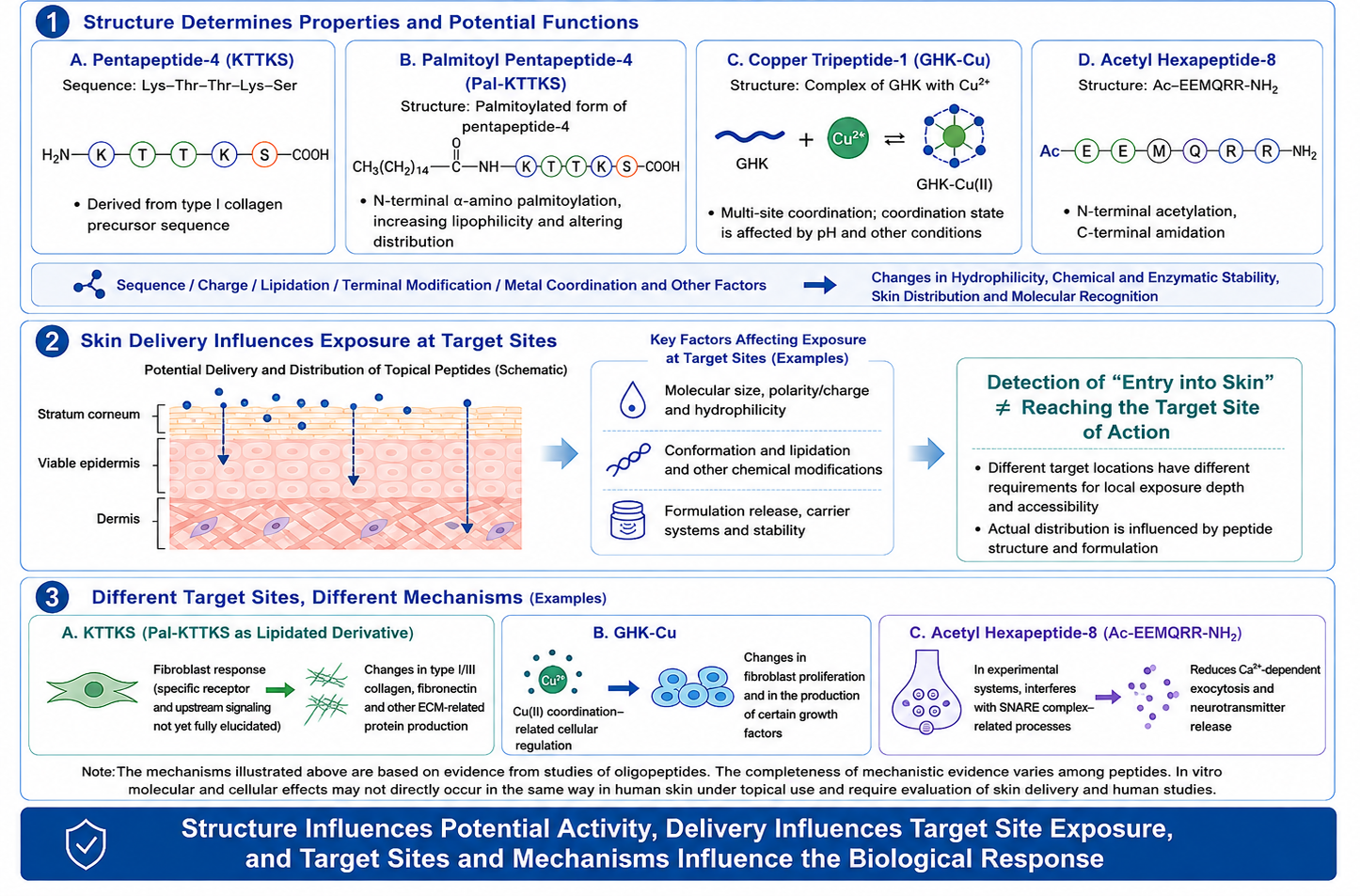
1. What Does the Structure of an Oligopeptide Determine?
1.1 A Short Peptide Chain Does Not Mean the Same Biological Effect
A typical peptide chain consists of amino acid residues linked by peptide bonds. The —CO—NH— amide structure formed between adjacent residues is called a peptide bond, and its basic backbone can be written as:
—NH—CHR¹—CO—NH—CHR²—CO—
R¹ and R² represent the side chains of different amino acids. The structures of these side chains determine the charge, polarity, hydrophobicity, steric volume, hydrogen-bonding capacity, and ability of the residues to participate in metal coordination.
Therefore, even two pentapeptides or hexapeptides of the same length may have markedly different chemical properties and biological recognition characteristics if their amino acid compositions or sequence arrangements differ.
Several representative short peptides studied in skincare research have demonstrated different types of activity:
Representative oligopeptide | Main structural characteristics | Major processes investigated |
KTTKS pentapeptide | Specific sequence derived from procollagen | Production of extracellular matrix-related proteins |
Palmitoyl-KTTKS | KTTKS conjugated with a palmitoyl group | Altered skin partitioning and stability |
GHK-Cu | Coordination system formed between the GHK tripeptide and Cu(II) | Metal coordination and fibroblast regulation |
Acetyl Hexapeptide-8 | Hexapeptide with N-terminal acetylation and C-terminal amidation | SNARE-related exocytotic processes |
2. From Sequence to Function: Why Do Different Oligopeptides Act Differently?
2.1 KTTKS: A Specific Short Sequence with Extracellular Matrix-Regulating Activity
KTTKS consists of lysine-threonine-threonine-lysine-serine (Lys-Thr-Thr-Lys-Ser, KTTKS) and is a short sequence found within the carboxyl-terminal propeptide of type I procollagen.
Starting from fragments related to type I procollagen, Katayama et al. progressively shortened the sequence and found that KTTKS retained substantial biological activity. When cultured mesenchymal cells were exposed to KTTKS, production of type I collagen, type III collagen, and fibronectin increased in concentration- and time-dependent manners, whereas total protein synthesis did not increase in parallel.[2]
These findings indicate that the principal biological significance of KTTKS arises from the functional sequence formed by its specific amino acid arrangement.
The extracellular matrix (ECM) consists of collagen, fibronectin, and other macromolecules and plays an important role in the structural organization of the dermis. Existing classical studies provide relatively strong support for an association between KTTKS and changes in ECM production; however, its direct receptor and the complete upstream signaling pathway have not been established with the same level of causal evidence.[2]
2.2 Lipidation: Modifying Physicochemical Properties Beyond the Functional Sequence
KTTKS contains multiple polar and ionizable groups and is therefore relatively hydrophilic overall. When a palmitoyl group is attached to its N-terminus, palmitoyl-KTTKS (Pal-KTTKS) is formed.
Its structure contains two functionally distinct components:
Palmitoyl hydrophobic group — KTTKS peptide sequence
The KTTKS portion retains the original pentapeptide sequence, while the palmitoyl group increases the overall hydrophobic character of the molecule and alters its lipid-water partitioning.
Lipidation mainly affects the following properties:
Structural change | Associated change in properties |
Introduction of a long-chain fatty acyl group | Increased molecular hydrophobicity |
Altered lipid-water partitioning | Changes in interactions with stratum corneum lipids |
N-terminal modification | Potential changes in susceptibility to certain peptidases |
Altered overall amphiphilicity | Potential changes in solubility, aggregation, release, and skin retention |
Differences in skin distribution and stability between palmitoyl-KTTKS and unmodified KTTKS were further demonstrated in subsequent skin-delivery studies.[3]
2.3 GHK-Cu: Metal Coordination Alters the Chemical State of the Oligopeptide
GHK consists of glycine-histidine-lysine (Gly-His-Lys, GHK). Coordination groups within GHK can form complexes with divalent copper ions, Cu(II).
The basic coordination relationship can be represented as:
GHK + Cu²⁺ ⇌ GHK-Cu(II)
This equation indicates that a coordination equilibrium exists between GHK and Cu(II). The actual coordination species present in solution are influenced by pH, concentration, and other ligands and do not necessarily remain as a single structure under all conditions.
Using potentiometric titration and visible absorption spectroscopy, Lau and Sarkar demonstrated that GHK and Cu(II) can form multiple coordination species in solution.[4] Subsequent nuclear magnetic resonance and electron paramagnetic resonance studies showed that, within a certain pH range, Cu(II) may be coordinated by three nitrogen atoms and one oxygen atom from GHK.[5]
GHK-Cu therefore represents a peptide-metal coordination system. The copper ion is not simply present alongside the peptide but participates in the formation of a new chemical state.
In experiments using human dermal fibroblasts, Pollard et al. found that GHK-Cu treatment shortened the population doubling time of both normal and radiation-damaged fibroblasts. In irradiated fibroblasts, increased early production of basic fibroblast growth factor (bFGF, also known as FGF2) and vascular endothelial growth factor (VEGF) was also observed.[6]
These findings support the ability of GHK-Cu to influence fibroblast proliferation and the production of certain growth factors.
2.4 Acetyl Hexapeptide-8: Research Focuses on SNARE-Related Exocytotic Processes
Acetyl Hexapeptide-8 is a terminally modified hexapeptide. Its amino acid sequence consists of glutamic acid-glutamic acid-methionine-glutamine-arginine-arginine and is commonly written as Ac-EEMQRR-NH₂, where Ac indicates N-terminal acetylation and NH₂ indicates C-terminal amidation.
The research rationale for this peptide differs from that for KTTKS and primarily involves proteins associated with vesicular exocytosis.
Synaptosomal-associated protein of 25 kDa (SNAP-25) participates in the formation of the soluble N-ethylmaleimide-sensitive factor attachment protein receptor (SNARE) complex. The SNARE complex is involved in fusion between vesicle membranes and the plasma membrane and is an important molecular machinery for Ca²⁺-dependent neurotransmitter exocytosis.
The study by Blanes-Mira et al. showed that Acetyl Hexapeptide-8 can interfere with the formation and/or stability of the SNARE complex and reduce neurotransmitter release in experimental systems.[7]
The process supported by these studies can be summarized as:
Acetyl Hexapeptide-8 → interference with SNARE complex-related processes → inhibition of Ca²⁺-dependent exocytosis → reduced neurotransmitter release
This mechanism involves modulation of specific protein-complex formation and exocytotic processes and is distinct from the mechanism by which KTTKS promotes the production of ECM-related proteins.
2.5 Can Oligopeptides Activate Cellular Signaling Pathways?
Certain oligopeptides can affect cellular signaling and cellular function. Different experimental findings provide different levels of mechanistic information:
Experimental finding | Main conclusion supported |
Increased or decreased production of a particular protein | A related cellular function has changed |
Changes in the expression of certain genes | A transcriptional response has occurred |
Changes in the phosphorylation of signaling proteins | A related signaling process has been modulated |
Direct binding experiments identify a target protein | Supports a direct interaction between the peptide and the target |
The effect is markedly reduced after target blockade or genetic intervention | Provides further evidence for a causal relationship between the target and the downstream effect |
3. From Formulation to Target: Why Do Oligopeptides Face Skin-Delivery Challenges?
Once an oligopeptide has demonstrated cellular activity, a topical product must address another question: can the molecule approach the relevant site of action in an intact form?
Cell-culture studies typically add peptides directly to the culture medium and investigate what happens after target cells have already been exposed to a certain concentration of the oligopeptide.
Topical skincare products, by contrast, begin at the skin surface. Oligopeptides must first be released from the formulation, enter the stratum corneum, and then continue to partition and diffuse within the skin tissue.
These two types of experiments investigate different stages of the same continuous process.
3.1 The Stratum Corneum Is a Major Barrier to Topical Oligopeptide Delivery
Highly organized lipid domains are present between the cells of the stratum corneum. The major lipids include ceramides, cholesterol, and free fatty acids. Together with corneocytes, these intercellular lipids form an important structural basis of the skin barrier.[8]
Most oligopeptides have one or more of the following characteristics:
① They contain multiple amide and other polar groups;
② They can form multiple hydrogen bonds;
③ Their side chains may become ionized at certain pH values;
④ They are relatively hydrophilic overall.
These properties favor the presence of peptides in aqueous phases but do not necessarily favor their entry into the lipid environment of the stratum corneum.
Therefore, a short peptide chain does not directly imply high skin penetration. Actual delivery is influenced by multiple factors, including molecular size, polarity, charge, lipophilicity, conformation, chemical modification, and the formulation environment.
3.2 Lipidation Can Alter the Distribution of KTTKS in the Skin
Choi et al. used full-thickness hairless mouse skin in a Franz diffusion system to compare the stability and skin distribution of KTTKS and palmitoyl-KTTKS.
Under the experimental conditions, neither peptide reached quantifiable levels in the receptor fluid within 48 hours. Unmodified KTTKS was not detected in the analyzed stratum corneum, epidermis, or dermis. In contrast, palmitoyl-KTTKS was detected at 4.2 ± 0.7, 2.8 ± 0.5, and 0.3 ± 0.1 μg/cm² in the stratum corneum, epidermis, and dermis, respectively.[3]
This experiment directly supports a clear structure-delivery relationship:
While retaining the core KTTKS sequence, introduction of a palmitoyl group altered the distribution of the peptide across different layers of the skin.
This is also an important rationale for lipidation in the design of skincare oligopeptides.
3.3 The Same Oligopeptide May Be Delivered Differently in Different Formulations
Oligopeptides do not enter the skin directly from a pure raw-material state. Instead, they are incorporated into emulsions, serums, gels, or other formulation matrices.
Topical delivery involves:
Release from the formulation → partitioning between the formulation and the stratum corneum → diffusion within the stratum corneum and into subsequent tissues
Hoppel et al. investigated the skin delivery of Acetyl Hexapeptide-8 from different emulsion structures. In experiments using porcine ear skin, a water-in-oil-in-water (W/O/W) multiple emulsion increased the extent to which Acetyl Hexapeptide-8 entered the skin. Overall, water-rich W/O/W and oil-in-water (O/W) emulsions showed better delivery performance than oil-rich water-in-oil (W/O) emulsions.[9]
Therefore, the actual performance of the same oligopeptide in different products depends not only on the structure of the ingredient itself, but also on how the formulation controls solubilization, release, and skin partitioning.
3.4 “Entering the Skin” and “Reaching the Target” Are Not the Same Endpoint
The distribution of topically applied oligopeptides follows a clear spatial hierarchy:
Skin surface → stratum corneum → viable epidermis → dermis → target cells → intracellular site of action
Different mechanisms of action have different requirements regarding delivery location.
Effects involving epidermal cells require attention to exposure in the viable epidermis. Effects involving dermal fibroblasts and ECM regulation require consideration of distribution into deeper skin layers. Mechanisms involving intracellular protein complexes additionally require cellular uptake and intracellular exposure.
Kraeling et al. studied the distribution of Acetyl Hexapeptide-8 using ex vivo human cadaver skin and hairless guinea pig skin. A 10% Acetyl Hexapeptide-8 O/W emulsion was applied at 2 mg/cm² for 24 hours. The results showed that most of the applied peptide remained on the skin surface and was removed during the washing procedure. In human skin, approximately 0.22% of the applied dose was present in the stratum corneum and approximately 0.01% in the epidermis, while the hexapeptide was not detected in the dermis or in the receptor fluid of the diffusion cell.[10]
These findings correspond to a specific concentration, formulation, and ex vivo skin model and cannot be directly extrapolated to the skin distribution of other Acetyl Hexapeptide-8 products.
The central issue illustrated by this study is that demonstrating molecular activity in biochemical or cellular experiments and achieving sufficient exposure at the corresponding site of action after topical application are two continuous but distinct research questions.
4. Stability Determines Whether Oligopeptides Reaching the Skin Retain Their Intact Structure
The activity of oligopeptides generally depends on an intact amino acid sequence and a specific chemical structure. If key peptide bonds are cleaved, terminal structures are altered, or important side chains undergo chemical changes, the original molecular recognition properties may also change.
Stability should be evaluated at two stages: product storage and degradation within the skin.
4.1 Stability in the Product
Oligopeptides in a formulation exist within a system defined by a specific pH, aqueous environment, temperature, metal ion concentration, and the presence of other ingredients.
Different sequences and forms of modification vary in their susceptibility to hydrolysis, oxidation, aggregation, and other degradation processes. Therefore, for a finished product, a more meaningful stability parameter is the change in the content of intact target peptide during storage, rather than simply the amount of raw material added during manufacturing.
The initial amount added represents how much raw material was incorporated during formulation manufacture, whereas the content of intact peptide at the time of use indicates how much of the target structure remains after storage.
4.2 Peptidases in the Skin Can Further Reduce the Concentration of Intact Peptide
The skin contains multiple proteases and peptidases; therefore, oligopeptides may continue to undergo enzymatic hydrolysis after entering the skin.
Park et al. established a liquid chromatography-tandem mass spectrometry (LC-MS/MS) method to study the stability of KTTKS in rat skin homogenates. The study found that KTTKS was relatively susceptible to peptide-bond cleavage mediated by aminopeptidases in the skin.[11]
Choi et al. further compared KTTKS with palmitoyl-KTTKS. Both peptides underwent degradation in skin extracts and homogenates, but palmitoyl-KTTKS showed greater stability under the experimental conditions. The stability of both peptides increased markedly after the addition of protease inhibitors.[3]
Palmitoylation therefore affects two properties relevant to topical activity: skin partitioning and enzymatic stability.
5. From Molecular Mechanisms to Human Efficacy: Different Experiments Answer Different Questions
Research on oligopeptides generally includes molecular experiments, cellular experiments, ex vivo skin studies, and human efficacy studies. These studies represent different stages of the same overall process.
Level of research | Main question addressed |
Molecular experiments | Whether the peptide interacts with a specific molecule or protein-related process |
Cellular experiments | What functional changes occur after cells are exposed to the peptide |
Ex vivo skin studies | Which skin layers the peptide reaches after topical application and how much is retained |
Human studies of the final formulation | Whether actual use produces measurable improvements in the skin |
5.1 Human Efficacy Study of Palmitoyl-KTTKS
Robinson et al. conducted a 12-week, double-blind, placebo-controlled, randomized split-face study involving 93 White women aged 35–55 years.
The study compared a basic moisturizing product with a test product containing 3 ppm palmitoyl-KTTKS in the same base formulation. Quantitative image analysis and expert image assessment both showed improvements in wrinkle- and fine-line-related parameters with the palmitoyl-KTTKS-containing test product compared with the base formulation.[12]
Even when the same oligopeptide is used, different products may produce different outcomes because of differences in concentration, formulation structure, stability, and skin delivery.
5.2 Human Efficacy Study of Acetyl Hexapeptide-8
Wang et al. conducted a randomized, placebo-controlled study involving 60 Chinese subjects, who were assigned in a 3:1 ratio to receive Acetyl Hexapeptide-8 or placebo treatment twice daily for four weeks.
Clinical evaluation and analysis of silicone skin replicas showed improvements in periocular wrinkles and parameters related to skin roughness in the Acetyl Hexapeptide-8 group.[13]
This study supports the anti-wrinkle efficacy of the specific treatment regimen tested. The three levels of evidence concerning Acetyl Hexapeptide-8 should be understood separately:
① SNARE-related experiments
These demonstrate that the hexapeptide can interfere with exocytosis-related processes in the corresponding experimental systems.[7]
② Ex vivo skin studies
These show that, under the conditions of a specific O/W formulation, the peptide is distributed primarily in the stratum corneum, with only a small proportion entering the epidermis and no detectable peptide in the dermis.[10]
③ Human efficacy studies
These show that improvements in parameters related to periocular wrinkles were observed under a specific regimen of use.[13]
Together, these three types of results constitute the research evidence for this ingredient. However, the human anti-wrinkle findings themselves do not establish that every molecular step of the proposed SNARE-related mechanism occurs sequentially in human skin.
6. How Should We Understand Why Different “Oligopeptides” Produce Different Effects?
Differences among skincare oligopeptides arise mainly from three sequential levels.
6.1 Level One: Structure Determines Potential Activity
Amino acid arrangement and chemical modification determine the molecular surface properties of a peptide and the molecular interactions in which it can participate.
KTTKS is associated with the production of ECM-related proteins; GHK-Cu is a metal-coordinating peptide system that influences fibroblast responses; and Acetyl Hexapeptide-8 is involved in SNARE-related exocytotic processes.[2][4–7]
6.2 Level Two: Delivery Determines Where the Active Molecule Can Reach
Once a structure confers potential activity, topical effects are further influenced by release from the formulation and by the skin barrier.
After palmitoylation, the distribution and stability of KTTKS change in ex vivo mouse skin. Acetyl Hexapeptide-8 also shows clear differences in skin delivery when incorporated into different emulsions.[3][9]
6.3 Level Three: The Target Determines Where the Peptide Needs to Reach
The biological processes regulated by oligopeptides are located in different tissues and cellular compartments.
When the proposed action involves the stratum corneum or epidermis, viable epidermal cells, the dermis and fibroblasts, cell-surface targets, or intracellular protein processes, the required delivery depth and exposure to intact peptide are not the same.
When the site of delivery matches the site of action, the biological plausibility of translating an in vitro mechanism into a topical effect becomes stronger.
7. What Information Should Be Considered When Evaluating Oligopeptide Skincare Products?
For products labeled as containing one or more oligopeptides, the relevant technical information can be reviewed in the following order:
Evaluation category | Information to consider | Question addressed |
Molecular identity | Specific sequence, terminal modifications, lipidation, or metal-coordination state | Which peptide is actually being used? |
Biological activity | Changes in protein production, gene expression, enzymes, or protein-related processes | What responses can occur after the peptide comes into contact with cells? |
Mechanistic evidence | Data on direct targets, binding, blockade, or signaling processes | Which step of the mechanism has actually been established? |
Formulation stability | Content of intact target peptide after storage | How much intact molecule remains at the time of use? |
Skin delivery | Distribution in the stratum corneum, epidermis, and dermis | Where can the peptide reach after topical application? |
Target matching | Whether skin distribution is consistent with the proposed site of action | Does delivery support the proposed mechanism? |
Human studies | Final formulation, duration of use, control conditions, and measurement endpoints | Does actual product use produce measurable effects on the skin? |
8. Classification and Research Applications of Representative Chemicals Related to Oligopeptide Structure, Target-Related Activity, and Skin Delivery
Table 1. Oligopeptides Related to Extracellular Matrix Regulation, Collagen Modulation, and Structural Modification
Classification | CAS No. | Aladdin Catalog No. | Name | Grade or Purity | Product Features and Applications |
Immunoglobulin-derived lipopeptide | 221227-05-0 | Pal-Gly-Gln-Pro-Arg-OH, free form | ≥98% | Used for research on immunoglobulin-derived peptides, inflammation-related cellular responses, skin partitioning of lipidated peptides, and formulation-based delivery. | |
Collagen-related signaling lipopeptide | 623172-56-5 | Palmitoyl tripeptide-5 biTFA | ≥98% | Used for research on collagen-related signaling, fibroblast matrix synthesis, lipopeptide conformation, and skin delivery. | |
Tripeptide sequence salt form | 72957-37-0 | Liver Cell Growth Factor acetate salt | ≥98% | Used for research on the glycine-histidine-lysine tripeptide sequence, differences among salt forms, fibroblast responses, and extracellular matrix renewal. | |
Extracellular matrix signaling lipopeptide | 147732-56-7 | Palmitoyl Tripeptide-1 | ≥97% | Used for research on lipidated tripeptide structure, fibroblast responses, extracellular matrix-related changes, stratum corneum partitioning, and carrier-mediated delivery. | |
Procollagen-derived functional pentapeptide | 149128-48-3 | Pentapeptide-4 | _ | Used for research on pentapeptide sequence activity, fibroblast responses, production of type I/III collagen and fibronectin, and comparison of properties before and after lipidation. |
Table 2. Functional Oligopeptides Related to Neuromodulation, Exocytosis, and Skin Tone
Classification | CAS No. | Aladdin Catalog No. | Name | Grade or Purity | Product Features and Applications |
Enkephalin-mimetic neuromodulatory peptide | 64963-01-5 | [D-Ala²]Leucine Enkephalin | Moligand™, ≥98% | Used for research on enkephalin receptor activity, proteolytic stability of neuropeptides, neural signaling, and control studies involving neuromodulatory anti-wrinkle peptides. | |
Neurotransmitter-release-related mimetic peptide | 868844-74-0 | Acetyl Octapeptide-3 (acetate salt) | ≥99% | Used for research on protein interactions related to neurotransmitter vesicle release, peptide sequence activity, cellular uptake, and comparative studies of neuromodulatory anti-wrinkle mechanisms. | |
Skin-tone-regulation-related tetrapeptide | 1036207-61-0 | Tetrapeptide-30 | ≥98% | Used for research on skin-tone-related cellular signaling, pigmentation processes, peptide stability, and skin cell responses. | |
Melanogenesis-related signaling peptide | 158563-45-2 | Nonapeptide-1 | ≥98% | Used for research on melanogenesis-related signaling, melanocyte responses, sequence specificity, and cellular targets. | |
Neurotransmitter-release-related mimetic peptide | 616204-22-9 | Hexapeptide | ≥98% | Used for research on protein-complex processes associated with neurotransmitter vesicle release, regulation of exocytosis, cellular uptake, and distribution across skin layers. | |
Neuromuscular-signaling-related mimetic peptide | 823202-99-9 | Snake Venom-Like Peptide, Diacetate Salt | ≥98% | Used for research on neuromuscular-signaling-related mimetic peptides, receptor activity, cellular responses, and mechanisms associated with expression lines. |
Table 3. Materials Related to Oligopeptide Lipidation, Copper Coordination, and Skin-Delivery Research
Classification | CAS No. | Aladdin Catalog No. | Name | Grade or Purity | Product Features and Applications |
Copper-coordination reagent | 10125-13-0 | Copper(II) Chloride Dihydrate | ACS | Used for research on complexation between the glycine-histidine-lysine tripeptide and divalent copper, screening of coordination ratios, and comparison of different copper sources. | |
Copper-coordination reagent | 7758-99-8 | Copper(II) Sulfate Pentahydrate | For cell culture, ≥98% | Used for research on coordination between tripeptides and copper ions, copper-dependent cellular and extracellular matrix responses, and copper-peptide-related control studies. | |
Lipid-bilayer-modulating component | 57-88-5 | Cholesterol | Animal-origin-free, low endotoxin, for cell culture, ≥99% | Used to regulate liposome membrane fluidity and stability and for research on stratum corneum lipid models, oligopeptide encapsulation in carrier systems, and release. | |
Natural phospholipid carrier material | 8002-43-5 | Phospholipids from Sunflower (Non-GMO) | Natural, with ≥60% phosphatidylcholine | Used for the construction of liposomes and phospholipid vesicles and for research on the encapsulation of hydrophilic oligopeptides, membrane binding of lipidated peptides, release, and skin delivery. | |
Reagent for peptide-chain lipidation | 57-10-3 | Palmitic Acid | Suitable for synthesis, Moligand™ | Used for N-terminal palmitoylation of short peptides, screening of lipidation reaction conditions, and research comparing hydrophilicity/hydrophobicity, stability, and skin partitioning before and after lipidation. | |
Copper-coordination reagent | 6046-93-1 | Copper(II) Acetate Monohydrate | ≥99% | Used for research on complexation between tripeptides and divalent copper, screening of coordination conditions, preparation of copper peptides, and comparison of different copper sources. | |
Co-solvent and skin-partitioning medium | 57-55-6 | 1,2-Propanediol | ACS, ≥99.5% | Used for research on oligopeptide co-solubilization, stratum corneum hydration, formulation release, and skin-partitioning conditions. | |
Compositionally defined phospholipid membrane material | 63-89-8 | 1,2-Dipalmitoyl-sn-glycero-3-phosphocholine (DPPC) | Moligand™, ≥99% | Used to construct compositionally defined phospholipid bilayers, liposomes, and model membranes for studying oligopeptide encapsulation, membrane interactions, release, and skin delivery. |
Note: The products listed above are representative Aladdin products related to scientific research. Specific applications should be determined according to product specifications, batch-specific COAs, and the intended reaction or evaluation system. Additional information on product specifications, grades, and COAs can be retrieved from the Aladdin website using the “product name/CAS/catalog number.”
References
[1] IUPAC-IUB Joint Commission on Biochemical Nomenclature. Nomenclature and symbolism for amino acids and peptides (Recommendations 1983). Pure and Applied Chemistry. 1984;56(5):595-624. doi:10.1351/pac198456050595.
[2] Katayama K, Armendariz-Borunda J, Raghow R, Kang AH, Seyer JM. A pentapeptide from type I procollagen promotes extracellular matrix production. Journal of Biological Chemistry. 1993;268(14):9941-9944.
[3] Choi YL, Park EJ, Kim E, Na DH, Shin YH. Dermal stability and in vitro skin permeation of collagen pentapeptides (KTTKS and palmitoyl-KTTKS). Biomolecules & Therapeutics. 2014;22(4):321-327. doi:10.4062/biomolther.2014.053.
[4] Lau SJ, Sarkar B. The interaction of copper(II) and glycyl-L-histidyl-L-lysine, a growth-modulating tripeptide from plasma. Biochemical Journal. 1981;199(3):649-656. doi:10.1042/bj1990649.
[5] Laussac JP, Haran R, Sarkar B. N.m.r. and e.p.r. investigation of the interaction of copper(II) and glycyl-L-histidyl-L-lysine, a growth-modulating tripeptide from plasma. Biochemical Journal. 1983;209(2):533-539. doi:10.1042/bj2090533.
[6] Pollard JD, Quan S, Kang T, Koch RJ. Effects of copper tripeptide on the growth and expression of growth factors by normal and irradiated fibroblasts. Archives of Facial Plastic Surgery. 2005;7(1):27-31. doi:10.1001/archfaci.7.1.27.
[7] Blanes-Mira C, Clemente J, Jodas G, et al. A synthetic hexapeptide (Argireline) with antiwrinkle activity. International Journal of Cosmetic Science. 2002;24(5):303-310. doi:10.1046/j.1467-2494.2002.00153.x.
[8] Weerheim A, Ponec M. Determination of stratum corneum lipid profile by tape stripping in combination with high-performance thin-layer chromatography. Archives of Dermatological Research. 2001;293(4):191-199. doi:10.1007/s004030100212.
[9] Hoppel M, Reznicek G, Kählig H, Kotisch H, Resch GP, Valenta C. Topical delivery of acetyl hexapeptide-8 from different emulsions: influence of emulsion composition and internal structure. European Journal of Pharmaceutical Sciences. 2015;68:27-35. doi:10.1016/j.ejps.2014.12.006.
[10] Kraeling MEK, Zhou W, Wang P, Ogunsola OA. In vitro skin penetration of acetyl hexapeptide-8 from a cosmetic formulation. Cutaneous and Ocular Toxicology. 2015;34(1):46-52. doi:10.3109/15569527.2014.894521.
[11] Park EJ, Kim MS, Choi YL, Shin YH, Lee HS, Na DH. Liquid chromatography-tandem mass spectrometry to determine the stability of collagen pentapeptide (KTTKS) in rat skin. Journal of Chromatography B. 2012;905:113-117. doi:10.1016/j.jchromb.2012.08.010.
[12] Robinson LR, Fitzgerald NC, Doughty DG, Dawes NC, Berge CA, Bissett DL. Topical palmitoyl pentapeptide provides improvement in photoaged human facial skin. International Journal of Cosmetic Science. 2005;27(3):155-160. doi:10.1111/j.1467-2494.2005.00261.x.
[13] Wang Y, Wang M, Xiao S, Pan P, Li P, Huo J. The anti-wrinkle efficacy of argireline, a synthetic hexapeptide, in Chinese subjects: a randomized, placebo-controlled study. American Journal of Clinical Dermatology. 2013;14(2):147-153. doi:10.1007/s40257-013-0009-9.
For more related articles, see below:
Antioxidant Mechanisms, Stability, and Delivery Strategies of Resveratrol in Skincare Research
Beneath the Skin: Protein- and Peptide-Based Actives in Skincare and Aesthetic Medicine
Hyaluronidase: Unlocking a “Magic Enzyme” in Biomedicine
Trehalose: Physicochemical Characteristics, Manufacturing Processes, and Application Guidelines
Sources, Biological Functions, Isolation/Characterization, and Emerging Applications of Exosomes
Applicability Comparison of Vitronectin, Laminin and Fibronectin in Cell Culture Coating Systems
Ferulic Acid: Structural Features, Preparation Routes, and Key Points for Research Applications
Role of Sphingolipid Metabolic Remodeling in Apoptotic and Inflammatory Signaling
How to decipher the whitening code?
Niacin (Vitamin B3): Structural Features, Metabolic Roles, and Application Landscape
The "Six Key Checkpoints" of Skin Lightening
Tyrosinase: a key regulatory enzyme in melanin synthesis and its biological and applied significance


 危险品化学品经营许可证(带存储)