AK Taq DNA Polymerase V2是在野生型的Taq DNA 聚合酶的基础上,通过基因工程改造,对其氨基酸突变,增强与DNA模板的结合能力,使其针对干PCR模板中的杂质的抗干扰能力明显提升,在常规野生型Taq无法扩增出目的片段的条件下仍可以正常扩增,同时该酶保留了Taq酶5’→3’的外切酶活性,可用于探针法荧光定量PCR检测。同时在原酶的基础上加入两个Taq单克隆抗体进行修饰,增强对Taq酶不同活性位点的封闭效果,提高特异性。
高温加热前,抗aq 5’-3’聚合酶活性位点Taq单克隆抗体与Taq 聚合酶结合从而抑制聚合酶的活性,达到抑制低温条件下由引物 的非特异性退火或引物二聚体引起的非特异性扩增作用。抗Taq 5’-3’外切酶活性位点的单克隆抗体与Taq聚合酶结合从而抑制 外切酶活性,降低了Taq酶在全混体系中对于引物探针的降解,保 证全混体系的稳定性。
当扩增反应体系被加热到95℃2.5分钟时,聚合酶活性因抗Taq 单克隆抗体变性得到恢复,因此无需特殊失活处理,在常规PCR 反应条件下即可使用。通过与改良的buffer配合使用,快速激活, 能有效增加反应产物的量和提高PCR反应灵敏度和特异性。可应 用于快速PCR、血液、土壤、植物切片、痰液等含干扰物质较多 的样品的扩增实验。
适用范围
热启动法进行PCR 扩增、全血直扩、抗干扰扩增、快速PCR。
注意事项
引物设计
1. 引物 3'端最后一个碱基最好为 G 或者 C;
2. 引物 3'端最后 8 个碱基应避免出现连续错配;
3. 引物 3'端应避免出现发夹结构;
4. 正向引物和反向引物的 Tm 值相差不超过 1℃为佳,Tm 值调整至 55 ~ 65℃为佳(引物 Tm 值推荐使用 Primer Premier 5 进行计算);
5. 引物额外附加序列,即与模板非配对序列,不应参与引物 Tm值计算;
6. 引物的 GC 含量控制在 40% - 60%之间;
7. 引物 A、G、C、T 整体分布要尽量均匀,避免使用 GC 或者AT 含量高的区域;
8. 引物内部或者两条引物之间避免有 5 个碱基以上的互补序列,两条引物的 3'端避免有 3 个碱基以上的互补序列;
9. 引物设计完毕请使用 NCBI BLAST 功能检索引物特异性,以避免非特异性扩增产生。
其他注意事项
1. 过多的模板 DNA 易导致非特异性 PCR 产物的产生;
2. 进行定性长片段快速扩增(≥1 kb)时,建议使用 5×AK Taq Fast Buffer(without Mg²⁺)。
使用方法
反应体系配制前准备
1. 室温/4℃溶解并混匀反应所需的各种溶液。并放置于冰浴上 或冰盒内。建议反应液体分装使用,避免反复冻融。
2. 参考下表设置荧光定量PCR 反应体系,建议荧光定量PCR反应体系的配制在冰浴或在冰盒上进行:
| 组分 | 加入体积 | 终浓度 |
|---|
| 5×AK Taq Buffer(without Mg²⁺) | 10μL | 1× | | dNTP(25mM each) | 0.4μL | 0.2mM | | Forward Primer(10 μM) | 1μL | 0.2μM | | Reverse Primer(10 μM) | 1μL | 0.2μM | | Probe(10 μM) | 0.5μL | 0.1μM | | AK Taq DNA Polymerase V2(5 U/μL) | 0.5μL | 0.05U/μL | | 100mM MgCl₂ | 1μL | 2mM | | Template DNA | 10μL | — | | ddH₂O | To 50μL | — | | 终体积 | 50μL | — |
|
3. MgCl₂ 的使用浓度可在1~3mM 范围内进行调整,Mg²⁺ 浓度过高可能会导致非特异性产物增加;
4. 对于模板的使用两份给予建议:
哺乳动物基因组 DNA 0.1-1μg
大肠杆菌基因组 DNA 10-100ng
5. 用于荧光定量PCR 时,全血加入体积建议≤5%(v/v)反应 体积,过多的血样加入会影响荧光信号的收集。
6. 进行定性快速长片段PCR 扩增,特别是长片段扩增时( \((≥1\) kb),建议使用5×AK Taq Fast Buffer,但5×AK Taq Fast Buffer 不适用于荧光定量PCR,会导致扩增曲线荧光值信号下降。
反应程序
1. 常规定性 PCR
| 步骤名称 | 温度 | 时间 | 循环数 |
|---|
| 热激 | 95℃ | 2min30s | 1 | | 变性 | 95℃ | 10s | 30~35 | | 退火 | 55℃ | 20s | 30~35 | | 延伸 | 72℃ | 20s | 30~35 | | 延伸 | 72℃ | 7min | 1 | | 保存 | 12℃ | ∞ | 1 |
|
2. 快速PCR (扩增1Kb-λDNA 为例):
| 步骤名称 | 温度 | 时间 | 循环数 |
|---|
| 热激 | 95℃ | 2min30s | 1 | | 变性 | 98℃ | 1s | 30~35 | | 退火 | 55℃ | 5s | 30~35 | | 延伸 | 72℃ | 5s | 30~35 | | 延伸 | 72℃ | 5min | 1 | | 保存 | 12℃ | ∞ | 1 |
|
3. 荧光定量PCR:
| 步骤名称 | 温度 | 时间 | 循环数 |
|---|
| 热激 | 95℃ | 2min30s | 1 | | 变性 | 95℃ | 15s | 35~40 | | 退火 + 延伸 | 55℃ | 40s | 35~40 |
|
3.1 PCR 反应的设置需根据模板、引物、PCR 产物的长度和GC 含量等条件的不同设定不同的PCR 反应条件包括温度、时间和循 环数等。
3.2 延伸的时间设置需根据PCR 产物的长度进行设置,通常每 kb 产物的延伸时间最快为5s。例如PCR 产物的长度为1kb,则延 伸时间可以设置为5s,PCR 产物的长度为2kb,则延伸时间可以 设置为10s,如效果不加,可再适当延长至15s,其他长度片段以 此类推。
实验用例
延伸速率:
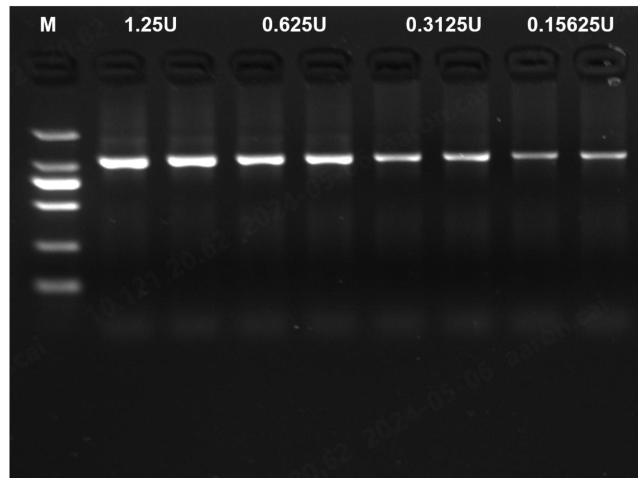
AK Taq V2 显示出更强的延伸性能,当延伸时间为5 秒,酶量 低至0.15625U 时,仍可扩增1kb 片段。
5’-3’外切酶活性封闭情况:

在不同温度条件下,AK Taq V2 的5’-3’外切酶活性封闭的效果更好,能有效减少对于引物探针的降解。
AK Taq DNA Polymerase V2 is developed based on the wild-type Taq DNA polymerase. Through genetic engineering modification, its amino acids are mutated to enhance the binding ability with DNA templates. This modification significantly improves its anti-interference capability against impurities in PCR templates, enabling it to amplify target fragments normally even under conditions where conventional wild-type Taq polymerase fails to do so. Meanwhile, this enzyme retains the 5’→3’ exonuclease activity of Taq polymerase and can be used in probe-based quantitative real-time PCR (qPCR) detection. Additionally, two Taq monoclonal antibodies are added to modify the original enzyme, which enhances the blocking effect on different active sites of Taq polymerase and improves specificity.
Before high-temperature heating, the Taq monoclonal antibody targeting the 5’-3’ polymerase active site of Taq binds to Taq polymerase to inhibit its polymerase activity, thereby suppressing non-specific amplification caused by non-specific annealing of primers or primer dimers under low-temperature conditions. The monoclonal antibody targeting the 5’-3’ exonuclease active site of Taq binds to Taq polymerase to inhibit its exonuclease activity, reducing the degradation of primer-probes by Taq polymerase in the pre-mixed system and ensuring the stability of the pre-mixed system.
When the amplification reaction system is heated to 95°C for 2.5 minutes, the polymerase activity is restored due to the denaturation of the anti-Taq monoclonal antibodies. Therefore, no special inactivation treatment is required, and the enzyme can be used under conventional PCR reaction conditions. When used in conjunction with the improved buffer, it can be activated quickly, effectively increasing the amount of reaction products and improving the sensitivity and specificity of PCR reactions. It can be applied in rapid PCR and amplification experiments of samples containing relatively high levels of interfering substances, such as blood, soil, plant sections, and sputum.
Scope of Application
Hot-start PCR amplification, direct whole blood amplification, anti-interference amplification, rapid PCR
Precautions
Primer Design
1. The last base at the 3' end of the primer is preferably G or C.
2. Continuous mismatches should be avoided in the last 8 bases at the 3' end of the primer.
3. Hairpin structures should be avoided at the 3' end of the primer.
4. It is optimal that the Tm value difference between the forward primer and the reverse primer does not exceed 1°C, and the Tm value is preferably adjusted to 55–65°C (Primer Premier 5 is recommended for calculating the primer Tm value).
5. The additional sequences of the primer (i.e., sequences not paired with the template) should not be involved in the calculation of the primer Tm value.
6. The GC content of the primer should be controlled between 40% and 60%.
7. The overall distribution of A, G, C, and T in the primer should be as uniform as possible, and regions with high GC or AT content should be avoided.
8. Complementary sequences of more than 5 bases should be avoided within a single primer or between two primers, and complementary sequences of more than 3 bases should be avoided at the 3' ends of the two primers.
9. After primer design, the NCBI BLAST function should be used to check the primer specificity to avoid non-specific amplification.
Other Precautions
1. Excessive template DNA is likely to lead to the production of non-specific PCR products.
2. For rapid amplification of qualitative long fragments (≥1 kb), it is recommended to use 5×AK Taq Fast Buffer (without Mg²⁺).
Usage Method
Preparation before Reaction System Configuration
1. Dissolve and mix all solutions required for the reaction at room temperature or 4°C, then place them on an ice bath or in an ice box. It is recommended to aliquot the reaction solutions for use to avoid repeated freezing and thawing.
2. Refer to the table below to set up the quantitative real-time PCR (qPCR) reaction system. It is recommended that the preparation of the qPCR reaction system be carried out on an ice bath or in an ice box:
Component
| Volume Added
| Final Concentration
|
|---|
| 5×AK Taq Buffer(without Mg²⁺) | 10μL | 1× | | dNTP(25mM each) | 0.4μL | 0.2mM | | Forward Primer(10 μM) | 1μL | 0.2μM | | Reverse Primer(10 μM) | 1μL | 0.2μM | | Probe(10 μM) | 0.5μL | 0.1μM | | AK Taq DNA Polymerase V2(5 U/μL) | 0.5μL | 0.05U/μL | | 100mM MgCl₂ | 1μL | 2mM | | Template DNA | 10μL | — | | ddH₂O | To 50μL | — | | 终体积 | 50μL | — |
|
3. The working concentration of MgCl₂ can be adjusted within the range of 1–3 mM; excessively high Mg²⁺ concentration may lead to an increase in non-specific products.
4. Recommendations for the use of two types of templates are as follows:
Mammalian genomic DNA: 0.1–1 μg
E. coli genomic DNA: 10–100 ng
5. When used for quantitative real-time PCR (qPCR), the volume of whole blood added is recommended to be ≤ 5% (v/v) of the reaction volume; excessive addition of blood samples will affect the collection of fluorescent signals.
6. For rapid qualitative PCR amplification of long fragments, especially for fragments ≥ 1 kb, it is recommended to use 5×AK Taq Fast Buffer. However, 5×AK Taq Fast Buffer is not suitable for qPCR, as it will cause a decrease in the fluorescence signal of the amplification curve.
Reaction Procedure
1. Conventional Qualitative PCR
| Step Name | Temperature | Time | Number of Cycles |
|---|
| Heat Shock | 95°C | 2min30s | 1 | | Denaturation | 95°C | 10s | 30 - 35 | | Annealing | 55°C | 20s | 30 - 35 | | Extension | 72°C | 20s | 30 - 35 | | Extension | 72°C | 7min | 1 | | Storage | 12°C | ∞ | 1 |
|
2. Rapid PCR (Taking the Amplification of 1kb λDNA as an Example)
| Step Name | Temperature | Time | Number of Cycles |
|---|
| Heat Shock | 95°C | 2min30s | 1 | | Denaturation | 98°C | 1s | 30 - 35 | | Annealing | 55°C | 5s | 30 - 35 | | Extension | 72°C | 5s | 30 - 35 | | Extension | 72°C | 5min | 1 | | Storage | 12°C | ∞ | 1 |
|
3. Fluorescent Quantitative PCR:
| Step Name | Temperature | Time | Number of Cycles |
|---|
| Heat Shock | 95°C | 2min30s | 1 | | Denaturation | 95°C | 15s | 35 - 40 | | Annealing + Extension | 55°C | 40s | 35 - 40 |
|
3.1 The settings of the PCR reaction need to be determined according to different conditions such as the template, primers, length of the PCR product, and GC content. Different PCR reaction conditions include temperature, time, number of cycles, etc.
3.2 The extension time needs to be set according to the length of the PCR product. Usually, the fastest extension time for each kb of product is 5 seconds. For example, if the length of the PCR product is 1 kb, the extension time can be set to 5 seconds; if the length of the PCR product is 2 kb, the extension time can be set to 10 seconds. If the result is not satisfactory, it can be appropriately extended to 15 seconds, and so on for fragments of other lengths.
Experimental Examples
Extension Rate:
AK Taq V2 shows stronger extension performance. When the extension time is 5 seconds and the enzyme amount is as low as 0.15625 U, it can still amplify a 1 kb fragment.
5’-3’ Exonuclease Activity Blocking:

Under different temperature conditions, AK Taq V2 has a better blocking effect on 5’-3’ exonuclease activity and can effectively reduce the degradation of primer-probes.


 ZJ26F0434072


 危险品化学品经营许可证(带存储)