
计算溶液所需的质量、体积或浓度。
G25 Spin 脱盐柱
有货
BioReagent,即用型 级 ,适用于对基线干扰要求严格的色谱和分析工作流程。
2-8°C储存,禁止冷冻。低温运输,禁止冷冻 。请查阅批次 COA 获取详细规格。
SDS、COA、产品数据表及规格说明书均可下载。可通过批号查询获取批次 COA。
在色谱分析、有机合成和交叉偶联反应领域已被 0 篇同行评审文献引用。
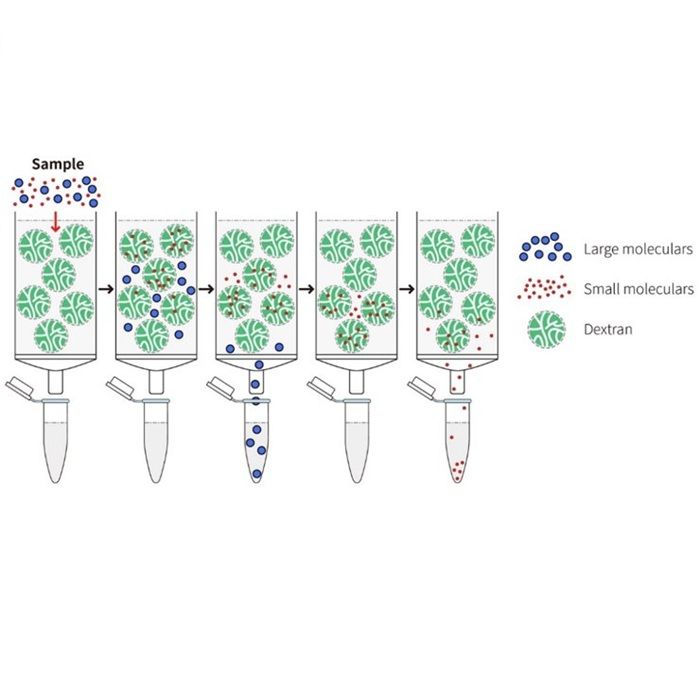
G25 蛋白脱盐预装柱,是使用 G25 葡聚糖基质研发的一款从大分子蛋白质样品中滤除盐类、咪唑等小分子物质的即用型层析柱,俗称脱盐柱。本品无需装柱,能够代替耗时的传统透析处理,以达到快速纯化蛋白质/替换蛋白质缓冲液的目的,对盐类和小分子物质的脱除率在 95%以上,蛋白样品脱盐效率高,回收率超 90%。本品支持离心法操作,主要用于去除大于 5kDa 的蛋白质、核酸、多肽、多糖等样品中盐离子、咪唑、去垢剂、小分子染料、缓冲剂等杂质。
产品规格:
柱体积:0.5 mL
上样量:50-150μl
包装:5支/25支
基质:葡聚糖
排阻极限:Mr5000
填料粒径:50-150μm
pH 稳定性:2-13
储存:2-8 ℃
产品特点:
操作方便,节省时间,显著优于传统透析;
对盐和小分子的脱除率在 95%以上,蛋白样品脱盐效率高;
蛋白样品回收率高,达到 90%以上;
可高效去除大于 5kDa 的蛋白质、多肽、核酸、多糖等样品 中盐离子、咪唑、去垢剂、小分子染料、缓冲剂等杂质。
使用说明:
一、离心脱盐:
1、流出保护液:拧松脱盐柱盖子,折断柱子下端堵头,将脱盐柱置于2mL收集管中。1000xg离心2分钟,丢弃离心下来的保存溶液,并将脱盐柱放回收集管中。
注:使用非水平转头的情况下,由于离心可能会使树脂压实形成一个向上的斜面,该斜面的方向宜在后续步骤中保持,在柱外壳上的斜面向上位置做标记,在随后的离心步骤中需要调整好离心管的放入方向,确保离心后斜面的方向和位置不会改变。
2、平衡:用移液器或滴管沿柱内壁缓慢加入平衡液,直至充满柱管,轻轻拧上脱盐柱上盖,1000×g离心2分钟,丢弃溶液,重复此步骤3次。
3、上样:移液器吸头贴近填料的中心位置(注意不要触及填料)缓慢加入 10%-30%柱床体积样品,使样品进入填料。
4、将脱盐柱放入新的洁净收集管中,轻轻拧上脱盐柱上盖,1000×g离心2分钟,收集管中的液体即为脱盐后的蛋白。
5、可通过 A280nm 紫外吸收值、Bradford 蛋白浓度测定、SDS-PAGE 凝胶电泳等方法检测蛋白样品浓度。
二、介质清洗与再生:
1、将使用过的脱盐柱,加入去离子水清洗,重复三次。
2、将处理好的脱盐柱,加入 20%乙醇溶液,下端放上堵头,拧紧盖子 2-8℃保存即可。
注意事项:
1、为防止交叉污染,本品建议一次性使用。 为了防止离子相互作用,建议在样品缓冲液中保持低盐浓度(25 mM NaCl)。
2、填料在高浓度醇溶液或饱和盐溶液中会有失水收缩现象,请勿将上述溶液进行过柱。
3、样品处理量应适宜,过多会影响脱盐效果,过少会影响回收效率,上样时应缓慢将样品均匀加至管中心位置。
4、当样品浓度过低时,需先将样品用超滤管浓缩到所需体积或所需浓度。
5、保存和纯化过程中应始终保持基质湿润,避免气泡进入脱盐柱中。
Product Introduction:
The G25 pre-packed protein desalting column is a ready-to-use chromatography column developed using G25 Sephadex matrix. It is commonly known as a desalting column and is designed to filter out small molecular substances such as salts and imidazole from macromolecular protein samples. This product eliminates the need for column packing and can replace the time-consuming traditional dialysis process, achieving the purpose of rapid protein purification and protein buffer replacement. The removal rate of salts and small molecular substances is over 95%, with high desalting efficiency for protein samples and a recovery rate exceeding 90%.This product supports operation by centrifugation methods. It is mainly used to remove impurities such as salt ions, imidazole, detergents, small molecular dyes, and buffers from samples including proteins, nucleic acids, polypeptides, and polysaccharides with a molecular weight greater than 5 kDa.
Product Specifications:
Column volume: 0.5 mL
Sample loading volume: 50-150 μl
Packaging: 5pieces/25 pieces
Matrix: Sephadex
Exclusion limit: Mr5000
Particle size of filler: 50-150 μm
pH stability: 2-13
Storage: 2-8 ℃
Product Features:
Easy to operate and time-saving, significantly superior to traditional dialysis;
The removal rate of salts and small molecules is over 95%, with high desalting efficiency for protein samples;
High recovery rate of protein samples, reaching more than 90%;
It can efficiently remove impurities such as salt ions, imidazole, detergents, small molecule dyes, and buffers from samples of proteins, polypeptides, nucleic acids, polysaccharides, etc. with a molecular weight greater than 5 kDa.
Instructions for Use
1. Centrifugal Desalting:
1) Drain the protective solution: Loosen the cap on a spin column, twist the tab off of the bottom, then place the column into a collection tube. Centrifuge the column‑tube assembly at 1,000 x g for 2 minutes to remove the storage solution. Discard the flowthrough, then place the column back into the collection tube.
Note: When using a non-horizontal rotor, the centrifugation may cause the resin to compact and form an upward slope. The direction of this slope should be maintained in the subsequent steps. Mark the position of the upward slope on the column shell, and in the subsequent centrifugation steps, adjust the direction of the centrifuge tube to ensure that the direction and position of the slope do not change after centrifugation.
2) Equilibration: Slowly add equilibration buffer along the inner wall of the column using a pipette or dropper until the column is fully filled. Centrifuge the column‑tube assembly at 1,000 x g for 2 minutes to equilibrate the column. Repeat this step 3 times, discarding the buffer from the collection tube each time.
3) Sample loading: Hold the pipette tip close to the center of the filler (being careful not to touch the filler) and slowly add the sample in an amount equivalent to 10%-30% of the column bed volume, allowing the sample to enter the filler.
4) Place the desalting column into a new clean collection tube, centrifuge at 1000 g for 2 minutes. The liquid in the collection tube is the desalted protein.
5) The concentration of the protein sample can be detected by methods such as A280nm ultraviolet absorption, Bradford protein concentration determination, and SDS-PAGE gel electrophoresis.
2. Medium Cleaning and Regeneration:
1) Add deionized water to the used desalting column for cleaning, and repeat this three times.
2) Add 20% ethanol solution to the treated desalting column, place a plug at the lower end, tighten the cap, and store it at 2-8℃.
Precautions:
1) To prevent cross-contamination, it is recommended that this product be used disposable. To avoid ionic interactions, it is advisable to maintain a low salt concentration (25 mM NaCl) in the sample buffer.
2) The filler will lose water and shrink in high-concentration alcohol solutions or saturated salt solutions. Do not pass the above-mentioned solutions through the column.
3) The sample processing amount should be appropriate. Too much will affect the desalting effect, and too little will affect the recovery efficiency. When loading the sample, slowly and evenly add the sample to the center of the tube.
4) When the sample concentration is too low, the sample should first be concentrated to the required volume or concentration using an ultrafiltration tube.
5) The matrix should be kept moist at all times during storage and purification, and avoid bubbles entering the desalting column.
通过匹配包装上的批号来查找并下载产品的 COA,每批产品都进行了严格的验证,您可放心使用!
| 批号(Lot Number) | 证书类型 | 货号 |
|---|---|---|
 ZJ26F0938963 |
分析证书 | G1506505 |
| ZJ26F0938964 |
分析证书 | G1506505 |
| ZJ26F0938965 |
分析证书 | G1506505 |
| ZJ26F0636532 |
分析证书 | G1506505 |
| ZJ26F0636533 |
分析证书 | G1506505 |
| ZJ26F0636531 |
分析证书 | G1506505 |
| ZJ26F0131851 |
分析证书 | G1506505 |
| ZJ26F0131852 |
分析证书 | G1506505 |
| ZJ26F0131850 |
分析证书 | G1506505 |


 危险品化学品经营许可证(带存储)