
计算溶液所需的质量、体积或浓度。
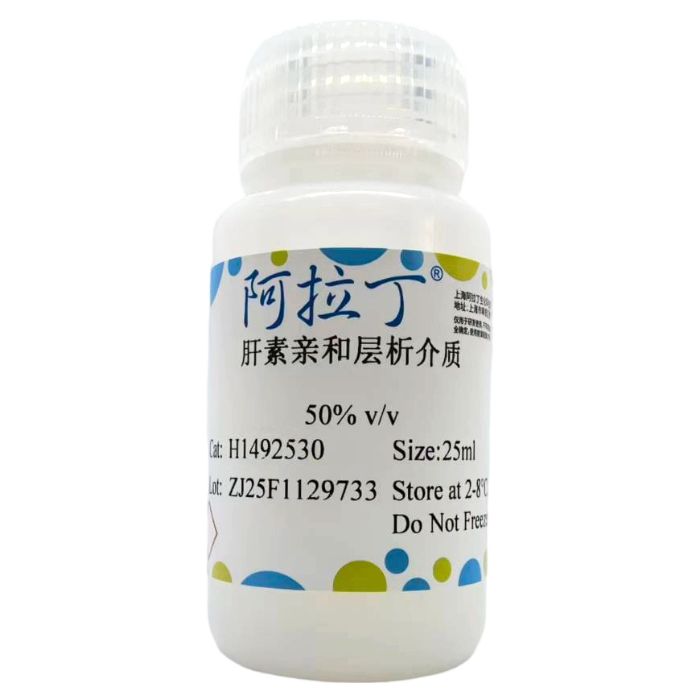
肝素亲和层析介质
有货
BioReagent,通过内毒素测试 级 ,适用于对基线干扰要求严格的色谱和分析工作流程。
2-8°C储存,禁止冷冻。低温运输,禁止冷冻 。请查阅批次 COA 获取详细规格。
SDS、COA、产品数据表及规格说明书均可下载。可通过批号查询获取批次 COA。
在色谱分析、有机合成和交叉偶联反应领域已被 0 篇同行评审文献引用。
储存缓冲液:20% (v/v) Ethanol, 0.05 M NaAc
本产品由琼脂糖凝胶层析介质基球上键合肝素而成。肝素亲和的原理较为复杂,一般认为肝素与蛋白的结合是离子相互作用、氢键与范德华力等多种驱动力共同作用的结果。肝素填料主要用于凝血酶III、凝血因子、脂蛋白、酯酶、激素、干扰素等的分离纯化。也有文献报道将肝素填料用于外泌体的纯化。本产品保留了琼脂糖极好的亲水性及大网架结构,与生物活性大分子有很好的相容性,具有载量高,非特异性吸附少,流速快等特点,适用于各种肝素亲和层析。
阿拉丁肝素亲和层析介质储存在20% (v/v) 乙醇(含0.05 M NaAc)中,凝胶和保护液的体积比为1:1,我司产品规格为实际凝胶的体积。
|
注:
① 90%体积以上的微球在此粒径范围;
② 测试结果为单位体积填料纯化菌体获得的纯蛋白量(重组人酸性成纤维细胞生长因子);
③ 10cm柱高下的最大测试流速。
使用说明
1、色谱柱装填
以下阐述与层析系统连接时,填料的色谱柱装填方法。
(1)所有需要用到的材料的温度要与色谱操作的温度一样,液体最好做脱气处理。
(2)填料用量计算:通过沉降定量填料体积,需要的沉降填料体积=柱体积×压缩比(也称压缩因子)。沉降体积是指填料在20%乙醇保存液中自然沉降完全读取的稳定体积。肝素亲和层析介质的压缩比为~1.15。为使达到装柱比,可通过柱头下压的方法,也可以通过高流速压柱。
(3)填料清洗:将填料悬液充分摇匀后量取相应体积,抽滤除去液体,并用约3倍填料体积的纯化水洗涤,重复3次,以除去保存液。
(4)装柱填料悬液准备:将填料转移到适当的容器中,加入适量的装柱液,制成 50~75 v%的装柱填料悬液,使用前搅匀。
(5)装填前准备:在清洗干净的层析柱下端加入装柱液,以除去下垫片及层析柱下端的空气,在柱内保留少量的蒸馏水,拧紧下堵头,调整柱子使其垂直于地面。
(6)装填:将搅匀后的填料悬液一次性缓慢倒入层析柱内(必要时使用装柱器),为避免引入气泡,应使之沿层析柱内壁自然流下。将所有填料加入后,用装柱液将装柱器加满,拧紧装柱器上盖,将柱子与层析系统连接。
(7)压柱:使柱内填料自然沉降(或50~150 cm/h的低流速下沉降),待填料沉降完全后(填料与液体的界面清晰),去除装柱器,装上上柱头,并将柱头下降至界面处; 通过高流速(推荐流速见下表,注意柱压不超过0.3 MPa),继续压柱至界面清晰稳定,标记界面稳定时的柱高。停泵,打开柱头上的阀门/堵头,关闭柱底的阀门/堵头,下压柱头至标记位置下方与压缩比对应的位置,旋紧柱头,装柱完成。装柱完成后,需用高流速平衡柱内的填料。
|
2、柱效测定和评价
完成装柱后、使用前可通过柱效测定和评价可以确认层析柱装填质量。柱效通常用理论塔板高度(HETP)和非对称因子(As)来评价。
柱效测定可以采用丙酮或者NaCl作为样品进行,按照下表配制样品溶液和流动相。
|
根据UV或者电导率曲线计算理论塔板高度(HETP)、理论塔板数(N)和非对称因子(As),公式如下:
HETP = L / N
N = 5.54 × (Vʀ / Wₕ)²
As = a / b
其中:L为柱高; Vʀ为保留体积;Wₕ为半高峰宽;a为在10%峰高处的第一个半峰宽;b为在10%峰高处的第二个半峰宽。
一般来说,HETP的数值应小于填料平均粒径的三倍(即HETP/D50<3,D50为填料的平均粒径),As应在0.8~1.5之间。
3、平衡与上样
在上样前,可用初始缓冲液A在操作流速下平衡层析柱,观察检测器的变化,直到电导、pH等参数不变。本产品的缓冲液体系可为磷酸盐、柠檬酸盐和Tris-HCl等,浓度为10~20 mM,pH为7~8为宜。
样品通常溶于上述缓冲液A,或者将样品溶液进行换液处理,置换成缓冲液A体系。上样量可按“mg目标蛋白/mL填料”来设定,通常为DBC10%的50~80%,例如肝素亲和层析介质产品对rh-aFGF的DBC10%为~10 mg/mL,纯化时的上样量可为5~8 mg/mL。除了DBC10%,也可以测试上样流穿液中的目标蛋白确定上样量。
4、洗杂
在缓冲液A中添加一定量的盐对上样后的色谱柱进行冲洗可以抑制非特异性吸附,从而提高产物纯度。200~600 mM 的 NaCl 是常用的提高离子强度的盐,具体的离子强度可以通过线性梯度或者阶跃梯度确定。洗杂的体积通常为3~10个柱体积。
5、洗脱
洗脱过程则可以进一步提高缓冲液A中的盐浓度,添加1.5~2 M的NaCl可将目的蛋白有效洗脱。
6、再生与在位清洗
通常可用5 CV的洗脱液将填料再生。若有失活蛋白质或脂类物质在再生时洗不掉,可用在位清洗(CIP)除去。可采用以下选择进行在位清洗:0.1 mol/L NaOH、非离子型表面活性剂等。在位清洗可有效去除介质上的杂质,反向效果更佳。
7、填料保存
填料的初始保存液为20%乙醇,含50 mM醋酸钠,使用过后可继续用相同的保存液。保存温度在2~30℃为宜,不可冻存。
This product is an affinity chromatography medium formed by coupling heparin to agarose gel base beads. The mechanism of heparin affinity is complex and generally involves multiple driving forces such as ionic interactions, hydrogen bonding, and van der Waals forces. Heparin-based resins are primarily used for the separation and purification of antithrombin III, coagulation factors, lipoproteins, esterases, hormones, interferons, and more. Some literature also reports the use of heparin resins for exosome purification. This product retains the excellent hydrophilicity and large-pore structure of agarose, ensuring good compatibility with bioactive macromolecules. It features high binding capacity, low non-specific adsorption, and fast flow rates, making it suitable for various heparin affinity chromatography applications.
Aladdin Heparin Agarose Resin is stored in 20% (v/v) ethanol (containing 0.05 M sodium acetate), with a settled gel to storage solution ratio of 1:1. The product specification refers to the actual volume of the settled gel.
|
Notes:
① Over 90% of the beads fall within this size range.
② Binding capacity measured as pure recombinant human acidic fibroblast growth factor (rh-aFGF) yield per mL resin.
③ Maximum tested flow rate at 10 cm column height.
Protocol
1. Column Packing
The following procedure describes column packing when connected to a chromatography system:
(1) Equilibrate all materials to the operating temperature. Degas liquids if possible.
(2) Resin Quantity Calculation:
Settled resin volume = Column volume × Compression factor (~1.15 for this resin).
(3) Resin Preparation: Resuspend the resin slurry thoroughly. Measure the required volume, remove storage solution by filtration, and wash 3 times with ~3 resin volumes of purified water.
(4) Packing Slurry Preparation: Transfer resin to a suitable container and add packing solution to achieve a 50–75% (v/v) slurry. Mix well before use.
(5) Pre-packing Setup: Fill the bottom of the clean column with packing solution to remove air from the bottom frit and outlet. Retain a small amount of liquid, tighten the bottom end fitting, and ensure the column is vertical.
(6) Packing: Pour the well-mixed slurry into the column in one slow, continuous motion (use a packing reservoir if needed). After adding all resin, fill the reservoir with packing solution, attach the top lid, and connect the column to the system.
(7) Compression: Allow the resin to settle naturally (or use a low flow rate of 50–150 cm/h). Apply a high flow rate (600 cm/h; ensure pressure ≤0.3 MPa) until the interface is stable. Mark the stable height, stop the pump, and lower the adapter to the position corresponding to the compression factor (~1.15). Tighten the adapter and equilibrate the column at a high flow rate.
|
2. Column Efficiency Testing
After packing, assess column efficiency using HETP (Height Equivalent to a Theoretical Plate) and As (Asymmetry Factor) with acetone or NaCl as tracers:
|
Calculate HETP, N, and As using:
HETP = L / N
N = 5.54 × (Vʀ / Wₕ)²
As = a / b
HETP should be <3× the average particle diameter (HETP/D₅₀ < 3), and As should be 0.8–1.5.
3. Equilibration and Loading
Equilibrate the column with initial Buffer A (e.g., 10–20 mM phosphate, citrate, or Tris-HCl buffer, pH 7–8) at the operating flow rate until baseline (conductivity/pH) stabilizes.
Dissolve or dialyze the sample into Buffer A. Load at 50–80% of DBC₁₀% (e.g., 5–8 mg rh-aFGF/mL resin for a DBC₁₀% of ~10 mg/mL). Alternatively, determine the load by monitoring target protein breakthrough in the flow-through.
4. Washing
Wash with 3–10 CV of Buffer A containing 200–600 mM NaCl to reduce non-specific binding. Optimize salt concentration using linear or step gradients.
5. Elution
Elute with Buffer A containing 1.5–2 M NaCl.
6. Regeneration and Cleaning-in-Place (CIP)
Regenerate with 5 CV of elution buffer. For stubborn contaminants (e.g., denatured proteins, lipids), use CIP agents such as 0.1 M NaOH or non-ionic surfactants. Reverse flow may enhance cleaning efficiency.
7. Storage
Store in 20% ethanol with 50 mM sodium acetate at 2–30°C. Do not freeze.
通过匹配包装上的批号来查找并下载产品的 COA,每批产品都进行了严格的验证,您可放心使用!
| 批号(Lot Number) | 证书类型 | 货号 |
|---|---|---|
 ZJ26F0535581 |
分析证书 | H1492530 |
| ZJ25F1129735 |
分析证书 | H1492530 |
| ZJ25F1129734 |
分析证书 | H1492530 |
| ZJ25F1129733 |
分析证书 | H1492530 |


 危险品化学品经营许可证(带存储)