细胞转染是指将外源分子导入真核细胞内以改变其基因型或表型的一种技术。随着分子生物学和细胞生物学研究的不断发展,转染已经成为研究和控制基因功能的常规手段,广泛应用于基因功能研究、调控基因表达、突变分析,以及基因治疗、细胞治疗、蛋白生产、疫苗生产等领域。转染大致可分为物理介导、化学介导和生物介导三类途径。其中化学介导方法因其兼具高效低毒、方便快捷等优点,应用广泛。化学介导方法包括经典的磷酸钙共沉淀法、脂质体转染方法以及多种阳离子物质介导的转染方法。
理想的细胞转染方法应该具有转染效率高、细胞毒性小等优点。脂质体和阳离子聚合物是目前研究最多的人工合成载体。脂质体对细胞膜具有很高的亲和力,它们可以很容易地通过内吞作用或直接膜融合进入细胞质,并通过脂质-磷脂交换释放结合的DNA。因此,这些材料通常具有较高的转染效率。然而,脂质体在基因递送方面具有关键的局限性,包括可重复制备性差,以及一定的细胞毒性。市面上多种商业化的脂质体转染试剂要求细胞铺板密度较高,以90%-95%为佳,这有助于减少阳离子脂质体细胞毒性造成的影响。但是,如果研究的基因要求比较长的表达时间,例如细胞周期相关基因,或者细胞表面蛋白,又或者转染后续需要进行继续培养和功能研究,则不适合用脂质体核酸转染试剂。阳离子聚合物载体是另一类研究较多的人工合成载体。这些聚合物通过离子相互作用与DNA形成纳米尺寸的复合物。阳离子聚合物在基因递送方面具有几个独特的特征,例如,易于制造、配方稳定、易于修饰等。目前,众多的研究者和生物公司将新一代转染试剂的开发聚焦在非脂质体的聚合物上,以寻找更高效低毒,同时对研究影响较小的转染试剂。
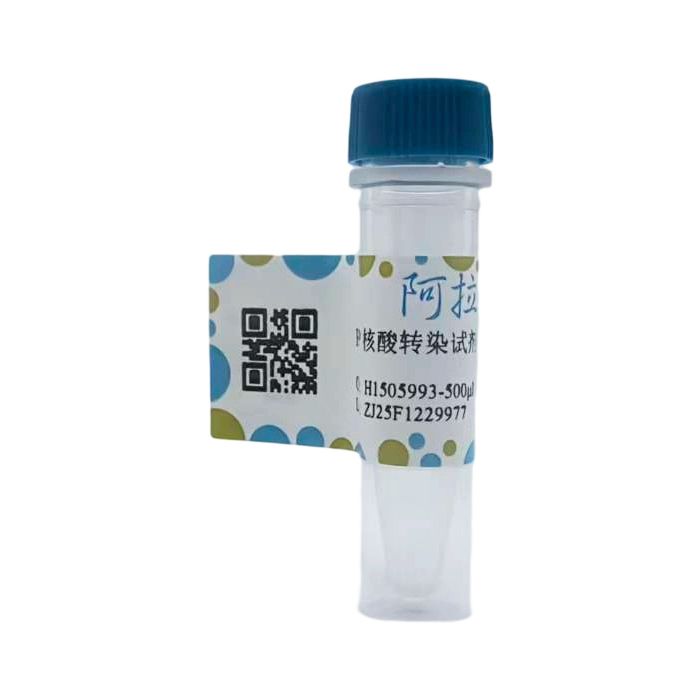
HP Nucleic Acid Transfection Reagent (H1505993) 是性能更优异的阳离子高分子聚合物转染试剂,适用于DNA、RNA的转染。其原理为带正电的高分子聚合物与核酸带负电的磷酸基团形成带正电的复合物后,与细胞表面带负电的蛋白多糖相互作用,并通过内吞作用进入细胞,随后在胞质中释放,实现外源核酸的细胞转染。HP Nucleic Acid Transfection Reagent (H1505993) 使用的阳离子高分子表面引入了细胞穿膜肽和内涵体逃逸促进剂,其细胞内吞能力和内涵体逃逸能力进一步增强,以保证更多的复合物进入细胞质,从而实现更优异的细胞转染效果。
HP Nucleic Acid Transfection Reagent (H1505993) 对多种常见细胞、难转细胞、原代细胞均具有高水平转染效率,具有高效低毒、操作简单、重复性好等优点。其独特的配方使其可直接加入培养基中,血清的存在不会影响转染效率,这样可以减少去除血清对细胞的损伤。同时,转染后不需要除去HP Nucleic Acid Transfection Reagent-核酸复合物或更换新鲜培养基,也可根据具体情况优化转染体系。
产品特点:
⁕ 卓越的转染效率——针对广泛类型的细胞,均表现出卓越的转染效率。
⁕ 细胞毒性低——转染的细胞仍保持很好的活性。
⁕ 适用范围广——普通细胞,难转细胞,原代细胞全面覆盖。
⁕ 操作简单——在血清存在时亦具有可靠的转染效率,转染后无需去除复合物或更换新鲜培养基。
适用范围:
HP Nucleic Acid Transfection Reagent 采用先进的阳离子高分子聚合物为主要成分,是一种高效的核酸转染试剂,可成功转染多种真核细胞、难转细胞、原代细胞,适用于DNA、RNA的转染。
实验流程概要:

图1. HP Nucleic Acid Transfection Reagent (H1505993) 转染实验流程图
实验步骤:
(以24孔板为例,其他培养板加样体积参考表一:转染量度标准)
1.准备待转染细胞
(1)贴壁细胞:转染前一天,将胰酶消化后的细胞按照每孔0.5-1.5x10⁵个细胞的量进行铺板,使其在转染时密度为50%左右。
(2)悬浮细胞:转染当天,配制转染试剂-核酸复合物之前,在24孔板中进行细胞铺板,每500 µL生长培养基中加入1-3x10⁵个细胞。
⁕ 细胞状态会极大影响转染效率,待转染细胞应处于良好生长状态,建议使用生长处于指数期、存活率大于90% 的细胞进行转染。
2.准备转染试剂-核酸复合物
(1)取0.5 μg质粒加入到1.5 mL离心管中,加入2 μL转染试剂与质粒混合,室温孵育3分钟。
⁕ 转染试剂使用量受细胞类型及其他实验条件影响。通常情况下,24孔板的推荐DNA用量为0.2-0.6 μg,转染试剂推荐用量为1-4 μL。建议初次使用时,可在推荐范围内进行不同用量的预实验,以优化转染效果。
(2)往上述混合物中加入100 μL无血清基础培养基(推荐使用 Optimal-MEM减血清培养基(含酚红)(O778393)),轻轻混匀,在室温下静置30分钟,形成转染试剂-核酸复合物。
⁕ 转染试剂-核酸复合物在室温下4个小时内保持稳定。
3.细胞转染
给细胞更换新鲜的预热的完全培养基(500 μL/孔),将上述100 µL转染试剂-核酸复合物加入每孔细胞,轻轻摇动培养板混匀。
⁕ 对于悬浮细胞系:转染5小时后,可选择加入PMA和/或PHA以提高CMV启动子的活性并促进基因表达。对于Jurkat细胞,PHA和PMA的终浓度分别为1 µg/mL和50 ng/mL,可以提高CMV启动子活性和基因表达。对于K562细胞,只加入PMA足以提高启动子活性。
4.分析转染细胞
转染细胞培养24-48小时后,可根据实际情况用荧光检测法、Western Blot、RT-PCR、ELISA、流式细胞术、报告基因等检测转染效果,或加入筛选药物进行稳定细胞株的筛选。
表一:转染量度标准
细胞培养装置规格 | 培养体系 (mL) | DNA (μg)
| 转染试剂 (μL) | Optimal-MEM Reduced Serum Medium (with Phenol Red) (O778393) |
96孔板
| 0.1 | 0.1 | 0.4 | 20 |
24孔板
| 0.5 | 0.5 | 2 | 100 |
12孔板
| 1 | 1 | 4 | 200 |
6孔板
| 2 | 2 | 8 | 400 |
60mm 皿
| 4 | 2-4 | 8-16 | 800 |
100mm 皿
| 10 | 5-10 | 20-40 | 2000 |
注意事项:
1.核酸质量:想要获得最高的转染效率和最低的细胞毒性,应选用高纯度、无菌、无污染、无内毒素的优质核酸。质粒中的内毒素是转染的大敌,内毒素会导致转染效率显著下降,特别是对内毒素敏感的细胞,例如原代细胞、悬浮细胞、造血细胞等。推荐使用无内毒素质粒抽提试剂盒进行质粒提取,保证质粒A₂₆₀/A₂₈₀比值为1.8-2.0。同时,需合理计算质粒用量,转染过量的质粒可能会导致细胞毒性甚至死亡。
2. 细胞质量:细胞状态会极大影响转染效率,建议使用生长处于指数期、存活率大于90%的细胞进行转染。
3. 细胞密度:建议细胞传代后12-24小时内、细胞密度约为50%时进行转染。不同的细胞转染实验,对细胞密度的要求不尽相同。在进行不同核酸或不同细胞系的转染时,需要根据说明书优化实验条件。此外,在实验过程中应保证相同的接种条件,确保实验数据的可重复性。
4. 质粒与转染试剂的使用量:对于24孔板培养的大多数细胞系来说,我们推荐的DNA用量为0.2-0.6 μg(推荐0.5 μg),转染试剂的用量为1-4 μL(推荐2 μL)。想要获得最优的转染结果,需要对DNA用量及转染试剂用量进行优化,根据所转染的细胞类型及质粒选择适合的用量。
5. HP Nucleic Acid Transfection Reagent 可用于有血清培养基的转染,转染后不需要去除复合物或换培养基。但是,制备转染复合物时要求用无血清基础培养基稀释DNA和转染试剂(推荐使用 Optimal-MEM减血清培养基(含酚红)(O778393)),因为血清会影响复合物的形成。
6. 由于一些特殊培养基中的某些成分可能会抑制阳离子聚合物介导的转染,因此有必要检测特殊培养基与本产品的相容性。
7. 为了您的健康安全,请规范操作,穿戴实验服与手套开展实验。
8. 本产品仅供科研使用,请勿用于临床诊断及治疗。
实验案例分析:
1.转染前一天,将图2所示9种状态良好的细胞接种于24孔板,使其在转染时密度约为50%。
2.按照每孔计量,取0.5 μg GFP质粒加入到1.5 mL离心管中,加入2 μL 转染试剂(H1505993)与质粒混合,室温孵育3 分钟后,往混合物中加入100 μL Optimal-MEM减血清培养基(含酚红)(O778393),轻轻混匀,在室温下静置30 分钟,形成转染试剂-核酸复合物。
3.给细胞更换新鲜的预热的完全培养基(500 μL/孔),将上述100 µL转染试剂-核酸复合物加入每孔细胞,轻轻摇动培养板混匀。
4.转染细胞培养48小时后,用荧光显微镜检测GFP绿色荧光蛋白表达情况,并拍照记录,实验结果如图2所示。

图2. 采用HP Nucleic Acid Transfection Reagent (H1505993) 转染GFP质粒(0.5 μg),48小时后用荧光显微镜检测GFP绿色荧光蛋白表达情况。
Cell transfection refers to a technique that introduces exogenous molecules into eukaryotic cells to alter their genotype or phenotype. With the continuous development of molecular biology and cell biology research, transfection has become a routine method for studying and controlling gene functions, widely applied in fields such as gene function research, regulation of gene expression, mutation analysis, as well as gene therapy, cell therapy, protein production, and vaccine production. Transfection can be roughly divided into three categories: physical-mediated, chemical-mediated, and biological-mediated approaches. Among them, chemical-mediated methods are widely used due to their advantages of high efficiency, low toxicity, convenience, and rapidity. Chemical-mediated methods include the classic calcium phosphate co-precipitation method, liposome transfection method, and various cationic substance-mediated transfection methods.
An ideal cell transfection method should have advantages such as high transfection efficiency and low cytotoxicity. Liposomes and cationic polymers are currently the most studied synthetic carriers. Liposomes have a high affinity for cell membranes; they can easily enter the cytoplasm through endocytosis or direct membrane fusion, and release the bound DNA through lipid-phospholipid exchange. Therefore, these materials usually have high transfection efficiency. However, liposomes have key limitations in gene delivery, including poor reproducibility in preparation and certain cytotoxicity. Many commercial liposome transfection reagents on the market require a high cell plating density, preferably 90%-95%, which helps reduce the impact of cytotoxicity caused by cationic liposomes. However, if the studied gene requires a relatively long expression time (e.g., cell cycle-related genes, cell surface proteins) or if subsequent culture and functional studies are needed after transfection, liposome nucleic acid transfection reagents are not suitable. Cationic polymer carriers are another type of widely studied synthetic carriers. These polymers form nano-sized complexes with DNA through ionic interactions. Cationic polymers have several unique characteristics in gene delivery, such as ease of manufacturing, stable formulation, and ease of modification. Currently, many researchers and biotech companies are focusing on the development of new-generation transfection reagents based on non-liposomal polymers to find more efficient and low-toxicity transfection reagents with less impact on research.
HP Nucleic Acid Transfection Reagent (H1505993) is a cationic polymer transfection reagent with superior performance, suitable for the transfection of DNA and RNA. Its principle is that positively charged polymers form positively charged complexes with the negatively charged phosphate groups of nucleic acids. These complexes then interact with negatively charged proteoglycans on the cell surface, enter the cell through endocytosis, and are subsequently released in the cytoplasm, achieving cellular transfection of exogenous nucleic acids. The cationic polymer used in HP Nucleic Acid Transfection Reagent (H1505993) has cell-penetrating peptides and endosome escape promoters introduced on its surface, which further enhance its endocytic capacity and endosome escape ability, ensuring that more complexes enter the cytoplasm and thus achieving better cell transfection effects.
HP Nucleic Acid Transfection Reagent (H1505993) has high transfection efficiency in various common cells, hard-to-transfect cells, and primary cells, with advantages such as high efficiency, low toxicity, simple operation, and good reproducibility. Its unique formula allows it to be directly added to the culture medium, and the presence of serum does not affect transfection efficiency, which can reduce cell damage caused by serum removal. Meanwhile, there is no need to remove the HP Nucleic Acid Transfection Reagent-nucleic acid complex or replace it with fresh medium after transfection, and the transfection system can also be optimized according to specific conditions.
Product Features:
⁕ Excellent transfection efficiency — It exhibits outstanding transfection efficiency across a wide range of cell types.
⁕ Low cytotoxicity — Transfected cells maintain good viability.
⁕ Broad application range — Comprehensive coverage of common cells, hard-to-transfect cells, and primary cells.
⁕ Simple operation — It maintains reliable transfection efficiency even in the presence of serum, and there is no need to remove the complex or replace with fresh medium after transfection.
Scope of Application:
HP Nucleic Acid Transfection Reagent uses advanced cationic polymer as its main component. It is a high-efficiency nucleic acid transfection reagent that can successfully transfect a variety of eukaryotic cells, hard-to-transfect cells, and primary cells, and is suitable for the transfection of DNA and RNA.
Summary of Experimental Procedure:
Figure 1. Flowchart of Transfection Experiment Using HP Nucleic Acid Transfection Reagent (H1505993)
Experimental Steps:
(Take a 24-well plate as an example; for the sample addition volume of other culture plates, refer to Table 1: Transfection Quantity Standards)
1. Prepare Cells for Transfection
(1) Adherent cells: One day before transfection, seed the trypsin-digested cells at a density of 0.5–1.5×10⁵ cells per well, ensuring the cell density reaches approximately 50% at the time of transfection.
(2) Suspension cells: On the day of transfection, before preparing the transfection reagent-nucleic acid complex, seed the cells in a 24-well plate by adding 1–3×10⁵ cells to 500 µL of growth medium per well.
⁕ Cell status significantly affects transfection efficiency. Cells to be transfected should be in a good growth state; it is recommended to use cells in the exponential growth phase with a survival rate >90% for transfection.
2. Prepare Transfection Reagent-Nucleic Acid Complex
(1) Add 0.5 μg of plasmid to a 1.5 mL centrifuge tube, then add 2 μL of transfection reagent to mix with the plasmid, and incubate at room temperature for 3 minutes.
⁕ The amount of transfection reagent used is affected by cell type and other experimental conditions. Under normal circumstances, the recommended DNA amount for a 24-well plate is 0.2–0.6 μg, and the recommended amount of transfection reagent is 1–4 μL. For first-time use, it is recommended to conduct pre-experiments with different dosages within the recommended range to optimize transfection efficiency.
(2) Add 100 μL of serum-free basal medium (Optimal-MEM Reduced Serum Medium (with Phenol Red) (Cat. No. O778393) is recommended) to the above mixture, mix gently, and let it stand at room temperature for 30 minutes to form the transfection reagent-nucleic acid complex.
⁕ The transfection reagent-nucleic acid complex remains stable at room temperature for up to 4 hours.
3. Cell Transfection
Replace the cell culture medium with fresh, pre-warmed complete medium (500 μL per well), then add the 100 µL transfection reagent-nucleic acid complex to each well of cells, and gently swirl the plate to mix.
⁕ For suspension cell lines: 5 hours after transfection, PMA and/or PHA can be optionally added to enhance the activity of the CMV promoter and promote gene expression. For Jurkat cells, the final concentrations of PHA and PMA are 1 µg/mL and 50 ng/mL, respectively, which can improve CMV promoter activity and gene expression. For K562 cells, adding PMA alone is sufficient to enhance promoter activity.
4. Analyze Transfected Cells
After culturing the transfected cells for 24–48 hours, the transfection efficiency can be detected by methods such as fluorescence detection, Western Blot, RT-PCR, ELISA, flow cytometry, or reporter gene assays according to actual needs. Alternatively, screening drugs can be added for the selection of stable cell lines.
Table 1: Transfection Volume Standards
Specifications of Cell Culture Equipment | Culture System (mL) | DNA (μg) | Transfection Reagent (μL) | Optimal-MEM Reduced Serum Medium (with Phenol Red) (O778393) |
96-well plate
| 0.1 | 0.1 | 0.4 | 20 |
24-well plate
| 0.5 | 0.5 | 2 | 100 |
12-well plate
| 1 | 1 | 4 | 200 |
6-well plate
| 2 | 2 | 8 | 400 |
60mm Dish
| 4 | 2-4 | 8-16 | 800 |
100mm Dish
| 10 | 5-10 | 20-40 | 2000 |
Precautions:
1. Nucleic Acid Quality: To achieve the highest transfection efficiency and lowest cytotoxicity, high-quality nucleic acids with high purity, sterility, no contamination, and no endotoxins should be used. Endotoxins in plasmids are a major obstacle to transfection, as they can significantly reduce transfection efficiency—especially for endotoxin-sensitive cells such as primary cells, suspension cells, and hematopoietic cells. It is recommended to use an endotoxin-free plasmid extraction kit for plasmid isolation, ensuring the plasmid has an A₂₆₀/A₂₈₀ ratio of 1.8–2.0. Meanwhile, the amount of plasmid used should be calculated appropriately; excessive plasmid transfection may cause cytotoxicity or even cell death.
2. Cell Quality: Cell status significantly affects transfection efficiency. It is recommended to use cells in the exponential growth phase with a survival rate >90% for transfection.
3. Cell Density: Transfection is recommended to be performed within 12–24 hours after cell passage, when the cell density is approximately 50%. Different cell transfection experiments have varying requirements for cell density. When transfecting different nucleic acids or different cell lines, experimental conditions need to be optimized according to the instruction manual. Additionally, consistent seeding conditions should be maintained throughout the experiment to ensure the reproducibility of experimental data.
4. Dosages of Plasmid and Transfection Reagent: For most cell lines cultured in 24-well plates, the recommended DNA dosage is 0.2–0.6 μg (0.5 μg is preferred), and the recommended transfection reagent dosage is 1–4 μL (2 μL is preferred). To obtain optimal transfection results, it is necessary to optimize the dosages of DNA and transfection reagent, and select appropriate dosages based on the type of transfected cells and plasmids.
5. HP Nucleic Acid Transfection Reagent can be used for transfection in serum-containing medium, and there is no need to remove the complex or replace the medium after transfection. However, when preparing the transfection complex, DNA and transfection reagent must be diluted in serum-free basal medium (Optimal-MEM Reduced Serum Medium (with Phenol Red) (Cat. No. O778393) is recommended), as serum can interfere with complex formation.
6. Since certain components in some special media may inhibit cationic polymer-mediated transfection, it is necessary to test the compatibility between the special medium and this product.
7. For your health and safety, please operate in a standardized manner and wear a lab coat and gloves during the experiment.
8. This product is for research use only and shall not be used for clinical diagnosis or treatment.
Experimental Case Analysis:
1. One day before transfection, the 9 types of cells in good condition (as shown in Figure 2) were seeded into a 24-well plate, ensuring the cell density reached approximately 50% at the time of transfection.
2. For each well, add 0.5 μg of GFP plasmid to a 1.5 mL centrifuge tube, then add 2 μL of transfection reagent (H1505993) to mix with the plasmid. After incubating at room temperature for 3 minutes, add 100 μL of Optimal-MEM Reduced Serum Medium (with Phenol Red) (Cat. No. O778393) to the mixture, mix gently, and let it stand at room temperature for 30 minutes to form the transfection reagent-nucleic acid complex.
3. Replace the cell culture medium with fresh, pre-warmed complete medium (500 μL per well), then add the 100 µL transfection reagent-nucleic acid complex to each well of cells, and gently swirl the plate to mix.
4. After culturing the transfected cells for 48 hours, the expression of GFP (Green Fluorescent Protein) was detected using a fluorescence microscope, and images were captured for documentation. The experimental results are shown in Figure 2.
Figure 2. GFP (Green Fluorescent Protein) expression was detected by fluorescence microscopy 48 hours after transfecting GFP plasmid (0.5 μg) using HP Nucleic Acid Transfection Reagent (H1505993).

 ZJ25F1229976

 危险品化学品经营许可证(带存储)