葡萄糖-6-磷酸脱氢酶 (G6PDH或G6PD) 是磷酸戊糖途径 (PPP) 的第一个关键酶和限速酶,催化葡萄糖-6-磷酸 (G6P) 转化为6-磷酸葡萄糖酸内酯 (6-PG)。该途径对NADPH的生成至关重要,NADPH通过维持GSH再生来调控氧化还原平衡,同时参与脂肪酸生物合成。G6PDH缺乏可导致新生儿黄疸、非免疫性溶血性贫血等疾病。
本试剂盒是一种高灵敏度的基于WST-8显色反应的G6PDH (葡萄糖-6-磷酸脱氢酶) 活性检测试剂盒,通过比色法检测细胞、组织或其它样品中G6PDH的酶活性。WST-8是MTT的升级替代产品,与MTT、XTT、MTS相比具有明显优势:WST-8还原产生的formazan是水溶性的,无需溶解步骤;产物更易溶解;试剂稳定性更好;线性范围更宽,灵敏度更高。 G6P在G6PDH催化下氧化生成6-PG,同时NADP⁺被还原为NADPH。生成的NADPH在电子耦合试剂1-mPMS作用下将WST-8还原生成橙黄色的formazan,在450nm处有最大吸收峰。反应体系中生成的formazan量与样品中G6PDH活性呈正比关系。
产品组分
H1511293 | 组件 | 物理外观 | 100T | 储存温度 | 单次使用量 |
H1511293A | 反应缓冲液 | 液体 | 5.5 mL | -20℃. | 按需 |
H1511293B | G6PDH底物 | 液体 | 220 μL | -20℃. | 2 μL |
H1511293C | 显色液 | 液体 | 220 μL | -20℃. 避光 | 2 μL |
H1511293D | G6PDH (0.25U/μL) | 液体 | 25 μL | -20℃. | 按需 |
H1511293E | G6PDH提取液 | 液体 | 50 mL | -20℃. | 按需 |
使用方法
1. 样品准备
1) G6PDH提取液室温或37℃水浴解冻,解冻后置于冰浴。如果37℃水浴解冻,须注意解冻后立即置于冰浴。
2) 细胞样品的准备:对于培养的贴壁细胞,PBS洗涤一次。对于培养的悬浮细胞,离心收集细胞,弃上清并吸净残留液体。 用移液器加入100-200 μL冰浴预冷的G6PDH提取液,并轻轻吹打,以促进细胞的裂解。随后1200g,4ºC离心5-10分钟,取上清作为待测样品,冰浴存放备用。注:裂解过程在冰上或室温操作均可,但以冰浴操作为佳,可以有效减少内源性蛋白酶等导致的酶活性下降。
3)组织样品:冰浴预冷PBS洗涤后剪碎, 按照10-30 mg组织加入400 μL冰浴预冷的G6PDH提取液匀浆。1200g,4℃离心5-10分钟,取上清备用。制备好的细胞或组织样品如果不能立即检测,可以-20ºC或-80ºC冻存。
2. 试剂准备
1)G6PDH标准品配制:取4 μL G6PDH (0.25 U/μL) 和996 μL G6PDH提取液混匀,即为1 U/mL G6PDH标准品(稀释后不稳定,需尽快使用)。
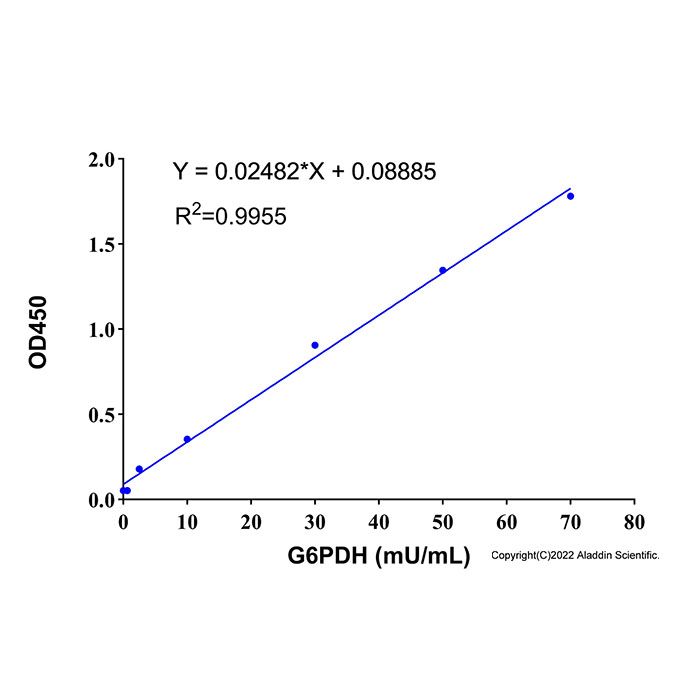
2)标准曲线设置:用G6PDH提取液将1 U/mL标准品进行系列稀释,建议设置0、0.625、2.5、10、30、50、70mU/mL浓度梯度,每孔加入50 μL标准品。
3)G6PDH检测液配制(现配现用,每孔需50 μL):
组分 | 背景对照检测液 | 标准品/样品检测液 |
反应缓冲液 | 48 μL | 46 μL |
显色液 | 2 μL | 2 μL |
G6PDH底物 | - | 2 μL |
3. 样品测定
1)吸取50 μL待测样品或标准品至96孔板中,建议设置重复孔。
2)每孔加入50 μL对应G6PDH检测液,轻柔混匀(避免气泡)。
3)37℃避光孵育10分钟(如显色较浅可延长至15-30分钟)。测量450nm处吸光度。
4. 活性计算
将标准品和样品的吸光度减去空白对照(0 mU/mL标准品)吸光度。如背景对照吸光度较高,需再减去背景对照值。以G6PDH酶活性为横坐标、吸光度为纵坐标绘制标准曲线,计算样品中G6PDH活性。
结果展示
标准曲线

注意事项
1、显色液须避光保存,从开始显色反应后所有步骤需避光操作。
2、G6PDH提取液略显粘稠,稀释时务必确保混匀均匀,否则易导致数据波动。
3、避免气泡:加样和混匀过程中尽量避免产生气泡,以免影响吸光度测定。
4、标准曲线:如需要测定绝对活力且不能严格控制反应温度和时间的,每次检测需设置标准曲线。
5、样品稀释:样品G6PDH活性超出线性范围时,需用G6PDH提取液适当稀释后重新检测。
6、本产品仅限于专业人员的科学研究用,不得用于临床诊断或治疗。
7、为了您的安全和健康,请穿实验服并戴一次性手套操作。
Glucose-6-phosphate dehydrogenase (G6PDH or G6PD) is the first key enzyme and rate-limiting enzyme of the pentose phosphate pathway (PPP), catalyzing the conversion of glucose-6-phosphate (G6P) to 6-phosphogluconolactone (6-PG). This pathway is critical for the generation of NADPH, which regulates redox homeostasis by maintaining GSH regeneration and is also involved in fatty acid biosynthesis. Deficiency of G6PDH can lead to neonatal jaundice, non-immune hemolytic anemia, and other diseases.
This kit is a highly sensitive G6PDH (glucose-6-phosphate dehydrogenase) activity assay kit based on the WST-8 colorimetric reaction, designed to detect G6PDH enzyme activity in cells, tissues, or other samples via colorimetric method. WST-8 is an upgraded alternative to MTT, offering significant advantages over MTT, XTT, and MTS: the formazan produced by WST-8 reduction is water-soluble, eliminating the need for a dissolution step; the product is more readily soluble; the reagent exhibits better stability; and it provides a wider linear range and higher sensitivity. G6P is oxidized to 6-PG under the catalysis of G6PDH, while NADP⁺ is reduced to NADPH. The generated NADPH, in the presence of the electron coupling reagent 1-mPMS, reduces WST-8 to produce an orange-yellow formazan, which has a maximum absorption peak at 450 nm. The amount of formazan produced in the reaction system is proportional to the G6PDH activity in the sample.
Components
H1511293 | Components | Appearance | 100T | Storage | Quantity Per Test |
H1511293A | Reaction Buffer | Liquid | 5.5 mL | -20℃. | As needed |
H1511293B | G6PDH Substrate | Liquid | 220 μL | -20℃. | 2 μL |
H1511293C | Chromogenic Solution | Liquid | 220 μL | -20℃. Store in the dark | 2 μL |
H1511293D | G6PDH Standard (0.25U/μL) | Liquid | 25 μL | -20℃. | As needed |
H1511293E | G6PDH Extraction Buffer | Liquid | 50 mL | -20℃. | As needed |
Protocol
1. Sample Preparation
1) Thaw the G6PDH Extraction Buffer at room temperature or in a 37°C water bath, then place it on ice after thawing. If thawed in a 37°C water bath, be sure to immediately place it on ice after thawing.
2) Cell sample preparation: For adherent cells, wash once with PBS. For suspension cells, collect cells by centrifugation, discard the supernatant and carefully remove residual liquid. Add 100-200 μL of ice-cold G6PDH Extraction Buffer using a pipette and gently pipette up and down to promote cell lysis. Then centrifuge at 1,200 × g for 5-10 minutes at 4°C. Collect the supernatant as the test sample and store on ice until use. Note: Lysis can be performed either on ice or at room temperature, but ice-cold operation is preferred as it effectively reduces enzyme activity loss caused by endogenous proteases.
3) Tissue samples: Wash with ice-cold PBS, then mince the tissue. Add 400 μL of ice-cold G6PDH Extraction Buffer per 10-30 mg of tissue and homogenize. Centrifuge at 1,200 × g for 5-10 minutes at 4°C and collect the supernatant for use. If the prepared cell or tissue samples cannot be assayed immediately, they can be stored at -20°C or -80°C.
2. Reagent Preparation
1) Preparation of G6PDH standard: Mix 4 μL of G6PDH (0.25 U/μL) with 996 μL of G6PDH Extraction Buffer to obtain a 1 U/mL G6PDH standard (note: the diluted standard is unstable and should be used promptly).
2) Standard curve setup: Dilution of the 1 U/mL standard using G6PDH Extraction Buffer. It is recommended to set the following concentration gradients: 0, 0.625, 2.5, 10, 30, 50 and 70 mU/mL. Add 50 μL of each standard per well.
3) Preparation of G6PDH Assay Buffer (prepare immediately before use; 50 μL required per well:
Component | Background Control Assay Buffer | Standard/Sample Assay Buffer |
Reaction Buffer | 48 μL | 46 μL |
Chromogenic Solution | 2 μL | 2 μL |
G6PDH Substrate | - | 2 μL |
3. Sample Assay
1) Pipette 50 μL of test sample or standard into a 96-well plate. Duplicate wells are recommended.
2) Add 50 μL of the corresponding G6PDH Assay Buffer to each well and mix gently (avoid bubbles).
3)Incubate at 37°C in the dark for 10 minutes (if the color development is too light, the incubation time can be extended to 15-30 minutes). Measure the absorbance at 450 nm.
4. Activity Calculation
Subtract the absorbance of the blank control (0 mU/mL standard) from the absorbance values of both standards and samples. If the background control absorbance is relatively high, further subtract the background control value. Plot a standard curve with G6PDH enzyme activity on the x-axis and absorbance on the y-axis, and calculate the G6PDH activity in the samples.
Result Presentation
Standard Curve
Notes
1. The Chromogenic Solution must be protected from light during storage. All steps following the initiation of the colorimetric reaction must be performed in the dark.
2. The G6PDH Extraction Buffer is slightly viscous. Ensure thorough mixing upon dilution to avoid data fluctuations.
3. Avoid bubbles: Minimize the generation of bubbles during pipetting and mixing, as bubbles may interfere with absorbance measurements.
4. Standard curve: For absolute activity determination when reaction temperature and time cannot be strictly controlled, a standard curve must be established for each assay.
5. Sample dilution: If the G6PDH activity of the sample exceeds the linear range of the standard curve, the sample should be appropriately diluted with G6PDH Extraction Buffer and re-assayed.
6. For research use only. Not for use in clinical diagnosis or therapeutic procedures.
7. For your safety and health, please wear a lab coat and disposable gloves during operation.

 ZJ26F0737907


 危险品化学品经营许可证(带存储)