
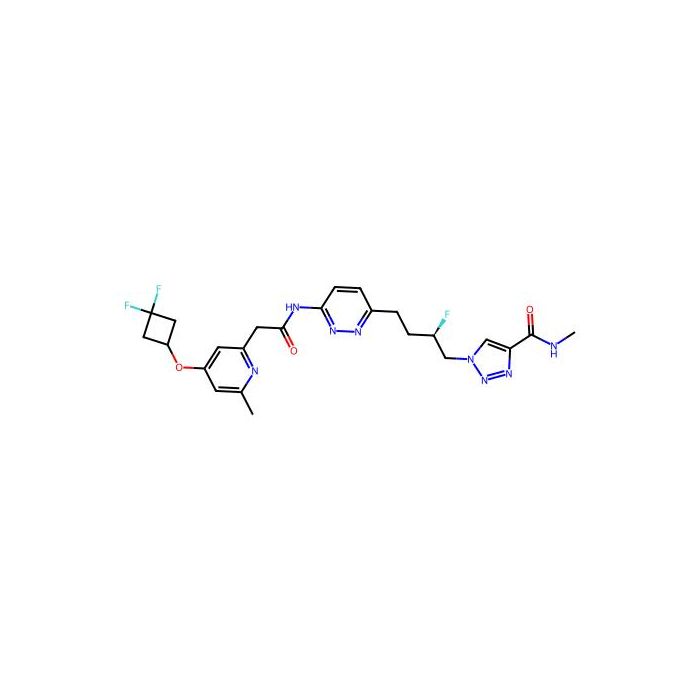
计算溶液所需的质量、体积或浓度。
| 活性类型 | 活性值-log(M) | 作用机制 | 期刊 | 参考文献(PubMed IDs) |
|---|
提供 ≥99% 纯度,适用于对基线干扰要求严格的色谱和分析工作流程。
-20°C储存。超低温运输 。请查阅批次 COA 获取详细规格。
SDS、COA、产品数据表及规格说明书均可下载。可通过批号查询获取批次 COA。
在色谱分析、有机合成和交叉偶联反应领域已被 0 篇同行评审文献引用。
IPN-60090 is an orally active and highly selective inhibitor of glutaminase 1 ( GLS1 ; IC 50 =31 nM), with no activity observed against GLS-2. IPN-60090 exhibits excellent physicochemical and pharmacokinetic properties in vivo . IPN-60090 can be used for solid tumors research, such as lung and ovarian cancers
In Vitro
There are two known isoforms of glutaminase: GLS-1 (also called kidney-type or KGA), and GLS-2 (also called liver-type or LGA). GLS-1 is ubiquitous and GLS-2 expression appears limited primarily to the liver. In a dual-coupled enzyme assay, IPN60090 inhibits purified recombinant human GLS-1 (GAC isoform) with an IC 50 of 31 nM, and has no activity against GLS-2, with an IC 50 of >50000 nM. IPN60090 inhibits the proliferation of A549 cells with an IC 50 of 26 nM. MCE has not independently confirmed the accuracy of these methods. They are for reference only.
In Vivo
IPN60090 (3 mg/kg for i.v.; 10 mg/kg for p.o.) has excellent pharmacokinetic properties, with CL=4.1 mL/min/kg, t 1/2 =1 hour, C max =19 μM, F%=89%. IPN-60090 (oral administration; 100 mg/kg; twice daily; 30 days) shows similar efficacy and target engagement to CB-839 dosed orally at 250 mg/kg twice daily. And the 100 mg/kg BID dose of IPN-60090 is a tolerated dose for the following model study. IPN-60090 (oral administration; 100 mg/kg; twice daily; 30 days; monotherapy or in combination with TAK228 ) causes tumor growth inhibition. IPN-60090 alone demonstrates robust in vivo target engagement in a dose-dependent manner. The glutamate/glutamine ratios and the free plasma concentrations of IPN-60090 at 4 hours post-dose on both day 4 and day 28 are all decreased. Furthermore, IPN-60090 in combination with TAK228 strongly causes an 85% tumor growth inhibition, IPN-60090 alone causes a 28% tumor growth inhibition in vivo. MCE has not independently confirmed the accuracy of these methods. They are for reference only. Animal Model: Female CD-1 miceDosage: 3 mg/kg for i.v.; 10 mg/kg for p.o. (Pharmacokinetic Analysis) Administration: Intravenous injection and oral administration Result: CL (4.1 mL/min/kg), t 1/2 (1 hour) for i.v.; C max (19 μM), F% (89%) for p.o.. Animal Model: Ru337 non-small cell lung cancer patient-derived xenograft (PDX) subcutaneous mouse model as monotherapy or in combinationDosage: 100 mg/kg Administration: Oral administration; 100 mg/kg; twice daily; 30 days; monotherapy or in combination with TAK228 Result: Exhibited an improvement in the combination regimen group over either single agent.
Form:Solid
IC50& Target:IC50: 31 nM (GLS1)
分类树(Taxonomy Tree)
| 界(kingdom) | 有机化合物 |
|---|---|
| 超类(Superclass) | 有机酸及其衍生物 |
| 类(Class) | 羧酸及其衍生物 |
| 亚类(Subclass) | 氨基酸、肽和类似物 |
| 中间层级节点(Intermediate Tree Nodes) | 氨基酸及其衍生物 - α氨基酸及其衍生物 |
| 直接上位类(Direct Parent) | α-氨基酸酰胺 |
| 其他上位类(Alternative Parents) | 多卤吡啶 O-烷基嘧啶 N-芳基酰胺 甲基吡啶 烷基芳基醚 2-卤代吡啶 哒嗪及其衍生物 N-酰胺 咪唑内酰胺类 乙烯基酰胺 三唑类 二级酮亚胺 杂芳族化合物 炔丙基型1,3-偶极有机化合物 羧酸酰胺 氮杂环化合物 有机光子化合物 有机氟化物 有机氧化物 碳氢化合物衍生物 烷基氟化物 |
| 分子骨架(Molecular Framework) | 芳香族杂单环化合物 |
| 取代基(Substituents) | 1,2,3-三唑 - 2-卤代吡啶 - 芳基醚 - 氟化烷基 - 烷基溴化物 - α-氨基酸酰胺 - 芳香族杂单环化合物 - 氮杂环 - 吡唑 - 羧酰胺基 - 乙醚 - 杂芳香族化合物 - 烃衍生物 - 咪唑内酰胺 - 亚胺 - 酮亚胺 - 甲基吡啶 - N-酰胺基胺 - N-芳基酰胺 - O-烷基嘧啶 - 有机1,3-双极性化合物 - 有机硝基化合物 - 有机氧化物 - 有机氧化合物 - 有机氟化物 - 有机卤化物 - 有机杂环化合物 - 有机氮化合物 - 有机氧化合物 - 有机氮化合物 - 多卤代吡啶 - 丙炔型1,3-双极性有机化合物 - 吡嗪 - 吡啶 - 醛酮亚胺 - 乙烯酰胺 |
| 描述(Description) | 该化合物属于α-氨基酸酰胺类有机化合物。此类化合物为α-氨基酸的酰胺衍生物。 |
| 外部描述符(External Descriptors) | 暂无 |
| 作用机制 | Action Type | target ID | Target Name | Target Type | Target Organism | Binding Site Name | 参考文献 |
|---|


 危险品化学品经营许可证(带存储)