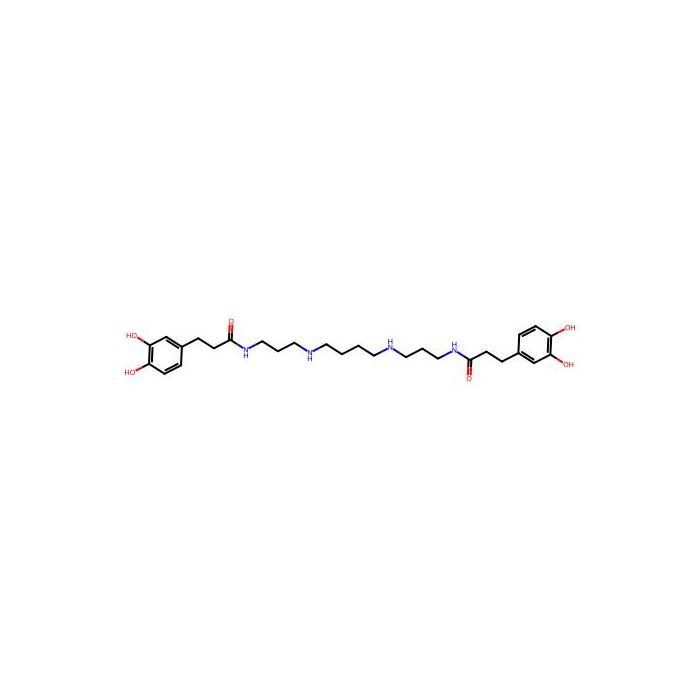
Kukoamine A 被发现存在于宁夏枸杞 (Lycium chinense,L. chinense) Miller 的根皮中。Kukoamine A 可抑制纯化的簇生锥虫锥虫硫醇还原酶和大豆脂氧合酶 (lipoxygenase),并激活 μ-阿片 (μ-opioid) 受体。Kukoamine A 能够抑制癌细胞增殖、迁移和侵袭,引起 G0/G1 期细胞周期阻滞并诱导细胞凋亡 (apoptosis)。Kukoamine A 具有神经保护作用,还可诱导自噬 (autophagy)。Kukoamine A 可抑制 LPS (HY-D1056) 诱导的 NO、ROS、PGE2、TNF-α、IL-1β、IL-6 的产生以及 COX-2 的活性。Kukoamine A 可通过下调 Srebp-1c 逆转棕榈酸诱导胰岛素抵抗、脂质蓄积和氧化应激。Kukoamine A 可用于癌症、感染、炎症、代谢性疾病和神经系统疾病的研究,例如胶质母细胞瘤和帕金森病。
Kukoamine A is found in the root barks of Lycium chinense (L. chinense) Miller. Kukoamine A inhibits purified Crithidia fasciculata trypanothione reductase and soybean lipoxygenase, activates μ-opioid receptor. Kukoamine A can inhibt cancer cell proliferation, migration and invasion, cause G0/G1 phase cell cycle arrest and induce apoptosis. Kukoamine A exerts neuroprotective effect and can induce autophagy . Kukoamine A inhibits LPS (HY-D1056)-induced NO, ROS, PGE2, TNF-α, IL-1β, IL-6 production and COX-2 activity. Kukoamine A reverses palmitic acid-induced insulin resistance, lipid accumulation, and oxidative stress via downregulation of Srebp-1c. Kukoamine A can be used for the research of cancer, infection, inflammation, metabolic and neurological disease, such as glioblastoma and Parkinson's disease.



 危险品化学品经营许可证(带存储)