产品介绍
高密度脂蛋白(HDL)作为一种抗动脉粥样硬化的脂蛋白,能够将胆固醇从肝外组织转运到肝脏进行代谢,转化为胆汁酸或直接通过胆汁从肠道排出体外,从而减少动脉壁上的胆固醇沉积,通过促进胆固醇逆向转运、抗炎、抗氧化、抑制血栓的形成和改善内皮细胞功能等多种方式实现抗动脉粥样硬化作用。
胆固醇酯酶(CHE)和胆固醇氧化酶(CHO)经化学修饰后,与葡萄糖硫酸钠、硫化环状糊精复合物并用,使对LDL、VLDL、乳糜微粒的酶反应性降低,只选择性与HDL-胆固醇发生作用。基于此原理,使用选择性沉淀剂将HDL-C特异性分离出来,利用固醇酯酶催化胆固醇酯水解生成游离胆固醇(FC),FC在CHO作用下被氧化生成4-胆甾烯酮和过氧化氢;接着与4-氨基氨替吡啉等反应生成红色醌类化合物,其在546nm处有特征吸收峰,通过检测546nm处吸光值即可得出HDL-C含量。
产品组分
L1505572 | 组分 | 物理外观 | 96 T | 储存条件 | 单次使用量 |
L1505572A | HDL-C 捕获剂 | 液体 | 18 mL | 2-8℃. | 按需 |
L1505572B | R1试剂 | 液体 | 8 mL | 2-8℃. 避光保存. | 80 μL |
L1505572C | R2试剂 | 液体 | 2 mL | 2-8℃. 避光保存. | 20 μL |
L1505572D | 胆固醇标准品(10mM) | 液体 | 0.5 mL | 2-8℃. | 按需 |
自备试剂
研钵(匀浆机)、天平、冰盒、台式离心机、可调式移液枪、水浴锅(烘箱、培 养箱、金属浴)、96孔板、离心管、酶标仪、蒸馏水(去离子水、超纯水均可)、乙醇。
使用方法
1. 样本提取
1) 组织样本:称取约0.1g组织样本加入研钵中,加入1mL乙醇,进行冰浴匀浆,12000rpm,4℃或室温离心10min,取上清液待测。注:建议先选取1-3个差异大的样本进行预实验,熟悉操作流程,根据预实验结果确定或调整样本浓度,以防造成样本或试剂不必要的浪费!
2) 液体样本:澄清的液体样本直接测定,若浑浊则离心后取上清检测。
3) 血清样本:若是常规的澄清的血清样本,可直接按下表加入试剂后检测;若血清样本中含的蛋白含量较高,按操作表加入试剂后会产生浑浊现象,可先取200μL血清+200μL乙醇,上下混匀几次,于8000rpm,4℃或室温离心5min,取上清液待测。
4) 细菌/细胞样本:先收集细菌或细胞到离心管内,离心后弃上清;取约500万细菌或细胞加入1mL乙醇,超声波破碎细菌或细胞(冰浴,功率200W,超声3s,间隔10s,重复30次);12000rpm 4℃离心10min,取上清,置冰上待测。注:若增加样本量,可按照细菌/细胞数量(10⁴):提取液(mL)为500~1000:1的比例进行提取。
2. HDL-C的相分离
1) 取50μL血清或血浆(样品体积范围 20-100μL),加等体积50μL HDL-C捕获剂,振荡混匀。室温(20-25°C)孵育10-30分钟。2000g 离心20分钟。
2) 取上清,上清液含HDL-C,最好即时测定。按照“相分离”原理,较长时放置可能出现絮状物是non-HDL fraction疏水相组分包括部分血浆蛋白,使用前应再次2000g 离心5分钟,取上清测定。
3. HDL-C含量测定
1) 标准品溶解和稀释:将10mM胆固醇标准品用无水乙醇稀释为10、5、2.5、1.25、0.625、0.312、0.1562mmol/L。注意设置标准品0浓度管即空白管(蒸馏水+工作溶液),立即使用,用毕弃去。
2) 工作溶液配制:计算样本和标准品反应所需工作溶液体积,按 R1:R2=4:1 比例,取试剂混合均匀,得到检测工作液,立即使用或4ºC保存<1天,变色弃去。
3) HDL-C 测定:使用干净透明的普通96孔板,参见下表加样,取90μL工作溶液,10μL上清液,标准品管加样量也是10μL,反应总体系为100μL。允许稍微增加或减少样品的加入量,并同时调整工作液体积,样本或标准品体积可调整范围5-20μL。注意:较长期放置后如有絮状物应再次2000g离心5min取上清测定。
试剂组分(μL) | 测定管 | 标准管 | 空白管 |
样本 | 10 μL | - | - |
标准品 | - | 10 μL | - |
蒸馏水 | - | - | 10 μL |
工作液 | 90 μL | 90 μL | 90 μL |
4) 各孔内液体混合均匀后,37ºC孵育20min。
5) 酶标仪预热30min,设定波长到546nm。先用空白管调零,然后测定各标准品管和样本管OD值。
4. 绘制标准曲线并计算浓度:
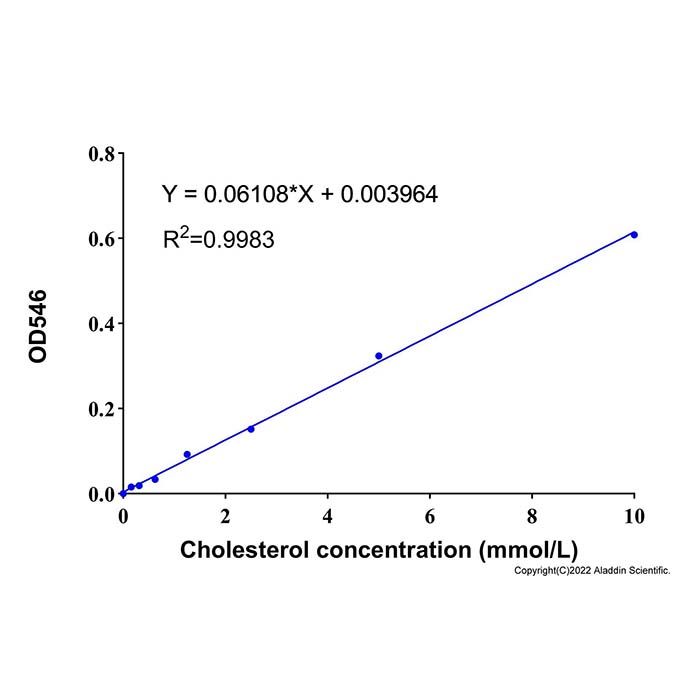
1) Excel作图步骤:各标准品管OD值为y轴,标准品浓度为x轴绘制标准曲线,进而计算出各测定管HDL-C含量。
结果展示
标准曲线

注意事项
1. 维生素C>0.18g/L、血红蛋白>2g/L、胆红素>0.25g/L、强还原剂二硫苏糖醇、巯基乙醇等会干扰测定。
2. 尽量使用新鲜样本,建议样品4ºC保存时间应短于24小时,-80ºC保存也应不超过1个月。
3. 本产品仅用于科学研究,不得用于临床诊断或治疗。
Introduction
High-density lipoprotein (HDL) is an anti-atherosclerotic lipoprotein that transports cholesterol from extrahepatic tissues to the liver for metabolism, where it is converted into bile acids or directly excreted into the intestine via bile, thereby reducing cholesterol deposition on arterial walls. HDL exerts its anti-atherosclerotic effects through multiple mechanisms, including promoting reverse cholesterol transport, exerting anti-inflammatory and antioxidant activities, inhibiting thrombus formation, and improving endothelial cell function.
Chemically modified cholesterol esterase (CHE) and cholesterol oxidase (CHO), in combination with dextran sulfate sodium and sulfated cyclodextrin complex, significantly reduce the enzymatic reactivity toward cholesterol in LDL, VLDL, and chylomicrons, while exhibiting selective reactivity toward HDL-cholesterol. Based on this principle, a selective precipitating reagent is used to specifically isolate HDL-C. Cholesterol esterase (CHE) catalyzes the hydrolysis of cholesteryl esters to free cholesterol (FC), which is then oxidized by cholesterol oxidase (CHO) to Δ⁴-cholestenone and hydrogen peroxide (H₂O₂). Subsequently, the generated hydrogen peroxide reacts with 4-aminoantipyrine and phenolic derivatives to form a red quinone-imine chromogen, which exhibits a characteristic absorption peak at 546 nm. The HDL-C content is determined by measuring the absorbance at 546 nm.
Kit Contents
L1505572 | Components | Appearance | 96 T | Storage | Quantity Per Test |
L1505572A | HDL-C Capture Reagent | Liquid | 18 mL | 2-8℃. | As needed |
L1505572B | R1 Reagent | Liquid | 8 mL | 2-8℃. Store in the dark. | 80 μL |
L1505572C | R2 Reagent | Liquid | 2 mL | 2-8℃. Store in the dark. | 20 μL |
L1505572D | Cholesterol Standard (10mM) | Liquid | 0.5 mL | 2-8℃. | As needed |
Self-provided reagents and equipment:
Mortar (or homogenizer), balance, ice box, benchtop centrifuge, adjustable pipette, water bath (or oven, incubator, metal bath), 96-well plate, centrifuge tube, microplate reader, distilled water (deionized water or ultrapure water), ethanol.
Protocol
1. Sample Preparation
1) Tissue samples: Weigh approximately 0.1 g of tissue into a mortar. Add 1 mL of ethanol and homogenize on ice. Centrifuge at 12000 rpm for 10 min at 4°C or room temperature. Collect the supernatant for analysis. Note: It is recommended to perform a preliminary experiment using 1-3 samples with significant differences to familiarize yourself with the procedure and to determine or adjust the sample concentration accordingly, so as to avoid unnecessary waste of samples or reagents.
2) Liquid samples: Clear liquid samples can be directly assayed. If turbid, centrifuge and use the supernatant for testing.
3) Serum samples: For conventional clear serum samples, reagents can be added directly according to the table below. If the serum contains high protein content, turbidity may appear after reagent addition. In such cases, mix 200 µL of serum with 200 µL of ethanol, vortex several times, centrifuge at 8000 rpm for 5 min at 4°C or room temperature, and collect the supernatant for testing.
4) Bacterial/Cell samples: Collect bacteria or cells into a centrifuge tube, centrifuge, and discard the supernatant. Take approximately 5 million bacteria or cells, add 1 mL of ethanol, and disrupt the cells by ultrasonication on ice (power: 200 W, sonicate for 3 s, interval for 10 s, repeat 30 times). Centrifuge at 12000 rpm for 10 min at 4°C, collect the supernatant, and keep on ice until use. Note: If scaling up, the ratio of bacterial/cell count (×10⁴) to extraction solution (mL) can be adjusted to 500–1000:1.
2. Phase Separation of HDL-C
1) Take 50 µL of serum or plasma (sample volume range: 20-100 µL), add an equal volume (50 µL) of HDL-C capture reagent, and vortex to mix. Incubate at room temperature (20-25°C) for 10-30 min. Centrifuge at 2000 g for 20 min.
2) Collect the supernatant, which contains HDL-C. It is recommended to measure immediately. Based on the phase separation principle, flocculent precipitates may appear upon prolonged storage (these are hydrophobic components of the non-HDL fraction, including some plasma proteins). If this occurs, re-centrifuge at 2000 g for 5 min and use the supernatant for determination.
3. Determination of HDL-C Content
1) Standard preparation and dilution: Dilute the 10 mmol/L cholesterol standard with anhydrous ethanol to the following concentrations: 10, 5, 2.5, 1.25, 0.625, 0.3125, 0.15625 mmol/L. Note: Include a zero-concentration standard tube (blank) containing distilled water + working solution. Prepare immediately before use and discard after use.
2) Working solution preparation: Calculate the required volume of working solution for all sample and standard reactions. Prepare the free cholesterol detection working solution by mixing Reagent R1 and R2 at a ratio of 4:1 (R1:R2). Use immediately or store at 4°C for <1 day. Discard if the color changes.
3) HDL-C assay: Use a clear, transparent standard 96-well plate. Add reagents according to the table below: 90 µL of working solution and 10 µL of supernatant (standard tubes also receive 10 µL), making a total reaction volume of 100 µL. Slight adjustments to sample volume are acceptable (range: 5-20 µL), with corresponding adjustments to the working solution volume. Note: If flocculent precipitates appear after prolonged storage, re-centrifuge at 2000 g for 5 min and use the supernatant for measurement.
Reagent Components (μL) | Sample Well | Standard Well | Blank Well |
Sample | 10 μL | - | - |
Standard | - | 10 μL | - |
Distilled Water | - | - | 10 μL |
Working Solution | 90 μL | 90 μL | 90 μL |
4) After thoroughly mixing the liquid in each well, incubate in a water bath at 37°C for 20 min.
5) Preheat the microplate reader for 30 min and set the wavelength to 546 nm. First, zero the instrument using the blank well, then measure the OD values of each standard well and sample well.
4. Plotting the standard curve and calculating concentrations:
1) Procedure for plotting in Excel: Use the OD values of the standard wells as the Y-axis and the standard concentrations as the X-axis to generate a standard curve. Then calculate the HDL-C content in each sample well based on the curve.
Result Presentation
Typical Standard Curve:

Notes
1. The following substances may interfere with the assay: vitamin C > 0.18 g/L, hemoglobin > 2 g/L, bilirubin > 0.25 g/L, and strong reducing agents such as dithiothreitol (DTT) and β-mercaptoethanol.
2. It is recommended to use fresh samples whenever possible. Samples should be stored at 4°C for less than 24 hours, and storage at -80°C should not exceed 1 month.
3. This product is for research use only and is not intended for clinical diagnosis or therapeutic use.



 危险品化学品经营许可证(带存储)