慢病毒载体(Lentiviral vector)具有广泛的宿主范围,能够有效感染分裂和非分裂细胞,并整合进宿主细胞基因组,从而在多种类型的细胞中实现稳定的基因功能性表达或沉默,为细胞标记、基因功能研究、靶点发现、细胞与基因治疗等提供了可能性。
慢病毒载体的制造包括几个步骤:生产、纯化、储存和基因转移。慢病毒是一种极其脆弱的包膜病毒载体,在生产过程中的剪切力、挤压、温度、pH、离子强度以及操作时间等均会对其活性产生较大影响。此外,慢病毒还比较容易聚集,这对于慢病毒生产和储存造成了较大挑战。慢病毒载体一般在灌装后储存于-80℃条件下,在使用时需要经历冻融并在37℃条件下感染目的细胞。在低温时,蛋白质可能易于变性,脂双层可能易于丧失结构完整性。慢病毒载体通常需要在-80℃低温下进行长期储存,因为病毒载体的反复冻融可导致转导能力的丧失。但是,慢病毒载体保存于常规生理缓冲液中稳定性较差,在-80℃保存或反复冻融的过程中,慢病毒载体的活性会快速下降,从而提高了慢病毒载体的成本并限制了其应用。因此,一款能够将病毒载体制剂在低温下稳定储存的保护液显得尤为重要。
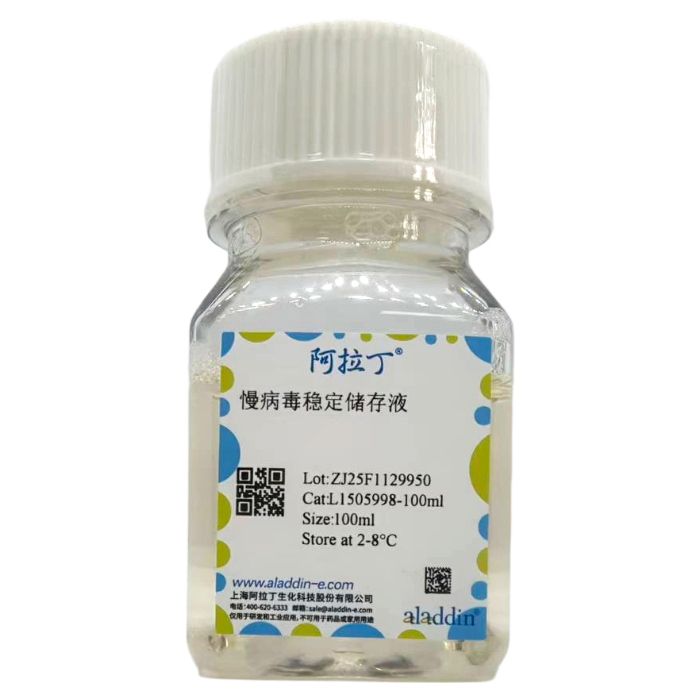
阿拉丁研发了一款能够提高慢病毒载体活力并保证病毒稳定性的慢病毒稳定储存液(L1505998)。使用本产品溶解慢病毒颗粒,能够提高慢病毒载体在-80℃条件下的稳定性,并提高慢病毒载体在反复冻融中的稳定性,保证慢病毒载体的活性,提高慢病毒载体对靶细胞的转导效率。同时,本产品所采用的试剂化学成分明确,有利于实现工业化大规模生产和应用。
产品特点:
⁕ 病毒活性高。
⁕ -80℃保存或反复冻融的情况下,可维持慢病毒载体的稳定性。
⁕ 防止病毒聚集,增强转导能力。
⁕ 化学成分明确,有利于实现工业化大规模生产和应用。
实验步骤:
1.将含有慢病毒颗粒的培养基转移至无菌容器中,800xg离心10分钟以除去细胞碎片。
⁕ 为保证病毒活性,浓缩前的病毒上清液应尽量选择新鲜收集的病毒原液。
2. 使用0.45μm过滤器过滤上清液至无菌容器中。
⁕ 如果使用滤膜过滤,推荐使用低蛋白结合力的纤维素醋酸酯或聚醚砜(PES)膜,不推荐使用硝酸纤维素膜(NC)。
3. 向每4体积含慢病毒的上清液中加入1体积慢病毒浓缩试剂(5x,S1506239),使慢病毒浓缩试剂(5x)稀释为工作浓度(1x)。
4. 将上述混合物于4℃ 摇床中慢速孵育3小时或过夜。
⁕ 慢病毒颗粒在 4℃ 可稳定长达4天。
5. 将混合物4℃ 4000 x g 离心25分钟。离心后,慢病毒颗粒可能在容器底部显示为米色或白色沉淀。
6. 小心弃去上清液,4℃ 4000 x g 离心5分钟,再次弃尽残余液体,应尽量避免吸走沉淀物,该沉淀物即为慢病毒颗粒。
7. 用初始体积(原上清液体积)1/10 -1/100 的本产品溶解病毒颗粒,使用移液器小心吹打,重悬慢病毒颗粒。
8. 小体积分装慢病毒,储存于 -80℃ 冰箱中,留取少量病毒测定滴度。
⁕ 应尽量避免慢病毒反复冻融,否则会降低病毒滴度。
适用范围:
适用于任何慢病毒颗粒的低温稳定储存。
注意事项:
1. 为了您的健康安全,请规范操作,穿戴实验服与手套开展实验。
2. 所有慢病毒操作均需在BSL2级生物安全柜中进行。
3. 本产品仅供科研使用,请勿用于临床诊断及治疗。
Lentiviral vectors have a broad host range, enabling efficient infection of both dividing and non-dividing cells. They integrate into the host cell genome, thereby achieving stable functional expression or silencing of genes in various cell types. This provides possibilities for cell labeling, gene function research, target discovery, and cell and gene therapy.
The manufacturing of lentiviral vectors involves several steps: production, purification, storage, and gene transfer. Lentiviruses are extremely fragile enveloped viral vectors—factors such as shear force, extrusion, temperature, pH, ionic strength, and operation time during production can significantly affect their activity. Additionally, lentiviruses are prone to aggregation, which poses considerable challenges to their production and storage.Typically, lentiviral vectors are stored at -80°C after filling. For use, they need to undergo freeze-thaw cycles and infect target cells at 37°C. At low temperatures, proteins may tend to denature, and lipid bilayers may easily lose structural integrity. Lentiviral vectors usually require long-term storage at -80°C because repeated freeze-thaw cycles of the viral vector can lead to loss of transduction ability. However, lentiviral vectors exhibit poor stability when stored in conventional physiological buffers; their activity decreases rapidly during storage at -80°C or repeated freeze-thaw cycles. This increases the cost of lentiviral vectors and limits their applications. Therefore, a protective solution capable of stably storing viral vector formulations at low temperatures is particularly important.
Aladdin has developed a Lentivirus Stable Storage Solution (L1505998) that enhances the viability of lentiviral vectors and ensures their stability. Using this product to resuspend lentiviral particles can improve the stability of lentiviral vectors at -80°C and during repeated freeze-thaw cycles, maintain the activity of lentiviral vectors, and enhance the transduction efficiency of lentiviral vectors in target cells. Meanwhile, the reagents used in this product have well-defined chemical compositions, which facilitate industrial-scale production and application.
Product Features:
⁕ High viral activity.
⁕ Maintains the stability of lentiviral vectors during storage at -80°C or repeated freeze-thaw cycles.
⁕ Prevents viral aggregation and enhances transduction capability.
⁕ Well-defined chemical composition, facilitating industrial-scale production and application.
Experimental Steps:
1. Transfer the medium containing lentiviral particles to a sterile container, and centrifuge at 800×g for 10 minutes to remove cell debris.
⁕ To ensure viral activity, the viral supernatant before concentration should preferably be freshly collected undiluted viral solution.
2. Filter the supernatant through a 0.45 μm filter into a sterile container.
⁕ If using a membrane filter, low protein-binding cellulose acetate or polyethersulfone (PES) membranes are recommended; nitrocellulose (NC) membranes are not recommended.
3. Add 1 volume of Lentivirus Concentration Reagent (5×, S1506239) to every 4 volumes of lentivirus-containing supernatant, diluting the Lentivirus Concentration Reagent (5×) to the working concentration (1×).
4. Incubate the above mixture slowly in a shaker at 4°C for 3 hours or overnight.
⁕ Lentiviral particles can remain stable at 4°C for up to 4 days.
5. Centrifuge the mixture at 4000×g and 4°C for 25 minutes. After centrifugation, lentiviral particles may appear as a beige or white precipitate at the bottom of the container.
6. Carefully discard the supernatant, then centrifuge again at 4000×g and 4°C for 5 minutes. Discard all residual liquid thoroughly, taking care to avoid aspirating the precipitate—this precipitate is the lentiviral particles.
7. Resuspend the viral particles with this product (the Lentivirus Stable Storage Solution) at a volume of 1/10 to 1/100 of the initial volume (original supernatant volume). Gently pipette up and down to resuspend the lentiviral particles.
8. Aliquot the lentivirus into small volumes, store them in a -80°C refrigerator, and reserve a small amount of virus for titer determination.
⁕ Repeated freeze-thaw cycles of the lentivirus should be avoided as much as possible, as this will reduce the viral titer.
Scope of Application:
Suitable for the low-temperature stable storage of any lentiviral particles.
Precautions:
1. For your health and safety, please operate in compliance with standard procedures and wear a lab coat and gloves when conducting experiments.
2. All lentivirus-related operations must be performed in a BSL-2 (Biosafety Level 2) biological safety cabinet.
3. This product is for research use only and shall not be used for clinical diagnosis or treatment.

 ZJ25F1129950

 危险品化学品经营许可证(带存储)