亮氨酸氨基肽酶(LAP)是一类能水解肽链 N-末端为亮氨酸的酶,广泛存在于肝、肾、胰等组织中,尤其以肝脏中含量最为丰富。LAP 分解 L-亮氨酸-4-硝基苯胺生成对硝基苯胺,后者在 405 nm 有最大吸收峰,通过测定吸光值升高速率来计算 LAP 活性。
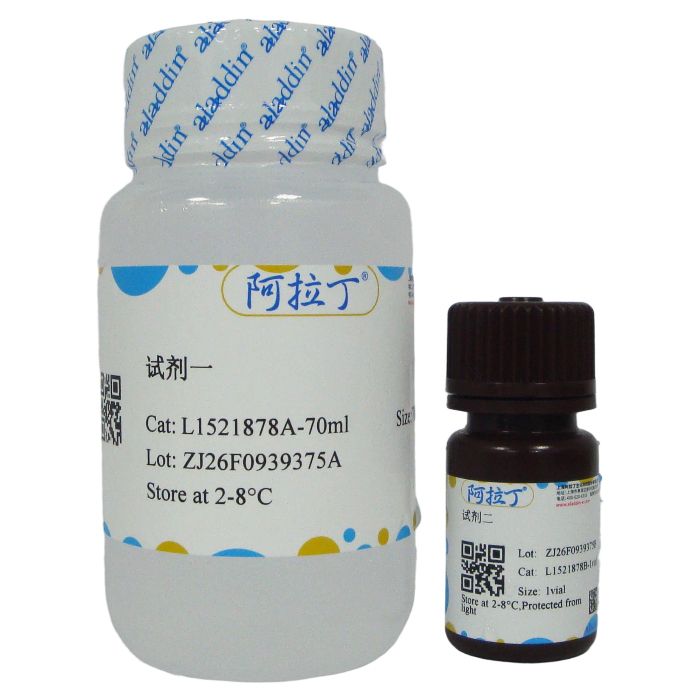
| 项目号 | 物理外观 | 组件 | 48T | 96T | 储存 | | L1521878A | 液体 | 试剂一 | 70 mL | 70 mL×2 | 2-8℃. | | L1521878B | 粉末 | 试剂二 | 1 瓶 | 1 瓶 | 2-8℃. Store in the dark. |
|
注意:正式检测前,建议选择 2-3 个预期差异较大的样本进行预实验。
自备耗材
·酶标仪或可见分光光度计(能测 405 nm 处的吸光度)
·96 孔板或微量玻璃比色皿、可调节式移液枪及枪头
·离心机、水浴锅、超声破碎仪
·去离子水、冰
·匀浆器或研钵
试剂准备
试剂一:即用型;使用前,平衡到室温;4℃保存。
试剂二:临用前配制;对于 48 T,临用前加入 9 mL 试剂一 ;对于 96 T,临用前加入 18 mL 试剂一 ;充分溶解待用(较
难溶解时,可 60℃水浴加热约 30 min 促进溶解),用不完的试剂-20℃分装避光保存 1 个月,禁止反复冻融。
注意:试剂二有一定的刺激性,建议在使用过程中做好个人防护。
样本制备
1. 动植物组织:称取约 0.1 g 组织,加入 1 mL 试剂一 (组织质量(g):试剂一体积(mL)为 1:10)进行冰浴匀浆,然后 10,000
g,4℃离心 10 min,取上清置于冰上待测。
2. 细胞或细菌:收集 500 万细胞或细菌到离心管内,用预冷 PBS 清洗细胞,离心后弃上清,加入 1 mL 试剂一 ,冰浴超声波破
碎细胞或细菌 5 min(功率 20%或 200 W,超声 3 s,间隔 7 s,重复 30 次),然后 8,000 g,4℃离心 10 min,取上清液,置冰上
待测。
3. 血清(浆):直接检测。
注意:建议使用新鲜样本。如果不立即使用,可将样品在-80℃下保存一个月。
实验步骤
1. 酶标仪或可见分光光度计预热 30 min,调节波长到 405 nm。可见分光光度计用去离子水调零。
2. 酶促反应(下述操作在 96 孔板或微量玻璃比色皿中进行):
| 试剂 | 测定管(μL) | 空白管(μL) | | 样本上清 | 50 | 0 | 试剂一
| 0 | 50 | 试剂二
| 150 | 150 |
|
充分混匀后于 405 nm 处测定 30 s 时的吸光值A1,迅速置于 37℃水浴 3 min(有控温功能的酶标仪可以将温度调至 37℃),取出擦干后快速测定 210 s 时的吸光值 A2,计算 ΔA=A2−A1。
注意:空白孔只需测定 1 次。实验之前建议选择 2-3 个预期差异大的样本做预实验。如果 ΔA小于 0.02 可适当加大样本量。如果 ΔA大于 0.5,样本可用试剂一进一步稀释,计算结果乘以稀释倍数,或减少提取用样本量。
结果计算
注意:我们为您提供的计算公式,包括推导过程计算公式和简洁计算公式。两者完全相等。
LAP 活力单位的计算:
A. 用 96 孔板测定的计算公式如下
1、血清(浆)LAP 活力的计算:
单位的定义:每 mL 血清(浆)每分钟生成 1 nmol 的对硝基苯胺定义为一个酶活力单位。
LAP(U/mL)= ΔA ×V反总÷(ε×d)×10⁹]÷V样÷T=274.35×ΔA
2、组织、细菌或细胞中 LAP 活力的计算:
(1) 按样本蛋白浓度计算:
单位的定义:每 mg 组织蛋白每分钟生成 1 nmol 对硝基苯胺定义为一个酶活力单位。
LAP(U/mg prot)=[ΔA×V反总÷(ε×d)×10⁹]÷(V样×Cpr)÷T=274.35×ΔA÷Cpr
(2) 按样本鲜重计算:
单位的定义:每 g 组织每分钟生成 1 nmol 对硝基苯胺定义为一个酶活力单位。
LAP (U/g 鲜重)=[ΔA×V反总÷(ε×d)×10⁹]÷(W×V样÷V样总))÷T=274.35×ΔA÷W
(3) 按细菌或细胞密度计算:
单位的定义:每 10⁴ 个细菌或细胞每分钟生成 1 nmol 对硝基苯胺定义为一个酶活力单位。
LAP(U/10⁴)=[ΔA×V反总÷(ε×d)×10⁹]÷(500×V样÷V样总)÷T=0.548×ΔA
V反总:反应体系总体积,2×10⁻⁴ L;ε:对硝基苯胺摩尔消光系数,9.72×10³ L/mol/cm;d:96 孔板光径,0.5 cm;10⁹:换算系数,1 mol=1×10⁹ nmol;
V样:加入样本体积,0.05 mL;
V样总:试剂一添加体积,1 mL;
T:反应时间,3 min;
Cpr:样本蛋白质浓度,mg/mL;
W:样本质量,g;
500:对应细胞 / 细菌总量 500 万。
B. 使用微量玻璃比色皿测定的计算公式
将上述计算公式中光径 d: 0.5 cm 调整为 d: 1 cm 进行计算即可。
结果展示
实验实例:
取小鼠血清直接按照测定步骤操作,用 96 孔板测得计算 ΔA=1.013-0.867=0.145,计算亮氨酸氨基肽酶活性得: LAP (U/mL)=274.35×ΔA=274.35×0.145=39.78 U/mL。
Leucine aminopeptidase (LAP) is a type of enzyme capable of hydrolyzing peptides with leucine at the N-terminus. It is widely distributed in tissues including liver, kidney and pancreas, with the highest abundance in the liver. LAP decomposes L-leucine-4-nitroanilide to produce p-nitroaniline, which exhibits a maximum absorption peak at 405 nm. LAP activity is quantified by measuring the rising rate of absorbance value.
| Item No. | Appearance | Components | 48T | 96T | Storage |
| L1521878A | Liquid | Reagent 1 | 70 mL | 70 mL×2 | 2-8℃. |
| L1521878B | powder | Reagent 2 | Powder×1 vial | Powder×1 vial | 2-8℃. Store in the dark. |
Notes: It is recommended to perform a pre-experiment with 2–3 samples of expected large differences before formal testing.
Self-supplied Consumables & Equipment
·Microplate reader or visible spectrophotometer (capable of measuring absorbance at 405 nm)
·96-well plates or micro glass cuvettes, adjustable pipettes and pipette tips
·Centrifuge, water bath sonicator, ultrasonic homogenizer
·Deionized water, ice
·Tissue homogenizer or mortar
Reagent Preparation
Reagent 1: Ready-to-use; equilibrate to room temperature before use; store at 4 °C.
Reagent 2: Prepare immediately before use. For 48-test kit: Add 9 mL Reagent I before use.
For 96-test kit: Add 18 mL Reagent 1 before use.
Mix thoroughly until fully dissolved. If dissolution is difficult, heat in a 60 °C water bath for approximately 30 min to accelerate dissolving. Aliquot unused reagent and store away from light at -20 °C for up to 1 month; repeated freeze-thaw cycles are prohibited.
Notes: Reagent 2 is irritant. Wear proper personal protective equipment during operation.
Sample Preparation
1.Animal & Plant Tissues: Weigh approximately 0.1 g tissue, add 1 mL Reagent 1 (tissue mass (g) : Reagent I volume (mL) = 1:10), homogenize on ice. Centrifuge at 10,000 g, 4 °C for 10 min, collect supernatant and keep on ice for testing.
2.Cells or Bacteria: Collect 5 million cells or bacteria into a centrifuge tube, wash with pre-cooled PBS, centrifuge and discard supernatant. Add 1 mL Reagent 1, lyse cells/bacteria by sonication on ice for 5 min (power: 20% / 200 W, sonicate for 3 s with 7 s interval, repeat 30 times). Centrifuge at 8,000 g, 4 °C for 10 min, collect supernatant and store on ice for testing.
3.Serum (Plasma):Detect directly without pretreatment.
Notes: Fresh samples are recommended. Samples can be stored at -80 °C for one month if testing cannot be performed immediately.
Experimental Procedures
1.Preheat microplate reader or visible spectrophotometer for 30 min, set wavelength to 405 nm. Zero the visible spectrophotometer with deionized water.
2.Enzymatic reaction (conduct all operations in 96-well plates or micro glass cuvettes):
| Reagent | Assay Well (μL) | Blank Well (μL) |
| Sample Supernatant | 50 | 0 |
| Reagent 1 | 0 | 50 |
| Reagent 2 | 150 | 150 |
Mix thoroughly, measure absorbance A₁ at 405 nm at the 30-second time point. Immediately incubate in a 37 °C water bath for 3 min (set microplate reader temperature to 37 °C if temperature-controlled). Wipe the plate/cuvette dry quickly and measure absorbance A₂ at the 210-second time point. Calculate ΔA = A₂ − A₁.
Notes: Only one measurement is required for blank wells. Run a pre-experiment with 2–3 samples of expected large differences prior to formal testing.
If ΔA < 0.02: Appropriately increase sample loading volume.
If ΔA > 0.5: Dilute sample further with Reagent 1 and multiply final result by dilution factor, or reduce initial sample mass during extraction.
Result Calculation
Notes: Two equivalent formulas are provided: a full derivation formula and a simplified concise formula. The bolded concise formula is recommended for final calculation.
Calculation of LAP Activity Units:
A. Calculation formulas for 96-well plate detection
1.Calculation of LAP activity in serum (plasma)
Definition of activity unit: One unit (U) is defined as the amount of enzyme that generates 1 nmol p-nitroaniline per minute per mL serum (plasma).
LAP (U/mL) = [ΔA × Vtotal ÷ (ε × d) × 10⁹] ÷ Vsample ÷ T = 274.35 × ΔA
2.Calculation of LAP activity in tissues, bacteria or cells
(1) Calculation based on sample protein concentration
Definition of activity unit: One unit (U) is defined as the amount of enzyme that generates 1 nmol p-nitroaniline per minute per mg total tissue protein.
LAP (U/mg prot) = [ΔA × Vtotal ÷ (ε × d) × 10⁹] ÷ (Vsample × Cpr) ÷ T = 274.35 × ΔA ÷ Cpr
(2) Calculation based on fresh sample weight
Definition of activity unit: One unit (U) is defined as the amount of enzyme that generates 1 nmol p-nitroaniline per minute per g fresh tissue.
LAP (U/g fresh weight) = [ΔA × Vtotal ÷ (ε × d) × 10⁹] ÷ (W × Vsample ÷ Vtotal reagent) ÷ T = 274.35 × ΔA ÷ W
(3) Calculation based on bacterial/cell density
Definition of activity unit: One unit (U) is defined as the amount of enzyme that generates 1 nmol p-nitroaniline per minute per 10⁴ cells or bacteria.
LAP (U/10⁴ cells) = [ΔA × Vtotal ÷ (ε × d) × 10⁹] ÷ (500 × Vsample ÷ Vm total reagent) ÷ T = 0.548 × ΔA
Parameter explanation: Vtotal: Total reaction system volume, 2×10⁻³ L ε: Molar extinction coefficient of p-nitroaniline, 9.72×10³ L/mol/cm d: Light path of 96-well plate, 0.5 cm 10⁹: Conversion factor, 1 mol = 1×10⁹ nmol Vsample: Volume of loaded sample, 0.05 mL Vtotal reagent: Volume of added Reagent 1, 1 mL T: Reaction incubation time, 3 min Cpr: Sample protein concentration, mg/mL W: Fresh sample mass, g 500: Total cell/bacteria count, 5 million
B. Calculation formulas for micro glass cuvette detection
Adjust light path d from 0.5 cm to 1 cm in all above formulas for calculation.

 ZJ26F0939375


 危险品化学品经营许可证(带存储)