
计算溶液所需的质量、体积或浓度。
为什么选择此级别
提供 ≥95% 纯度,适用于对基线干扰要求严格的色谱和分析工作流程。
储存与运输
-20°C储存。超低温运输 。请查阅批次 COA 获取详细规格。
质量文档
SDS、COA、产品数据表及规格说明书均可下载。可通过批号查询获取批次 COA。
文献证明
在色谱分析、有机合成和交叉偶联反应领域已被 0 篇同行评审文献引用。
概述
LV-320 is a potent and uncompetitive ATG4B inhibitor with an IC 50 of 24.5 µM and a K d of 16 µM. LV-320 inhibits ATG4B enzymatic activity, blocks autophagic flux in cells, and is stable, non-toxic and active in vivo
In Vitro
LV-320 (0-120 µM; SKBR3, MCF7, JIMT1, and MDA-MB-231 cells) treatment results in a dose-dependent increase in endogenous LC3B-II and protein p62 levels in all four cell lines. LV-320 (120 µM; 48 hours; MDA-MB-231 cells) treatment results in an increase in LC3B-II, indicating that LV-320 blocks autophagic flux. MCE has not independently confirmed the accuracy of these methods. They are for reference only. Western Blot AnalysisCell Line: SKBR3, MCF7, JIMT1, and MDA-MB-231 cells Concentration: 0 µM, 25 µM, 50 µM, 75 µM, 100 µM, or 120 µM Incubation Time: Result: Resulted in a dose-dependent increase in endogenous LC3B-II and protein p62 levels in all four cell lines. Cell Autophagy AssayCell Line: MDA-MB-231 cells Concentration: 120 µM Incubation Time: 48 hours Result: Blocked autophagic flux.
In Vivo
LV-320 (100-200 mg/kg; oral gavage; three times over two days; GFP-LC3 mice) treatment results in a terminal blood level of 169 µM and a liver level of 104 µM. The expression of GFP-LC3 puncta is significantly greater accumulation in LV-320 treated animals compared to controls. LC3B-II protein is also increased in LV-320-treated animals. The treatment do not cause significant toxicity in mice at either dose . MCE has not independently confirmed the accuracy of these methods. They are for reference only. Animal Model: GFP-LC3 mice (females, 9-14 weeks) Dosage: 100 mg/kg or 200 mg/kg Administration: Oral gavage; three times over two days (Pharmacokinetic study) Result: Terminal blood levels were 169 µM and liver levels were 104 µM. LC3B-II protein level was also increased.
Form:Solid
IC50& Target:IC50: 24.5 µM (ATG4B),Kd: 16 μM (ATG4B)
规格
规格或纯度
≥95%
英文名称
LV-320
生化机理
LV-320 是一种强效、非竞争性 ATG4B 抑制剂,其 IC 50 为 24.5u2009µM,K d 为 16u2009µM。LV-320 可抑制 ATG4B 酶的活性,阻断细胞中的自噬通量,并且稳定、无毒,在体内具有活性。
储存条件
-20°C储存
运输条件
超低温运输
作用类型
抑制剂
纯度
≥95%
名称和识别符
分子类型
未知
IUPAC Name
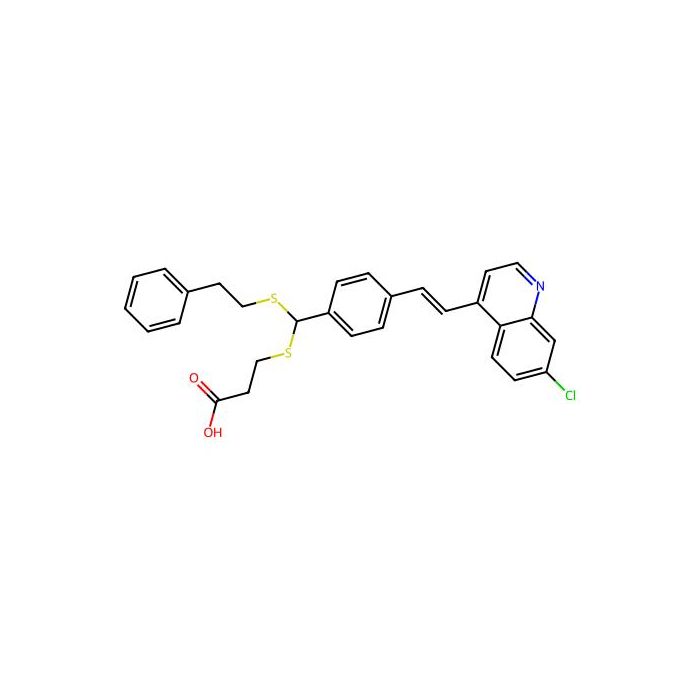
3-[[4-[(E)-2-(7-chloroquinolin-4-yl)ethenyl]phenyl]-(2-phenylethylsulfanyl)methyl]sulfanylpropanoic acid
INCHI
1S/C29H26ClNO2S2/c30-25-12-13-26-23(14-17-31-27(26)20-25)9-6-22-7-10-24(11-8-22)29(35-19-16-28(32)33)34-18-15-21-4-2-1-3-5-21/h1-14,17,20,29H,15-16,18-19H2,(H,32,33)/b9-6+
InChi Key
PHENTWJNXGESKT-RMKNXTFCSA-N
Smiles
C1=CC=C(C=C1)CCSC(C2=CC=C(C=C2)C=CC3=C4C=CC(=CC4=NC=C3)Cl)SCCC(=O)O
Isomeric SMILES
C1=CC=C(C=C1)CCSC(C2=CC=C(C=C2)/C=C/C3=C4C=CC(=CC4=NC=C3)Cl)SCCC(=O)O
PubChem CID
分子量
520.11
技术文档
高级数据
系统学分类
分类树(Taxonomy Tree)
| 界(kingdom) | 有机化合物 |
|---|---|
| 超类(Superclass) | 有机杂环化合物 |
| 类(Class) | 喹啉及其衍生物 |
| 亚类(Subclass) | 卤代喹啉 |
| 中间层级节点(Intermediate Tree Nodes) | 暂无 |
| 直接上位类(Direct Parent) | 卤代喹啉 |
| 其他上位类(Alternative Parents) | 羟基吡啶 苯及其取代衍生物 杂芳族化合物 亚磺酰基化合物 一元羧酸及其衍生物 二烷基硫醚 羧酸 氮杂环化合物 有机光子化合物 有机氧化合物 有机氮化合物 有机氯化物 有机氧化物 碳氢化合物衍生物 |
| 分子骨架(Molecular Framework) | 芳香族杂多环化合物 |
| 取代基(Substituents) | 芳香族杂多环化合物 - 氮杂环 - 苯基化合物 - 羧酰胺基 - 羧酸衍生物 - 二烷基硫醚 - 卤喹啉 - 杂芳香族化合物 - 烃衍生物 - 羟基吡啶 - 单羧酸或其衍生物 - 单环苯基基团 - 有机硝基化合物 - 有机氧化物 - 有机氧化合物 - 有机氯化物 - 有机卤化物 - 有机氮化合物 - 有机氧化合物 - 有机氮化合物 - 有机硫化合物 - 吡啶 - 硫酰基化合物 - 硫醚 |
| 描述(Description) | 该化合物属于有机化合物中的卤代喹啉类。这类化合物含有喹啉骨架,其环上一个或多个位置被n个卤素原子取代。 |
| 外部描述符(External Descriptors) | 暂无 |
三维结构
交互式化学结构模型
作用机制
| 作用机制 | Action Type | target ID | Target Name | Target Type | Target Organism | Binding Site Name | 参考文献 |
|---|
化学和物理性质
溶解性
DMSO : 135 mg/mL (259.56 mM; Need ultrasonic)
质检证书(CoA,COO,BSE/TSE 和分析图谱)
C of A & Other Certificates(BSE/TSE, COO):
输入批号以搜索分析图谱:
溶液计算器
常见问题
本产品的纯度是多少?
本产品的化学纯度(含量)为 ≥95%。批次的具体数值以分析证书(COA)为准。
本产品应如何储存?
请于?20 °C条件下保存。需冷冻保存以维持规定的有效期。
本产品如何运输?
本产品采用保温箱配冰袋运输。收货后请立即拆包,并按上述储存条件保存。
本产品的 CAS 号、分子式和分子量是多少?
本产品的 CAS 号为 2449093-46-1,分子式为 C29H26ClNO2S2,分子量为 520.11 g/mol。InChIKey PHENTWJNXGESKT-RMKNXTFCSA-N。
如何获取批次专用COA?
每个订单都会随附分析证书(COA),您也可以从账户订单历史中下载。如需订购前的COA,请联系您的客户代表,或使用PDP上的"申请COA"按钮——我们将提供代表性批次的COA。
产品仅提供给经过验证的企业、机构和合格的专业人员用于研发。不适用于人类、动物、诊断或治疗。
Copyright © 2023至今 上海阿拉丁生化科技股份有限公司 保留所有权利。


 危险品化学品经营许可证(带存储)