
计算溶液所需的质量、体积或浓度。
为什么选择此级别
提供 ≥99% 纯度,适用于对基线干扰要求严格的色谱和分析工作流程。
储存与运输
2-8°C储存,干燥。低温运输 。请查阅批次 COA 获取详细规格。
质量文档
SDS、COA、产品数据表及规格说明书均可下载。可通过批号查询获取批次 COA。
文献证明
在色谱分析、有机合成和交叉偶联反应领域已被 0 篇同行评审文献引用。
概述
Lometrexol (DDATHF) hydrate, an antipurine antifolate , can inhibit the activity of glycinamide ribonucleotide formyltransferase (GARFT) but do not induce detectable levels of DNA strand breaks. Lometrexol hydrate can further inhibit de novo purine synthesis, causing abnormal cell proliferation and apoptosis , even cell cycle arrest. Lometrexol hydrate has anticancer activity. Lometrexol hydrate also is a potent human Serine hydroxymethyltransferase1/2 (h SHMT1/2 ) inhibitor .
In Vitro
Lometrexol (DDATHF) hydrate binds tightly to GART, resulting in a rapid and prolonged depletion of intracellular purine ribonucleotides. Lometrexol (1-30 μM; 2-10 hours) hydrate induces rapid and complete growth inhibition in L1210 cells. Lometrexol (1 μM; 2-24 hours) hydrate induces cell cycle arrest in murine leukemia L1210 cells. MCE has not independently confirmed the accuracy of these methods. They are for reference only. Cell Viability AssayCell Line: Mouse leukemia L1210 cells Concentration: 1, 30 μM Incubation Time: 2, 4, 6, 8, 10 hours Result: Induced rapid and complete growth inhibition. Cell Cycle AnalysisCell Line: L1210 cells Concentration: 1 μM Incubation Time: 2, 4, 8, 12, 24 hours Result: Caused a rapid loss of the G2/M phase population of cells and an early S phase accumulation of cells by 8 hours. By 24 h, the S phase population appeared to be slowly shifting to higher DNA content, and hence, from mid-to-late S phase.
In Vivo
Lometrexol (DDATHF; i.p.; 15-60 mg/kg; on gestation day 7.5) hydrate induces neural tube defects (NTDs) by disturbing purine metabolism and increases the rate of embryonic resorption and growth retardation in a dose-dependent manner . Lometrexol (i.p.; 40 mg/kg; on gestation day 7.5) hydrate decreases glycinamide ribonucleotide formyl transferase (GARFT) activity and Changes of ATP, GTP, dATP and dGTP levels . Lometrexol (i.p.; 40 mg/kg; on gestation day 7.5) hydrate induces abnormal proliferation and apoptosis exist in neural tube defects (NTDs) . MCE has not independently confirmed the accuracy of these methods. They are for reference only. Animal Model: C57BL/6 mice (7-8 week, 18-20 g) Dosage: 15, 30, 35, 40, 45 and 60 mg/kg Administration: Intraperitoneal injection; on gestation day 7.5 Result: Increased the rate of embryonic resorption and growth retardation in a dose-dependent manner. Animal Model: C57BL/6 mice (7-8 week, 18-20 g) Dosage: 40 mg/kg Administration: Intraperitoneal injection; on gestation day 7.5 Result: Inhibited glycinamide ribonucleotide formyl transferase (GARFT) activity and GARFT activity was maximally inhibited after at 6 hours. Decreased the levels of ATP, GTP, dATP, and dGTP of NTDs embryonic brain tissue significantly at 6 hours. Animal Model: C57BL/6 mice (7-8 week, 18-20 g) Dosage: 40 mg/kg Administration: Intraperitoneal injection; on gestation day 7.5, for 4 days Result: Decreased the expression of proliferation-related genes (Pcna, Foxg1 and Ptch1) and increased the expression of apoptosis-related genes (Bax, Casp8 and Casp9) in NTD groups.
Form:Solid
规格
别名
洛美曲索水合物
规格或纯度
≥99%
英文名称
Lometrexol hydrate
生化机理
水合洛美曲沙醇(DDATHF)是一种抗嘌呤的抗叶酸盐,可抑制甘氨核糖核苷酸甲酰转移酶(GARFT)的活性,但不会诱发可检测到的 DNA 链断裂。水合洛美曲沙可进一步抑制嘌呤合成。
储存条件
2-8°C储存,干燥
运输条件
低温运输
纯度
≥99%
名称和识别符
分子类型
小分子
IUPAC Name
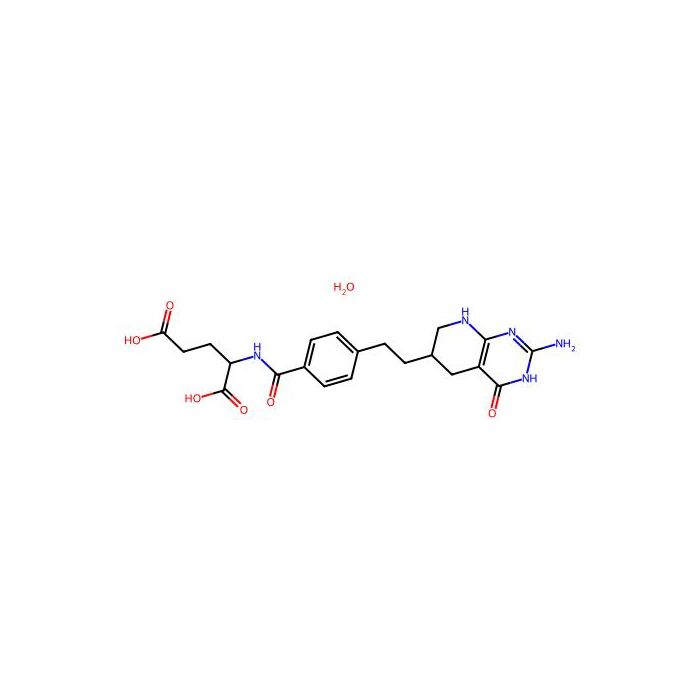
(2S)-2-[[4-[2-[(6R)-2-amino-4-oxo-5,6,7,8-tetrahydro-3H-pyrido[2,3-d]pyrimidin-6-yl]ethyl]benzoyl]amino]pentanedioic acid;hydrate
INCHI
1S/C21H25N5O6.H2O/c22-21-25-17-14(19(30)26-21)9-12(10-23-17)2-1-11-3-5-13(6-4-11)18(29)24-15(20(31)32)7-8-16(27)28;/h3-6,12,15H,1-2,7-10H2,(H,24,29)(H,27,28)(H,31,32)(H4,22,23,25,26,30);1H2/t12-,15+;/m1./s1
InChi Key
AEFQSKJUVDZANQ-YLCXCWDSSA-N
Smiles
C1C(CNC2=C1C(=O)NC(=N2)N)CCC3=CC=C(C=C3)C(=O)NC(CCC(=O)O)C(=O)O.O
PubChem CID
分子量
461.47
技术文档
高级数据
三维结构
交互式化学结构模型
化学和物理性质
溶解性
DMSO : 40 mg/mL (86.68 mM; Need ultrasonic and warming)
质检证书(CoA,COO,BSE/TSE 和分析图谱)
C of A & Other Certificates(BSE/TSE, COO):
输入批号以搜索分析图谱:
溶液计算器
常见问题
本产品的纯度是多少?
本产品的化学纯度(含量)为 ≥99%。批次的具体数值以分析证书(COA)为准。
本产品应如何储存?
请于2–8 °C、干燥条件下保存。请与干燥剂一同密封保存,本品对湿气敏感。
本产品如何运输?
本产品采用湿冰冷藏运输。收货后请立即拆包,并按上述储存条件保存。
本产品的 CAS 号、分子式和分子量是多少?
本产品的 CAS 号为 1435784-14-7,分子式为 C21H27N5O7,分子量为 461.47 g/mol。InChIKey AEFQSKJUVDZANQ-YLCXCWDSSA-N。
如何获取批次专用COA?
每个订单都会随附分析证书(COA),您也可以从账户订单历史中下载。如需订购前的COA,请联系您的客户代表,或使用PDP上的"申请COA"按钮——我们将提供代表性批次的COA。
产品仅提供给经过验证的企业、机构和合格的专业人员用于研发。不适用于人类、动物、诊断或治疗。
Copyright © 2023至今 上海阿拉丁生化科技股份有限公司 保留所有权利。


 危险品化学品经营许可证(带存储)