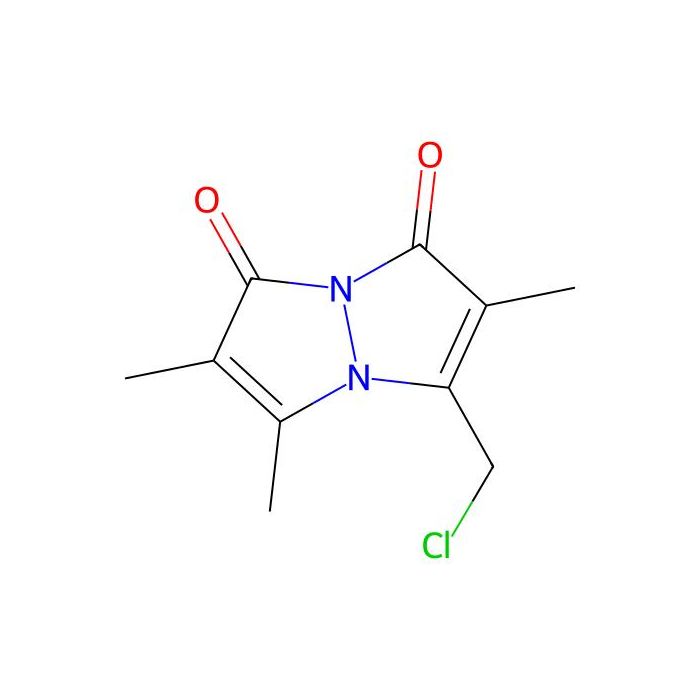
General description:Monochlorobimane is a glutathione (GSH) fluorescent cell-permeable probe. When incubated with the test cell culture, it readily enters the cells and forms a fluorescent complex. The Monochlorobimane-GSH reaction is catalyzed by glutathione-S-transferase, which is detected fluorometrically.Monochlorobimane, also known as mBCl, is a non-fluorescent compound that forms a fluorescent complex upon reaction. The fluorescence is detected at 394/490nm.
In vitro
A common technique to measure Glutathione (GSH) in cultured cells is to add Monochlorobimane to the culture medium where it readily enters cells to form a fluorescent GSH-monochlorobimane adduct that can be measured fluorometrically. The Monochlorobimane approach gives comparable results to the HPLC technique. Monochlorobimane concentration can be lowered to 25 mM and still accurately measure homogenate GSH content.
fluorescence:λex 380 nm; λem 461 nm in methanol, λex 390 nm; λem 478 nm in 0.1 M phosphate pH 7.5 (after derivatization with glutathione)

 D2608519


 危险品化学品经营许可证(带存储)