NAD激酶(NADK, EC2.7.1.23)广泛存在于动物、植物、微生物和培养细胞中,是目前所发现的生物体内唯一能够催化NAD+磷酸化生成NADP+的酶,可催化NAD(H)以ATP或无机多聚磷酸[poly(P)]作为磷酰基供体进行磷酸化反应,生成NADP(H)。因此,NAD激酶在合成NADP(H)以及调节NAD(H)与NADP(H)的平衡上具有重要作用。
测定原理: NADK催化NAD+磷酸化,生成NADP+;NADP+可被6-磷酸葡萄糖脱氢酶还原为NADPH;在340nm 下测定NADPH增加速率。可反映出NADK活性的大小。
Component
| 50T
| Storage
|
提取液
| 50 mL
| 2-8℃
|
试剂一
| 25 mL
| 2-8℃
|
试剂二
| 50 mL | 2-8℃
|
试剂三
| 1EA
| -20℃ |
试剂四
| 1EA
| -20℃
|
自备仪器和用品
紫外分光光度计、台式离心机、可调式移液器、1ml石英比色皿、研钵、冰和蒸馏水。
样本的前处理
1、细菌、细胞或组织样品的制备:
细菌或培养细胞:先收集细菌或细胞到离心管内,离心后弃上清;按照细菌或细胞数量(104个): 提取液体积(ml)为500~1000:1的比例(建议500万细菌或细胞加入1ml提取液),超声波破碎细菌或 细胞(冰浴,功率20%或200W,超声3s,间隔10s,重复30次);8000g4℃离心10min,取上清,置冰上待测。
组织:按照组织质量(g):提取液体积(ml)为1:5~10的比例(建议称取约0.1g组织,加入1ml提 取液),进行冰浴匀浆。8000g 4℃离心10min,取上清,置冰上待测。
2、血清(浆)样品:直接检测。
测定步骤:
1、分光光度计预热30min以上,调节波长至340nm,蒸馏水调零。
2、将试剂一和试剂二37℃(哺乳动物)或25℃(其它物种)水浴15min以上。
3、工作液Ⅰ的配制:在试剂三中加入12ml试剂一,充分混匀待用;用不完的试剂分装后-20℃保存,禁止反复冻融;
工作液Ⅱ的配制:在试剂四中加入45ml试剂二,充分混匀待用;用不完的试剂分装后-20℃保存,禁止反复冻融。
4、加样表
试剂名称(μL)
| 测定管
| 对照管
|
样本
| 100 | 100 |
工作液Ⅰ
| 400 |
|
| 试剂一 |
| 400 |
充分混匀,37℃(哺乳动物)或25℃(其它物种)水浴15min,立即煮沸 2min(盖紧,防止水分散失)冰浴冷却,10000g,25℃离心10min,取上清。
加完试剂混匀,室温静置15min,340nm下测定吸光值,ΔA=A测定-A对照。
NADK活性计算:
1、血清(浆)NADK活力的计算
单位的定义:每ml血清(浆)每分钟生成1nmol的NADP定义为一个酶活力单位。
NADK(nmol/min/ml)=[ΔA×V 反总÷(ε×d)×10⁹]÷V样÷T=53.59×ΔA
2、组织、细菌或细胞中NADK活力的计算
2.1 按样本蛋白浓度计算
单位的定义:每mg组织蛋白每分钟生成1nmol NADP定义为一个酶活力单位。
NADK(nmol/min /mg prot)=[ΔA×V 反总÷(ε×d)×10⁹]÷(V样×Cpr)÷T=53.59×ΔA÷Cpr
2.2 按样本鲜重计算
单位的定义:每g组织每分钟生成1nmol NADP定义为一个酶活力单位。
NADK(nmol/min /g 鲜重)=[ΔA×V反总÷(ε×d)×10⁹]÷(W×V样÷V样总)÷T=53.59×ΔA÷W
2.3 按细菌或细胞密度计算
单位的定义:每1万个细菌或细胞每分钟生成1nmol NADP定义为一个酶活力单位。
NADK(nmol/min /10⁴ cell)=[ΔA×V 反总÷(ε×d)×10⁹]÷(500×V 样÷V 样总)÷T=0.107×ΔA
参数说明:
V反总:反应体系总体积,5×10⁻⁴L
ε:NADPH摩尔消光系数,6.22×10³L/mol/cm
d:比色皿光径, 1cm
V样:加入样本体积,0.1ml
V样总:加入提取液体积,1ml
T:反应时间,15min
Cpr:样本蛋白质浓度,mg/ml;
W:样本质量,g
注意事项
正式测定前务必取2-3个预期差异较大的样本做预测定。
NAD Kinase (NADK, EC 2.7.1.23) is widely present in animals, plants, microorganisms, and cultured cells. It is the only known enzyme that catalyzes the phosphorylation of NAD⁺ to NADP⁺ in vivo. It can utilize ATP or inorganic polyphosphate [poly(P)] as a phosphoryl donor to catalyze the phosphorylation of NAD(H), generating NADP(H). Therefore, NADK plays a crucial role in synthesizing NADP(H) and regulating the balance between NAD(H) and NADP(H).
Assay Principle
NADK catalyzes the phosphorylation of NAD⁺ to generate NADP⁺. The generated NADP⁺ is then reduced to NADPH by Glucose-6-Phosphate Dehydrogenase (G6PDH). The rate of increase in NADPH, measured by the rise in absorbance at 340 nm, reflects the activity of NADK.
Component
| 50T
| Storage
|
Extraction Buffer
| 50 mL
| 2-8℃
|
Reagent 1
| 25 mL
| 2-8℃
|
Reagent 2
| 50 mL | 2-8℃
|
Reagent 3
| 1EA
| -20℃ |
Reagent 4
| 1EA
| -20℃ |
Required Materials and Equipment (Not Provided)
UV spectrophotometer, benchtop centrifuge, adjustable pipettes, 1 ml quartz cuvette, mortar and pestle, ice, and distilled water.
Sample Preparation
1.Bacteria, Cells, or Tissues:
Bacteria or Cultured Cells: Collect cells by centrifugation and discard the supernatant. Add Extraction Buffer at a ratio of 1 ml per 5-10 million cells (e.g., 1 ml for 5 million cells). Sonicate on ice (20% power or 200W, pulse 3s on/10s off, repeat 30 times). Centrifuge at 8000 g, 4°C for 10 min. Collect the supernatant and keep it on ice.
Tissues: Homogenize tissue on ice in Extraction Buffer at a ratio of 1:5-10 (w/v) (e.g., 0.1 g tissue in 1 ml buffer). Centrifuge the homogenate at 8000 g, 4°C for 10 min. Collect the supernatant and keep it on ice.
2.Serum (or Plasma) Samples: Assay directly.
Assay Procedure:
1.Preheat the spectrophotometer for at least 30 min. Set wavelength to 340 nm. Zero with distilled water.
2.Pre-warm Reagent 1 and Reagent 2 at 37°C (for mammalian samples) or 25°C (for other species) for at least 15 min.
3.Working Solution I Preparation: Add 12 mL of Reagent 1 to the contents of Reagent 3. Mix thoroughly. Aliquot and store unused portions at -20°C. Avoid repeated freeze-thaw cycles.
Working Solution II Preparation: Add 45 mL of Reagent 2 to the contents of Reagent 4. Mix thoroughly. Aliquot and store unused portions at -20°C. Avoid repeated freeze-thaw cycles.
4.Assay Setup:
Reagent
| Test Tube (μL) | Control Tube (μL)
|
Sample
| 100 | 100 |
Working Solution I
| 400 |
|
| Reagent 1 |
| 400 |
Mix thoroughly. Incubate at 37°C (mammalian) or 25°C (other species) for 15 min.
Immediately boil for 2 min (tighten caps to prevent evaporation).
Cool on ice.
Centrifuge at 10,000 g, 25°C for 10 min. Collect the supernatant.
5.Detection:
Reagent
| Volume (μL)
|
Supernatant (from step 4)
| 200
|
Working Solution II
| 800 |
Add reagents to a new tube or cuvette. Mix thoroughly after addition.
Let the reaction stand at room temperature for 15 min.
Measure the absorbance at 340 nm.
Calculate ΔA = ATest - AControl.
NADK Activity Calculation:
General Parameters:
VTotal (Total reaction volume for detection step) = 5 × 10⁻⁴ L (0.5 mL = 500 μL)
ε (NADPH molar extinction coefficient) = 6.22 × 10³ L/mol/cm
d (Cuvette light path) = 1 cm
VSample (Sample volume in initial reaction) = 0.1 mL (100 μL)
VSample Total (Total extraction volume) = 1 mL
T (Reaction time for NADK enzyme step) = 15 min
Cpr (Sample protein concentration, mg/mL)
W (Sample mass, g)
500 (Cell/Bacteria count in millions for example calculation: 5 million)
1. For Serum (Plasma):
Definition: One unit of activity is defined as the amount of enzyme that generates 1 nmol of NADP⁺ per minute per ml of serum.
Calculation:
NADK Activity (nmol/min/ml) = [ΔA × VTotal ÷ (ε × d) × 10⁹] ÷ VSample ÷ T
Simplified Formula: NADK (nmol/min/ml) = 53.59 × ΔA
2. For Tissues, Bacteria, or Cells:
a. Based on Sample Protein Concentration:
Definition: One unit of activity is defined as the amount of enzyme that generates 1 nmol of NADP⁺ per minute per mg of protein.
Calculation:
NADK Activity (nmol/min/mg prot) = [ΔA × VTotal ÷ (ε × d) × 10⁹] ÷ (VSample × Cpr) ÷ T
Simplified Formula: NADK (nmol/min/mg prot) = 53.59 × ΔA ÷ Cpr
b. Based on Sample Fresh Weight:
Definition: One unit of activity is defined as the amount of enzyme that generates 1 nmol of NADP⁺ per minute per gram of fresh tissue.
Calculation:
NADK Activity (nmol/min/g fresh weight) = [ΔA × VTotal ÷ (ε × d) × 10⁹] ÷ (W × VSample / VSample Total) ÷ T
Simplified Formula: NADK (nmol/min/g fresh weight) = 53.59 × ΔA ÷ W
c. Based on Bacterial or Cell Density:
Definition: One unit of activity is defined as the amount of enzyme that generates 1 nmol of NADP⁺ per minute per 10⁴ cells.
Calculation (example for 5 million cells in 1 ml extract):
NADK Activity (nmol/min/10⁴ cell) = [ΔA × VTotal ÷ (ε × d) × 10⁹] ÷ (500 × VSample / VSample Total) ÷ T
Simplified Formula: NADK (nmol/min/10⁴ cell) = 0.107 × ΔA
Precautions
Before formal assay, it is essential to perform a pilot test with 2-3 samples expected to have significant differences in activity.



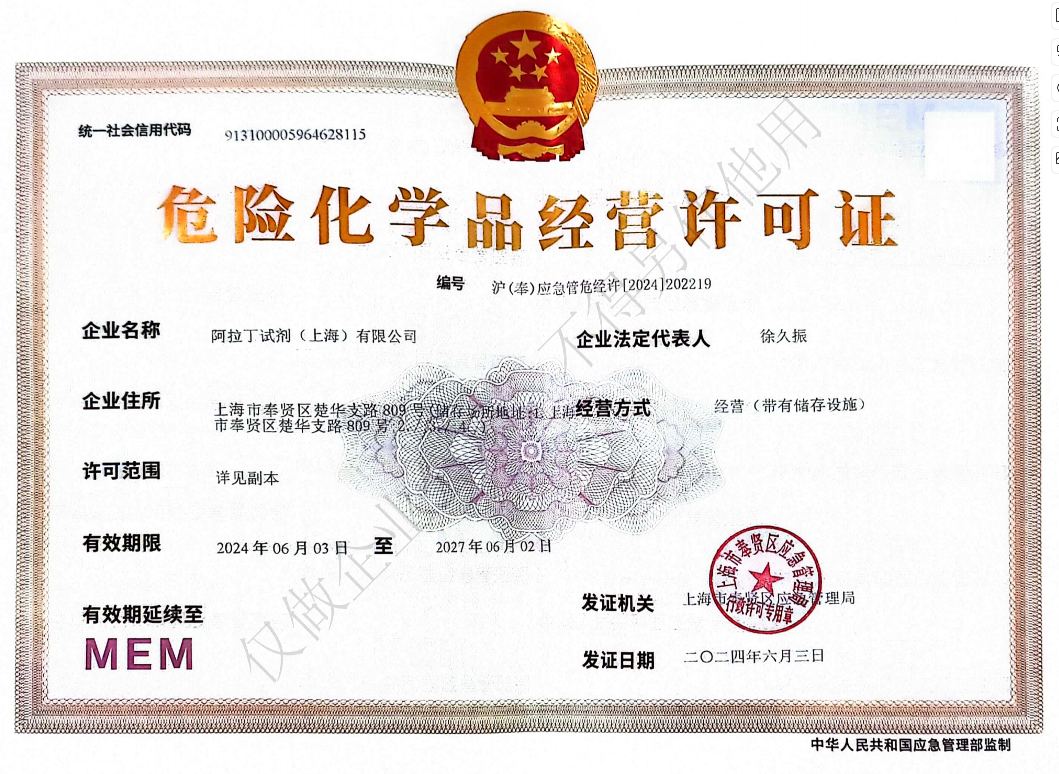 危险品化学品经营许可证(带存储)