本试剂盒的检测对象为水(地表水、地下水、饮用水、生活污水、工业废水、农田灌溉水等)和土壤 / 沉积物中的亚硝酸盐(以亚硝酸盐氮 NO₂⁻-N 计)。亚硝酸盐是氮素生物地球化学循环的关键中间产物,也是环境监测、农业生态评价、污染防控领域的核心必测指标。
本试剂盒核心原理为样本中的亚硝酸盐(NO₂⁻)在酸性条件下与对氨基苯磺酸(或对氨基苯磺酰胺)发生重氮化反应。生成的重氮盐会立即与N-1 - 萘基乙二胺盐酸盐(NED)发生偶联反应,形成粉红色至深红色的偶氮类有色化合物,这类有色物质在530-545 nm波长下有特征光吸收峰,且颜色深浅与样本中亚硝酸盐的浓度呈正相关
使用方法
1. 样本制备
(1)土壤样本:取适量土壤样品,去除石块、树枝等杂质,过2mm筛网,准确称取0.5g,加入 1mL 提取液,室温震荡 1h,3000rpm,25℃离心 10min,待其分层后,取上清液待测。
(2)水样:直接检测;如果浑浊,可以离心后再测定。
2、试剂准备
(1)试剂盒中的试剂平衡至室温。
(2)分别将4 mL(48 T)和6 mL(96 T) 酸性缓冲液加入检测试剂A,B中,充分溶解(可超声溶解),2-8℃避光保存,长期保存可放-20℃。
(3)配制系列 NO₂⁻ 标准溶液:取1 mmol/L标准品:用蒸馏水将1 mmol/L标准品按下表稀释,现用现配。
NO₂⁻ 标准(1mM)加入体积(μL) | 1 | 5 | 10 | 15 | 20 | 25 | 蒸馏水 | 99 | 95 | 90 | 85 | 80 | 75 | NO₂⁻ 含量(μM) | 10 | 50 | 100 | 150 | 200 | 250 |
|
注意:每次实验都要做一次标准品检测,制作标曲;稀释后的标准品溶液不稳定,必须在4小时内使用。
3.操作步骤
(1)正式测定前务必取 2-3 个预期差异较大的样本做预测定。
(2)酶标仪预热30min,调节波长到530nm。
(3)按照下表依次加入各试剂:
试剂(μL) | 空白孔 | 标准孔 | 测定孔 | 双蒸水 | 100 | 0 | 0 | 标准品 | 0 | 100 | 0 | 样品 | 0 | 0 | 100 | 试剂A | 50 | 50 | 50 | 试剂B | 50 | 50 | 50 |
|
混匀,室温静置15min,于96 孔板中检测 A530 吸光值。
4. 结果计算
以空白调零,用系列 NO2 - 标准含量(μM)为横坐标,以对应的吸光度为纵坐标,制作标准曲线,根据测定孔的吸光度进而计算 NO2 - 含量:
(1)土壤样本:亚硝酸含量(μmol/g)=N×F×V/W
(2)水样:亚硝酸含量(μmol/L)=F×N
N:从标曲查得NO2 -含量(μM);
F:稀释倍数;
V:提取液总体积(L);
W:样本质量。
5. 注意事项
(1) 建议尽量现配先用,试剂开封后请尽快使用,以防影响后续实验效果。
(2) 试剂盒检测范围不等同于样本中待测物的浓度范围。如果样品中待测物浓度过高或过低,请对样本做适当的稀释或浓缩。
(3) 本产品仅供科学研究使用,不适用于临床诊断。为了您的安全和健康,请穿实验服并戴一次性手套操作。
6. 结果展示
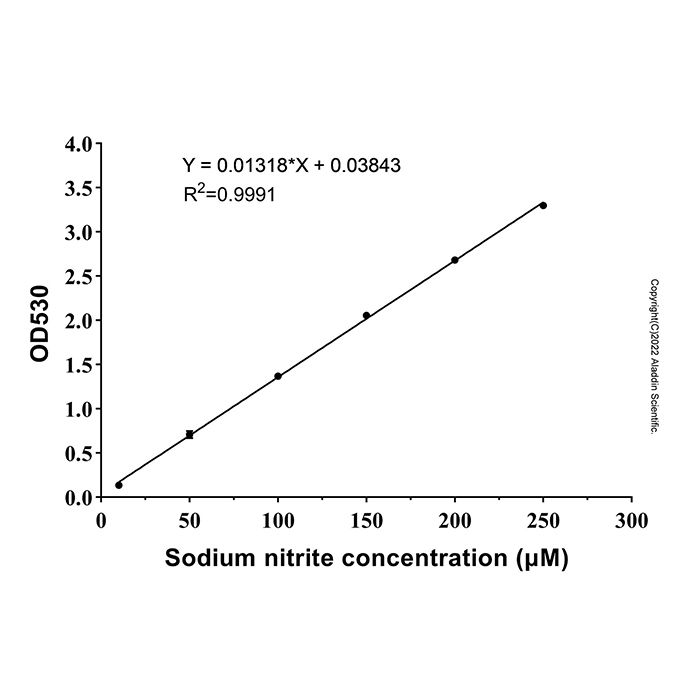
典型标准曲线:Y = 0.01318*X + 0.03843,0.9991

This kit is used for the detection of nitrite (calculated as nitrite nitrogen NO₂⁻-N) in water (surface water, groundwater, drinking water, domestic sewage, industrial wastewater, farmland irrigation water, etc.) and soil/sediment. Nitrite is a key intermediate in the biogeochemical cycle of nitrogen, and also a core mandatory indicator in the fields of environmental monitoring, agroecological assessment, and pollution prevention and control.
The core principle of this kit is that nitrite (NO₂⁻) in the sample undergoes a diazotization reaction with sulfanilic acid (or sulfanilamide) under acidic conditions. The generated diazonium salt immediately undergoes a coupling reaction with N-(1-naphthyl)ethylenediamine dihydrochloride (NED), forming a pink to deep red azo-colored compound. Such colored substances have a characteristic absorption peak at 530–545 nm, and the color intensity is positively correlated* with the nitrite concentration in the sample.
Usage
1. Sample Preparation
(1) Soil samples
Take an appropriate amount of soil sample, remove impurities such as stones and branches, and sieve through a 2 mm mesh. Accurately weigh 0.5 g, add 1 mL of extraction solution, shake at room temperature for 1 h, and centrifuge at 3000 rpm, 25 °C for 10 min. After stratification, take the supernatant for testing.
(2) Water samples
Detect directly; if turbid, centrifuge before measurement.
2. Reagent Preparation
(1) Equilibrate the reagents in the kit to room temperature.
(2) Add 6 mL of acidic buffer solution to Detection Reagent A and B respectively, dissolve completely (ultrasonic dissolution is available), store at 2–8 °C away from light; for long-term storage, store at -20 °C.
(3) Preparation of serial NO₂⁻ standard solutions.
Take the 1 mmol/L standard: dilute the 1 mmol/L standard with distilled water according to the table below, prepare fresh before use.
Volume of NO₂⁻ standard (1 mM) added (μL) | 1 | 5 | 10 | 15 | 20 | 25 | Distilled water (μL) | 99 | 95 | 90 | 85 | 80 | 75 | NO₂⁻ content (μM) | 10 | 50 | 100 | 150 | 200 | 250 |
|
Note:A standard curve must be established with standard solutions in each experiment.Diluted standard solutions are unstable and must be used within 4 hours.
3. Procedures
(1) Before formal measurement, be sure to perform a pre-test using 2–3 samples with expected large differences.
(2) Preheat the microplate reader for 30 min, and set the wavelength to 530 nm.
(3) Add each reagent sequentially according to the table below:
Reagents (μL) | Blank | Standard | Sample | Double-distilled water | 100 | 0 | 0 | Standard | 0 | 100 | 0 | Sample | 0 | 0 | 100 | Reagent A | 50 | 50 | 50 | Reagent B | 50 | 50 | 50 |
|
Mix well and incubate at room temperature for 15 min, then measure the absorbance at 530 nm (A530) in a 96 well plate.
4. Result Calculation
Zero the instrument with the blank control. Construct a standard curve using the NO₂⁻ standard concentrations (μM) as the abscissa (X axis) and the corresponding absorbance values as the ordinate (Y axis). Calculate the NO₂⁻concentration in the sample wells based on the standard curve.
(1) Soil samples:
Nitrite content (μmol/g fresh weight) = n × f × Vₑₓₜ / W = 2f × n
(2) Water samples:
Nitrite content (μmol/mL) = f × n
Where:
- n: NO₂⁻concentration obtained from the standard curve (μM)
- f: Dilution factor
- Vₑₓₜ: Volume of extraction solution
- W: Sample weight
5. Notes
(1) It is recommended that reagents be prepared and used immediately. Please use the reagents as soon as possible after opening to avoid affecting experimental results.
(2) The detection range of the kit is not equivalent to the concentration range of the analyte in the sample. If the analyte concentration in the sample is too high or too low, please dilute or concentrate the sample appropriately.
(3) This product is for research use only and not suitable for clinical diagnosis. For your safety and health, please wear a lab coat and disposable gloves during operation.
6. Results Presentation
Typical standard curve:
Y = 0.01318X + 0.03843, R² = 0.9991


 ZJ26F0434343

 危险品化学品经营许可证(带存储)