微生物的呼吸作用主要分为有氧呼吸和无氧呼吸,氧化酶反应、过氧化氢酶反应和硝酸盐反应是呼吸作用的重要环节,在细菌鉴定中起着重要作用。硝酸盐还原反应存在于与微生物合成与分解的两个过程中:合成过程中,硝酸盐还原为亚硝酸盐和氨,再由氨转化氨基酸和细胞内其他含氮化合物;分解代谢过程中,硝酸盐或亚硝酸盐代替氧作为呼吸酶系统中的终末受氢体,能使硝酸盐还原的细菌从硝酸盐中获得氧而形成亚硝酸盐和其他还原性产物。硝酸盐还原过程可因细菌不同而异。有的细菌仅使硝酸盐还原为亚硝酸盐,如大肠埃希氏菌等;有的细菌可使其还原为亚硝酸盐和离子态的铵;有的细菌能使硝酸盐或亚硝酸盐还原为氮,如假单胞菌和沙雷菌属等;有的细菌还可以将其还原产物在合成性代谢中完全利用。
阿拉丁硝酸盐还原试验试剂又称作Griess试剂、亚硝酸盐试剂等,主要由对氨基苯磺酸溶液、α-萘胺溶液和锌还原剂组成,主要用于鉴别肠杆菌、假单胞菌等。大肠埃希氏菌等细菌仅能使硝酸盐还原为亚硝酸盐,在乙酸作用下,亚硝酸盐与试剂中的对氨基苯磺酸作用生成重氮基苯磺酸,后者与α-萘胺结合生成紫红色~红色产物;假单胞菌、沙雷菌等细菌能使硝酸盐或亚硝酸盐还原为氮或氧化氮,该作用被称为脱硝化或脱氮化作用,产生气泡,但无红色出现。该试剂仅用于科研领域,不适用于临床诊断或其他用途。
产品组分及储存条件:
N1510445
| Component
| 2×10mL
| 2×50mL
| Storage
|
N1510445A
| 对氨基苯磺酸溶液
| 10mL
| 50mL
| RT. Store in the dark.
|
N1510445B
| α-萘胺溶液
| 10mL
| 50mL
| RT. Store in the dark.
|
N1510445C
| 锌还原剂
| 0.2g | 1g | RT. Store in the dark. |
自备材料:
硝酸盐培养基、精密天平(精度值0.1mg)、恒温培养箱、接种环、试管、酒精灯等
操作步骤(仅供参考):
1、被检细菌接种于硝酸盐培养基,35°C培养1~4天。
2、取适量的对氨基苯磺酸溶液和α-萘胺溶液等量混合后即为硝酸盐还原试验试剂。
3、取0.1ml硝酸盐还原试验试剂加入培养基中,立即观察结果。
4、若加入硝酸盐还原试验试剂不出现红色,需向试管中加入少许锌还原剂(1~3mg),摇晃2~5min,使充分反应,如出现红色,则表示培养基中仍存在硝酸盐;若仍不产生红色,则表示硝酸盐已被还原为氨或氮,可在培养基内加入1支小倒管,若有气泡产生,表示有氮气生成,可排除假阴性。
染色结果:
未加锌还原剂呈紫红色~红色
| 阳性(肠杆菌科细菌、韦荣球菌)
|
加锌还原剂呈紫红色~红色
| 阴性
|
加锌还原剂不变色
| 假阴性(假单胞菌、沙雷菌等)
|
注意:加入试剂无颜色反应,可能原因:1、硝酸盐没有被还原,实验确为阴性;2、硝酸盐被还原为氨和氮等其他物质,进而导致假阴性。这时可加入少许锌还原剂,如出现红色则说明实验确为阴性,如果未出现红色则说明实验为假阴性。
注意事项:
1、细菌培养及实验,应注意自我防护。
2、待检细菌培养时间也会影响染色,阳性菌培养时间过长或已死亡或细菌溶解,都常呈阴性反应。
3、某些厌氧菌(韦荣球菌)亦呈阳性反应。
4、必须在加入试剂之后立即判定结果,否则因颜色迅速褪色而造成判定困难,如铜绿假单胞菌、嗜麦芽窄食单胞菌等。
5、对氨基苯磺酸溶液和α-萘胺溶液含有乙酸,有刺激性气味,应避免吸入。
6、锌还原剂可用锌粒替代,2~8粒或5~20mg锌粒,可替代1~3mg锌还原剂。
7、为了您的安全,请穿实验服并戴一次性手套操作。
8、试剂开封后请尽快使用,以防影响后续实验效果。
The respiration of microorganisms is mainly divided into aerobic respiration and anaerobic respiration. The oxidase reaction, catalase reaction, and nitrate reaction are key steps in the respiratory process and play an important role in bacterial identification. Nitrate reduction reactions are involved in two processes of microbial synthesis and decomposition: In the synthetic process, nitrate is reduced to nitrite and ammonia, which are then converted into amino acids and other nitrogen-containing intracellular compounds. In the catabolic process, nitrate or nitrite replaces oxygen as the terminal hydrogen acceptor in the respiratory enzyme system. Bacteria capable of nitrate reduction obtain oxygen from nitrate to form nitrite and other reductive products. The nitrate reduction process varies among different bacterial species. Some bacteria only reduce nitrate to nitrite, such as Escherichia coli; some can reduce nitrate to both nitrite and ionic ammonium; some bacteria can reduce nitrate or nitrite to nitrogen gas, such as species of the genera Pseudomonas and Serratia; some bacteria can also fully utilize their reductive products in synthetic metabolism.
Aladdin Nitrate Reduction Test Reagent, also known as Griess Reagent or Nitrite Reagent, mainly consists of sulfanilic acid solution, α-naphthylamine solution, and zinc reducing agent. It is primarily used for the identification of Enterobacteriaceae, Pseudomonas, and other bacterial strains. Bacteria such as Escherichia coli can only reduce nitrate to nitrite. Under the action of acetic acid, nitrite reacts with sulfanilic acid in the reagent to form diazobenzenesulfonic acid, which then binds to α-naphthylamine to produce a fuchsine to red-colored product. Bacteria such as Pseudomonas and Serratia can reduce nitrate or nitrite to nitrogen gas or nitrogen oxides; this process is called denitrification, which produces gas bubbles but no red coloration.This reagent is intended for research use only and is not suitable for clinical diagnosis or any other purposes.
Product Components and Storage Conditions:
N1510445
| Component
| 2×10mL
| 2×50mL
| Storage
|
N1510445A
| Sulfanilic Acid Solution
| 10mL
| 50mL
| RT. Store in the dark.
|
N1510445B
| α-Naphthylamine Solution
| 10mL
| 50mL
| RT. Store in the dark.
|
N1510445C
| Zinc Reducing Agent
| 0.2g | 1g | RT. Store in the dark. |
Materials Required (Self-prepared):
Nitrate medium, analytical balance (precision: 0.1 mg), constant-temperature incubator, inoculation loops, test tubes, alcohol lamps, etc.
Operating Procedures (For Reference Only):
1. Inoculate the test bacteria into the nitrate medium and incubate at 35°C for 1–4 days.
2. Mix equal volumes of an appropriate amount of sulfanilic acid solution and α-naphthylamine solution to prepare the nitrate reduction test reagent.
3. Add 0.1 mL of the nitrate reduction test reagent to the medium and observe the result immediately.
4. If no red color develops after adding the nitrate reduction test reagent, add a small amount of zinc reducing agent (1–3 mg) to the test tube, shake for 2–5 minutes to allow sufficient reaction. A red color indicates that nitrate is still present in the medium; if no red color still develops, it means the nitrate has been reduced to ammonia or nitrogen gas. Place a small inverted Durham tube inside the medium. The production of gas bubbles indicates nitrogen gas generation, which can rule out false negatives.
Staining Results:
Fuchsine to red color without adding zinc reducing agent
| Positive (Enterobacteriaceae, Veillonella)
|
Fuchsine to red color after adding zinc reducing agent
| Negative
|
No color change after adding zinc reducing agent
| False negative (Pseudomonas, Serratia, etc.) |
Note:No color reaction after reagent addition may result from two causes:
Nitrate has not been reduced, indicating a true negative result of the test.
Nitrate has been reduced to other substances such as ammonia and nitrogen, leading to a false negative result.
In this case, add a small amount of zinc reducing agent. A red color indicates a true negative result, while no red color indicates a false negative result.
Precautions:
1. Personal protection should be taken during bacterial culture and the experiment.
2. The incubation time of the test bacteria can also affect the reaction results. A positive bacterial strain may show a negative reaction if incubated for an excessively long time, or if the bacteria have died or lysed.
3. Certain anaerobic bacteria (e.g., Veillonella) can also yield a positive reaction.
4. The test results must be interpreted immediately after adding the reagent. Otherwise, rapid fading of the color will make result judgment difficult, especially for strains such as Pseudomonas aeruginosa and Stenotrophomonas maltophilia.
5. Sulfanilic acid solution and α-naphthylamine solution contain acetic acid and have a pungent odor; inhalation should be avoided.
6. Zinc reducing agent can be replaced with zinc granules. 2–8 granules or 5–20 mg of zinc granules are equivalent to 1–3 mg of zinc reducing agent.
7. For your safety, wear a lab coat and disposable gloves during the operation.
8. Please use the reagents as soon as possible after opening to avoid affecting subsequent experimental results.
 ZJ26F0737700

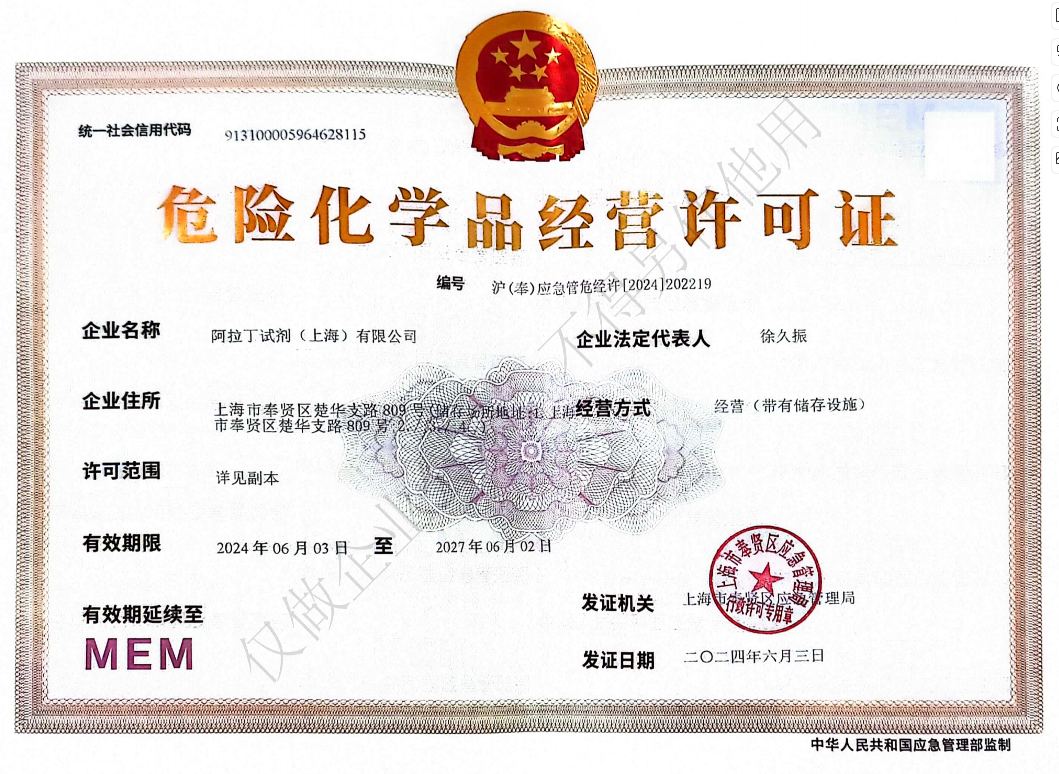 危险品化学品经营许可证(带存储)