亚硝酸盐广泛应用于肉制品加工,是常用护色、防腐助剂:加工过程中亚硝酸盐释放一氧化氮,与肉中肌红蛋白结合形成亚硝基肌红蛋白,维持肉制品红润外观;同时对肉毒梭状芽孢杆菌等腐败菌具有显著抑制作用,可有效规避肉毒素中毒风险。亚硝酸盐存在明确健康危害:短期大量摄入可诱发急性高铁血红蛋白血症;在缺乏维生素C等阻断剂的胃部酸性环境中,其易与食物中的仲胺、酰胺类物质反应生成N-亚硝基化合物,长期暴露将增加消化道癌症风险。
本试剂盒采用国标经典格里斯分光光度法:酸性条件下亚硝酸盐与对氨基苯磺酸完成重氮化,再与 N-(1-萘基)乙二胺二盐酸盐偶合形成紫红色特征偶氮染料,染料在 540 nm 波长下有最大吸收;在线性区间 1.563-100 μM 内,显色体系吸光度差值与亚硝酸盐浓度成正比,通过标准曲线法即可实现食品样品中亚硝酸盐精准、比色定量。
该试剂盒仅用于科研领域,不适用于临床诊断或其他用途。
储运单元货号 | 储运单元名称 | 组分货号 | 组分名称 | 物理外观 | 50T | 储存 | 单次测试使用量 |
N1521784NT | 食品中亚硝酸盐含量检测试剂盒 (盐酸萘乙二胺, 比色法) (常温组分) | N1521784A | 提取液 I | 无色透明液体 | 50 mL | Room temperature. | 按需 |
|
| N1521784B | 提取液 II | 黄色液体 | 50 mL | Room temperature. | 按需 |
|
| N1521784C | 提取液 III | 无色透明液体 | 50 mL | Room temperature. | 按需 |
|
| N1521784D | 活性炭 | 黑色固体 | 0.1 g | Room temperature. | 按需 |
N1521784WT | 食品中亚硝酸盐含量检测试剂盒 (盐酸萘乙二胺, 比色法) (2-8℃组分) | N1521784E | 试剂 一 | 无色透明液体 | 25 mL | 2-8℃.避光 | 325 µL |
|
| N1521784F | 试剂 二 | 无色透明液体 | 25 mL | 2-8℃.避光 | 325 µL |
|
| N1521784G | 亚硝酸钠 (1M) | 无色透明液体 | 2.5 mL | 2-8℃. | 350 µL |
注意事项:
1. 试剂盒试剂含有致癌芳香胺类物质及有毒亚硝酸盐,全部操作必须在通风橱内完成;实验全程穿戴实验服、丁腈手套、防护目镜,严禁皮肤直接接触试剂。
2. 显色孵育全过程必须避光,防止偶氮染料光降解导致结果偏差;若样品吸光值过高,可减少称样量或稀释上清液,并在最终结果中折算稀释倍数;高脂、高色素样品需通过活性炭脱色、正己烷脱脂消除基质干扰。
3. 正式检测前建议开展预实验,选用高低浓度差异明显的样品验证提取与显色体系;试剂盒配套组分请勿与其他品牌试剂混用,避免交叉干扰影响准确度。
使用说明:
1. 材料准备
额外所需材料:
(1) 所需仪器:可见分光光度计 (能测540 nm处的吸光度)。
(2) 其它:96孔板、制冰机、离心机、水浴锅。
2. 试剂准备
(1) 提取液 I:即用型;常温保存。提取液 I 为饱和溶液,有少量析出为正常现象,使用前充分摇匀。
(2) 提取液 II:即用型;常温保存。
(3) 提取液 III:即用型;常温保存。
(4) 活性炭:即用型;常温保存。
(5) 试剂 一:即用型;使用前,平衡到室温;4℃避光保存。
(6) 试剂 二:即用型;使用前,平衡到室温;4℃避光保存。
(7) 标准曲线设置:用去离子水将1 M 亚硝酸钠标准品稀释成100 μM。按下表所示,用去离子水将100 μM 亚硝酸钠标准品稀释至50、25、12.5、6.25、3.125、1.563 µM。
序号 | 标准品体积 | 去离子水体积 (μL) | 标准品浓度 (μM) |
标品 1 | 取 800 μL 100 μM 亚硝酸钠标准工作液 | 0 | 100 |
标品 2 | 取 400 μL 标品 1 (浓度 100 μM) | 400 | 50 |
标品 3 | 取 400 μL 标品 2 (50 μM) | 400 | 25 |
标品 4 | 取 400 μL 标品 3 (25 μM) | 400 | 12.5 |
标品 5 | 取 400 μL 标品 4 (12.5 μM) | 400 | 6.25 |
标品 6 | 取 400 μL 标品 5 (6.25 μM) | 400 | 3.125 |
标品 7 | 取 400 μL 标品 6 (3.125 μM) | 400 | 1.563 |
标品 8 | 0 | 800 | 0 |
注 1:试剂 II 和亚硝酸钠标准配有一定毒性,建议在通风橱进行实验。
注 2:每次实验都要做一次标准品检测,制作标曲;稀释后的标准品溶液不稳定,必须在4小时内使用。
3. 样本制备
称取样品约 0.2 g 鲜重或 0.05 g 干重,充分破碎均质;加入 0.5 mL 提取液 I,加盖密封沸水浴 15 分钟,冷却至室温;加入 0.5 mL 提取液 II,涡旋混匀;再加入 0.5 mL 提取液 III,用镊子加入活性炭约 1 mg,充分混匀;常温避光静置 30 分钟;8000×g、25 ℃ 离心 15 分钟,小心吸取中层澄清上清液待测。
注 1: 沸水浴务必拧紧离心管管盖,防止加热过程中溶剂挥发造成提取体积偏差。
注 2: 加入提取液 II、III 后样品体系变粘稠属于正常现象,不影响脱色与离心分离;深色样品活性炭用量可增至 2-3 mg,请勿过量添加,防止吸附亚硝酸盐造成结果偏低;若离心后上清浑浊,同等条件二次离心 10 分钟后再取样。
4. 实验步骤
(1) 酶标仪或可见分光光度计预热 30 分钟,调节波长到 540 nm。可见分光光度计用去离子水调零。
(2) 操作表 (下述操作在96孔板或比色玻璃比色皿中操作)
试剂 | 测定孔 (μL) | 标准孔 (μL) | 空白孔 (μL) |
待测样本上清液 | 350 | 0 | 0 |
亚硝酸钠标准工作液 | 0 | 350 | 0 |
去离子水 | 0 | 0 | 350 |
试剂 一 | 325 | 325 | 325 |
试剂二 | 325 | 325 | 325 |
混匀,25 ℃ 避光静置 15 分钟,分光光度计以去离子水做基线调零, 于 540 nm处测定吸光值,记为 ΔA测、ΔA标准、A空白,计算 ΔA测= ΔA测 - A空白、ΔA标准 = ΔA标准 - A空白。
注:空白孔和标准孔只需测定1次。实验之前建议选择2-3个预期差异大的样本做预实验。如果ΔA测小于0.001可适当增加样品称取量。如果ΔA测大于1.0,将上清液用去离子水梯度稀释后重测,最终结果乘以稀释倍数n。
5. 结果计算
注:我们为您提供的计算公式,包括推导过程计算公式和简洁计算公式。两者完全相等。建议以加粗的简洁计算公式为最终计算公式。
(1) 标准曲线的绘制:
以标准液浓度为 y 轴,ΔA 标为 x 轴绘制标准曲线。将 ΔA 测代入标准曲线公式计算出 y (μM)。
(2) 样本亚硝酸盐含量计算:
NO₂⁻ (μg/g)=y × V样总 × 46 ÷ 1,000 ÷ W × n=0.069 × y ÷ W × n
参数说明:
V样总: 样本总体积, 1.5 mL;
46: NO₂⁻ 相对分子质量, g/mol;
1,000: 单位换算系数, 1L = 1,000 mL;
W: 样本质量, g;
n: 样本的稀释倍数。
6. 结果展示
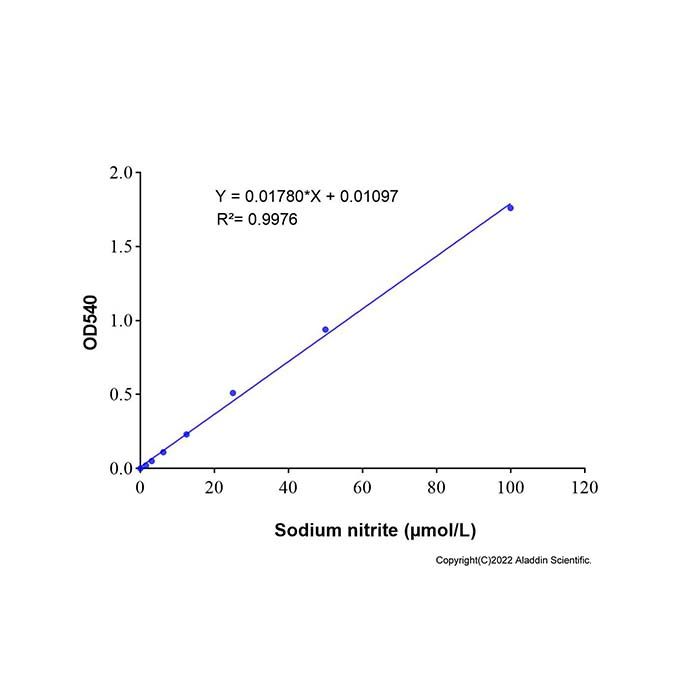
典型标准曲线:

注: 此为典型标准曲线,受仪器及操作影响,实际曲线参数会略有偏差。
Nitrites are widely used as color fixatives and preservatives in meat product processing. During processing, nitrites release nitric oxide, which binds with myoglobin in meat to form nitrosomyoglobin, maintaining the ruddy color of meat products. Meanwhile, they can significantly inhibit spoilage bacteria such as Clostridium botulinum, effectively eliminating the risk of botulinum toxin poisoning.
Nitrites pose definite health hazards: acute massive intake can induce acute methemoglobinemia. In the acidic gastric environment without blocking agents such as vitamin C, nitrites tend to react with secondary amines and amides in food to generate N-nitroso compounds, and long-term exposure increases the risk of digestive tract cancers.
This kit adopts the classic Griess spectrophotometric method stipulated in national standards. Under acidic conditions, nitrites undergo diazotization reaction with sulfanilic acid, followed by coupling reaction with N-(1-naphthyl) ethylenediamine dihydrochloride to form characteristic purplish-red azo dyes, which have maximum absorption at a wavelength of 540 nm. Within the linear range of 1.563-100 μM, the absorbance difference of the chromogenic system is proportional to nitrite concentration. Trace and accurate quantification of nitrites in food samples can be achieved via the standard curve method.
This kit is only for scientific research purposes and shall not be used for clinical diagnosis or other applications.
Precautions
1. Kit reagents contain carcinogenic aromatic amines and toxic nitrites. All operations must be carried out in a fume hood. Wear a lab coat, nitrile gloves and safety goggles throughout the experiment, and avoid direct skin contact with any reagents.
2. The entire chromogenic incubation process must be protected from light to prevent photodegradation of azo dyes and resultant test deviation. If the sample absorbance value is excessively high, reduce the sample weight or dilute the supernatant, and convert the dilution factor in the final calculation. For high-fat and heavily pigmented samples, remove matrix interference via activated carbon decolorization and n-hexane degreasing.
3. A preliminary test is recommended before formal detection using samples with markedly high and low concentrations to verify the extraction and chromogenic system. Do not mix kit components with reagents from other brands to avoid cross-interference and compromised accuracy.
Storage Unit No. | Storage Unit Name | Component No. | Component Name | Appearance | 50T | Storage | Quantity Per Test |
N1521784NT | Food Nitrite Assay Kit (NED, Colorimetric method) (RT Components) | N1521784A | Extraction Solution I | Colorless clear liquid | 50 mL | Room temperature. | As needed |
|
| N1521784B | Extraction Solution II | Yellow liquid | 50 mL | Room temperature. | As needed |
|
| N1521784C | Extraction Solution III | Colorless clear liquid | 50 mL | Room temperature | As needed |
|
| N1521784D | Activated Carbon | Black solid | 0.1 g | Room temperature. | As needed |
N1521784WT | Food Nitrite Assay Kit (NED, Colorimetric method) (2-8℃ Components) | N1521784E | Reagent I | Colorless clear liquid | 25 mL | 2-8℃. Protect from light. | 325 µL |
|
| N1521784F | Reagent II | Colorless clear liquid | 25 mL | 2-8℃. Protect from light. | 325 µL |
|
| N1521784G | NaNO₂ Standard(1M) | Colorless clear liquid | 2.5 mL | 2-8℃. | 350 µL |
Instructions for Use
1. Materials Preparation
Additional materials required:
(1) Instruments: Microplate reader or visible spectrophotometer capable of measuring absorbance at 540 nm.
(2) Consumables: 96-well microplate, ice maker, centrifuge, water bath.
2. Reagent Composition and Storage
(1) Extraction Solution I: Ready-to-use, store at room temperature. It is a saturated solution; slight precipitation is normal. Shake thoroughly before use.
(2) Extraction Solution II: Ready-to-use, store at room temperature.
(3) Extraction Solution III: Ready-to-use, store at room temperature.
(4) Activated Carbon: Ready-to-use, store at room temperature.
(5) Reagent I: Ready-to-use, equilibrate to room temperature before use; store at 4 °C protected from light.
(6) Reagent II: Ready-to-use, equilibrate to room temperature before use; store at 4 °C protected from light.
(7) Standard Curve Preparation
Dilute 1 M sodium nitrite stock solution to 100 μM with deionized water. Serially dilute the 100 μM working standard solution to 50, 25, 12.5, 6.25, 3.125 and 1.563 μM with deionized water as shown in the table below.
No. | Volume of Standard Solution | Volume of Deionized Water (μL) | Concentration (μM) |
Std.1 | 800 µL of 100 μM NaNO₂ Standard | 0 | 100 |
Std.2 | 400 µL of Std.1 (100 μM) | 400 | 50 |
Std.3 | 400 µL of Std.2 (50 μM) | 400 | 25 |
Std.4 | 400 µL of Std.3 (25 μM) | 400 | 12.5 |
Std.5 | 400 µL of Std.4 (12.5 μM) | 400 | 6.25 |
Std.6 | 400 µL of Std.5 (6.25 μM) | 400 | 3.125 |
Std.7 | 400 µL of Std.6 (3.125 μM) | 400 | 1.563 |
Std.8 | 0 | 800 | 0 |
Note 1: Reagent II and sodium nitrite standards are toxic. All dilutions and operations should be performed in a fume hood.
Note 2: A standard curve must be generated for each independent experiment. Diluted standard solutions are unstable and must be used within 4 hours after preparation.
3. Sample Pretreatment
Weigh approximately 0.2 g fresh sample or 0.05 g dry sample and fully homogenize. Add 0.5 mL Extraction Solution I, tightly cap the centrifuge tube and heat in a boiling water bath for 15 minutes, then cool to room temperature. Add 0.5 mL Extraction Solution II and vortex to mix thoroughly. Add another 0.5 mL Extraction Solution III, introduce approximately 1 mg activated carbon with tweezers and mix well. Keep the mixture protected from light at ambient temperature for 30 minutes. Centrifuge at 8000×g and 25 °C for 15 minutes, then carefully collect the middle clear supernatant for subsequent detection.
Note 1: Tighten the tube cap during boiling water bath incubation to avoid solvent evaporation and deviation in total extraction volume.
Note 2: Viscosity increase after adding Extraction Solution II and III is normal and will not affect decolorization or centrifugation. For deeply colored samples, the dosage of activated carbon can be increased to 2-3 mg, but avoid excessive addition which may adsorb nitrite and lead to underreported results. If the supernatant remains turbid after centrifugation, re-centrifuge under identical conditions for another 10 minutes before sampling.
4. Experimental Procedures
(1) Preheat the microplate reader or visible spectrophotometer for 30 minutes and set the wavelength to 540 nm. Zero the visible spectrophotometer with deionized water.
(2) Reaction System Setup (Operate in a 96-well microplate or micro quartz cuvette).
Reagent | Test Well (μL) | Standard Well (μL) | Blank Well (μL) |
Sample Supernatant | 350 | 0 | 0 |
Sodium Nitrite Working Standard | 0 | 350 | 0 |
Deionized Water | 0 | 0 | 350 |
Reagent I | 325 | 325 | 325 |
Reagent II | 325 | 325 | 325 |
Mix gently, incubate at 25 °C in the dark for 15 minutes, and zero the spectrophotometer with deionized water. Measure absorbance at 540 nm, recorded as Atest, Astandard and Ablank.
Calculate corrected absorbance:
ΔAtest = Atest − Ablank
ΔAstd = Astandard − Ablank
Note: Blank wells and standard series only need to be tested once per run. Run a preliminary test with 2-3 samples with expected large concentration differences before formal testing.
If ΔAtest <0.001, appropriately increase the sample weighing mass.
If ΔAtest >1.0, serially dilute the supernatant with deionized water for re-testing, and multiply the final result by the dilution factor n.
5. Result Calculation
Two equivalent formulas are provided below. The simplified bold formula is recommended for final calculation.
(1) Standard Curve Plotting
Plot the standard curve with nitrite concentration on the Y-axis and corrected absorbance ΔA<sub>std</sub> on the X-axis. Substitute ΔA<sub>test</sub> into the linear equation to solve for concentration y (unit: μM).
(2) Calculation of Nitrite Content in Samples
NO₂⁻ (μg/g) = y × Vtotal × 46 ÷ 1000 ÷ W × n = 0.069 × y ÷ W × n
Parameter Explanation:
y: Nitrite concentration of sample extract calculated from standard curve, unit: μM
Vtotal: Total extraction volume = 1.5 mL;
46: Relative molecular mass of nitrite ion (NO₂⁻), g/mol;
1000: Volume conversion factor (1 L = 1000 mL);
W: Weighed sample mass, unit: g;
n: Supernatant dilution factor (n = 1 if undiluted).
6. Results Presentation
Typical Standard Curve:
%20%E4%B8%BB%E5%9B%BE.jpg)
Note: This is a typical standard curve, actual curve parameters may vary slightly due to instrument and operation differences.

 ZJ26F0939413

 危险品化学品经营许可证(带存储)