
计算溶液所需的质量、体积或浓度。
为什么选择此级别
提供 ≥99% 纯度,适用于对基线干扰要求严格的色谱和分析工作流程。
储存与运输
2-8°C储存。低温运输 。请查阅批次 COA 获取详细规格。
质量文档
SDS、COA、产品数据表及规格说明书均可下载。可通过批号查询获取批次 COA。
文献证明
在色谱分析、有机合成和交叉偶联反应领域已被 0 篇同行评审文献引用。
概述
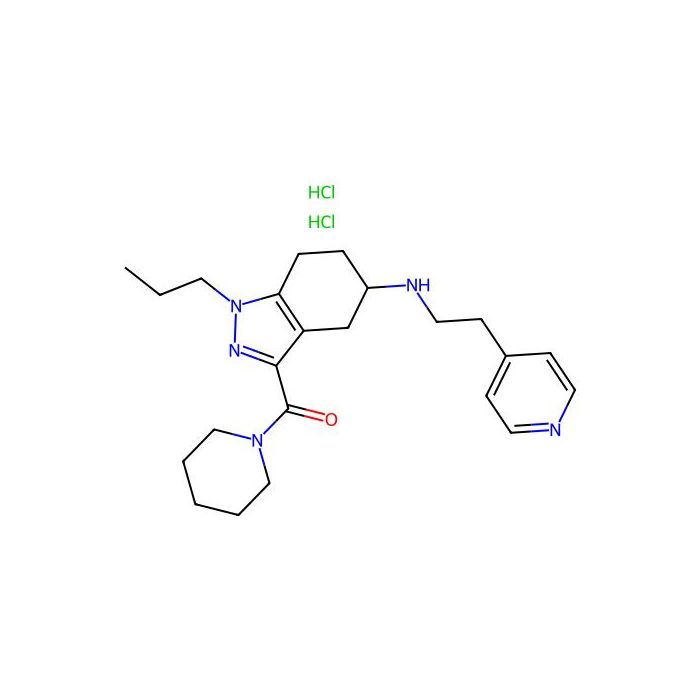
NUCC-390 dihydrochloride is a novel and selective small-molecule CXCR4 receptor agonist. NUCC-390 dihydrochloride induces internalization of CXCR4 receptors and acts in an opposite way of AMD3100 NUCC-390 dihydrochloride promotes nerve recovery of function after neurodegeneration in vivo .
In Vitro
NUCC-390 dihydrochloride (10 μM) produces strong (Ca)i response, but this effect can be blocked by the known potent and selective CXCR4 antagonist AMD3100. NUCC-390 dihydrochloride (10 μM; pre-treatment 30 mins) leads to increased levels of pERK, it has the capability of stimulating signaling activity downstream of CXCR4 receptors. NUCC-390 dihydrochloride (10 μM; 2 hours) can induce CXCR4 receptor internalization, and non-treated cells exhibit some diffuse expression of CXCR4-YFP throughout the cytosol and clear expression in the cell membrane in HEK cells. NUCC-390 dihydrochloride (0-1.25 μM; 24 hours) boosts axonal growth in cultured cerebellar granule neurons (CGNs) via CXCR4. MCE has not independently confirmed the accuracy of these methods. They are for reference only. Western Blot AnalysisCell Line: C8161 cells Concentration: 10 μM Incubation Time: Pre-treated 30 mins Result: Increased the level of pERK. Cell Proliferation AssayCell Line: Cerebellar granule neurons (CGNs) Concentration: 0 μM; 0.0625 μM; 0.25 μM; 1.25 μM Incubation Time: 24 hours Result: Stimulated axonal growth via CXCR4.
In Vivo
NUCC-390 dihydrochloride (hind limb injection; 3.2 mg/kg; twice daily; 3 days) contributes to the functional and anatomical recovery of the neuromuscular junction (NMJ) following an acute nerve terminal damage by α-LTx in CD-1 mice. MCE has not independently confirmed the accuracy of these methods. They are for reference only. Animal Model: Six to eight-week-old CD1 miceDosage: 3.2 mg/kg Administration: Hind limb injection; twice daily; 3 days Result: Promoted functional and anatomical recovery of the NMJ.
Form:Solid
IC50& Target:CXCR4
规格
别名
NUCC-390 二盐酸盐
规格或纯度
≥99%
英文名称
NUCC-390 dihydrochloride
生化机理
NUCC-390 二盐酸盐是一种新型选择性小分子 CXCR4 受体激动剂。NUCC-390 二盐酸盐可诱导 CXCR4 受体内化,其作用方式与 AMD3100 ( HY-10046 ) 相反。NUCC-390 二盐酸盐促进神经
储存条件
2-8°C储存
运输条件
低温运输
作用类型
激动剂
纯度
≥99%
名称和识别符
分子类型
小分子
分子量
468.46
技术文档
高级数据
化学和物理性质
溶解性
DMSO : 100 mg/mL (213.47 mM; Need ultrasonic) H2O : 25 mg/mL (53.37 mM; Need ultrasonic)
质检证书(CoA,COO,BSE/TSE 和分析图谱)
C of A & Other Certificates(BSE/TSE, COO):
输入批号以搜索分析图谱:
溶液计算器
常见问题
本产品的纯度是多少?
本产品的化学纯度(含量)为 ≥99%。批次的具体数值以分析证书(COA)为准。
本产品应如何储存?
请于2–8 °C条件下保存。需冷藏保存以维持规定的有效期。
本产品如何运输?
本产品采用湿冰冷藏运输。收货后请立即拆包,并按上述储存条件保存。
本产品的 CAS 号、分子式和分子量是多少?
本产品的 CAS 号为 2749281-71-6,分子式为 C23H35Cl2N5O,分子量为 468.46 g/mol。
如何获取批次专用COA?
每个订单都会随附分析证书(COA),您也可以从账户订单历史中下载。如需订购前的COA,请联系您的客户代表,或使用PDP上的"申请COA"按钮——我们将提供代表性批次的COA。
产品仅提供给经过验证的企业、机构和合格的专业人员用于研发。不适用于人类、动物、诊断或治疗。
Copyright © 2023至今 上海阿拉丁生化科技股份有限公司 保留所有权利。


 危险品化学品经营许可证(带存储)