Complement C3 (C3) is the most abundant component of the complement system, with levels in human plasma of ~1.2-1.5 mg/ml. It is central to the activation of both the classical and alternative complement pathways, both of which lead to the proteolytic processing of C3 to C3a and C3b. C3 exists as a heterodimer with molecular masses of 115 kDa and 75 kDa, although it is readily processed to create C3a, C3b or C3c depending on the processed state.
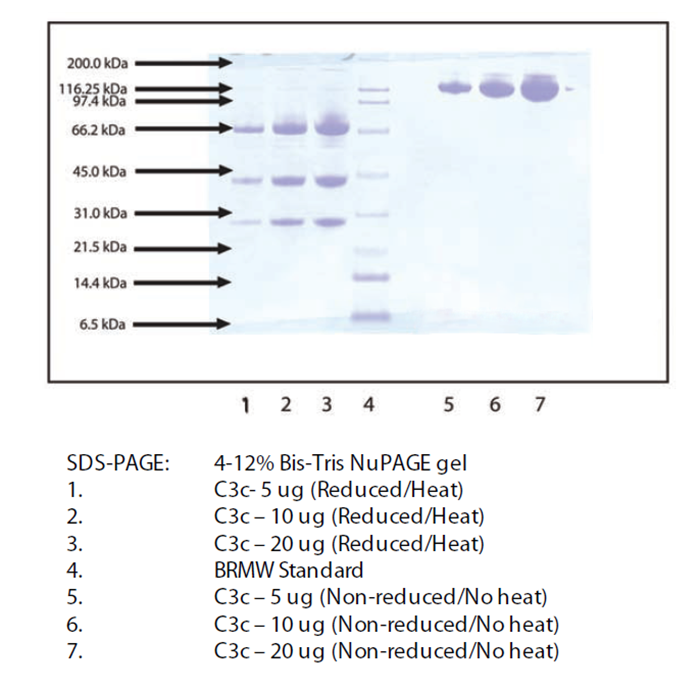
Purity: ≥95% by SDS-PAGE.
Reacts to C3 antisera on Western Blot
Negative against C4 antisera on Western Blot
Not biologically active.
Prepared from plasma shown to be non reactive for HBsAg, anti-HCV, anti-HBc, and negative for anti-HIV 1 & 2 by FDA-required tests.
Precursor of non-enzymatic components of the classical, alternative, lectin and GZMK complement pathways, which consist in a cascade of proteins that leads to phagocytosis and breakdown of pathogens and signaling that strengthens the adaptive immune system.Complement C3b: Non-enzymatic component of C5 convertase. Generated following cleavage by C3 convertase, it covalently attaches to the surface of pathogens, where it acts as an opsonin that marks the surface of antigens for removal. Complement C3b binds covalently via its reactive thioester, to cell surface carbohydrates or immune aggregates. Together with complement C4b, it then recruits the serine protease complement C2b to form the C5 convertase, which cleaves and activate C5, the next component of the complement pathways. In the alternative complement pathway, recruits the serine protease CFB to form the C5 convertase that cleaves and activates C5. C3a anaphylatoxin: Mediator of local inflammatory process released following cleavage by C3 convertase. Acts by binding to its receptor, C3AR1, activating G protein-coupled receptor signaling, promoting the phosphorylation, ARRB2-mediated internalization and endocytosis of C3AR1. C3a anaphylatoxin stimulates the activation of immune cells such as mast cells and basophilic leukocytes to release inflammation agents, such as cytokines, chemokines and histamine, which promote inflammation development. Also acts as potent chemoattractant for the migration of macrophages and neutrophils to the inflamed tissues, resulting in neutralization of the inflammatory triggers by multiple ways, such as phagocytosis and generation of reactive oxidants. Acylation stimulating protein: Adipogenic hormone that stimulates triglyceride synthesis and glucose transport in adipocytes, regulating fat storage and playing a role in postprandial triglyceride clearance. Appears to stimulate triglyceride synthesis via activation of the PLC, MAPK and AKT signaling pathways. Acts by binding to its receptor, C5AR2, activating G protein-coupled receptor signaling, promoting the phosphorylation, ARRB2-mediated internalization and endocytosis of C5AR2. C3-beta-c: Acts as a chemoattractant for neutrophils in chronic inflammation.

 ZJ26F0333009


 危险品化学品经营许可证(带存储)