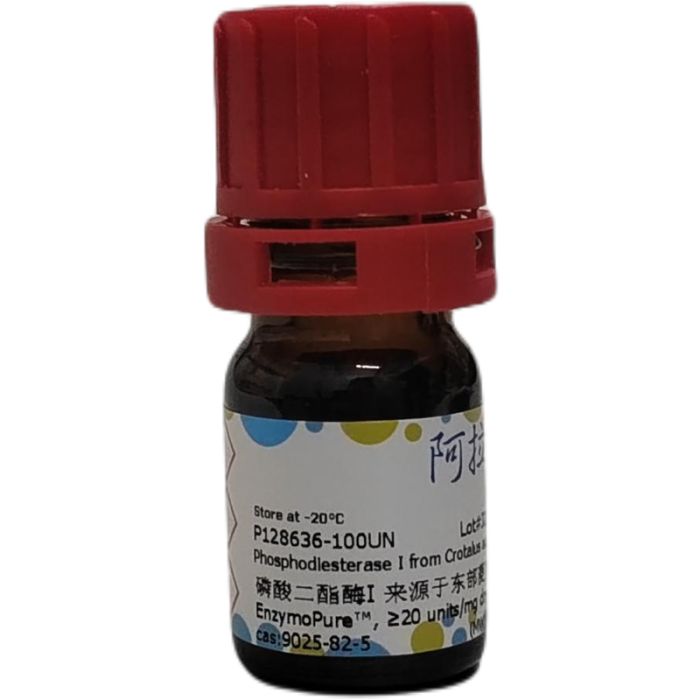
Venom exonuclease (Phosphodiesterase I) successively hydrolyzes 5'-mononucleotides from 3'-OH-terminated ribo- and deoxyribo-oligonucleotides. The enzyme has an optimal pH range of 9.8-10.4 and a molecular weight of 115 kDa. Phosphodiesterase is inhibited by reducing agents such as glutathione, cysteine and ascorbic acids. It is completely inhibited by 5mM EDTA while ATP, ADP and AMP are partial inhibitors. The enzyme has an absolute requirement for Mg²⁺.
The enzyme has been widely utilized as a tool for structural and sequence studies of nucleic acids.
Specificity
The enzyme has been purified by Dolapchiev et al. (1974) and Sulkowski and Laskowski, Sr. (1961) with endonuclease activity being eliminated as well as 5'-nucleotidase and nonspecific monophosphatase.
It is nonspecific with respect to base or sugar moieties of nucleotides. A variety of synthetic substrates are hydrolyzed. Exonuclease will not recognize nucleoside units in the syn conformation.
ADP-ribosylated proteins are cleaved at the pyrophosphate linkages by venom phosphodiesterase to yield phosphoribosyl-AMP.
Composition
A glycoprotein which binds concanavalin A.
Characteristics of Phosphodiesterase I
Molecular Weight: 115,000.
Optimal pH: 9.8-10.4.
Activators: The enzyme has an absolute requirement for Mg²⁺; an optimum concentration of 15 mM.
Inhibitors: Reducing agents such as glutathione, cysteine and ascorbic acid. It is completely inhibited by 5 mM EDTA while ATP, ADP and AMP are partial inhibitors.

 E2625523

 危险品化学品经营许可证(带存储)