储存缓冲液:
20 mM Phosphate buffer, 2%mannitol as protectant, pH7.4.
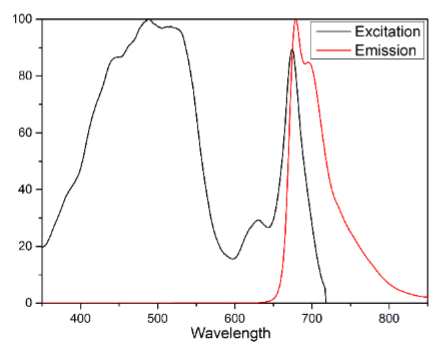
Peridinin-Chlorophyll-Protein(PerCP) 是从甲藻(Dinophyceae sp.)中分离出的分子量35.5 kDa 的多甲藻黄素-叶绿素-蛋白质复合物。它具有较宽的激发光谱,主峰在482 nm处,有较大的斯托克位移,发射最高峰在677 nm处。PerCP及其偶联物是适用于细胞表面标记技术(如流式细胞术)的大型复合物。PerCP-Cy5.5是一种稳定的 488nm激光激发的串联染料。PerCP-Cy5.5可以染色低丰度靶标。 在多色流式细胞仪中,通常可以稳定的检测到Cyanine5.5信号。在双激光管仪器上与APC共同检测时,需要做补偿调节,但比PerCP补偿少。
产品性质
纯度:A482/A280>4.2
激发波长:480nm
发射波长:697nm
形态:溶液
稳定性及储存
储存条件:2-8°C 避光保存,勿冷冻。
稳定性:在适宜条件下至少可以储存6个月。
使用方法
1、抗体的修饰
① 抗体修饰试剂(DTT/TCEP)溶解于 ddH₂O 配制成 2mg/ml 的抗体修饰液。
② 取待标记抗体(纯度 > 90%),用 PBS 缓冲液调整浓度到 5-10mg/ml 左右,按照每 mg 抗体加入 10μl 抗体修饰液,轻轻混匀,在室温下搅拌反应 60-90 分钟。
③ 反应完成后,转移到超滤管内芯,并添加 MES 缓冲液,通过超滤管多次离心置换溶液去除多余抗体修饰试剂,超滤管内芯收集液为修饰完成的抗体,并调节浓度至 1-5mg/ml。
2、PerCP-Cy5.5 串联染料活化
① PerCP-Cy5.5 串联染料用 0.1M PBS(Ph=7.4 5mM EDTA)溶解,浓度 5-10mg/ml。
② 将 SMCC 溶解于无水二甲基亚砜(DMSO)配制成 10mg/ml 的母液
③ 每 mg 的 PerCP-Cy5.5 串联染料添加 18μl 的 SMCC(n (PerCP-Cy5.5):n (SMCC)=1:20),铝箔封好后于室温旋转反应 1h,使 PerCP-Cy5.5 串联染料分子上的氨基与琥珀酰胺反应生成衍生化的 PerCP-Cy5.5 串联染料。
④ 反应完成后,将反应液移至超滤离心管内,于 4℃、5 min、12000 g 下离心并除去滤液,再加入 500μl MES 缓冲液混匀离心;重复此操作 5 次。
⑤ 收集活化的 PerCP-Cy5.5 串联染料溶液。
3、活化的 PerCP-Cy5.5 与抗体偶联
① 用 MES 缓冲液将活化的 PerCP-Cy5.5 浓度调整为 5mg/ml;为了获得 PerCP-Cy5.5 的精确重量,我们建议使用 PerCP 的消光系数作为测量(即 [PerCP-Cy5.5] = 0.086 × A482,其中 [PerCP-Cy5.5] 是以 mg/ml 为单位的浓度,A482 为波长为 482nm 时的吸光值,且控制范围在 0.3~0.8 即可)。
② 将修饰抗体与活化的 PerCP-Cy5.5 按照质量比 2.25:1 比例(每 mg 修饰抗体对应 0.45mg 活化的 PerCP-Cy5.5)混合,室温避光反应 2 小时;
③ 将 NEM 溶解于无水二甲基亚砜(DMSO)配制成 12.5mg/ml 溶液(0.1M),按照每毫克抗体 5ul 的体积 NEM 溶液加入步骤②反应产物中,封闭未反应完的活性基团;
④ 将步骤③溶液加入超滤管通过反复离心去除封闭试剂等;
⑤ 标记好的抗体分装,加入适当保护剂,-20℃保存备用。
注意事项
1. PerCP-Cy5.5 需要避光低温保存,标记过程尽量保证其避光;
2. 封闭剂与修饰剂需现用现配,不能长期保存;
3. 标记的抗体特异性要高,纯度不低于 90%,最好使用单克隆抗体,溶液环境不含游离氨基,最好为 PBS 溶液;标记前抗体需去除 NaN3 和 BSA,抗体的透析、浓缩和浓度测定等操作都会造成抗体量的损失,因此标记前准备抗体时需根据具体情况考虑最适的抗体量;
4. 由于抗体修饰后所带的基团容易被重新氧化,因此修饰后抗体需尽快与 Activated PerCP-Cy5.5 进行偶联。
Peridinin-Chlorophyll-Protein (PerCP) is a peridinin-chlorophyll-protein complex with a molecular weight of 35.5 kDa, isolated from dinoflagellates (Dinophyceae sp.). It has a broad excitation spectrum with a main peak at 482 nm, a large Stokes shift, and an emission peak at 677 nm. PerCP and its conjugates are large complexes suitable for cell surface labeling techniques such as flow cytometry. PerCP-Cy5.5 is a stable tandem dye excited by 488 nm laser. It can stain low-abundance targets. In multicolor flow cytometers, the Cyanine5.5 signal can usually be detected stably. When detected together with APC on dual-laser tube instruments, compensation adjustment is required, but less than that for PerCP.
Product Properties
Purity: A482/A280 > 4.2
Excitation Wavelength: 480 nm
Emission Wavelength: 697 nm
Form: Solution
Stability and Storage
Storage Conditions: Store at 2-8°C in the dark, do not freeze.
Stability: Can be stored for at least 6 months under suitable conditions.
Usage Methods
1. Antibody Modification
① Dissolve antibody modification reagent (DTT/TCEP) in ddH₂O to prepare an antibody modification solution with a concentration of 2 mg/ml.
② Take the antibody to be labeled (purity > 90%), adjust its concentration to approximately 5-10 mg/ml with PBS buffer, add 10 μl of the antibody modification solution per mg of antibody, mix gently, and stir at room temperature for 60-90 minutes.
③ After the reaction is completed, transfer to the inner core of an ultrafiltration tube, add MES buffer, and remove excess antibody modification reagent by repeated centrifugation and solution replacement through the ultrafiltration tube. The collected solution in the inner core of the ultrafiltration tube is the modified antibody, and adjust its concentration to 1-5 mg/ml.
2. Activation of PerCP-Cy5.5 Tandem Dye
① Dissolve PerCP-Cy5.5 tandem dye in 0.1M PBS (pH=7.4, 5mM EDTA) to a concentration of 5-10 mg/ml.
② Dissolve SMCC in anhydrous dimethyl sulfoxide (DMSO) to prepare a mother liquor with a concentration of 10 mg/ml.
③ Add 18 μl of SMCC per mg of PerCP-Cy5.5 tandem dye (n(PerCP-Cy5.5): n(SMCC) = 1:20), seal with aluminum foil, and react at room temperature with rotation for 1 hour to allow the amino groups on the PerCP-Cy5.5 tandem dye molecules to react with succinamide to form derivatized PerCP-Cy5.5 tandem dye.
④ After the reaction is completed, transfer the reaction solution to an ultrafiltration centrifuge tube, centrifuge at 4°C, 12000 g for 5 minutes, remove the filtrate, add 500 μl of MES buffer, mix well and centrifuge; repeat this operation 5 times.
⑤ Collect the activated PerCP-Cy5.5 tandem dye solution.
3. Conjugation of Activated PerCP-Cy5.5 with Antibody
① Adjust the concentration of activated PerCP-Cy5.5 to 5 mg/ml with MES buffer; to obtain the accurate weight of PerCP-Cy5.5, it is recommended to use the extinction coefficient of PerCP for measurement (i.e., [PerCP-Cy5.5] = 0.086 × A482, where [PerCP-Cy5.5] is the concentration in mg/ml, A482 is the absorbance at a wavelength of 482 nm, and the control range is 0.3 ~ 0.8).② Mix the modified antibody and activated PerCP-Cy5.5 at a mass ratio of 2.25:1 (0.45 mg of activated PerCP-Cy5.5 per mg of modified antibody), and react at room temperature in the dark for 2 hours.
③ Dissolve NEM in anhydrous dimethyl sulfoxide (DMSO) to prepare a 12.5 mg/ml solution (0.1M), add NEM solution at a volume of 5 μl per mg of antibody to the reaction product in step ② to block unreacted active groups.
④ Add the solution from step ③ to an ultrafiltration tube and remove blocking reagents, etc., by repeated centrifugation.
⑤ Aliquot the labeled antibody, add an appropriate protectant, and store at -20°C for later use.
Precautions
1. PerCP-Cy5.5 needs to be stored in the dark at low temperature, and try to ensure it is protected from light during the labeling process.
2. Blocking agents and modifiers should be prepared and used immediately and cannot be stored for a long time.
3. The labeled antibody should have high specificity and a purity of not less than 90%. It is best to use monoclonal antibodies, and the solution environment should not contain free amino groups, preferably PBS solution. Before labeling, NaN3 and BSA should be removed from the antibody. Operations such as dialysis, concentration, and concentration determination of the antibody will cause loss of antibody quantity. Therefore, when preparing the antibody before labeling, the optimal amount of antibody should be considered according to specific circumstances.
4. Since the groups carried by the antibody after modification are easily re-oxidized, the modified antibody should be conjugated with Activated PerCP-Cy5.5 as soon as possible.




 危险品化学品经营许可证(带存储)