类黄酮是一类多苯化合物,属于植物次生代谢物,对人体具有消炎,抗菌,降血脂,清除体内羟自由基,预防癌症等作用。
本试剂盒检测原理是在碱性亚硝酸盐溶液中,植物样本中类黄酮与铝离子形成在510 nm处有特征吸收峰的红色络合物,测定样品提取液在 510 nm 处的吸光值,即可计算样品类黄酮含量。
产品组分
P1521803 | 组件 | 物理外观 | 50T | 储存 | 单次测试使用量 |
P1521803A | 试剂A | 液体 | 4 mL | 2-8℃,避光 | 50 μL |
P1521803B | 试剂B | 液体 | 4 mL | 2-8℃ | 50 μL |
P1521803C | 试剂C | 液体 | 30 mL | 2-8℃ | 400 μL |
P1521803D | 标准品(1mg/mL) | 液体 | 1 mL | 2-8℃,避光 | 按需 |
使用方法
1. 需自备试剂
60%乙醇。
2. 样本制备
将样本烘干至恒重,粉碎,过30-50 目筛之后,称取约0.1g,加入1mL 60%乙醇。60℃ 振荡提取2 小时,25℃,10,000 × g 离心10 min,取上清,待测;或者用超声提取法进行提取,即超声功率300W,破碎5s,间歇8s,60℃,提取30min,10,000×g,25℃,离心10min,取上清,用60%乙醇定容至1mL,待测。
注意:60℃振荡提取可用振荡金属浴或水浴(水浴期间适时颠倒混匀)。
3. 标准品的配制
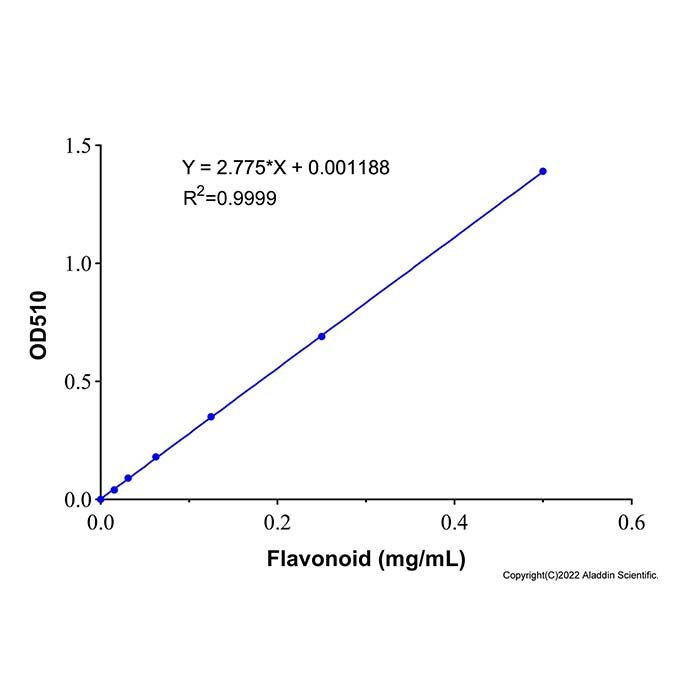
按照下表用60%乙醇将标准品稀释至0.5、0.25、0.125、0.0625、0.0313、0.0156 mg/mL。
Standard 工作液 | 1 | 2 | 3 | 4 | 5 | 6 |
浓度(mg/mL) | 0.5 | 0.25 | 0.125 | 0.0625 | 0.0313 | 0.0156 |
标准品(μL) | 300 | 300 μL of Std.1 | 300 μL of Std.2 | 300 μL of Std.3 | 300 μL of Std.4 | 300 μL of Std.5 |
60%乙醇(μL) | 300 | 300 | 300 | 300 | 300 | 300 |
4. 样本测定
1)按照下表在1.5mL EP管中进行检测体系配制,每个样品都需要设置一个对照管,空白管和标准管一般只做1 次。
试剂名称 | 对照管(μL) | 测定管(μL) | 标准管(μL) | 空白管(μL) |
待测样本 | 200 | 200 | - | - |
不同浓度Std. | - | - | 200 | - |
60%乙醇 | - | - | - | 200 |
试剂A | 50 | 50 | 50 | 50 |
混匀,室温静置5min |
试剂B | - | 50 | 50 | 50 |
混匀,室温静置5min |
试剂C | 400 | 400 | 400 | 400 |
60%乙醇 | 350 | 300 | 300 | 300 |
混匀,室温静置15min |
2)吸光度检测:比色杯光径1cm,用空白管调零,分光光度计测定各管510 nm 处吸光值A,分别记为A对照、A测定、A标准。
5. 结果计算
计算ΔA测定=A测定-A对照。以标准品浓度为X轴,A标准为Y轴,绘制标准曲线y=kx+b。将ΔA测定代入方程得到x值(mg/mL)。按照如下公式计算样本类黄酮含量。
1)按样本质量计算
类黄酮含量(mg/g)=x×V提取÷W×n
2)按样本蛋白浓度计算
类黄酮含量(mg/g)=x×V提取÷(Cpr×V提取)×n=x÷Cpr×n
V提取:加入提取液体积,1mL;W:样本质量,g;n:样本稀释倍数;Cpr:样本蛋白质浓度,mg/mL。
注意事项
1. 为了您的安全和健康,请穿实验服并戴乳胶手套操作。
2. 显色完成后应立即测定,2 小时后吸光值会下降。
3. 正式检测前,建议选择 2-3 个预期差异较大的样本进行预实验。
Flavonoids are a class of polyphenolic compounds and belong to the secondary metabolites of plants. They have anti-inflammatory, antibacterial, lipid-lowering, free radical scavenging, and cancer-preventing effects on the human body.
The detection principle of this kit is that in an alkaline nitrite solution, flavonoids in plant samples form a red complex with aluminum ions, which has a characteristic absorption peak at 510 nm. By measuring the absorbance value of the sample extract at 510 nm, the content of flavonoids in the sample can be calculated.
Kit Contents
P1521803 | Components | Appearance | 50T | Storage | Quantity Per Test |
P1521803A | Reagent A | Liquid | 4 mL | 2-8℃, dark | 50 μL |
P1521803B | Reagent B | Liquid | 4 mL | 2-8℃ | 50 μL |
P1521803C | Reagent C | Liquid | 30 mL | 2-8℃ | 400 μL |
P1521803D | Standard Solution (1 mg/mL) | Liquid | 1 mL | 2-8℃, dark | As needed |
Instructions for Use
1. Reagents to be prepared by yourself
60% ethanol.
2. Sample preparation
Dry the sample to a constant weight, crush it, pass it through a 30-50 mesh sieve, and then weigh approximately 0.1g. Add 1mL of 60% ethanol. Extract by shaking at 60℃ for 2 hours, then centrifuge at 10,000 × g for 10 minutes at 25℃. Take the supernatant for testing; or use ultrasonic extraction, that is, with an ultrasonic power of 300W, break for 5 seconds, rest for 8 seconds, extract at 60℃ for 30 minutes, then centrifuge at 10,000 × g for 10 minutes at 25℃. Take the supernatant and dilute to 1mL with 60% ethanol for testing.
Note: Shaking extraction at 60℃ can be done in a shaking metal bath or water bath (mix by inverting the tube at appropriate intervals during the water bath).
3. Preparation of standards
Dilute the standards with 60% ethanol to concentrations of 0.5, 0.25, 0.125, 0.0625, 0.0313, and 0.0156 mg/mL according to the table below.
Standard working solution | 1 | 2 | 3 | 4 | 5 | 6 |
Concentration (mg/mL) | 0.5 | 0.25 | 0.125 | 0.0625 | 0.0313 | 0.0156 |
Standard solution (μL) | 300 | 300 μL of Std.1 | 300 μL of Std.2 | 300 μL of Std.3 | 300 μL of Std.4 | 300 μL of Std.5 |
60% ethanol (μL) | 300 | 300 | 300 | 300 | 300 | 300 |
4. Sample Measurement
1) Prepare the detection system in 1.5 mL EP tubes according to the table below. Each sample should have a corresponding control tube. The blank tube and standard tube are usually prepared only once.
Reagent name | Control tube (μL) | Analysis tube (μL) | Standard tube (μL) | Blank tube (μL) |
Sample to be tested | 200 | 200 | - | - |
Different concentrations of Std. | - | - | 200 | - |
60% ethanol | - | - | - | 200 |
Reagent A | 50 | 50 | 50 | 50 |
Mix well, incubate at room temperature for 5 minutes |
Reagent B | - | 50 | 50 | 50 |
Mix well, incubate at room temperature for 5 minutes |
Reagent C | 400 | 400 | 400 | 400 |
60% ethanol | 350 | 300 | 300 | 300 |
Mix well, incubate at room temperature for 15 minutes |
2)The optical path of the colorimeter cuvette is 1 cm. The zero point is adjusted using the blank tube. The absorbance A at 510 nm of each tube is measured by the spectrophotometer and recorded as A control, A test, and A standard respectively.
5. Result calculation
Calculate ΔA test = A test - A control. Plot a standard curve with the standard concentration on the X-axis and A standard on the Y-axis in the form of y = kx + b. Substitute ΔA test into the equation to obtain the x value (mg/mL). Calculate the sample flavonoid content according to the following formula.
1) Calculation based on sample mass
Flavonoid content (mg/g) = x × V extraction ÷ W × n
2) Calculation based on sample protein concentration
Flavonoid content (mg/g) = x × V extraction ÷ (Cpr × V extraction) × n = x ÷ Cpr × n
V extraction: Volume of extraction solution added, 1 mL; W: Sample mass, g; n: Sample dilution factor; Cpr: Sample protein concentration, mg/mL.
Precautions
1. For your safety and health, please wear a lab coat and latex gloves when operating.
2. The absorbance value will decrease after 2 hours once the color development is completed. Therefore, it is recommended to measure immediately after the color development is finished.
3. Before the formal test, it is suggested to conduct a pre-experiment with 2-3 samples that are expected to have significant differences.

 ZJ26F0636430


 危险品化学品经营许可证(带存储)