
 J2409502
计算溶液所需的质量、体积或浓度。
为什么选择此级别
提供 ≥95% 纯度,适用于对基线干扰要求严格的色谱和分析工作流程。
储存与运输
2-8°C储存,充氩。低温运输 。请查阅批次 COA 获取详细规格。
质量文档
SDS、COA、产品数据表及规格说明书均可下载。可通过批号查询获取批次 COA。
文献证明
在色谱分析、有机合成和交叉偶联反应领域已被 0 篇同行评审文献引用。
概述
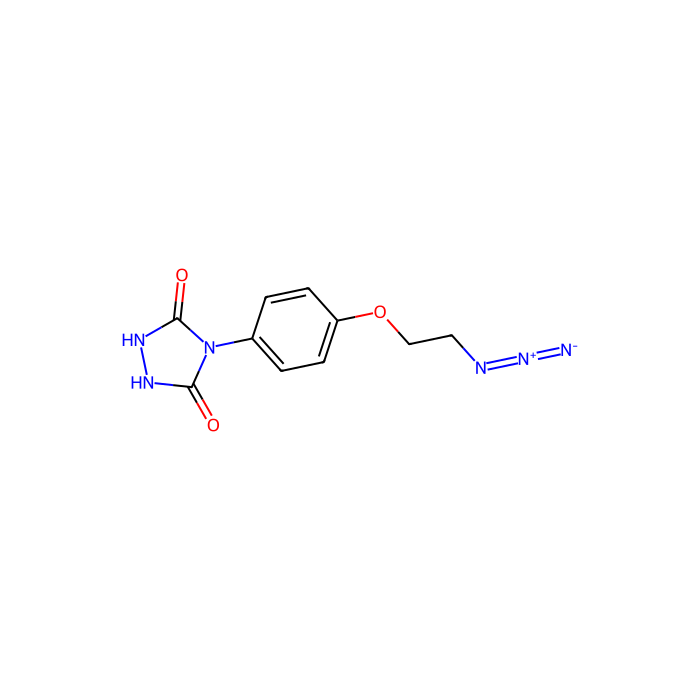
PTAD-叠氮化物(4-(4-(2-叠氮乙氧基)苯基)-1,2,4-三唑烷-3,5-二酮)是1,2,4-三唑烷-3,5-二酮衍生物。它可以由肼基甲酸乙酯制备。
应用
PTAD-叠氮化物可用于制备4-(4-(2-叠氮乙氧基)苯基)-3H-1,2,4-三唑-3,5(4H)-二酮和aplaviroc-尿唑。 最近,通过电化学酪氨酸点击(e-Y-CLICK)化学在肽和蛋白质的无痕化学选择性标记中证明了这种尿唑。
PTAD-叠氮化物是一种选择性交联剂,其一端用于与酪氨酸反应,另一端用于呈现叠氮化物。与酪氨酸生物偶联后,叠氮化物可以通过Cu(I)催化的点击化学反应与炔烃反应,或者在无铜反应中与环辛炔反应。已显示该试剂可选择性地将聚乙二醇或PEG链引入具有表面暴露的酪氨酸残基的蛋白质上。PTAD-叠氮化物也已用于抗体-药物偶联物的形成。本试剂与PBS、Tris及混合PBS/Tris缓冲液(首选)等不同缓冲系统相容。已显示与酪氨酸的连接对pH值和极端温度以及血浆稳定。
注意
必须首先通过与1,3-二溴-5,5-二甲基海因(产品#157902)以1:0.98摩尔比搅拌来激活PTAD-叠氮化物。当溶液颜色从无色变为深红色时,活化很明显,且应立即使用活化试剂。
用PTAD修饰蛋白的一般程序。
第1部分:PTAD激活
在有机溶剂(首选溶剂为DMF或乙腈,避免使用DMSO)中将1:0.98摩尔当量的未活化PTAD与1,3-二溴-5,5-二甲基海因(产品#157902)混合在一起
观察到颜色从无色/浅黄色变为深红色(混合约5分钟)。
溶液变红后,将现已活化的试剂储存在冰上,并在30分钟内用于蛋白修饰。
第2部分:蛋白修饰
将混合磷酸盐/Tris缓冲液或Tris缓冲液(pH值应为6-9)中的蛋白溶液添加到含有上述制备的活化PTAD试剂的eppendorf管(或其他小瓶)中,并在室温下轻轻混合30分钟。优选使用相对于蛋白10倍摩尔过量的试剂。使用最小值浓度为1mg/ml的蛋白(增强标记首选较高浓度)。
通过凝胶过滤去除过量的未反应的PTAD。
PTAD-Azide (4-(4-(2-Azidoethoxy)phenyl)-1,2,4-triazolidine-3,5-dione) is a 1,2,4-triazolidine-3,5-dione derivative. It can be prepared from ethyl hydrazinecarboxylate.
Note
PTAD-Azide must be first activated by stirring in a 1:0.98 molar ratio with 1,3-dibromo-5,5-dimethylhydantoin (product # 157902). Activation is evident upon solution color change from colorless to deep red and the activated reagent should be used immediately.
General Procedure for Protein Modification with PTAD.
Part 1: PTAD activation
Mix together 1:0.98 molar equivalents of unactivated PTAD to 1,3-dibromo-5,5-dimethylhydantoin (product # 157902) in organic solvent (preferred solvents are DMF or acetonitrile, avoid using DMSO)
Color change is observed from colorless/pale yellow to deep red (approximately 5 min of mixing).
After the solution turns red, store the now activated reagent on ice and use for protein modification within 30 min.
Part 2: Protein modification
Add protein solution in mixed phosphate/Tris buffer or Tris buffer (pH should be 6 - 9) to the eppendorf tube (or other vial) containing the activated PTAD reagent prepared above and mix gently at room temperature for up to 30 min. Preferably use 10-fold molar excess of reagent relative to protein. Use protein at a minimum concentration of 1 mg/ml (higher concentrations are preferred for enhanced labeling).
Remove excess unreacted PTAD by gel filtration.
PTAD-Azide may be used in the preparation of 4-(4-(2-azidoethoxy)phenyl)-3H-1,2,4-triazole-3,5(4H)-dione and aplaviroc-urazole.This urazole was recently demonstrated in the traceless, chemoselective labeling of peptides and proteins through electrochemical tyrosine-click (e-Y-CLICK) chemistry.
规格
英文别名
N₃₋Ph-Ur for e-Y-CLICK, 4-(4-(2-Azidoethoxy)phenyl)-1,2,4-triazolidine-3,5-dione
规格或纯度
≥95%
英文名称
PTAD-Azide
应用
PTAD-Azide is a selective crosslinking reagent that has one end for reacting with tyrosine and the other end for presenting an azide. After bioconjugation to tyrosine, the azide can be reacted with an alkyne through the Cu(I)-catalyzed click chemistry reaction or with a cyclooctyne in a copper-free reaction. This reagent has been shown to selectively introduce poly(ethylene glycol) or PEG chains onto proteins with surface exposed tyrosine residues. PTAD-Azide has also been used in the formation of antibody-drug conjugates. This reagent is compatible with different buffer systems such as PBS, Tris and mixed PBS/Tris buffer (preferred). The linkage with tyrosine has been shown to be stable to pH and temperature extremes as well as blood plasma.
储存条件
2-8°C储存,充氩
运输条件
低温运输
纯度
≥95%
名称和识别符
分子类型
小分子
INCHI
1S/C10H10N6O3/c11-15-12-5-6-19-8-3-1-7(2-4-8)16-9(17)13-14-10(16)18/h1-4H,5-6H2,(H,13,17)(H,14,18)
InChi Key
MHGMHPVYCVQIET-UHFFFAOYSA-N
Smiles
O=C(NNC1=O)N1C2=CC=C(OCCN=[N+]=[N-])C=C2
分子量
262.22
技术文档
高级数据
三维结构
交互式化学结构模型
化学和物理性质
敏感性
对热敏感;对湿度敏感
闪点(℉)
Not applicable
闪点(℃)
Not applicable
安全和危险性(GHS)
RIDADR
NONH for all modes of transport
质检证书(CoA,COO,BSE/TSE 和分析图谱)
C of A & Other Certificates(BSE/TSE, COO):
输入批号以搜索分析图谱:
溶液计算器
产品仅提供给经过验证的企业、机构和合格的专业人员用于研发。不适用于人类、动物、诊断或治疗。
Copyright © 2023至今 上海阿拉丁生化科技股份有限公司 保留所有权利。


 危险品化学品经营许可证(带存储)