
计算溶液所需的质量、体积或浓度。
为什么选择此级别
提供 ≥99% 纯度,适用于对基线干扰要求严格的色谱和分析工作流程。
储存与运输
-20°C储存。超低温运输 。请查阅批次 COA 获取详细规格。
质量文档
SDS、COA、产品数据表及规格说明书均可下载。可通过批号查询获取批次 COA。
文献证明
在色谱分析、有机合成和交叉偶联反应领域已被 0 篇同行评审文献引用。
概述
PK11007 is a mild thiol alkylator with anticancer activity. PK11007 stabilizes p53 via selective alkylation of two surface-exposed cysteines without compromising its DNA binding activity. PK11007 induces mutant p53 cancer cell death by increasing reactive oxygen species (ROS) levels.
In Vitro
PK11007 (0-120 µM; 24 hours; four p53 wild-type cell lines and fours p53 mutant cell lines) treatment results in a large viability reduction in mutant p53 cell lines MKN1 (V143A), HUH-7 (Y220C), NUGC-3 (Y220C), and SW480 (R273H/P309S) at concentrations ranging from 15 to 30 µM. PK11007 induces mainly caspase-independent cell death. PK11007 (0-60 µM; 3 hours or 6 hours; NUGC-4, NUGC-3, MKN1, HUH-6, and HUH-7 cancer cells) treatment up-regulates protein levels of the p53 target genes p21, MDM2, and PUMA in a mostly concentration-dependent manner in NUGC-3 (p53-Y220C), HUH-7 (p53-Y220C) and MKN1 (p53-V143A) cells, suggesting partial restoration of transcriptional activity to destabilized p53 mutants. PK11007 also increases p53 activity in HUH-6 and NUGC-4 cells, as indicated by the increase of MDM2, PUMA, and p21 protein levels. PK11007 (15-20 µM; 4.5 hours or 6 hours; MKN1, HUH-7, NUGC-3, HUH-6 cells) treatment increases transcription of p53 target genes in three mutant p53 cell lines after 6-h treatment. PUMA and p21 mRNA levels are up-regulated by a factor of 2 upon treatment of NUGC-3, MKN, and HUH-7 cells, as well as NOXA for the latter two. MDM2 levels are halved in MKN1 and NUGC-3 cells. PK11007 viability reduction is potentiated by glutathione depletion. To test whether PK11007 also increases ROS levels, NUGC-3, NUGC-4, HUH-6, HUH-7, and MKN1 cells with PK11007 are incubated for 2 h. There are elevated ROS levels in all cell lines after 2 h. In the mutant p53 cells MKN1, HUH-7, and NUGC-3, however, the ROS increase is higher at 60 µM PK11007 than in NUGC-4 and HUH-6 cells, suggesting that the higher PK11007 sensitivity of the mutant p53 cell lines is mediated by a stronger ROS induction. Basal and PK11007-induced ROS levels in MKN1 cells are at least twofold higher than in other cell lines. PK11007 inhibits cell proliferation, induces apoptosis and alters genes involved in cell death are all consistent with the ability of PK11007 to reactivate mutant p53. MCE has not independently confirmed the accuracy of these methods. They are for reference only. Cell Viability AssayCell Line: p53 wild-type cell lines (WI-38, HUH-6, NUGC-4, SJSA-1) and p53 mutant cell lines (HUH-7, NUGC-3, SW480, MKN1) Concentration: 0 μM, 20 μM, 40 μM, 60 µM, 80 µM, 100 µM and 120 µM Incubation Time: 24 hours Result: There was a large viability reduction in mutant p53 cell lines MKN1 (V143A), HUH-7 (Y220C), NUGC-3 (Y220C), and SW480 (R273H/P309S) and in p53 WT cell line SJSA-1 at concentrations ranging from 15 to 30 µM. The p53 WT cancer cell lines HUH-6, NUGC-4 and WI-38 were less sensitive with reduced cell viability only at high concentrations of compound (60 and 120 µM). Western Blot AnalysisCell Line: NUGC-4, NUGC-3, MKN1, HUH-6, and HUH-7 cancer cells Concentration: 0 μM, 15 μM, 30 μM, 60 µM Incubation Time: 3 hours or 6 hours Result: Up-regulated protein levels of the p53 target genes p21, MDM2, and PUMA in a mostly concentration-dependent manner in NUGC-3 (p53-Y220C), HUH-7 (p53-Y220C) and MKN1 (p53-V143A) cells. Also increased p53 activity in HUH-6 and NUGC-4 cells, as indicated by the increase of MDM2, PUMA, and p21 protein levels. RT-PCRCell Line: MKN1, HUH-7, NUGC-3, HUH-6 cells Concentration: 15 μM, 20 μM Incubation Time: 4.5 hours or 6 hours Result: Increased transcription of p53 target genes in three mutant p53 cell lines after 6-h treatment. PUMA and p21 mRNA levels were up-regulated by a factor of 2 upon treatment of NUGC-3, MKN, and HUH-7 cells, as well as NOXA for the latter two. MDM2 levels were halved in MKN1 and NUGC-3 cells.
Form:Solid
规格
规格或纯度
≥99%
英文名称
PK11007
生化机理
PK11007 是一种具有抗癌活性的温和硫醇烷化剂。PK11007 通过选择性地烷基化两个表面暴露的半胱氨酸来稳定 p53,而不会影响其 DNA 结合活性。PK11007 可通过增加活性烷基化半胱氨酸来诱导突变 p53 癌细胞死亡。
储存条件
-20°C储存
运输条件
超低温运输
作用类型
激活剂
纯度
≥99%
名称和识别符
分子类型
小分子
IUPAC Name
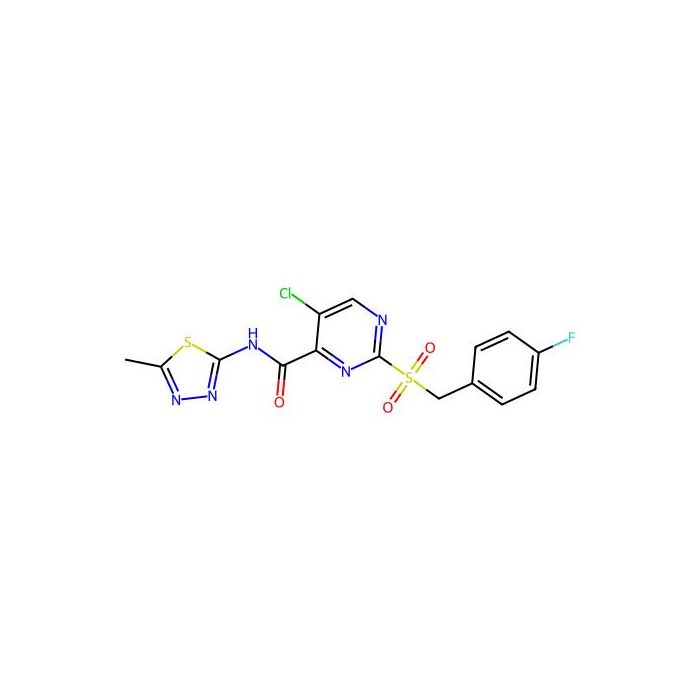
5-chloro-2-[(4-fluorophenyl)methylsulfonyl]-N-(5-methyl-1,3,4-thiadiazol-2-yl)pyrimidine-4-carboxamide
INCHI
1S/C15H11ClFN5O3S2/c1-8-21-22-14(26-8)20-13(23)12-11(16)6-18-15(19-12)27(24,25)7-9-2-4-10(17)5-3-9/h2-6H,7H2,1H3,(H,20,22,23)
InChi Key
IVZQUWCWXYFPOQ-UHFFFAOYSA-N
Smiles
CC1=NN=C(S1)NC(=O)C2=NC(=NC=C2Cl)S(=O)(=O)CC3=CC=C(C=C3)F
Isomeric SMILES
CC1=NN=C(S1)NC(=O)C2=NC(=NC=C2Cl)S(=O)(=O)CC3=CC=C(C=C3)F
PubChem CID
分子量
427.9
技术文档
高级数据
系统学分类
分类树(Taxonomy Tree)
| 界(kingdom) | 有机化合物 |
|---|---|
| 超类(Superclass) | 有机杂环化合物 |
| 类(Class) | 二嗪类 |
| 亚类(Subclass) | 嘧啶和嘧啶衍生物 |
| 中间层级节点(Intermediate Tree Nodes) | 嘧啶羧酸及其衍生物 |
| 直接上位类(Direct Parent) | 嘧啶酰胺类 |
| 其他上位类(Alternative Parents) | 卤代嘧啶 氟苯类 N-酰胺 乙烯基卤化物 噻二唑类 砜类 二级酮亚胺 杂芳族化合物 氟乙烯 氯乙烯 亚磺酰基化合物 炔丙基型1,3-偶极有机化合物 氟烯烃 氯烯烃 羧酸酰胺 氮杂环化合物 有机光子化合物 有机氧化合物 有机氟化物 有机氯化物 有机氧化物 碳氢化合物衍生物 |
| 分子骨架(Molecular Framework) | 芳香族杂单环化合物 |
| 取代基(Substituents) | 芳香族杂单环化合物 - 氮杂环 - 吡唑 - 苯基化合物 - 羧酰胺基 - 羧酸衍生物 - 氯代烯烃 - 氟萘 - 氟萘 - 卤代乙烯 - 卤苯 - 卤代嘧啶 - 杂芳香族化合物 - 烃衍生物 - 单环苯基基团 - N-酰胺基胺 - 有机1,3-双极性化合物 - 有机硝基化合物 - 有机氧化物 - 有机氧化合物 - 有机氯化物 - 有机氟化物 - 有机卤化物 - 有机氮化合物 - 有机氧化合物 - 有机氮化合物 - 有机硫化合物 - 丙炔型1,3-双极性有机化合物 - 嘧啶甲酰胺 - 醛酮亚胺 - 硫酰基化合物 - 磺酰基 - 磺酰基 - 噻二唑 - 氯乙烯 - 乙烯基氟化物 - 乙烯基卤化物 - 乙烯醯基鹵化物 |
| 描述(Description) | 该化合物属于嘧啶羧酰胺类有机化合物。这类化合物含有嘧啶环,且该环上连接有羧酰胺基团。 |
| 外部描述符(External Descriptors) | 暂无 |
三维结构
交互式化学结构模型
化学和物理性质
溶解性
DMSO : 250 mg/mL (584.30 mM; Need ultrasonic)
分子量
427.900 g/mol
XLogP3
2.300
氢键供体数Hydrogen Bond Donor Count
1
氢键受体数Hydrogen Bond Acceptor Count
9
可旋转键计数Rotatable Bond Count
5
精确质量Exact Mass
426.998 Da
单同位素质量Monoisotopic Mass
426.998 Da
拓扑极表面积Topological Polar Surface Area
151.000 Ų
重原子数Heavy Atom Count
27
形式电荷Formal Charge
0
复杂度Complexity
629.000
同位素原子数Isotope Atom Count
0
定义的原子立体中心计数Defined Atom Stereocenter Count
0
未定义的原子立体中心计数Undefined Atom Stereocenter Count
0
定义的键立体中心计数Defined Bond Stereocenter Count
0
未定义的键立体中心计数Undefined Bond Stereocenter Count
0
所有立体化学键的总数The total count of all stereochemical bonds
0
共价键合单元计数Covalently-Bonded Unit Count
1
质检证书(CoA,COO,BSE/TSE 和分析图谱)
C of A & Other Certificates(BSE/TSE, COO):
输入批号以搜索分析图谱:
溶液计算器
常见问题
本产品的纯度是多少?
本产品的化学纯度(含量)为 ≥99%。批次的具体数值以分析证书(COA)为准。
本产品应如何储存?
请于?20 °C条件下保存。需冷冻保存以维持规定的有效期。
本产品如何运输?
本产品采用保温箱配冰袋运输。收货后请立即拆包,并按上述储存条件保存。
本产品的 CAS 号、分子式和分子量是多少?
本产品的 CAS 号为 874146-69-7,分子式为 C15H11ClFN5O3S2,分子量为 427.9 g/mol。InChIKey IVZQUWCWXYFPOQ-UHFFFAOYSA-N。
如何获取批次专用COA?
每个订单都会随附分析证书(COA),您也可以从账户订单历史中下载。如需订购前的COA,请联系您的客户代表,或使用PDP上的"申请COA"按钮——我们将提供代表性批次的COA。
产品仅提供给经过验证的企业、机构和合格的专业人员用于研发。不适用于人类、动物、诊断或治疗。
Copyright © 2023至今 上海阿拉丁生化科技股份有限公司 保留所有权利。


 危险品化学品经营许可证(带存储)