
计算溶液所需的质量、体积或浓度。
为什么选择此级别
提供 ≥99% 纯度,适用于对基线干扰要求严格的色谱和分析工作流程。
储存与运输
2-8°C储存,干燥。低温运输 。请查阅批次 COA 获取详细规格。
质量文档
SDS、COA、产品数据表及规格说明书均可下载。可通过批号查询获取批次 COA。
文献证明
在色谱分析、有机合成和交叉偶联反应领域已被 0 篇同行评审文献引用。
概述
Pexidartinib hydrochloride (PLX-3397 hydrochloride) is a potent, orally active, selective, and ATP-competitive colony stimulating factor 1 receptor (CSF1R or M-CSFR) and c-Kit inhibitor, with IC 50 s of 20 and 10 nM, respectively. Pexidartinib hydrochloride exhibits 10- to 100-fold selectivity for c-Kit and CSF1R over other related kinases. Pexidartinib hydrochloride induces cell apoptosis and has anti-cancer activity
In Vitro
Pexidartinib hydrochloride (PLX-3397 hydrochloride) is a potent, selective and ATP-competitive CSF1R (cFMS) and c-Kit inhibitor, shows 10- to 100-fold selectivity for c-Kit and CSF1R over other related kinases, such as FLT3, KDR (VEGFR2), LCK, FLT1 (VEGFR1) and NTRK3 (TRKC), with IC 50 s of 160, 350, 860, 880, and 890 nM, respectively. MCE has not independently confirmed the accuracy of these methods. They are for reference only.
In Vivo
Pexidartinib hydrochloride (0.25, 1 mg/kg, i.p., twice daily for 8 days) inhibits the proliferation of microglia and BrdU-positive cells in neonatal mice. Pexidartinib hydrochloride (1 mg/kg, twice daily for 8 day) shows no obvious effect on the cleaved caspase-3-positive cells in mice. Pexidartinib hydrochloride (50 mg/kg; p.o.; every second day for 3 weeks) reduces tissue macrophage levels without affecting glucose homeostasis in mice. MCE has not independently confirmed the accuracy of these methods. They are for reference only. Animal Model: Neonatal miceDosage: 0.25, 1 mg/kg Administration: I.P. twice daily for 8 days Result: Decreased the number of microglia and BrdU-positive proliferative cells, but did not change the cleaved caspase-3-positive cells. Animal Model: 10-week old litter mate C57BL/6 mice (chow and high-fat diet fed mice)Dosage: 50 mg/kg Administration: P.o.; every second day for 3 weeks Result: Substantially reduced macrophage numbers in adipose tissue of both chow and high-fat diet fed mice without affecting total myeloid cell levels.
Form:Solid
IC50& Target:IC50: 10 nM (c-Kit), 20 nM (cFMS), 160 nM (FLT3), 350 nM (KDR), 860 nM (LCK), 880 nM (FLT1), 890 nM (NTRK3)
规格
别名
盐酸培西达替尼
英文别名
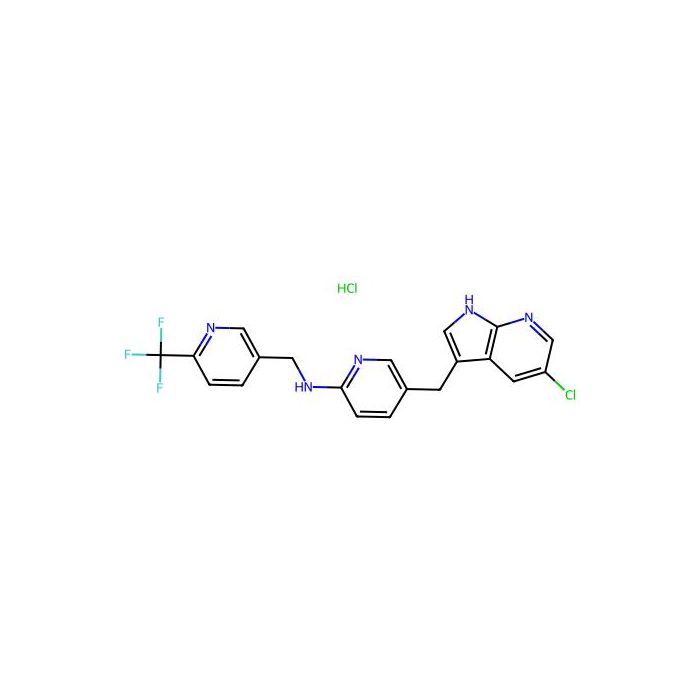
AZASETRON HYDROCHLORIDE [MART.] | Pexidartinib HCl | 5-[(5-Chloro-1H-pyrrolo[2,3-b]pyridin-3-yl)methyl]-N-[[6-(trifluoromethyl)pyridin-3-yl]methyl]pyridin-2-amine hydrochloride;5-[(5-Chloro-1H-pyrrolo[2,3-b]pyridin-3-yl)methyl]-N-[[6-(trifluoromethyl)pyri
规格或纯度
≥99%
英文名称
Pexidartinib hydrochloride
生化机理
盐酸培昔达替尼(PLX-3397 盐酸盐)是一种强效、口服活性、选择性和 ATP 竞争性集落刺激因子 1 受体(CSF1R 或 M-CSFR)和 c-Kit 抑制剂,IC 50 s 分别为 20 和 10 nM。Pexidartinib hydrochlori
储存条件
2-8°C储存,干燥
运输条件
低温运输
作用类型
抑制剂
作用机制
干细胞生长因子受体抑制剂
纯度
≥99%
名称和识别符
分子类型
小分子
IUPAC Name
5-[(5-chloro-1H-pyrrolo[2,3-b]pyridin-3-yl)methyl]-N-[[6-(trifluoromethyl)pyridin-3-yl]methyl]pyridin-2-amine;hydrochloride
INCHI
1S/C20H15ClF3N5.ClH/c21-15-6-16-14(10-28-19(16)29-11-15)5-12-2-4-18(26-7-12)27-9-13-1-3-17(25-8-13)20(22,23)24;/h1-4,6-8,10-11H,5,9H2,(H,26,27)(H,28,29);1H
InChi Key
CJLUYLRKLUYCEK-UHFFFAOYSA-N
Smiles
C1=CC(=NC=C1CC2=CNC3=C2C=C(C=N3)Cl)NCC4=CN=C(C=C4)C(F)(F)F.Cl
Isomeric SMILES
C1=CC(=NC=C1CC2=CNC3=C2C=C(C=N3)Cl)NCC4=CN=C(C=C4)C(F)(F)F.Cl
关联CAS
PubChem CID
MeSH Entry Terms
5-((5-chloro-1H-pyrrolo(2,3-b)pyridin-3-yl)methyl)-N-((6-(trifluoromethyl)pyridin-3-yl)methyl)pyridin-2-amine;pexidartinib;pexidartinib hydrochloride;PLX3397;Turalio
分子量
454.3
技术文档
高级数据
系统学分类
分类树(Taxonomy Tree)
| 界(kingdom) | 有机化合物 |
|---|---|
| 超类(Superclass) | 有机杂环化合物 |
| 类(Class) | 吡咯并吡啶 |
| 亚类(Subclass) | 暂无 |
| 中间层级节点(Intermediate Tree Nodes) | 暂无 |
| 直接上位类(Direct Parent) | 吡咯并吡啶 |
| 其他上位类(Alternative Parents) | 氨基吡啶及其衍生物 取代吡咯 咪唑内酰胺类 芳基氯化物 杂芳族化合物 氮杂环化合物 有机氟化物 有机氯化物 盐酸盐 碳氢化合物衍生物 胺类 烷基氟化物 |
| 分子骨架(Molecular Framework) | 芳香族杂多环化合物 |
| 取代基(Substituents) | 氟化烷基 - 烷基溴化物 - 氨基酸 - 氨基吡啶 - 芳香族杂多环化合物 - 芳基氯化物 - 芳基卤化物 - 氮杂环 - 杂芳香族化合物 - 烃衍生物 - 氟氯烃 - 咪唑内酰胺 - 有机硝基化合物 - 有机氯化物 - 有机氟化物 - 有机卤化物 - 有机氮化合物 - 吡啶 - 吡咯 - 吡咯吡嗪 - 取代吡咯 |
| 描述(Description) | 该化合物属于吡咯吡啶类有机化合物。这类化合物含有吡咯吡啶结构单元,即吡咯环与吡啶环共轭的结构。吡咯是由四个碳原子和一个氮原子构成的五元环,吡啶则是由五个碳原子和一个氮原子构成的六元环。 |
| 外部描述符(External Descriptors) | 暂无 |
三维结构
交互式化学结构模型
化学和物理性质
溶解性
DMSO : 60 mg/mL (132.08 mM; Need ultrasonic) H2O : <0.1 mg/mL (ultrasonic) (insoluble)
分子量
454.300 g/mol
XLogP3
氢键供体数Hydrogen Bond Donor Count
3
氢键受体数Hydrogen Bond Acceptor Count
7
可旋转键计数Rotatable Bond Count
5
精确质量Exact Mass
453.073 Da
单同位素质量Monoisotopic Mass
453.073 Da
拓扑极表面积Topological Polar Surface Area
66.500 Ų
重原子数Heavy Atom Count
30
形式电荷Formal Charge
0
复杂度Complexity
537.000
同位素原子数Isotope Atom Count
0
定义的原子立体中心计数Defined Atom Stereocenter Count
0
未定义的原子立体中心计数Undefined Atom Stereocenter Count
0
定义的键立体中心计数Defined Bond Stereocenter Count
0
未定义的键立体中心计数Undefined Bond Stereocenter Count
0
所有立体化学键的总数The total count of all stereochemical bonds
0
共价键合单元计数Covalently-Bonded Unit Count
2
安全和危险性(GHS)
质检证书(CoA,COO,BSE/TSE 和分析图谱)
C of A & Other Certificates(BSE/TSE, COO):
输入批号以搜索分析图谱:
溶液计算器
常见问题
本产品的纯度是多少?
本产品的化学纯度(含量)为 ≥99%。批次的具体数值以分析证书(COA)为准。
本产品应如何储存?
请于2–8 °C、干燥条件下保存。请与干燥剂一同密封保存,本品对湿气敏感。
本产品如何运输?
本产品采用湿冰冷藏运输。收货后请立即拆包,并按上述储存条件保存。
本产品的 CAS 号、分子式和分子量是多少?
本产品的 CAS 号为 2040295-03-0,分子式为 C20H16Cl2F3N5,分子量为 454.3 g/mol。InChIKey CJLUYLRKLUYCEK-UHFFFAOYSA-N。
如何获取批次专用COA?
每个订单都会随附分析证书(COA),您也可以从账户订单历史中下载。如需订购前的COA,请联系您的客户代表,或使用PDP上的"申请COA"按钮——我们将提供代表性批次的COA。
产品仅提供给经过验证的企业、机构和合格的专业人员用于研发。不适用于人类、动物、诊断或治疗。
Copyright © 2023至今 上海阿拉丁生化科技股份有限公司 保留所有权利。


 危险品化学品经营许可证(带存储)