离子交换层析法(Ion Exchange Chromatography,IEC)是以离子交换配基为固 定相,依据流动相中的组分离子与固定相平衡离子可逆交换时结合力差异而进行 分离的一种层析方法。离子交换层析法分辨率高、工作容量大且易于操作,现已 成为分离纯化生化制品、蛋白质、多肽等物质中使用最频繁的纯化技术之一。离 子交换层析介质主要由三部分组成:交联的网状骨架,即母体结构;固定在骨架 上的功能基团;与功能基团带相反电荷、可移动、能进行交换的活动离子。
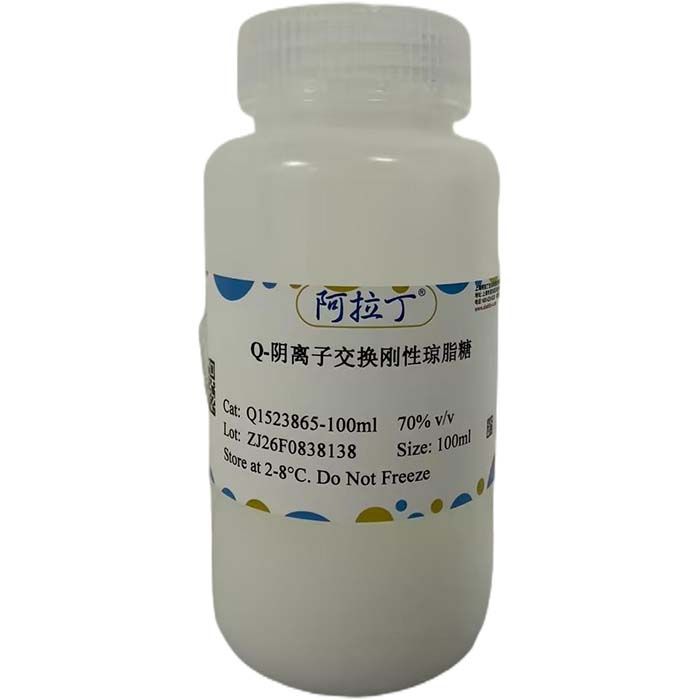
Q-阴离子交换刚性琼脂糖以高刚性琼脂糖微球为基质,平均粒径 75 μm,经过化学改构和修饰而成的,具有更好的机械性能, 在高流速条件下呈现较高动态结合载量,能在较短时间内处理大体积的样品。
本品特性为高刚性, 高流速,高耐压、低反压,常用于生物分子的捕获和中间纯化阶段,易于 进行大规模生产。
阿拉丁Q-阴离子交换刚性琼脂糖储存在20%乙醇 中,凝胶和保护液的体积比为7:3,我司产品规格为实际凝胶的体积。
参数 | 指标 |
基质 | 高刚性琼脂糖 |
配基 | 季氨基 |
平均粒径 | 75μm |
离子载量 | 160-220 μmol Cl -/mL介质 |
建议流速 | <600 cm/h |
建议压力 | <0.5 MPa(5 bar) |
工作 pH 范围① | 2-12 |
pH 稳定性 | 2-12(长期); 2-14(短期)② |
化学稳定性 | 常用缓冲液中稳定,如 1 M NaCl、1 M NaOH、6 M 盐酸胍、8 M 尿素、70% 乙醇、30%异丙醇等 |
储存 | 20%乙醇,2~8℃ |
保质期 | 5年 |
注:
① 工作 pH 范围,指在层析介质稳定前提下,实现分离纯化功能的 pH 范围。
② 长期,指介质在很长时间内保持稳定而不对其后续性能产生不利影响 的 pH 范围。短期,指根据经验给出的介质再生、在位清洗和消毒的 pH 范围。
使用说明
1、装柱
1.1 装柱缓冲液准备
纯化水,超声脱气15min。
1.2 层析介质准备
计算所需层析介质的量(压缩系数约为1.15),并称取备用。用真空抽滤瓶置 换至装柱缓冲液中。置换的介质加入一定量装柱缓冲液,制成约 50%浓度的胶悬 液。
1.3 层析柱准备
层析柱准备 检查层析柱,确保各部件完整、干净。安装下柱头,拧紧O型圈后,将层析柱垂 直固定在铁架台上,用水平仪检查并调整使层析柱保持竖直。用注射器吸取装柱 缓冲液,接于柱底的出口处,缓慢推出注射器内液体,排除底部筛网的气泡,取 下注射器后拧上堵头。层析柱中加入约2cm 高的装柱缓冲液。
1.4 装柱(以直径 16mm,床高 10cm 的层析柱为例)
混匀胶悬液,用玻璃棒引流缓慢倒入层析柱中,若液面离柱顶还有空隙,加装柱 缓冲液充满。将调节器连接至层析系统,启动泵以一定流速排除管路及顶部筛网 中的气泡后暂停。将调节器沿 45°放入柱中,固定好调节器并拧紧密封圈,注 意避免气泡进入。拧开层析柱底部的堵头,将底部管路放入到废液缸中,流速设 为60cm/h,至介质界面无变化后,设置流速为600cm/h,维持该流速 45min, 用记号笔在界面处做好标记,暂停系统。拧上底部堵头,层析柱上端与泵断开, 稍拧松调节器上的密封圈,将柱头压到胶面以下2mm 处,拧紧密封圈。将层析 柱顶部和底部管路连接到层析系统上,进行柱效测定。
2、柱效检测
完成装柱后、使用前可通过柱效测定和评价可以确认层析柱装填质量。柱效通常用理论塔板高度(HETP)和非对称因子(As)来评价。柱效测定可以采用丙酮或者NaCl 作为样品进行,按照下表配制样品溶液和流动相。
样品 | 1.0%丙酮 | 0.8 M NaCl |
样品体积 | 1.0%柱体积 | 1.0%柱体积 |
流动相 | 纯水 | 0.4 M NaCl |
流速 | 30 cm/h | 30 cm/h |
检测器 | UV-280 nm | 电导 |
根据UV或者电导率曲线计算理论塔板高度(HETP)、理论塔板数(N)和非对称因子(As),公式如下:
HETP = L / N
N = 5.54 × (VR / Wh )2
As = a / b
其中:L为柱高; VR为保留体积;Wh为半高峰宽;a为在10%峰高处的第一个半峰宽;b为在10%峰高处的第二个半峰宽。
一般来说,HETP的数值应小于填料平均粒径的三倍(即HETP/D50<3,D50为填料的平均粒径),As应在0.8~1.5之间。
3、分离纯化
3.1 柱平衡
将层析柱连接至纯化设备,使用结合缓冲液冲洗3-5CV 以上,至层析柱流出液 pH、电导同结合缓冲液的 pH、电导一致。平衡结束后将紫外归零。
3.2 加载样品
经 0.22/0.45 μm 过滤后的样品溶液加载在离子交换层析柱上,上样体积取决 于层析介质载量、样本溶液中与介质结合分子的浓度和其他层析条件。
3.3 柱冲洗
使用结合缓冲液冲洗3-5CV,将该条件下不与介质结合的杂质洗去(至 UV 280 检测值回归基线附近)。或根据前期实验确定的杂质淋洗条件进行柱冲洗。
3.4 洗脱
使用洗脱缓冲液冲洗层析柱,目标紫外峰升起后开始收集洗脱样品。
3.5 清洗和保存
用 1-2M NaCl 清洗 5CV,去除可逆结合的杂质,然后用纯化水冲洗至流出液电 导为0,最后用20%乙醇冲洗 2-3CV。 保存温度在2~8 ℃为宜,不可冻存。
4、在位清洗
在位清洗(Cleaning In Place,CIP)是去除层析介质上强结合的、沉淀的或者 变性的物质。杂质残留将会影响层析柱的层析性能。如果聚集严重,将会堵塞层 析柱,加大反压并减慢流速。所以定期的在位清洗能够防止污染物在柱床聚集, 有助于保持介质的载量,流速等。 层析柱使用 3-5 个循环后需进行 CIP,以恢复介质性能。通常使用无机盐、酸、 碱或有机溶剂等进行清洗,对于不同类型的杂质和污染物建议清洗条件如下:
4.1 去除离子交换作用吸附的杂质:用2-3CV 的2M NaCl 溶液清洗层析柱,然 后用3-5CV 纯化水冲洗层析柱。
4.2 去除蛋白沉淀、疏水性杂质:用 1M NaOH 浸泡层析柱1h以上,然后用5-10CV 纯化水冲洗层析柱。
4.3 去除强结合的疏水性杂质:用 3-5CV 的 70%乙醇或者 30%异丙醇冲洗层析柱 (15-20 min),然后用3-5 CV纯化水冲洗层析柱。
4.4 去除核酸:用中性缓冲液冲洗 1-2CV 后,以 pH3.0 的0.1M 乙酸清洗2-5CV, 再用1M NaOH,反向清洗 15-30min。 清洗后如果立即使用,用结合缓冲液冲洗 3-10CV 即可。
5、 消毒灭菌
消毒灭菌是为了将层析柱中的微生物污染降至最低。本品可使用 NaOH 溶液作为消毒剂。NaOH 溶液可有效去除病毒、细菌、酵母及 内毒素,运行成本极低。消毒步骤为:
5.1 使用结合缓冲液将层析柱冲洗3-5CV。
5.2 使用 0.5 M NaOH 溶液对层析柱冲洗2-5CV。
5.3 使用 0.5-1 M NaOH 溶液对层析柱浸泡 1 h。
5.4 使用 pH 在 7-8 之间的结合缓冲液冲洗层析柱 5-10 CV 后即完成消毒过程。
注意事项: 层析柱污染程度严重时,使用混有 30-40%丙醇的 0.5 M NaOH进行清洗。 高浓度NaOH或长时间NaOH处理会降低介质载量,消毒时要注意清洗浓度和时间。
6. 保存
未使用的介质应当保存在 2-8 ℃的干燥、通风、洁净环境中,确保容器口完全 密闭,切记不可冷冻。 已装填的层析柱 应当使用含0.2 M乙酸钠的 20%乙醇或 2%苯甲醇浸泡密封保存,防止微生 物污染。
7. 线性放大
在实验室规模优化后的纯化工艺,可以线性放大到中试或生产规模。在放大过程 中需要注意以下事项:
保持停留时间不变,保证动态载量的稳定。
根据需要的结合能力选择层析柱容积,如果柱高改变需要注意是否对纯化步骤产 生影响。
根据流速需求确定层析柱直径,根据已知的停留时间确定柱床高度,一般推荐 10-25 cm。
保证样品浓度均匀一致,洗脱条件一致。
Ion Exchange Chromatography (IEC) is a chromatographic separation method that uses ion exchange ligands as the stationary phase, and separates components based on the difference in binding affinity during the reversible exchange between component ions in the mobile phase and counterions on the stationary phase. With high resolution, large working capacity and easy operation, IEC has now become one of the most widely used purification technologies for the separation and purification of biochemical products, proteins, polypeptides and other substances.Ion exchange chromatography media are mainly composed of three parts: a crosslinked network skeleton (i.e., the matrix structure); functional groups immobilized on the skeleton; and mobile counterions with opposite charge to the functional groups, which are movable and capable of ion exchange.
Q Anion Exchange Rigid Agarose is based on high-rigidity agarose microspheres with an average particle size of 75 μm, and is prepared through chemical modification and functionalization. It has superior mechanical properties, exhibits high dynamic binding capacity under high flow rate conditions, and can process large-volume samples in a short time.
This product features high rigidity, high flow rate tolerance, high pressure resistance and low back pressure. It is commonly used in the capture and intermediate purification stages of biomolecules, and is suitable for easy scale-up to large-scale production.
Aladdin Q Anion Exchange Rigid Agarose is stored in 20% ethanol, with a volume ratio of gel to storage solution of 7:3. The product specification of our company refers to the actual volume of the gel.
Table 1 Product Specifications of Q Anion Exchange Rigid Agarose
Parameter | Specification | Matrix | High-rigidity Agarose | Ligand | Quaternary | Mean particle size | 75μm | Ion Capacity | 160-220 μmol Cl- /mL medium | Recommended Flow Rate | <600 cm/h | Recommended Pressure | <0.5 MPa (5 bar) | Working pH Range ① | 2-12 | pH Stability | 2-12 (Long-term) 2-14 (Short-term)② | Chemical Stability | Stable in common buffers, such as 1 M NaCl, 1 M NaOH, 6 M guanidine hydrochloride, 8 M urea, 70% ethanol, 30% isopropanol, etc. | Storage | 20% ethanol, 2~8℃ | Shelf Life | 5 years |
|
Notes:
① Working pH range: the pH range within which the separation and purification function can be achieved under the premise of stable chromatography medium.
② Long-term pH range: the pH range within which the medium remains stable for a long time without adverse effects on its subsequent performance. Short-term pH range: the empirically determined pH range for medium regeneration, cleaning in place and sanitization.
Instructions for Use
1. Column Packing
1.1 Preparation of Packing Buffer
Purified water, subjected to ultrasonic degassing for 15 minutes.
1.2 Preparation of Chromatography Medium
Calculate the required amount of chromatography medium (compression factor is approximately 1.15), weigh and set aside. Perform buffer exchange into the packing buffer using a vacuum filter flask. Add a certain amount of packing buffer to the exchanged medium to prepare a slurry with a concentration of approximately 50%.
1.3 Preparation of Chromatography Column
Inspect the chromatography column to ensure all components are intact and clean. Install the bottom column end fitting, tighten the O-ring, then vertically fix the chromatography column on an iron stand. Check and adjust the column with a spirit level to ensure it is perfectly vertical. Draw the packing buffer into a syringe, connect it to the outlet at the bottom of the column, slowly push out the liquid in the syringe to remove air bubbles from the bottom frit. Remove the syringe and screw on the end cap. Add packing buffer to the column to a height of approximately 2 cm.
1.4 Column Packing (taking a chromatography column with 16 mm inner diameter and 10 cm bed height as an example)
Mix the slurry thoroughly, and slowly pour it into the chromatography column guided by a glass rod. If there is a gap between the liquid level and the top of the column, fill it with packing buffer. Connect the flow adapter to the chromatography system, start the pump at a certain flow rate to remove air bubbles from the tubing and the top frit, then pause. Place the flow adapter into the column at a 45° angle, fix it in place and tighten the seal ring, taking care to avoid air bubbles entering. Unscrew the end cap at the bottom of the chromatography column, place the bottom tubing into the waste container, set the flow rate to 60 cm/h. After the medium interface remains unchanged, set the flow rate to 600 cm/h and maintain this flow rate for 45 minutes. Mark the interface with a marker pen and pause the system. Screw on the bottom end cap, disconnect the upper end of the column from the pump, slightly loosen the seal ring on the flow adapter, press the column end fitting to 2 mm below the gel surface, and tighten the seal ring. Connect the top and bottom tubing of the chromatography column to the chromatography system for column efficiency test.
2. Column Efficiency Test
After column packing is completed and before use, the packing quality of the chromatography column can be confirmed through column efficiency measurement and evaluation. Column efficiency is usually evaluated by the Height Equivalent to a Theoretical Plate (HETP) and the Asymmetry factor (As). Acetone or NaCl can be used as the sample for column efficiency measurement, and the sample solution and mobile phase are prepared according to the following table.
Table 2 Solution Preparation for Column Efficiency Test
| Test Sample | Sample Solution Preparation | Mobile Phase Preparation | Detection Method |
|---|
| Acetone | 0.1% (v/v) acetone in purified water | Purified water | UV detection at 280 nm | | NaCl | 0.8 M NaCl in purified water | Purified water | Conductivity detection |
|
|
Calculate the Height Equivalent to a Theoretical Plate (HETP), number of theoretical plates (N) and Asymmetry factor (As) according to the UV or conductivity curve, using the following formulas:
HETP = L / N
N = 5.54 × (VR / Wh )2
As = a / b
Where: L is the column height; VR is the retention volume; Wh is the peak width at half height; a is the first half peak width at 10% of the peak height; b is the second half peak width at 10% of the peak height.In general, the HETP value should be less than three times the average particle size of the packing material (i.e., HETP/D50 < 3, where D50 is the average particle size of the packing material), and As should be between 0.8 and 1.5.
3. Separation and Purification
3.1 Column Equilibration
Connect the chromatography column to the purification equipment, and rinse with binding buffer for more than 3-5 column volumes (CV) until the pH and conductivity of the column effluent are consistent with those of the binding buffer. Zero the UV detector after equilibration is completed.
3.2 Sample Loading
Load the sample solution filtered through 0.22/0.45 μm membrane onto the ion exchange chromatography column. The loading volume depends on the binding capacity of the chromatography medium, the concentration of the molecules bound to the medium in the sample solution, and other chromatographic conditions.
3.3 Column Washing
Rinse with binding buffer for 3-5 CV to remove impurities that do not bind to the medium under this condition (until the UV 280 detection value returns to near the baseline). Alternatively, perform column washing according to the impurity elution conditions determined in previous experiments.
3.4 Elution
Rinse the chromatography column with elution buffer, and start collecting the eluted sample when the target UV peak rises.
3.5 Washing and Storage
Wash with 1-2 M NaCl for 5 CV to remove reversibly bound impurities, then rinse with purified water until the conductivity of the effluent is 0, and finally rinse with 20% for 2-3 CV. Store the chromatography column in an environment at 2-8℃.Do not freeze.
4. Cleaning In Place (CIP)
Cleaning In Place (CIP) is the process of removing strongly bound, precipitated or denatured substances from the chromatography medium. Residual impurities will affect the chromatographic performance of the column. Severe aggregation will clog the chromatography column, increase back pressure and reduce flow rate. Therefore, regular CIP can prevent the accumulation of contaminants in the column bed and help maintain the binding capacity and flow rate of the medium.CIP should be performed after the chromatography column has been used for 3-5 cycles to restore the medium performance. Inorganic salts, acids, bases or organic solvents are usually used for cleaning. The recommended cleaning conditions for different types of impurities and contaminants are as follows:
4.1 Removal of impurities adsorbed by ion exchange
Wash the chromatography column with 2-3 CV of 2 M NaCl solution, then rinse the column with 3-5 CV of purified water.
4.2 Removal of protein precipitates and hydrophobic impurities
Soak the chromatography column in 1 M NaOH for more than 1 hour, then rinse the column with 5-10 CV of purified water.
4.3 Removal of strongly bound hydrophobic impurities
Rinse the chromatography column with 3-5 CV of 70% ethanol or 30% isopropanol for 15-20 minutes, then rinse the column with 3-5 CV of purified water.
4.4 Removal of nucleic acids
After rinsing with 1-2 CV of neutral buffer, wash with 2-5 CV of 0.1 M acetic acid at pH 3.0, then perform reverse flow washing with 1 M NaOH for 15-30 minutes. If the column is to be used immediately after cleaning, simply rinse with binding buffer for 3-10 CV.
5. Sanitization and Sterilization
Sanitization and sterilization are performed to minimize microbial contamination in the chromatography column. NaOH solution can be used as a disinfectant for this product. NaOH solution can effectively remove viruses, bacteria, yeast and endotoxins with extremely low operating costs. The sanitization steps are as follows:
5.1 Rinse the chromatography column with binding buffer for 3-5 CV.
5.2 Rinse the chromatography column with 0.5 M NaOH solution for 2-5 CV.
5.3 Soak the chromatography column in 0.5-1 M NaOH solution for 1 hour.
5.4 Rinse the chromatography column with binding buffer with pH between 7 and 8 for 5-10 CV to complete the sanitization process.
Precautions: When the chromatography column is severely contaminated, use 0.5 M NaOH mixed with 30-40% propanol for cleaning. High concentration of NaOH or prolonged NaOH treatment will reduce the binding capacity of the medium. Please pay attention to the cleaning concentration and time during sanitization.
6. Storage
Unused medium should be stored in a dry, ventilated and clean environment at 2-8 ℃, ensure the container mouth is completely sealed, and never freeze. Pre-packed chromatography columns should be soaked and sealed in 20% ethanol or 2% benzyl alcohol for storage to prevent microbial contamination.
7. Linear Scale-up
The optimized purification process at laboratory scale can be linearly scaled up to pilot or production scale. The following points should be noted during the scale-up process:
Keep the residence time unchanged to ensure the stability of the dynamic binding capacity.
Select the column volume according to the required binding capacity. If the column height is changed, pay attention to whether it will affect the purification steps.
Determine the column diameter according to the flow rate requirement, and determine the bed height according to the known residence time. The recommended bed height is generally 10-25 cm.
Ensure the sample concentration is uniform and consistent, and the elution conditions are the same.

 ZJ26F0838139


 危险品化学品经营许可证(带存储)