Measured by its ability to cleave Bis (p-Nitrophenyl) Phosphate (BPNPP). The specific activity is >8,000 pmol/min/μg, as measured under the described conditions.
Hydrolyzes lysophospholipids to produce lysophosphatidic acid (LPA) in extracellular fluids. Major substrate is lysophosphatidylcholine. Also can act on sphingosylphosphphorylcholine producing sphingosine-1-phosphate, a modulator of cell motility. Can hydrolyze, in vitro, bis-pNPP, to some extent pNP-TMP, and barely ATP. Involved in several motility-related processes such as angiogenesis and neurite outgrowth. Acts as an angiogenic factor by stimulating migration of smooth muscle cells and microtubule formation. Stimulates migration of melanoma cells, probably via a pertussis toxin-sensitive G protein. May have a role in induction of parturition. Possible involvement in cell proliferation and adipose tissue development. Tumor cell motility-stimulating factor.
Measured by its ability to cleave Bis (p-Nitrophenyl) Phosphate (BPNPP). The specific activity is >8,000 pmol/min/μg, as measured under the described conditions.
Lyophilized from 10mM PBS, 5% Trehalose, 5% Mannitol, pH 7.4
复溶
Reconstitute in sterile water to a concentration of 0.1-0.5 mg/ml.
储存条件
-20°C储存,避免反复冻融
运输条件
超低温运输
稳定性与储存
在 -20~-80℃ 下可保存 1 年以上。复溶后建议分装。避免冷冻/解冻循环。
图片
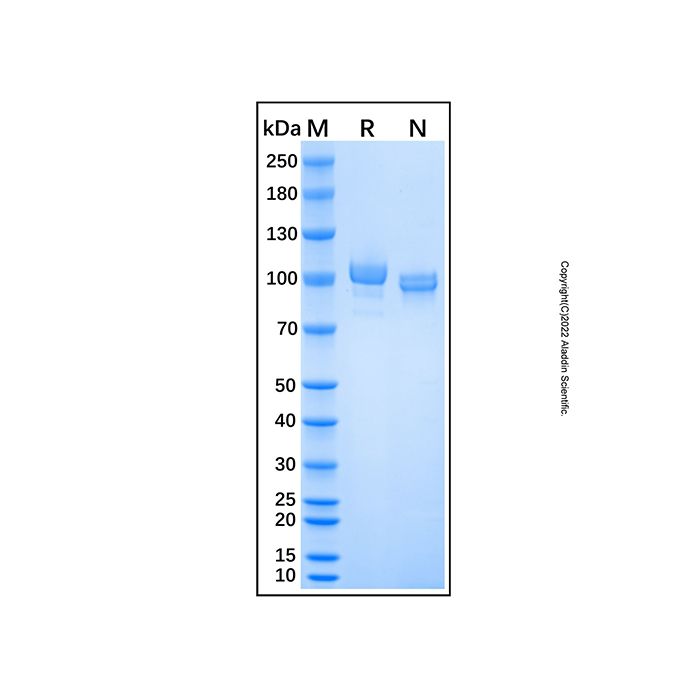
Recombinant Human ENPP-2/Autotaxin Protein (rp145556) - SDS-PAGE 2 μg/lane of Recombinant Human ENPP-2/Autotaxin Protein was resolved with SDS-PAGE under reducing (R) and non-reducing (N) conditions and visualized by Coomassie® Blue staining, showing the band at 97 - 108 kDa under reducing condition and 92 - 103 kDa under non-reducing condition.

 ZJ25F0723850


 危险品化学品经营许可证(带存储)