Measured by its ability to support the adhesion of MOLT‑4 human acute lymphoblastic leukemia cells. When 1 x 10^5 cells/well are added to Recombinant Human HPRG coated plates, adhesion is induced in a dose-dependent manner in the presence of Concanvalin A. The ED50 for this effect is 0.4-2 μg/mL.
Function Plasma glycoprotein that binds a number of ligands such as heme, heparin, heparan sulfate, thrombospondin, plasminogen, and divalent metal ions. Binds heparin and heparin/glycosaminoglycans in a zinc-dependent manner. Binds heparan sulfate on the surface of liver, lung, kidney and heart endothelial cells. Binds to N-sulfated polysaccharide chains on the surface of liver endothelial cells. Inhibits rosette formation. Acts as an adapter protein and is implicated in regulating many processes such as immune complex and pathogen clearance, cell chemotaxis, cell adhesion, angiogenesis, coagulation and fibrinolysis. Mediates clearance of necrotic cells through enhancing the phagocytosis of necrotic cells in a heparan sulfate-dependent pathway. This process can be regulated by the presence of certain HRG ligands such as heparin and zinc ions. Binds to IgG subclasses of immunoglobins containing kappa and lambda light chains with different affinities regulating their clearance and inhibiting the formation of insoluble immune complexes. Tethers plasminogen to the cell surface. Binds T-cells and alters the cell morphology. Modulates angiogenesis by blocking the CD6-mediated antiangiongenic effect of thrombospondins, THBS1 and THBS2. Acts as a regulator of the vascular endothelial growth factor (VEGF) signaling pathway; inhibits endothelial cell motility by reducing VEGF-induced complex formation between PXN/paxillin and ILK/integrin-linked protein kinase and by promoting inhibition of VEGF-induced tyrosine phosphorylation of focal adhesion kinases and alpha-actinins in endothelial cells. Also plays a role in the regulation of tumor angiogenesis and tumor immune surveillance. Normalizes tumor vessels and promotes antitumor immunity by polarizing tumor-associated macrophages, leading to decreased tumor growth and metastasis.
Measured by its ability to support the adhesion of MOLT‑4 human acute lymphoblastic leukemia cells. When 1 x 10^5 cells/well are added to Recombinant Human HPRG coated plates, adhesion is induced in a dose-dependent manner in the presence of Concanvalin A. The ED50 for this effect is 0.4-2 μg/mL.
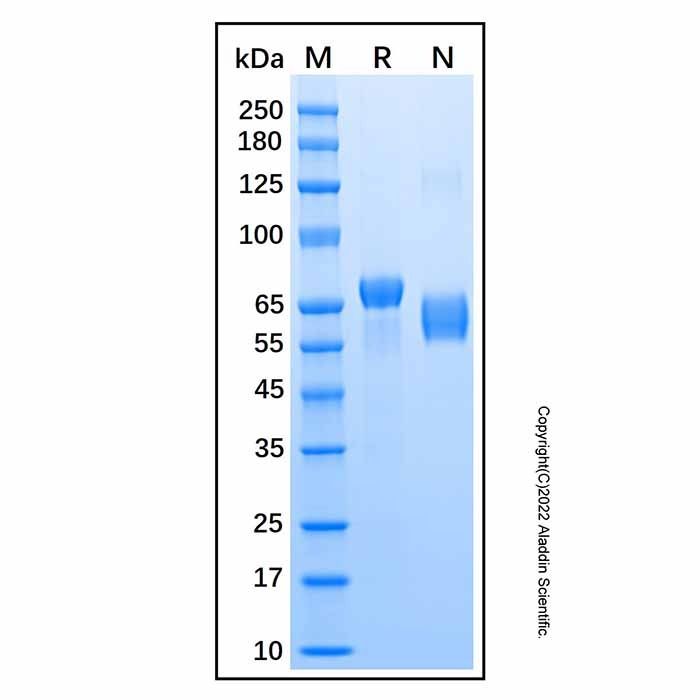
65 -75 kDa, under reducing conditions; 55 - 65 kDa, under non-reducing conditions.
分子类型
蛋白质
产品线
生物产品
储存与运输
物理形态
冻干(Lyophilized)
储存缓冲液
Lyophilized from 10mM PBS, 5% Trehalose, 5% Mannitol, pH 7.4
复溶
Reconstitute in sterile water to a concentration of 0.1-0.5 mg/ml.
储存条件
-20°C储存,避免反复冻融
运输条件
超低温运输
稳定性与储存
在 -20~-80℃ 下可保存 1 年以上。收货后建议分装。避免冷冻/解冻循环。
图片
Recombinant Human HPRG Protein (rp147069) - SDS-PAGE 2 μg/lane of Recombinant Human HPRG Protein was resolved with SDS-PAGE under reducing (R) and non-reducing (N) conditions and visualized by Coomassie® Blue staining, showing the band at 65 -75 kDa under reducing conditions and 55 - 65 kDa under non-reducing conditions.

 ZJ25F0217658


 危险品化学品经营许可证(带存储)