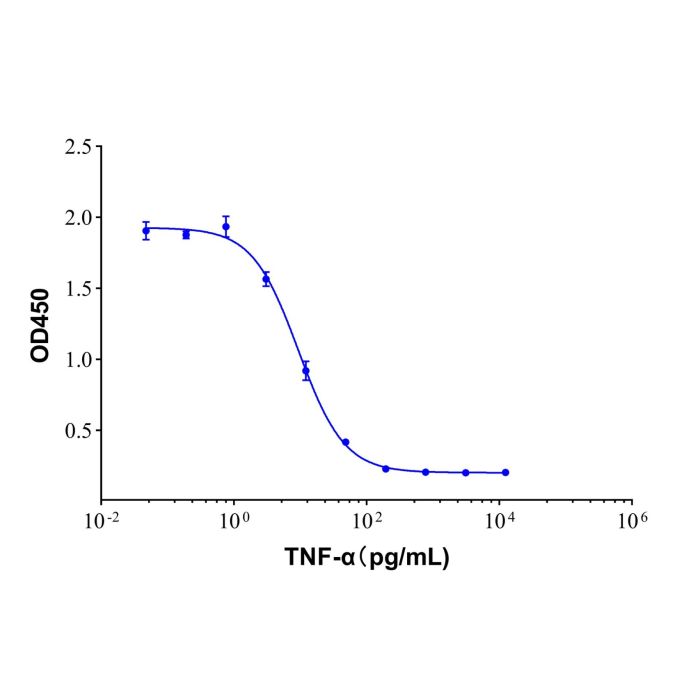
Measured in a cytotoxicity assay using L‑929 mouse fibroblast cells in the presence of the metabolic inhibitor actinomycin D (Catalog # A113142). The ED₅₀ for this effect is typically <0.05 ng/mL.
Tumor necrosis factor-α (TNFα) is a kind of cytokine mainly produced by macrophages and monocytes, which can participate in the immune response and inflammatory response of the body. The increase of TNFα value is closely related to sepsis, malignant tumor, heart failure and chronic inflammatory diseases, which can be used as an evaluation index of disease condition, treatment effect and prognosis. At the same time, TNFα is also a key target of autoimmune diseases. Cytokine that binds to TNFRSF1A/TNFR1 and TNFRSF1B/TNFBR. It is mainly secreted by macrophages and can induce cell death of certain tumor cell lines. It is potent pyrogen causing fever by direct action or by stimulation of interleukin-1 secretion and is implicated in the induction of cachexia. Under certain conditions it can stimulate cell proliferation and induce cell differentiation.
生物活性
Measured in a cytotoxicity assay using L‑929 mouse fibroblast cells in the presence of the metabolic inhibitor actinomycin D (Catalog # A113142). The ED₅₀ for this effect is typically <0.05 ng/mL.
Store at -80 ℃ for 24 months. Store at -20 ℃ for 12 months. Upon receipt, it is recommended to aliquot. Avoid freeze/thaw cycle.
图片
Recombinant Human TNF-alpha Protein (rp152506)-Protein Bioactivity Measured in a cytotoxicity assay using L‑929 mouse fibroblast cells in the presence of the metabolic inhibitor actinomycin D (Catalog # A113142). The EC₅₀ for this effect is typically <0.05ng/mL.
Recombinant Human TNF-alpha Protein (rp152506)-SDS-PAGE 2μg/lane of Recombinant Human TNF-alpha was resolved with SDS-PAGE under reducing (R) conditions and visualized by Coomassie® Blue staining, showing a single band at 16 kDa.


 ZJ23F0700612


 危险品化学品经营许可证(带存储)