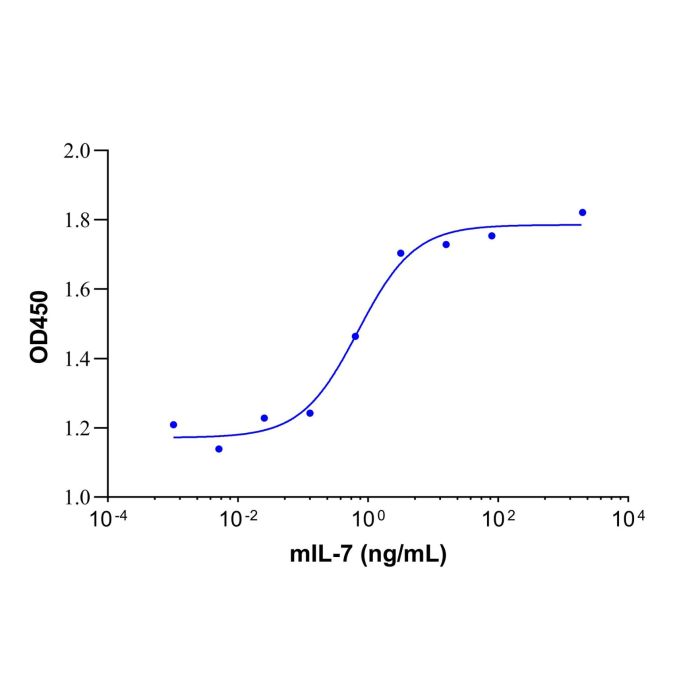
Measured in a cell proliferation assay using PHA-activated human peripheral blood mononuclear cell (PBMC). The ED50 for this effect is less than 1ng/mL。
Interleukin-7 (IL-7) is encoded by the IL7 gene in mouse and secreted by stromal cells in the red marrow and thymus. The protein signals through the IL-7 receptor, which is a heterodimer consisting of IL-7 receptor alpha and IL-2 receptor gamma chain. IL-7 stimulates the differentiation of hematopoietic stem cells into lymphoid progenitor cells and it can stimulate proliferation of B cells, T cells and NK cells. Mouse IL-7 has approximately 65 % and 88 % amino acid sequence identity with human and rat IL-7 and both proteins exhibit cross-species activity. Recombinant Mouse IL-7 is a 14.9kDa globular protein containing 129 amino acid residues.
Function
Hematopoietic growth factor capable of stimulating the proliferation of lymphoid progenitors. It is important for proliferation during certain stages of B-cell maturation.
Measured in a cell proliferation assay using PHA-activated human peripheral blood mononuclear cell (PBMC). The ED50 for this effect is less than 1ng/mL。
This vial must be briefly centrifuged prior to opening to bring the contents to the bottom. Reconstitute in a sterile aqueous buffer to an appropriate concentration.
Recombinant Mouse IL-7 Protein (rp154245)-Protein Bioactivity Measured in a cell proliferation assay using PHA-activated human peripheral blood mononuclear cell (PBMC). The ED50 for this effect is typically <1ng/mL.
Recombinant Mouse IL-7 Protein (rp154245)-SDS-PAGE 3μg/lane of Recombinant Mouse IL-7 Protein was resolved with SDS-PAGE under reducing (R) and non-reducing (N) conditions and visualized by Coomassie® Blue staining. Showing a single band at 12.9 kDa under reducing conditions and 12.1 kDa under non-reducing conditions.


 ZJ23F0600295


 危险品化学品经营许可证(带存储)