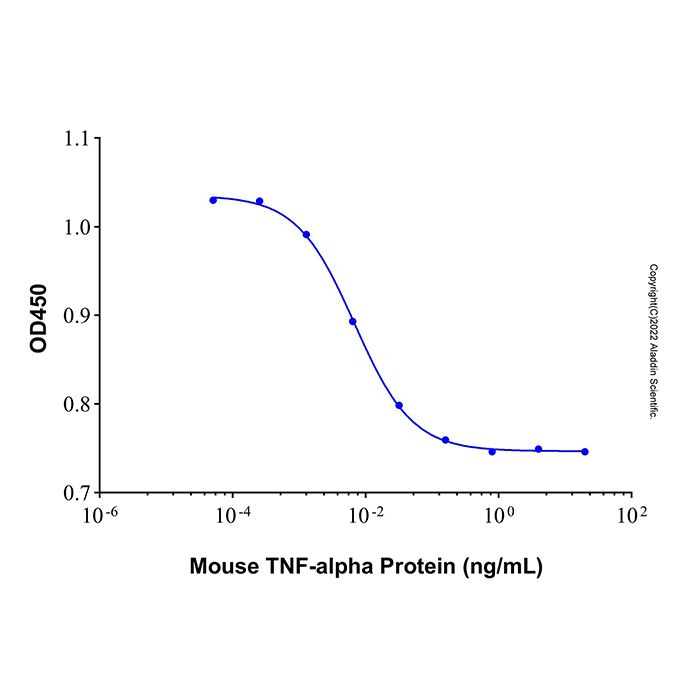
Recombinant Mouse TNF-alpha induces cytotoxicity in the L-929 mouse fibroblast cells in the presence of the metabolic inhibitor actinomycin D. The ED50 for this effect is typically 29-116 pg/mL, corresponding to a specific activity of 8.62×10^6-3.45×10^7 units/mg.
Purity ≥95% SDS-PAGE. Endotoxin level <0.1 EU/µg Function Cytokine that binds to TNFRSF1A/TNFR1 and TNFRSF1B/TNFBR. It is mainly secreted by macrophages and can induce cell death of certain tumor cell lines. It is potent pyrogen causing fever by direct action or by stimulation of interleukin-1 secretion and is implicated in the induction of cachexia, Under certain conditions it can stimulate cell proliferation and induce cell differentiation.
Recombinant Mouse TNF-alpha induces cytotoxicity in the L-929 mouse fibroblast cells in the presence of the metabolic inhibitor actinomycin D. The ED50 for this effect is typically 29-116 pg/mL, corresponding to a specific activity of 8.62×10^6-3.45×10^7 units/mg.
Lyophilized from 10mM PBS, 5% Trehalose, 5% Mannitol, pH7.4.
复溶
Reconstitute in sterile water to a concentration of 0.1-0.5 mg/ml.
储存条件
-20°C储存,避免反复冻融
运输条件
超低温运输
稳定性与储存
在 -20~-80℃ 下可保存 1 年以上。复溶后建议分装。避免冷冻/解冻循环。
图片
Recombinant Mouse TNF-alpha Protein (rp154764) - Protein Bioactivity Measured in a cytotoxicity assay using L‑929 mouse fibroblast cells in the presence of the metabolic inhibitor actinomycin D (A113142). The ED50 for this effect is 6.6 pg/mL.
Recombinant Mouse TNF-alpha Protein (rp154764) - SDS-PAGE 2 μg/lane of Recombinant Mouse TNF-alpha Protein was resolved with SDS-PAGE under reducing (R) and non-reducing (N) conditions and visualized by Coomassie® Blue staining, showing the band at 16 - 18 kDa under reducing condition and 16 - 18 & 30 - 32 kDa under non-reducing condition due to glycosylation.

 ZJ25F0926544


 危险品化学品经营许可证(带存储)