Background
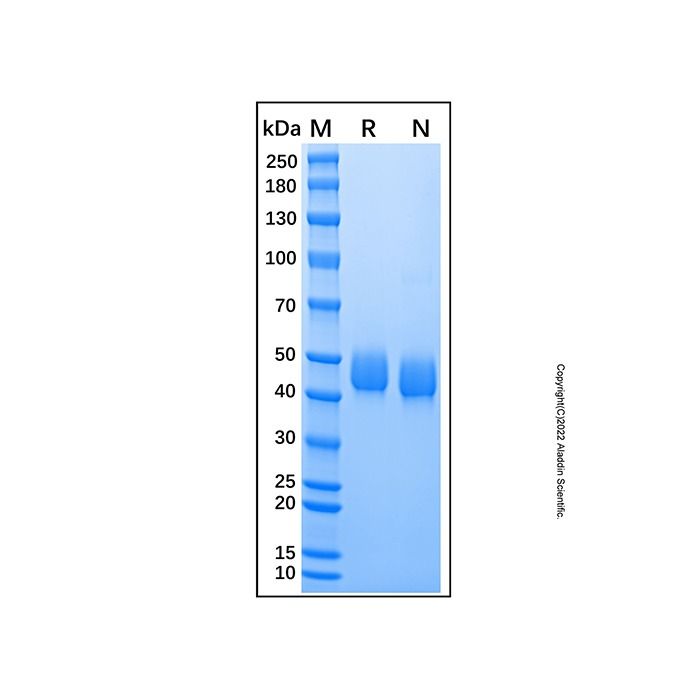
Lumican is a 40 kDa member of the family of small leucine-rich repeat proteoglycans (SLRPs) and the class II subfamily. Mouse Lumican is synthesized as a 338 amino acid (aa) precursor that contains an 18 aa signal sequence and a 320 aa mature chain (SwissProt #: 51885). The mature chain contains a negatively charged N-terminal domain containing sulfated tyrosine and disulfide bonds, 12 leucine-rich repeats (LRRs), four potential sites of N-linked glycosylation, and a carboxyl terminal domain containing two conserved cysteines. Mature mouse Lumican is 98%, 88%, and 70% aa identical to mature rat, human, and chick Lumican, respectively. SLRPs constitute an important fraction of noncollagenous extracellular matrix proteins (ECM) proteins. Lumican is expressed in a variety of tissues, including skin, artery, lung, cornea, kidney, bone, aorta, and articular cartilage. Lumican’s rolein vivohas been found using Lumican null mice. These mice have functional deficits including corneal opacity as well as skin and tendon fragility associated with disorganized and loosely packed collagen fibers. The abnormal connective tissue phenotype seen in the Lumican null mice shows the importance of the role of Lumican in collagen fibrillogenesis. In addition to the control of collagen fibril assembly, Lumican has been shown to play a role in the regulation of cell proliferation, migration, and adhesion. Lumican’s overexpression has been reported in carcinoid tumor, breast, colorectal, neuroendocrine, uterine cervical and pancreatic cancers.

 ZJ25F0217775


 危险品化学品经营许可证(带存储)